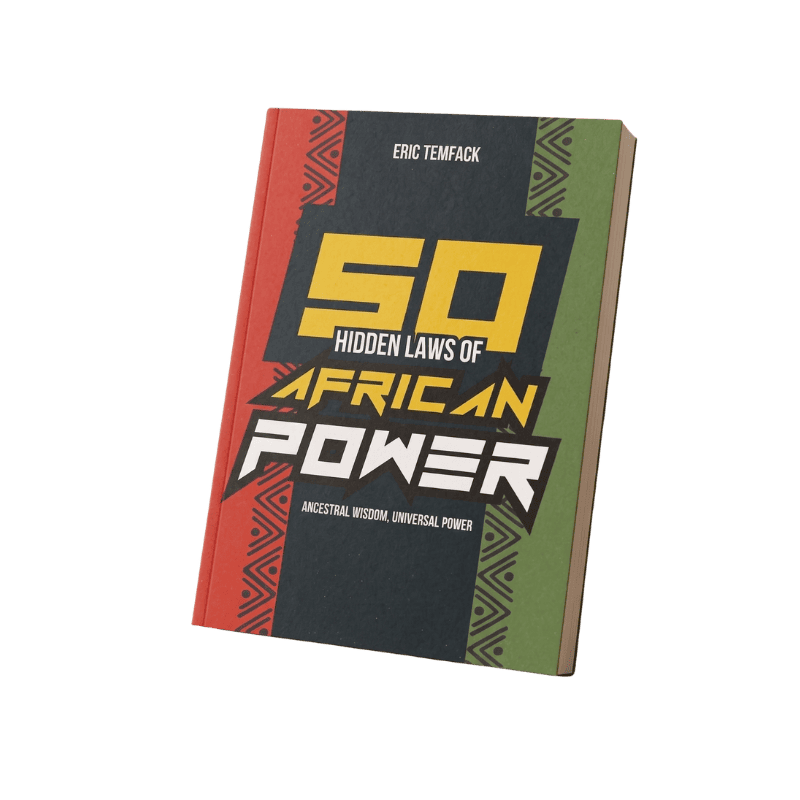

50 Hidden Laws of African Power | Eric Temfack | Ancestral Transformation Guide
50 Hidden Laws of African Power Cover
Official Release

50 HIDDEN LAWS OF AFRICAN POWER

Eric Temfack | Ancestral History + Modern Evidence (AHME Method). Ancestors guide you through the book to transform every aspect of your life.

50Laws
4.8 ★152 Reviews
200+Case Studies
6Life Domains
The Ancestors Speak

What each transformation guide will bring you

Through the 50 laws, African historical figures (Queen Nzinga, Sundiata Keita, Mansa Musa, etc.) reach out to you. Here are concrete examples of problems solved by readers using the book.

Relationships

  • Ancestor: Queen Nzinga (Kongo) | Law 7 (Master the theater of power): Roger restored communication with his partner by using posture and symbolic framing.
  • Ancestor: Sundiata Keita (Mali) | Law 9 (The art of the detour): Marie defused repetitive conflicts by no longer responding head on, but by creating a ritual of reconciliation.
  • Ancestor: Cleopatra VII (Egypt) | Law 26 (Speak the language of power but think in your own): David transformed a toxic relationship by establishing a new framework of respect.

Family Dynamics

  • Ancestor: Osei Tutu (Ashanti) | Law 4 (Embody a symbol): Fatima created a weekly ritual that reunited her fragmented family.
  • Ancestor: Moshoeshoe I (Lesotho) | Law 18 (Isolationism is a double edged sword): Issa balanced protecting his family with opening up to the outside world.
  • Ancestor: Yaa Asantewaa (Ghana) | Law 28 (Mobilize the excluded): Sophie gave elders a voice in family decisions, calming tensions.

Entrepreneurship

  • Ancestor: Mansa Musa (Mali) | Law 3 (Master the routes of gold and knowledge): Kevin doubled his revenue by seizing control of his supply chain.
  • Ancestor: Samori Toure (Guinea) | Law 13 (Reinvent the rules): Aminata created a niche market completely ignored by major corporations.
  • Ancestor: Aliko Dangote (Modern Nigeria inspired by the laws) | Law 35 (Build economic walls): Mamadou reduced his business's reliance on imports.

Career / Employee

  • Ancestor: Imhotep (Egypt) | Law 2 (Forge your legend through actions): Christophe secured a promotion by meticulously documenting his successes.
  • Ancestor: Cheikh Anta Diop | Law 31 (Control the narrative): Aisha reclaimed the narrative surrounding her work, highlighting her true value.
  • Ancestor: Nelson Mandela (South Africa) | Law 33 (Imprisonment can be a platform): Jacques turned a period of professional isolation into a training opportunity.

Internal Promotion

  • Ancestor: Shaka Zulu (Zulu) | Law 12 (Know when to be a lion or a fox): Emilie balanced firmness and cunning to secure a managerial position.
  • Ancestor: Hatshepsut (Egypt) | Law 41 (Do not confuse the mask with the face): Karim stopped playing a role and gained genuine legitimacy.
  • Ancestor: Haile Selassie (Ethiopia) | Law 32 (The idea must outlive the man): Laurence created a structural project that opened the doors to the executive committee.

Social Circle

  • Ancestor: Anansi (Spider God, Akan) | Law 38 (The network is the new kingdom): Sarah wove a circle of influential friends who propelled her career forward.
  • Ancestor: Askia Mohammed (Songhai) | Law 27 (Feigned submission is a form of war): Marc defused a toxic friendship by appearing to yield while firmly setting his boundaries.
  • Ancestor: Makeda (Queen of Sheba) | Law 29 (Send a call that resonates): Nadia organized unifying gatherings that deeply strengthened her friendships.
"The book is a bridge: each law is a conversation with an ancestor who tells you: 'Here is how I solved this problem, here is how you can do it.'"

| Excerpt from the preface | Eric Temfack

AHME Method (Ancestral History + Modern Evidence)

Examples of Ancestral Laws

LAW 29
Send a call that resonates

Lesson from Patrice Lumumba. Words become historical events.

  • Modern evidence: Greta Thunberg, Zelensky.
  • Transformation: Become a voice that truly matters in your circle.
LAW 30
Live as you teach

Lesson from Thomas Sankara. Integrity disarms critics.

  • Modern evidence: Jose Mujica, Patagonia.
  • Transformation: Align your actions with your values, gain absolute authority.
LAW 31
Control the narrative

Lesson from Cheikh Anta Diop. Define your own history.

  • Modern evidence: Black Panther, Nollywood.
  • Transformation: Take back the power of your personal narrative.
Exclusive Interview

Eric Temfack opens up

1. "You grew up between Cameroon and France. What was it like being 'between two worlds'?"
It’s juggling between two worlds, two cultures, two identities that are sometimes opposed. It wasn’t romantic. It was being nowhere. Too African for France, too French for Cameroon when I went back. But today, I realize it was a blessing in disguise. Because when you’re between two worlds, you see the flaws in both. You see what they’re hiding from you. You ask the questions nobody else asks. And that’s exactly what pushed me to write this book.
2. "50 laws of African power... Isn't that a bit ambitious?"
(He laughs genuinely.) Ambitious? Absolutely. But you know what? Ambition is exactly the first lesson I learned from these historical figures. I saw a massive void in books about power. They all quote Machiavelli, Sun Tzu, Marcus Aurelius, Robert Greene... Always the same continents. As if Africa had never produced strategists, empire builders, political geniuses. So yes, 50 laws is ambitious. But it’s not arrogance. It’s just common sense: I could write 5 volumes with African leaders. If I had told myself "it’s too ambitious", this book wouldn't exist. And we would continue to believe that power begins in Rome and ends on Wall Street.
3. "Why 'African'? Isn't it just power, period?"
Excellent question. I’ll be direct: yes, it’s power, period. But let me explain why I say 'African'. For centuries, you’ve been sold the history of power as if it had only one color, one geography. As if Machiavelli invented manipulation, Sun Tzu invented strategy, Carnegie invented leadership. As if Africa, this continent of 54 countries with 3000 years of empires, had nothing to say. So I say 'African' because it is the source, the historical origin of these laws. But the laws themselves are universal. A Swedish manager, a Brazilian entrepreneur, a Japanese executive... Everyone can apply them. Power has no passport.
4. "You've read Robert Greene's '48 Laws of Power'. How is your book different?"
First, we say Mr. Robert Greene, because if he had a church, I would surely be one of his apostles! I have profound admiration for his work. To answer your question: Greene quotes Machiavelli, Caesar, Louis XIV, Talleyrand... Always the same empires. Naturally, these are the figures that fit his frame of reference. I said to myself: "Wait, African strategists, who talks about them?" My book is not a response to Greene. It’s a complement. It is the missing library. Greene gave you 48 laws drawn from European and Asian history. I am giving you 50 others, drawn from African history. Strategies that no one has codified before. The key differences: my sources (Sundiata Keita, Mansa Musa, Queen Nzinga, Thomas Sankara); my immersive format (each law is a conversation with an ancestor); and I also demonstrate ethical power | how to be powerful without being toxic.
5. "A manager in Stockholm, what does he do with your book?"
Let me give you a highly concrete example. Imagine Lars, a manager at Spotify in Stockholm. He has a team of 15 people. The problem: high turnover, lack of motivation. He opens my book. He lands on Law 4: "Embody a symbol greater than yourself" | a lesson from the Ashanti Golden Stool. Osei Tutu created a sacred symbol to unify rival clans. Lars applies this: instead of being the all powerful boss, he creates a shared mission ("We create the soundtrack of people's lives"), collective rituals, a symbolic trophy. The result: the team no longer works for Lars, but for something much larger. Turnover drops, motivation skyrockets.
6. "Some will say: 'Another book on power, don't we have enough already?' What do you say?"
Yeah, we have books on power. Tons of them. But here is the problem: they all tell the exact same story | the history of power seen through Western eyes. As if Rome, the Renaissance, and Wall Street were the only laboratories of human power. It’s absurd. Africa is 54 countries, 3000 years of empires. And nobody has ever codified these strategies in a modern, actionable, universal format. My book is not "just another book on power". It is the first book that says: "Here is how Mansa Musa dominated the global economy in the 14th century | and here is how you apply that today." So no, we don't have enough. We have only listened to half the world. I am giving you the other half. The half they hid from you. If you are a serious strategist, you cannot afford to ignore 50% of the history of human power.
7. "Isn't power a toxic thing? Why praise it?"
Power is like a knife. You can use it to slice bread or to stab someone. The tool is neutral. The intention is what matters. I do not praise toxic power. I decode the mechanics of power, because if you don't understand them, you get eaten. Period. Now, look at the figures I cite: Sundiata Keita unified warring kingdoms to forge peace. Thomas Sankara used power to educate, heal, and liberate | he sold official Mercedes to buy vaccines, he planted 10 million trees, increased literacy from 13% to 73% in 4 years. Ethical power exists. And that is what I teach: how to be powerful without being toxic. Because true power is not domination. It is the capacity to create movement, to inspire, to transform.
8. "Is this a book for Black people or for everyone?"
For everyone. But I’ll be honest: there is an audience for whom this book will resonate differently. If you are Black, of African descent, and you’ve always been led to believe that your history starts with slavery, that your ancestors were "savages without civilization"... This book will repair you. Because you will discover that no. Your ancestors built empires that rivaled Rome. Mansa Musa controlled the gold of the medieval world. Queen Nzinga stood up to the Portuguese for 40 years. This book will restore your historical dignity. And that is powerful. But if you are a Swedish manager, a Japanese entrepreneur, an Argentine executive... This book will bring you unprecedented strategies. Because everyone quotes Sun Tzu, everyone quotes Machiavelli | but nobody quotes Sundiata, Samori Toure, Queen Nzinga. And yet, their strategies are equally potent, sometimes even better suited to the modern world. So yes, it is for everyone. But with a special mission: to restore Africa to its rightful place in the universal history of power. Not out of charity. Out of historical truth.

Why buy this book?

50 actionable laws
200+ modern case studies
Exclusive AHME Method
Transform relationships, family, career
ISBN 979-8271005299 Amazon 4.8 ★ (152 reviews) Available at Walmart, Barnes & Noble
📚 EXPLORE THE ENCYCLOPEDIA OF POWER (GLOBAL INDEX)
Extended Wisdom

The Library of Power

Dive into the sharp analyses of the strategists who forged history. A selection of our most powerful resources drawn directly from the book.

Frequently Asked Questions

Still hesitating?

Is this book suitable for non Africans?

Yes, the laws are universal. Thousands of readers in Europe, America, and Asia apply them daily.

Are there practical exercises?

Yes, each law is accompanied by a concrete application guide (exclusive content found only in the book).

Can I offer it as a gift?

Absolutely, it is the perfect gift for any strategist or leader in the making.

Where is it available in English?

On Amazon Worldwide and specialized international bookstores.

© 2026 Eric Temfack | 50 Hidden Laws of African Power | Actions | Wisdom

ISBN 979-8271005299 | English Paperback Edition