50 sourced Q&A based on real Google searches, decoding African history and memory
What is African historical memory?
African historical memory refers to the body of knowledge, narratives, practices, and archives—oral and written—preserved by the continent's communities and diaspora. It shapes identity, legitimises policies, and influences the world's perception of Africa. #beginner
What is the difference between memory and history?
History is a critical, dated, and verifiable academic reconstruction. Memory is a living, communal, and emotional transmission. They are complementary: memory nourishes history; history validates or nuances memory. #expert
Why do people say Africa has no history?
This colonial prejudice, notably voiced by Hegel, rested on the supposed absence of European‑style written sources. It deliberately ignored oral traditions, the Timbuktu manuscripts, Ethiopian chronicles, and archaeology. Africa has always had a rich and documented history. Law 31: Control the Narrative. #controversy
What is meant by 'epistemic sovereignty'?
A people's ability to produce, validate, and disseminate their own historical knowledge without relying on external or colonial validation frameworks. It is a cornerstone of intellectual autonomy and the decolonisation of knowledge. #epistemology
What is the 'Ancestral History + Modern Proof™' method?
An analytical framework developed by Éric Temfack that anchors each strategic principle in pre‑colonial African history, then validates it through 200+ verifiable contemporary case studies. Rigorous, actionable, and free of narrative bias. #methodology
What were the great empires of pre‑colonial Africa?
The Ghana Empire (8th‑12th c.), the Mali Empire (13th‑14th c.), the Songhai Empire (15th‑16th c.), the Kingdom of Benin, the Kingdom of Kongo, the Aksumite Empire, Great Zimbabwe, and the Kingdom of Kush are among the most influential. #empires
Who was Mansa Musa and why is he so famous?
Mali emperor in the 14th century, often considered the richest man in history. His 1324 pilgrimage to Mecca distributed so much gold that it disrupted the Mediterranean economy for a decade. He embodies Law 5: The Display of Wealth. #Mali
How does ancient Egypt (Kemet) connect to African history?
Kemet was an African civilisation, linked to Nubia, Punt, and the rest of the continent via the Nile. Cheikh Anta Diop's work established this continuity against the narrative that isolated Egypt from its African context. #Kemet
What was the Kingdom of Kush and why is it important?
A Nubian civilisation that ruled Egypt (25th Dynasty, the 'Black Pharaohs') and endured at Meroë for over a thousand years. Noted for its pyramids, its warrior queens (kandakes), and its still‑undeciphered Meroitic script. #Kush
What is the Manden Charter (Kurukan Fuga)?
Proclaimed by Sundiata Keita in 1236, it is one of history's earliest declarations of human rights. It abolished slavery, guaranteed freedom of expression, and organised the governance of the Mali Empire. Law 1: The Founding Charter. #Manden
Who built Great Zimbabwe?
The Shona people, ancestors of today's Zimbabweans. Despite colonial theories attributing the site to Phoenicians, archaeological evidence confirms an African construction between the 11th and 15th centuries. #Zimbabwe
Who was Queen Nzinga Mbandi?
Sovereign of Ndongo (present‑day Angola) in the 17th century. A formidable diplomat and military strategist, she resisted the Portuguese for 40 years. She embodies Law 7: Strategic Alliance and Law 40: The First Woman. #Nzinga
Who are the great female figures of pre‑colonial African history?
Queen Nzinga (Angola), Yaa Asantewaa (Ashanti/Ghana), Queen Amina of Zazzau (Nigeria), Ranavalona I (Madagascar), the Queen of Sheba/Makeda (Ethiopia), and the kandakes of Kush such as Amanirenas. #women
Is African oral tradition a reliable historical source?
Yes, when contextualised and cross‑referenced. Oral systems (griots, djelis, councils of elders) use communal validation, ritual repetition, and intergenerational correction to ensure the fidelity of the transmitted message. #orality
What role do griots play in transmitting African history?
Griots are oral historians, genealogists, and royal advisors. Through poetry, music (kora), and memorised epics, they have preserved and transmitted collective memory for centuries. Law 42: Memory is a lever for action. #griots
What do the Timbuktu manuscripts contain?
Over 700,000 documents covering astronomy, medicine, law, commerce, mathematics, and theology. They prove the existence of sophisticated scholarly networks in the Mali and Songhai empires long before colonisation. #Timbuktu
Why were the Timbuktu manuscripts hidden for so long?
They were kept in private family libraries, guarded by descendants of the scholars. During colonisation many were hidden to prevent looting. Their large‑scale rediscovery occurred from the 1970s to the 2000s. #manuscripts
Why is the Ge'ez script important for African history?
One of Africa's oldest writing systems still in use. It served the administration of the Aksumite Empire, diplomacy, and Ethiopian religious literature. It bears witness to a millennia‑long epistemic continuity. #Ge'ez
How can fragile archives be preserved in the African climate?
Through priority digitisation, climate‑controlled storage, microfilming, and training local conservators. Law 19: Logistics is the Queen of Battles. #conservation
What complementarity exists between oral and written archives?
Oral sources preserve context, emotion, and social validation. Written records fix chronology and factual data. Integrating both creates resilient, multidimensional, and culturally embedded archives. #archives
Why is the restitution of African cultural heritage crucial?
It restores symbolic sovereignty, rebuilds intergenerational memory, and transforms African museums into centres of self‑representation. Law 34: The symbol precedes and reinforces power. #restitution
What are the Benin Bronzes?
Thousands of brass plaques and sculptures created by the Kingdom of Benin (present‑day Nigeria) between the 13th and 19th centuries. Looted during the 1897 British punitive expedition, they illustrate pre‑colonial artistic sophistication. #Benin
Where are the Benin Bronzes currently located?
Scattered across more than 160 museums and private collections worldwide, principally the British Museum (London), the Ethnological Museum of Berlin, the Metropolitan Museum (New York), and the Musée du Quai Branly (Paris). #museums
How many African objects are held outside the continent?
According to the 2018 Savoy‑Sarr report, about 90% of sub‑Saharan Africa's cultural heritage is currently located outside the continent, mainly in European and American museums. #statistics
What is the difference between restitution and repatriation?
Repatriation refers to the physical return of an object. Restitution is broader: it includes legal recognition of ownership, associated documentation, and the transfer of conservation skills. #definition
How can one determine whether an African object was looted or legally acquired?
By tracing its provenance (pedigree) through museum registers, colonial archives, auction catalogues, and historical testimonies. Provenance research has become a discipline in its own right. #provenance
What is France's position on the restitution of African heritage?
Since the 2017 Ouagadougou speech and the 2018 Savoy‑Sarr report, France has initiated a restitution process. Twenty‑six objects were returned to Benin in 2021. A framework law on restitution is under parliamentary discussion. #France
Are there international treaties governing restitution?
Yes. The 1970 UNESCO Convention prohibits the illicit trafficking of cultural property. The 1995 UNIDROIT Convention addresses the return of stolen objects. However, their scope is limited for pre‑ratification looting. #law
Why is African history so little taught in Europe?
A direct legacy of the colonial construction of knowledge, which marginalised Africa in curricula. Programmes remain largely Eurocentric, although initiatives such as Erasmus+ are beginning to correct the imbalance. #Europe
How can African school curricula be decolonised?
By centring programmes on African chronologies, integrating indigenous knowledge, training teachers in critical historiography, and using locally produced textbooks. Law 36: To Educate is to Liberate. #curricula
Why teach in local languages rather than French or English?
Concepts of power, justice, and community are embedded in indigenous languages. Translating into colonial languages loses essential nuance and reinforces external frames of thought. Law 15: Legitimacy is built. #languages
Who was Cheikh Anta Diop and what is his legacy?
A Senegalese historian and physicist who demonstrated the African origin of ancient Egypt. His work restored Africa's civilisational dignity and founded epistemic sovereignty. He embodies Law 31: Control the Narrative. #Diop
What is the role of African universities in historical research?
To produce autonomous knowledge, train local archivists, publish in African‑indexed journals, and lead archaeological digs and digitisation projects. They are the engine of epistemic sovereignty. #universities
How can African youth reclaim their history?
Through participatory pedagogies, community archive projects, artist residencies, immersion travel, and engaging digital media. Law 12: Youth is a double‑edged sword. #youth
Does Pan‑Africanism still influence collective memory today?
Absolutely. Championed by Kwame Nkrumah and the African Union, Pan‑Africanism structures a shared memory of resistance, civilisational pride, and political unity. Law 21: Pan‑African Unity. #PanAfricanism
How is digital technology transforming the preservation of African history?
Through 3D digitisation, secure cloud storage, AI transcription, and open archives. It democratises access but requires sovereign data governance. Law 41: Information circulates, power follows. #digital
What are the risks of digital archives for African heritage?
Dependence on Western hosting, format obsolescence, weak cybersecurity, and algorithmic bias. Solutions: local infrastructure, open standards, and continuous technical training. Law 28: Anticipate the shock. #cybersecurity
How can AI help transcribe African oral traditions?
By automating speech recognition for African languages, subject indexing, and dialect translation. AI must augment, never replace, human validation by the knowledge‑holding communities. #AI
Why create sovereign digital memory platforms in Africa?
To avoid algorithmic censorship, protect collective cultural intellectual property, and guarantee permanent access to archives. Digital sovereignty extends historical sovereignty. #sovereignty
Who should govern African digital archives?
African states, in partnership with local universities, community organisations, and pan‑African institutions such as the African Union. Governance must be sovereign, transparent, and inclusive. #governance
What role does the African diaspora play in preserving memory?
It maintains transnational archives, finances restitutions, produces counter‑narratives, and connects ancestral knowledge to global academic platforms. Law 37: Far from the eyes, close to power. #diaspora
How do diasporic communities preserve their African roots?
Through cultural associations, DNA‑based genealogy projects, weekend schools, festivals, family digital archives, and immersion trips. Memory becomes an intergenerational identity bridge. #communities
Does restitution also concern the diaspora?
Yes. Restored objects reinforce diasporic identity pride, feed genealogical research, and legitimise cultural advocacy in host countries. It is a shared diplomatic asset. #identity
How can diasporic youth be connected to ancestral knowledge?
Through artist residencies on the continent, archival internships, immersion trips, and collaborative online projects. Law 21: Unity in diversity is a strength. #youth
How can I contact Éric Temfack for a conference or interview?
By email at
contact@temfackeric.com, by phone at +33 7 56 98 23 41, or via the contact form on temfackeric.com. Response guaranteed within 48 business hours.
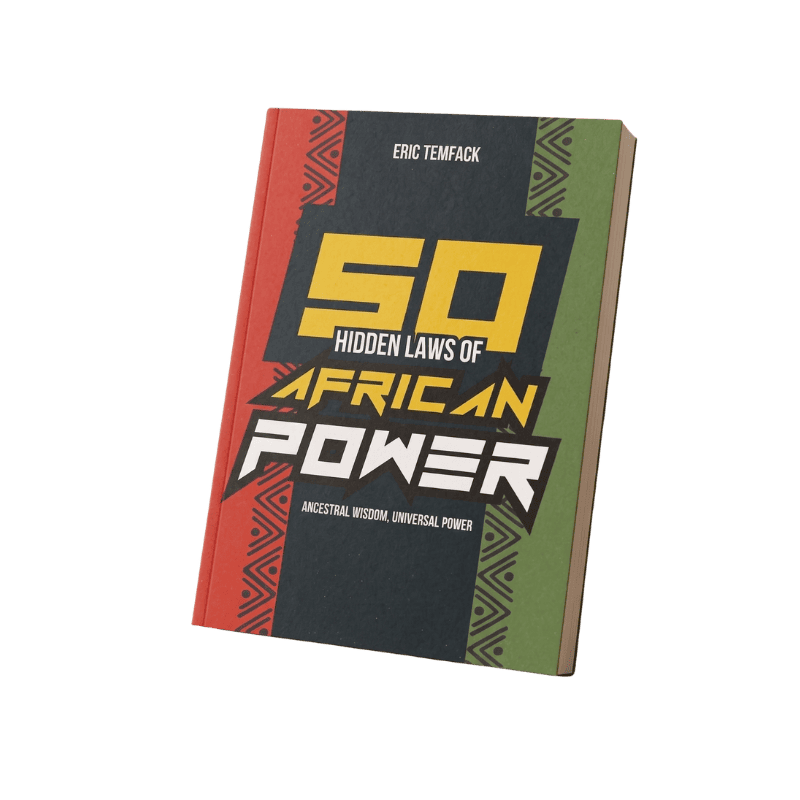
#contactWhere can I buy the book The 50 Hidden Laws of African Power?
Available in paperback and Kindle on Amazon.com, Amazon.fr, as well as at Books-A-Million, Barnes & Noble, Walmart (USA), Saxo (Denmark) and Tamery Sematawy (France). See the
/en/books/ page.
#bookIs there a French version of this FAQ?
What is the difference between the Encyclopedia of Power and this FAQ?
The
Encyclopedia of Power is a structured resource covering all 50 laws exhaustively. This FAQ answers the precise questions most searched on Google.
#resourcesHow can the impact of a memory project be measured?
Through qualitative indicators (social cohesion, identity esteem, community pride) and quantitative ones (museum attendance, academic publications, funds raised, diaspora engagement). Impact is measured over the long term. #impact
Is this FAQ updated regularly?
Yes. Revised quarterly to incorporate new restitutions, digital advances, academic publications, and reader feedback. Last updated: April 2026. #update