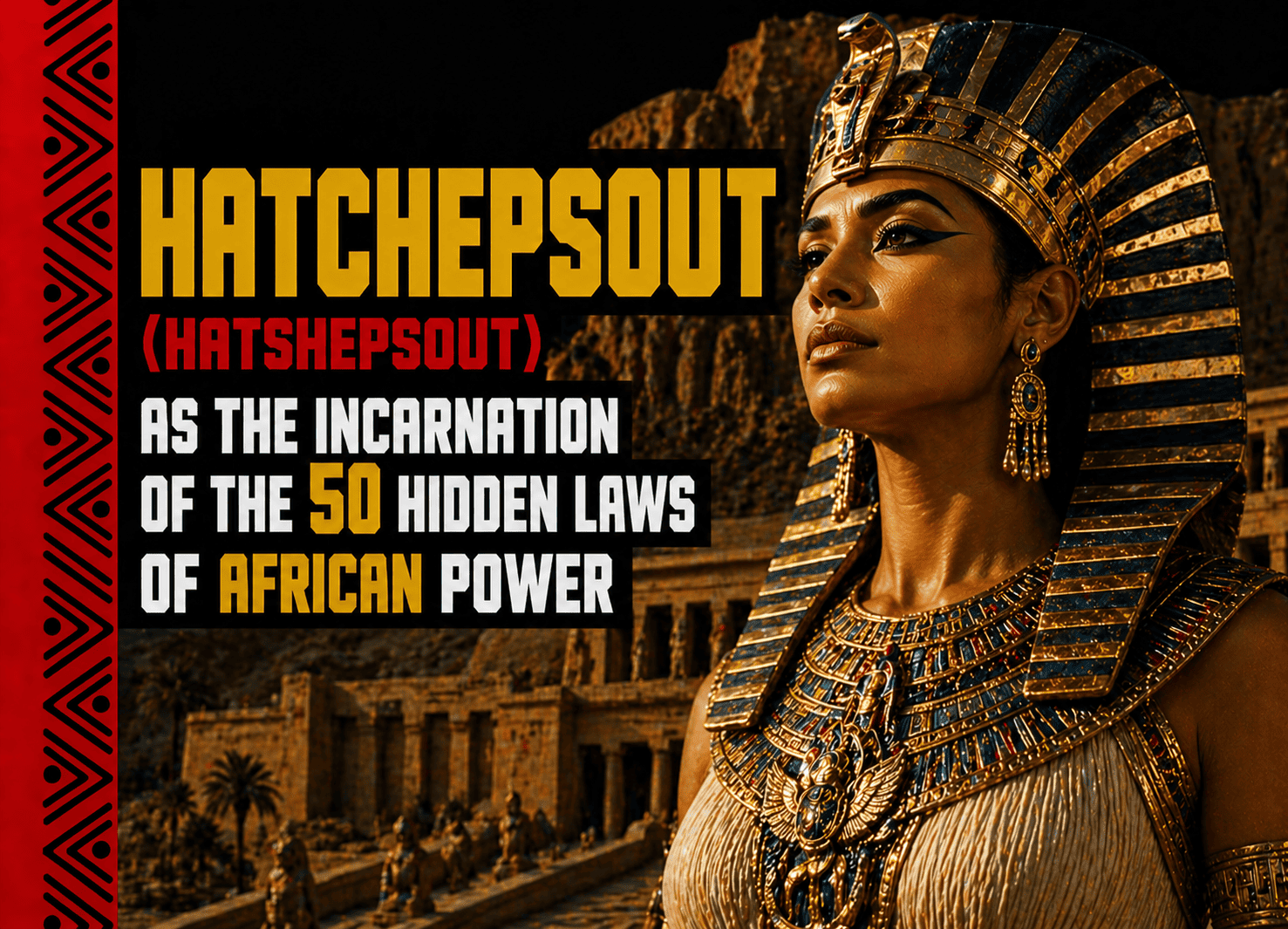
HATSHEPSUT — EMBODIMENT OF THE 50 HIDDEN LAWS OF AFRICAN POWER
Through divine legitimacy, the art of narrative, and unparalleled monuments, the “Pharaoh of the Two Lands” ruled ancient Egypt as a master.
I. HISTORICAL AND CIVILIZATIONAL CONTEXT
Egypt of the 18th Dynasty (New Kingdom, c. 1479‑1458 BCE)
Hatshepsut reigned during the peak of the Egyptian New Kingdom, the most brilliant period in Kemet’s history. After the warrior pharaohs of the 17th and early 18th dynasties (such as Ahmose and Thutmose I), Egypt had reunited the country, expelled the Hyksos, and extended its influence as far as Nubia and the Levant. It was in this context of expansion and prosperity that Hatshepsut, daughter of Thutmose I and wife of her half‑brother Thutmose II, rose to power.
Upon Thutmose II’s death, his son Thutmose III, still a child, was designated heir. Hatshepsut first became regent and later proclaimed herself full pharaoh – a rare and audacious usurpation for a woman. She reigned for about twenty years (c. 1479‑1458 BCE), leading trade expeditions (notably to the Land of Punt), launching a vast program of monumental construction (Deir el‑Bahari, Karnak, obelisks), and consolidating Egypt’s economy.
The Spiritual and Cosmological Context
To legitimise her power, Hatshepsut drew on Egyptian royal theology: she proclaimed herself “daughter of Amun,” the supreme god, who had taken the form of Thutmose I to unite with her mother (Ahmose). She had herself depicted with the male attributes of the pharaoh (false beard, king’s costume) while using feminine titles. She presented herself as the legitimate heir of Maat, cosmic order, and as the restorer of temples and cults after troubled times.
This theological construction – a woman ruling as a man thanks to divine birth – was a major political innovation. It showed that pharaonic power could transcend gender provided it was rooted in the sacred.
🔗 CONNECTION TO THE 50 HIDDEN LAWS OF AFRICAN POWER
→ Law #1: Master Cosmic Balance (Maat and Divine Legitimacy)
Points of convergence:
• Hatshepsut balanced male attributes (false beard, king’s name) and female titles (“Daughter of Ra”) – she embodied gender transcendence through office.
• She relied on solar theology (Amun, Ra) to legitimise her usurpation – the sacred as the cement of power.
• Modern application: African women leaders today must navigate between traditional expectations and modernity – Hatshepsut shows that power can transcend gender through the grace of history.
• Strategic lesson: Enduring power comes from a sacred narrative – invent your founding myth even if it contradicts appearances.
II. ORIGINS AND SOCIAL ASCENSION
Birth and Family
Hatshepsut was born around 1507 BCE. She was the eldest daughter of Pharaoh Thutmose I (a warrior‑king and great builder) and Queen Ahmose, who came from the Theban royal line. Her father had consolidated the empire and built temples. Hatshepsut therefore received a full princely education: hieroglyphic writing, administration, theology, and reading sacred texts.
She married her half‑brother Thutmose II (son of a secondary wife). From this union came a daughter, Neferure, but no son. When Thutmose II died, the throne passed to a child of a secondary wife, Thutmose III, then a few years old. Hatshepsut assumed the regency, then gradually sidelined the young king and proclaimed herself pharaoh.
Education and Skills
Hatshepsut was trained in the arts of governance:
- Reading administrative and accounting papyri.
- Theology and rituals – she took part in ceremonies at Karnak temple.
- Diplomacy – she sent trade expeditions to Punt.
- Command – she directed construction projects and mining economy.
Her political intelligence and mastery of symbols made her a formidable sovereign, capable of ruling an empire as a sole pharaoh.
Rise to the Throne: From Regent to Pharaoh
Hatshepsut began as regent for Thutmose III. She had herself depicted in scenes of co‑rule, with the young king shown as secondary. Then, around the 7th year of her reign, she proclaimed herself full pharaoh: she took the name “Maatkare” (“the Maat of Ra is the soul of Ra”), had herself crowned with the double crown, and ordered her depiction with the royal beard. It was a full‑blown usurpation, but she legitimised her action through divine inscriptions.
🔗 CONNECTION TO THE LAWS OF AFRICAN POWER
→ Law #3: “Transform Knowledge into Power”
Points of convergence:
• Hatshepsut used her knowledge of theology and protocol to invent a narrative of divine birth – she turned history into myth.
• She understood that the pharaoh’s image was a tool of control: she built statues of herself, obelisks, temples – architectural and symbolic knowledge became a political weapon.
• Modern application: African leaders must master visual and narrative codes to impose their legitimacy – image is power.
• Strategic lesson: A successful usurpation is never just a power grab – it is first a communication campaign.
III. TITLES AND FUNCTIONS
Hatshepsut accumulated royal and divine titles, adapting pharaonic tradition to the female gender:
- Pharaoh of Upper and Lower Egypt – Neferure (“the beauty of Ra”) then Maatkare.
- Daughter of Ra – traditional feminine title.
- Daughter of Amun – divine legitimation of her birth.
- Regent (initially) then Co‑ruler (officially) – with Thutmose III, who remained second.
- Great Royal Wife of the god Amun – important priestly title.
- Chief Builder – supervised the construction of Deir el‑Bahari, the Karnak obelisks.
- Chief Expedition Leader – organised the famous expedition to Punt.
This combination of titles (pharaoh, priestess, builder) made her a complete sovereign, capable of administering, symbolically waging war, and communicating with the gods.
🔗 CONNECTION TO THE LAWS OF AFRICAN POWER
→ Law #12: “Become Indispensable to Power”
Points of convergence:
• Hatshepsut held multiple functions: pharaoh, high priest, head of expeditions – without her, the kingdom would be decapitated.
• She legitimised her power both by blood (daughter of Thutmose I) and by divinity (daughter of Amun) – diversification of legitimacy sources.
• Modern application: African women leaders must cultivate multiple registers of legitimacy – traditional, intellectual, economic.
• Strategic lesson: Indispensability is built by becoming the sole convergence point of powers – economic, religious, military.
IV. ARCHITECTURAL ACHIEVEMENTS – DEIR EL‑BAHARI, AN ETERNAL MASTERPIECE
The Mortuary Temple of Deir el‑Bahari (Djeser‑Djeseru, “the Holy of Holies”)
Located on the west bank of Thebes, this temple is one of the most beautiful of ancient Egypt. It consists of three terraces connected by ramps, with colonnaded porticoes, chapels dedicated to Amun, Hathor and Anubis. The reliefs tell of Hatshepsut’s divine birth, her expedition to Punt and her offerings to the gods. The temple is a political manifesto: it shows a legitimate, pious and prosperous sovereign.
The Obelisks of Karnak
Hatshepsut erected two pink granite obelisks at Karnak, one of which stands nearly 30 metres high and weighs 300 tons. Inscribed with texts glorifying herself and her filiation with Amun, they were covered with electrum (a gold‑silver alloy) to shine in the sun – a true monument of prestige.
Other Constructions
She restored temples in Nubia, built chapels at Karnak and Hermopolis, and had rock‑cut sanctuaries made. Her architectural programme is one of the most extensive of the New Kingdom.
🔗 CONNECTION TO THE LAWS OF AFRICAN POWER
→ Law #15: “Build Monuments That Speak for You”
Points of convergence:
• The temple of Deir el‑Bahari is a speaking monument: the reliefs tell the official story, imposing Hatshepsut’s version.
• The obelisks, visible from afar, proclaim her power even after her death (some still stand).
• Modern application: African leaders must build cultural infrastructure – museums, universities – that bear their name and vision.
• Strategic lesson: Stone, well chosen, can silence critics – Hatshepsut’s monuments survived her successor’s damnatio memoriae.
V. THE EXPEDITION TO THE LAND OF PUNT – ECONOMIC SOFT POWER
Hatshepsut organised a naval expedition to the Land of Punt (probably the coast of modern‑day Somalia/Eritrea), rich in incense, myrrh, gold, ebony and exotic animals. The reliefs at Deir el‑Bahari show the laden ships, the queen of Punt offering gifts. This expedition was not military but commercial – it strengthened Egyptian influence without bloodshed. The products brought back were used for religious rituals (incense for Amun) and royal prestige.
🔗 CONNECTION TO THE LAWS OF AFRICAN POWER
→ Law #42: “Create a Legacy That Multiplies Your Power” (commercial soft power)
Points of convergence:
• The Punt expedition is an intangible monument: travel stories, botanical samples, exotic animals long impressed the imagination.
• The trade in incense and myrrh linked Egypt to East Africa for centuries – a lasting economic heritage.
• Modern application: African leaders should prioritise economic alliances and trade routes, not only military conquest.
• Strategic lesson: A successful trade partnership can yield more than a military victory – and lasts longer.
VI. ECONOMIC AND ADMINISTRATIVE MANAGEMENT – A PROSPEROUS REIGN
Under Hatshepsut, Egypt enjoyed a period of relative peace (no major wars). She exploited the gold mines of Nubia, controlled granite quarries (for the obelisks), and developed trade along the Nile and the Red Sea. She appointed competent officials (such as Senenmut, her favourite architect, possibly an advisor) and centralised the administration. Prosperity fuelled the great building projects and filled the granaries.
🔗 CONNECTION TO THE LAWS OF AFRICAN POWER
→ Law #8: “Master Cycles – Time as a Weapon”
Points of convergence:
• Hatshepsut mastered the cycles of the Nile flood and harvests to time monumental works and expeditions.
• She ran the economy without war, prolonging a peace cycle for over twenty years – prosperity as a tool of legitimation.
• Modern application: African leaders must harness natural and economic cycles to plan sustainable development.
• Strategic lesson: Whoever controls resources (gold, incense, granite) controls the future – no military campaigns needed.
VII. DAMNATIO MEMORIAE AND THE MYSTERY OF HER DEATH
Around 1458 BCE, Hatshepsut disappeared. The cause remains uncertain: perhaps disease or assassination. Her co‑ruler, Thutmose III (now an adult), became sole pharaoh. In the following years, he ordered her cartouches chiselled out, her statues broken, and her name removed from royal lists. This “damnatio memoriae” – condemnation of memory – aimed to erase the female usurper. Fortunately, the reliefs of Deir el‑Bahari, protected by lime or sand, were preserved. Egyptologists of the 19th century rediscovered her story.
🔗 CONNECTION TO THE LAWS OF AFRICAN POWER
→ Law #50: “Transcend Death – The Art of Immortality”
Points of convergence:
• Thutmose III’s damnatio memoriae paradoxically preserved Hatshepsut’s legend – hidden temples survived, while destroyed statues became archaeological rarities.
• Her mummy, identified in 2007 (KV60A), proved her existence – the body found, the name resurrected.
• Modern application: African leaders may be erased by hostile successors, but if their works remain, they will return.
• Strategic lesson: Immortality does not depend on the victor’s goodwill – it depends on the solidity of your monuments and the interest of future generations.
VIII. LEGACY AND MODERN REHABILITATION – FROM USURPER TO FEMININE ICON
In the 19th century, Egyptologists such as Mariette and Lepsius identified Hatshepsut as a female pharaoh. Long described as a cruel usurper, she has gradually been rehabilitated. Today she is celebrated as one of the greatest pharaohs – and a pioneer of women’s leadership. Her temples and obelisks attract millions of visitors. She embodies the power of women in African history, long before Cleopatra.
🔗 CONNECTION TO THE LAWS OF AFRICAN POWER
→ Law #45: “Become a Symbol – When Your Name Becomes a Movement”
Points of convergence:
• “Hatshepsut” has become a common noun for an exceptional female leader – a symbol of African feminine power.
• Feminist and Pan‑African movements cite her as proof that African women ruled long before the colonial era.
• Modern application: African women leaders should claim Hatshepsut’s heritage – not as an exception, but as a tradition.
• Strategic lesson: A forgotten name can be reborn and become a rallying banner – historical rehabilitation is a form of power.
IX. SOURCES AND TESTIMONIES
Egyptian sources: Reliefs at Deir el‑Bahari temple, inscriptions at Karnak, chiselled and restored statues, administrative papyri.
Archaeological sources: Excavations of tomb KV20 (Hatshepsut) and KV60A (identified as her mummy).
Modern studies: Works by Joyce Tyldesley (“Hatchetpsut: The Female Pharaoh”), Betsy Bryan, Zahi Hawass.
🔗 CONNECTION TO THE LAWS OF AFRICAN POWER
→ Law #28: “Control Your Narrative – History Belongs to the One Who Writes It”
Points of convergence:
• Thutmose III erased Hatshepsut from royal lists, but the monuments she left spoke for her – partial narrative control.
• Today, Egyptologists restore her legitimacy – proof that memory can be reborn if material traces survive.
• Modern application: African leaders must leave material evidence (archives, monuments, biographies) so they cannot be completely erased.
• Strategic lesson: The story of history is a perpetual struggle – chisel your enemies’ cartouches, but above all, build for eternity.
X. HATSHEPSUT IN CONTEMPORARY CONSCIOUSNESS
Feminist icon: She is a reference for African women politicians. Her ability to reign as pharaoh, despite gender obstacles, inspires leaders like Ellen Johnson Sirleaf.
Media presence: Documentaries, historical novels, travelling exhibitions – the Egyptian Museum in Cairo devotes a space to her.
Cultural tourism: Deir el‑Bahari temple is one of the most visited attractions in Luxor.
Scientific debate: Some Egyptologists still debate her exact role (regent or pharaoh?) – but the trend is towards recognition of her full sovereignty.
🔗 CONNECTION TO THE LAWS OF AFRICAN POWER
→ Law #37: “Cultivate Mystery – What Is Hidden Fascinates”
Points of convergence:
• The disappearance of her mummy for centuries, the damnatio memoriae, the ambiguity of her death – all these mysteries fuel fascination.
• Her identity as a female pharaoh defying conventional norms makes her even more intriguing.
• Modern application: Leaders may sometimes leave shadow zones – mystery prolongs interest.
• Strategic lesson: An incompletely documented destiny is an unfinished story – future generations want to complete it.
XI. MYSTERIES AND UNSOLVED QUESTIONS
The original tomb: Tomb KV20, built for her, is one of the oldest in the Valley of the Kings, but her mummy was found in another tomb (KV60A). Why was it moved?
The exact role of Senenmut: Was he her lover? A mere architect? The mystery persists.
Possible assassination: Did Thutmose III order her death? No evidence, but the damnatio memoriae suggests rancour.
The exact date and circumstances of her death: Not known whether she died of disease or violence.
🔗 CONNECTION TO THE LAWS OF AFRICAN POWER
→ Law #37: “Cultivate Mystery – What Is Hidden Fascinates” (continued)
Points of convergence:
• The tomb found in secondary state and doubts about her private relationships make Hatshepsut more human, hence more accessible.
• The debate over whether she was assassinated still engages Egyptologists – the unsaid maintains interest.
• Modern application: Leaders should not seek to explain everything – a guarded private life keeps curiosity alive.
• Strategic lesson: A personal mystery (like Senenmut) does not weaken the legend – it enriches it.
XII. LESSONS AND CONTEMPORARY RELEVANCE
Leadership can transcend gender: Hatshepsut proves that women can rule with authority by adopting existing power codes.
Architecture as a tool of pacification: She preferred building temples to waging war – sustainable construction is more effective than destruction.
Manage succession wisely: She failed to prepare a peaceful succession – Thutmose III erased her memory. Prepare your heirs.
The importance of narrative: She invented a divine birth to legitimise herself – every power takeover needs a founding myth.
🔗 CONNECTION TO THE LAWS OF AFRICAN POWER
→ Law #5: “Master Multiple Domains – The Power of the Renaissance”
Points of convergence:
• Hatshepsut was simultaneously pharaoh, high priest, architect, economist, diplomat – a polymath.
• She surrounded herself with talent (Senenmut) and used them to amplify her power – collective intelligence.
• Modern application: African women leaders must develop varied skills and surround themselves with experts.
• Strategic lesson: Women’s leadership is not about masculine force; it is about strategy, symbols, and perseverance.
CONCLUSION: IMMORTALITY THROUGH TEMPLE AND OBELISK
Hatshepsut remains, more than 3,500 years after her reign, one of the most fascinating figures of ancient Egypt. Her journey – princess turned regent, then full pharaoh – testifies to the power of will, political intelligence, and the ability to manipulate the symbols of power.
For contemporary Africa and its diaspora, Hatshepsut represents a pioneer of women’s leadership, a visionary builder, and a sovereign who preferred trade and architecture to war. She reminds us that women have always ruled on the continent, long before colonial history erased them. Her temple of Deir el‑Bahari, her granite obelisks, her travel accounts of Punt are invitations: build for eternity, mythologise your deeds, and even if your successors try to erase you, the stone will speak.
Her name, Hatshepsut (“Foremost of Noble Ladies”), resonates today as a challenge: may each generation produce its own Hatshepsut – those leaders who, through wisdom, construction, and mastery of symbols, show that authority has no gender.
🔗 SYNTHESIS: HATSHEPSUT AS THE EMBODIMENT OF THE HIDDEN LAWS OF AFRICAN POWER
The 12 Major Laws Embodied by Hatshepsut:
- Law #1 (Balance) – Feminine and masculine, pharaoh and priestess, war and trade – harmonious synthesis.
- Law #3 (Knowledge as Power) – Invention of divine birth, mastery of rituals and symbols – theological knowledge as weapon.
- Law #5 (Polymathy) – Administrator, architect, theologian, diplomat – multiple genius.
- Law #8 (Control of Time) – Exploitation of Nile cycles and quarries for obelisks – monumental patience.
- Law #12 (Indispensability) – Only woman able to legitimise the empire after Thutmose II’s death – unique pole.
- Law #15 (Monuments) – Deir el‑Bahari, obelisks, chapels – stone as discourse.
- Law #23 (Heal to Rule) – Commercial peace, temple restoration – economic and spiritual healing.
- Law #28 (Control of Narrative) – Her reliefs tell her version; Thutmose III tries to erase, but too late.
- Law #37 (Mystery) – Moved tomb, relationship with Senenmut, uncertain death – fascinating mystery.
- Law #42 (Multiplicative Legacy) – Temple still standing, obelisks still visible – active heritage.
- Law #45 (Symbol) – “Hatshepsut” = female pharaoh, African feminist icon – powerful concept.
- Law #50 (Immortality) – Erased from lists, but resurrected by Egyptology – memory conquers damnation.
Practical Application for the Modern Leader:
✅ Dare to break glass ceilings – a woman can rule with authority
✅ Build monuments (physical and narrative) that resist erasure
✅ Prioritise peace and trade over war when possible
✅ Surround yourself with talents (modern Senenmuts) who amplify your vision
✅ Prepare your succession – or you will suffer damnatio memoriae
The Hatshepsut Challenge for You:
“What gender or traditional barrier will you break? What ‘temple’ (project, institution, book) will you build so that your name survives even if your enemies try to erase it?”