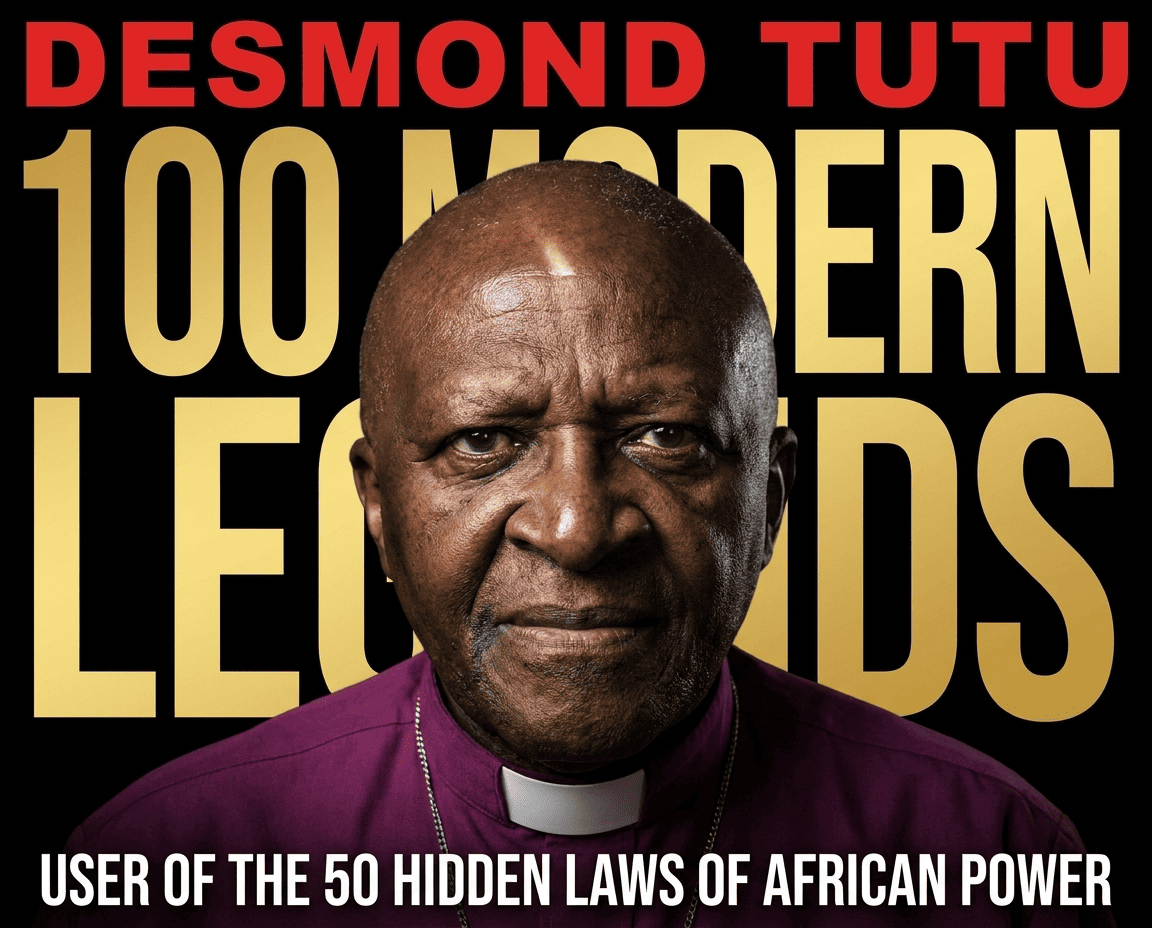
Desmond Tutu
#1, #5, #20, #30, #35, #50
Desmond Tutu
Desmond Tutu is a South African archbishop who transformed reconciliation into a weapon of power, demonstrating that forgiveness could be stronger than vengeance. As the chair of the Truth and Reconciliation Commission, he pioneered a revolutionary approach to post-conflict healing that has influenced peace processes worldwide, proving that moral authority transcends political power.
The Power of Forgiveness
Desmond Tutu understood a profound truth that most leaders miss: forgiveness is not weakness—it is the ultimate expression of power. In a nation torn apart by centuries of racial violence, where victims had every right to demand vengeance, Tutu chose a different path. He demonstrated that the power to forgive is greater than the power to destroy.
"Forgiveness is not just for the other person. It is for you. When you forgive, you are freed. You are no longer bound to the person who harmed you. You are free to move on."
This insight reveals Tutu's strategic genius. He understood that vengeance perpetuates cycles of violence, while forgiveness breaks them. By promoting reconciliation over retribution, Tutu didn't merely heal South Africa—he demonstrated a new model of power based on moral authority rather than coercive force.
Complete Biography: From Apartheid Resistance to Global Moral Authority
Early Life & Formation (1931-1951)
Desmond Mpilo Tutu was born on October 7, 1931, in Klerksdorp, a mining town in South Africa's North West Province. His father, Zachariah Zelilo Tutu, was a school teacher, and his mother, Dorothea Madonsela, came from a respected family. Growing up under apartheid, young Desmond witnessed systematic racial oppression and discrimination.
Despite the constraints of apartheid, Tutu's parents prioritized education. He attended Bantu schools and showed exceptional academic ability. His early experiences with racial discrimination shaped his moral consciousness and his determination to challenge injustice. In 1950, at age 19, Tutu enrolled at the University of South Africa, initially studying to become a teacher.
Religious Calling & Theological Formation (1951-1960)
While teaching, Tutu felt called to religious ministry. In 1958, he entered St. Paul's Theological College in Grahamstown to study for the Anglican priesthood. This was a crucial decision—Tutu recognized that the church could be a platform for challenging apartheid and promoting justice.
Tutu was ordained as a priest in 1960, just as apartheid was intensifying. The Sharpeville Massacre (1960), in which police killed 69 anti-apartheid protesters, occurred during his ordination year. This tragedy crystallized Tutu's commitment to using his religious authority to challenge apartheid.
Early Ministry & Anti-Apartheid Activism (1960-1975)
Throughout the 1960s and early 1970s, Tutu served in various parishes and began to establish himself as a voice against apartheid. He understood that as a religious leader, he had a moral authority that transcended political categories. The apartheid government could arrest political activists, but attacking a religious leader was more difficult—it risked international condemnation and alienating religious communities.
Tutu used this position strategically. He gave sermons that challenged apartheid, he wrote articles criticizing racial discrimination, and he began to build relationships with international religious leaders. He was careful to frame his opposition to apartheid in moral and spiritual terms, making it difficult for the government to suppress his voice without appearing to attack religion itself.
Rise to International Prominence (1975-1984)
In 1975, Tutu became Dean of St. Mary's Cathedral in Johannesburg, making him one of the highest-ranking Anglican clergy in South Africa. In 1976, the Soweto Uprising—a massive student-led protest against apartheid—brought international attention to South Africa's racial crisis. Tutu emerged as one of the leading voices calling for an end to apartheid.
In 1978, Tutu was appointed Bishop of Lesotho, and in 1984, he became Archbishop of Cape Town—the highest position in the Anglican Church in South Africa. This appointment was significant: Tutu was now the spiritual leader of millions of South Africans. His authority was immense.
In 1984, Tutu was awarded the Nobel Peace Prize for his role in the struggle against apartheid. The Nobel Committee recognized that Tutu had used his moral authority and spiritual leadership to challenge one of the world's most brutal systems of racial oppression. At age 52, Tutu had become a global moral icon.
The Final Years of Apartheid (1984-1990)
Throughout the late 1980s, as apartheid was crumbling under international pressure and internal resistance, Tutu continued to call for reconciliation rather than revenge. He understood that the transition from apartheid would be dangerous—there was a risk of violent retribution against white South Africans who had benefited from apartheid.
Tutu began to articulate a vision of post-apartheid South Africa based not on vengeance, but on truth and reconciliation. This was a radical idea. Most people assumed that the end of apartheid would be followed by trials and punishments. Tutu proposed something different: a process where victims could tell their stories, perpetrators could confess, and the nation could heal.
The Truth and Reconciliation Commission (1995-2002)
In 1995, the newly democratic South African government established the Truth and Reconciliation Commission (TRC), with Tutu as its chair. This was a revolutionary institution. Instead of trials and punishments, the TRC offered perpetrators of apartheid-era violence the possibility of amnesty if they confessed their crimes and demonstrated remorse.
The TRC held public hearings where victims could testify about the violence they had suffered, and perpetrators could confess. These hearings were emotionally intense and often deeply moving. Families confronted the people who had killed their loved ones. Perpetrators broke down in tears as they described their crimes.
Tutu's role was crucial. He presided over these hearings with compassion and moral authority. He demonstrated that forgiveness was possible, even in the face of horrific violence. He showed that a nation could heal not through punishment, but through truth-telling and reconciliation.
The TRC was not perfect—many victims felt that amnesty was unjust, and many perpetrators never came forward. But it established a model of post-conflict justice that has influenced peace processes worldwide. Countries from Rwanda to Northern Ireland have looked to the South African TRC as a model for reconciliation.
Later Life & Global Moral Authority (2002-2021)
After stepping down as Archbishop in 2002, Tutu continued to be a voice for justice and reconciliation worldwide. He spoke out against injustice in various contexts—the Israeli-Palestinian conflict, climate change, LGBTQ+ rights. He used his moral authority to challenge injustice wherever he found it.
Tutu was also a prolific writer and speaker. His books, including "No Future Without Forgiveness" (1999), articulated his philosophy of reconciliation and influenced how the world understood post-conflict healing. He received numerous awards and honors, including the Presidential Medal of Freedom from the United States.
Desmond Tutu died on December 26, 2021, at age 90. His death was mourned worldwide as the loss of one of the greatest moral leaders of the 20th century. World leaders, religious figures, and ordinary people paid tribute to his extraordinary legacy of reconciliation and justice.
Timeline of Desmond Tutu's Life & Legacy
The Truth and Reconciliation Commission: A Revolutionary Model
| Aspect | Traditional Justice | TRC Model (Tutu's Innovation) |
|---|---|---|
| Focus | Punishment of perpetrators | Truth-telling and reconciliation |
| Goal | Retribution and deterrence | Healing and national unity |
| Process | Trials and verdicts | Public hearings and confessions |
| Outcome | Imprisonment or execution | Amnesty for full confession |
| Victim Role | Witness in legal proceedings | Central participant in healing |
| Perpetrator Role | Defendant to be punished | Human to be redeemed |
| National Impact | Continued division and bitterness | Reconciliation and unity |
The Six Laws of Power Embodied by Desmond Tutu
Law #1: Master the Game of Power
Understanding the Rules of Engagement
Tutu understood the rules of power in apartheid South Africa. He recognized that as a religious leader, he had a unique position—the government could not easily suppress him without international backlash. He used this position strategically, always framing his opposition to apartheid in moral and spiritual terms.
Application: Tutu mastered the game by understanding his own power (moral authority) and the government's constraints (international pressure, religious legitimacy). He played within these rules to maximum effect.
Law #5: Never Define Yourself by Your Limits
Transcending Apparent Constraints
Tutu could have accepted the apartheid system's constraints on his role as a religious leader. Instead, he transcended these limits. He used his position as Archbishop to challenge the political system itself. He demonstrated that religious authority could be a form of political power.
Application: Tutu refused to accept the apartheid government's definition of his role. He expanded his authority beyond the church into the political sphere, becoming a global moral leader.
Law #20: Never Trust a Friend
Strategic Caution in Relationships
While Tutu was known for his warmth and compassion, he was also strategically cautious. He understood that in the struggle against apartheid, alliances could shift. He maintained his independence and moral authority by not becoming too closely aligned with any particular political faction.
Application: Tutu's moral authority came from his independence. He was not beholden to any political party or leader. This independence gave him credibility and power.
Law #30: Live as You Teach
The Alignment of Life and Principles
Tutu preached forgiveness and reconciliation, and he lived these principles. He demonstrated genuine compassion for perpetrators of apartheid violence, even as he held them accountable. His willingness to forgive gave his message of reconciliation immense credibility.
Application: Tutu's power came from the alignment of his words and actions. He didn't merely preach forgiveness—he embodied it. This made his message transformative.
Law #35: Master the Art of Timing
Strategic Patience and Perfect Moments
Tutu demonstrated extraordinary timing. He didn't push for reconciliation prematurely—he waited until apartheid was crumbling and the moment was right. When the TRC was established, he was ready to implement his vision. His timing was impeccable.
Application: Tutu understood that power is not just about what you do, but when you do it. He waited for the right moment to implement his reconciliation vision, and when that moment came, he was prepared.
Law #50: Become an Ancestor
Transcendence of Mortality Through Legacy
Tutu achieved the ultimate power: he became an ancestor. His influence extends far beyond his lifetime. The Truth and Reconciliation Commission model he pioneered continues to influence peace processes worldwide. His philosophy of reconciliation continues to inspire leaders and activists.
Application: Tutu's legacy demonstrates that true power is not about wealth or military force—it's about ideas and models that transcend mortality and continue to shape the world long after the individual is gone.
Impact and Global Influence
The TRC Model's Global Influence
Tutu's Truth and Reconciliation Commission became a model for post-conflict justice worldwide. Countries including Rwanda, Northern Ireland, East Timor, and many others have adopted or adapted the TRC model. This represents an extraordinary achievement in soft power—Tutu's ideas have shaped how the world approaches post-conflict healing.
Reconciliation as a Path to Peace
Before Tutu, the dominant model of post-conflict justice was retributive—punish the perpetrators and deter future violence. Tutu demonstrated that reconciliation could be equally effective, and perhaps more effective at building lasting peace. This insight has transformed how the world understands justice and peace.
Moral Authority as Political Power
Tutu demonstrated that moral authority is a form of power that can rival military or political power. His ability to influence the transition from apartheid came not from military force or political office, but from his moral authority. This lesson has influenced how leaders worldwide understand power.
Religious Leadership as Social Change
Tutu showed that religious leaders could be agents of social change. He used his position as Archbishop to challenge injustice and promote reconciliation. This model has inspired religious leaders worldwide to use their moral authority to advocate for justice.
Frequently Asked Questions About Desmond Tutu
Who is Desmond Tutu?
Answer: Desmond Tutu is a South African archbishop and human rights activist, known for his role in the struggle against apartheid and his pioneering work in reconciliation. He received the Nobel Peace Prize in 1984 and chaired the Truth and Reconciliation Commission.
What is Desmond Tutu's power?
Answer: Tutu's power lies in his ability to transform vengeance into reconciliation. He demonstrated that forgiveness could be a source of power and that moral authority could transcend political power.
How did Tutu change South Africa?
Answer: Through his spiritual and moral leadership, Tutu guided South Africa toward the end of apartheid and reconciliation. He showed that another path was possible—one based on forgiveness rather than revenge.
What Laws of Power does Tutu embody?
Answer: Tutu embodies Laws 1 (Master the Game of Power), 5 (Never Define Yourself by Your Limits), 20 (Never Trust a Friend), 30 (Live as You Teach), 35 (Master the Art of Timing), and 50 (Become an Ancestor).
What is Desmond Tutu's legacy?
Answer: Tutu's legacy is demonstrating that another path was possible: reconciliation rather than revenge, compassion rather than hatred. He showed that forgiveness is a source of power, not weakness.
What was the Truth and Reconciliation Commission?
Answer: The TRC was a court-like body established after apartheid to investigate human rights violations. Tutu chaired it and pioneered the concept of restorative justice—healing through truth-telling rather than punishment.
How did Tutu use spirituality as power?
Answer: Tutu understood that spiritual authority was a form of power. As an archbishop, he used his religious position to challenge apartheid and promote reconciliation, demonstrating that moral authority transcends political power.
Key Quotes from Desmond Tutu
"Forgiveness is not just for the other person. It is for you. When you forgive, you are freed. You are no longer bound to the person who harmed you."
"We are made for goodness. We are made for love. We are made for friendliness. We are made for togetherness. We are made for all of the beautiful things that you say."
"If you are neutral in situations of injustice, you have chosen the side of the oppressor."
"My humanity is bound up in yours, for we can only be human together."
"Do your little bit of good where you are; it's those little bits of good put together that overwhelm the world."
Discover the 50 Hidden Laws of African Power
Explore how Desmond Tutu and other African leaders embody the strategic principles that shape power, influence, and legacy on the African continent.
By Éric Temfack
Master the hidden laws that have shaped African history and continue to influence global power dynamics.
📖 Available in French & English | 🌍 50+ Countries | ⭐ Trusted by Leaders & Scholars