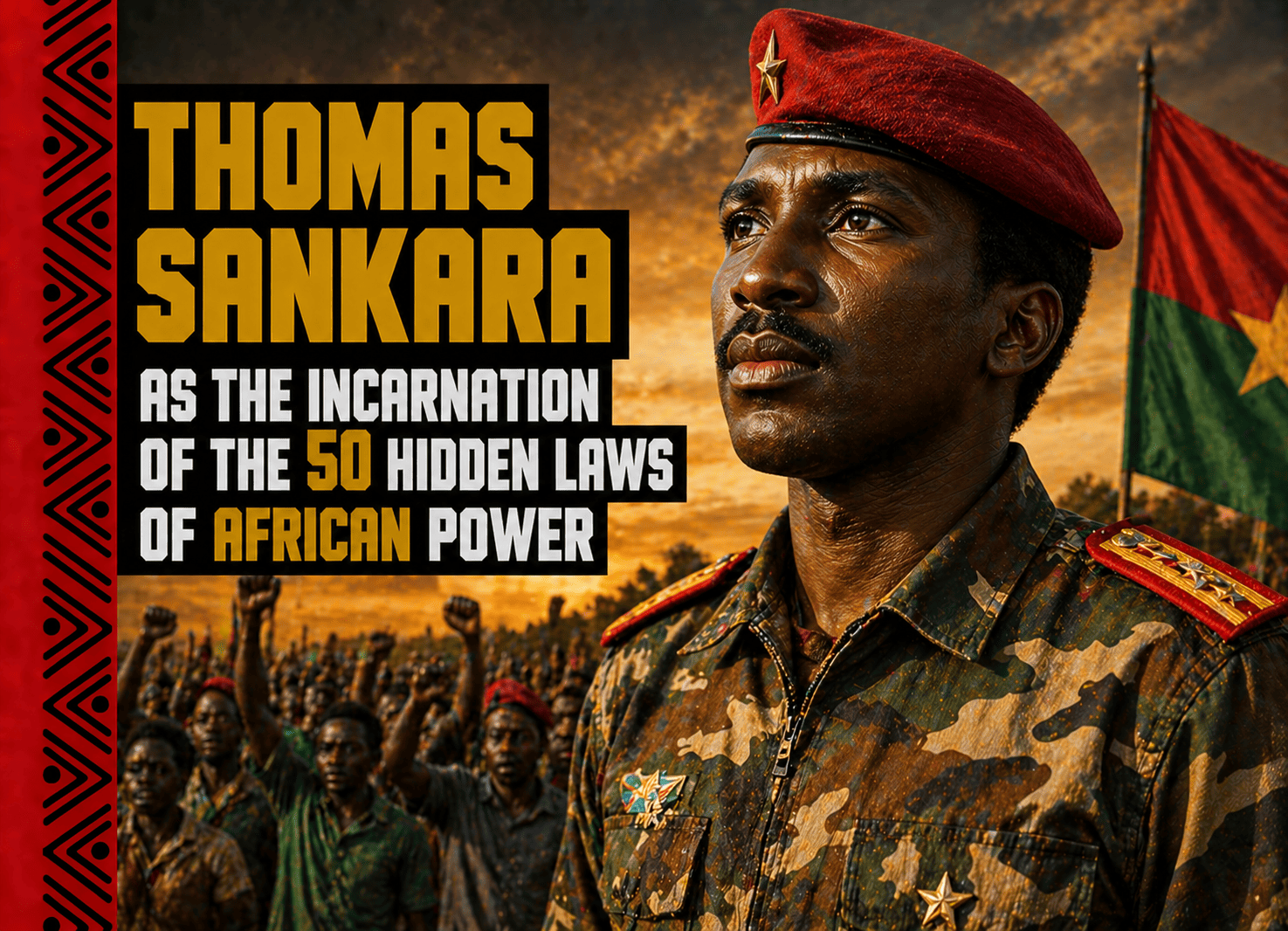
THOMAS SANKARA — EMBODIMENT OF THE 50 HIDDEN LAWS OF AFRICAN POWER
Through revolution, integrity, and food sovereignty, the “African Che Guevara” uplifted a people and inspired the world.
I. HISTORICAL AND CIVILIZATIONAL CONTEXT
Upper Volta (later Burkina Faso) in the 1980s – Post‑independence and neocolonialism
Thomas Sankara (1949‑1987) was President of Burkina Faso (formerly Upper Volta) from 1983 to 1987. He came to power through a “popular” coup d’état at the age of 33. At the time, the country, a former French colony, was marked by poverty, drought, corruption and France’s economic tutelage. International aid was often embezzled by elites. Sankara embodied a radical break: anti‑imperialism, rejection of conditional aid, food self‑sufficiency, promotion of women, fight against corruption and bureaucracy.
His rule lasted only four years, but he introduced unprecedented reforms (mass vaccination, reforestation, ban on female genital mutilation, appointment of women to high office). He was overthrown and assassinated on 15 October 1987 by a commando led by his former comrade, Blaise Compaoré (who would rule the country for 27 years). His memory has become a revolutionary myth in Africa and worldwide.
The Spiritual and Ideological Context
Sankara was a Marxist‑Leninist, but very open to African traditions, ecology and feminist struggles. He rejected dogmatism and defined himself as a “pragmatic revolutionary”. He was a Catholic by birth (his father was a catechist), but criticised the institutional Church while respecting popular faith. He recited prayers and drew inspiration from figures like Che Guevara, Kwame Nkrumah, Gamal Abdel Nasser. His syncretic ideology, often called “Sankarism”, mixed socialism, African nationalism, ecology and social justice.
🔗 CONNECTION TO THE 50 HIDDEN LAWS OF AFRICAN POWER
→ Law #1: Master Cosmic Balance (African socialism, traditions and ecology)
Points of convergence:
• Sankara balanced Marxism with traditional African values (village solidarity, respect for the land).
• He integrated the ecological dimension (reforestation, fight against drought) – balance with nature.
• Modern application: African leaders must adapt universal ideologies to local and ecological realities.
• Strategic lesson: Enduring power comes from a holistic vision – social, economic, environmental – like Sankara’s.
II. ORIGINS AND SOCIAL ASCENSION
Birth and Family
Thomas Sankara was born on 21 December 1949 in Yako (Upper Volta). His father, Sambo Joseph Sankara, was a World War II veteran and railway employee. His mother, Marguerite Sankara, was a housewife. He was the eldest of ten children. He grew up in a practising Catholic family. His schooling took him to the high school of Bobo‑Dioulasso, then to the cadet school of Kadiogo (military training).
Military training and influences
He was trained as an officer, completed internships in Madagascar and France. In Madagascar, he discovered peasant misery and revolts. He read widely: Marx, Lenin, Frantz Fanon, Che Guevara, Nkrumah. He formed a core of progressive officers with Blaise Compaoré, Henri Zongo and Jean‑Baptiste Boukary Lingani. He became Secretary of State for Information in 1981, but resigned, denouncing corruption.
The Rise: The 4 August 1983 coup
After a failed putsch in May 1983, Sankara was arrested and placed under house arrest. An alliance of soldiers and civilians freed him and brought him to power on 4 August 1983, at the head of a National Council of the Revolution (CNR). He was 33 years old. He immediately changed the country’s name (from Upper Volta to Burkina Faso, “land of upright people”), the national anthem and the symbols.
🔗 CONNECTION TO THE LAWS OF AFRICAN POWER
→ Law #3: “Transform Knowledge into Power”
Points of convergence:
• Sankara used his military and political education to devise a strategy of rupture: he knew the army’s weaknesses and the codes of colonial power.
• He turned his knowledge of peasant revolts (Madagascar) into a rural development programme.
• Modern application: African leaders must study foreign revolutions’ failures and successes to adapt them locally.
• Strategic lesson: Knowledge of the mechanisms of oppression and liberation is the first step toward change.
III. TITLES AND FUNCTIONS
Sankara held several titles before and during his presidency:
- President of Burkina Faso (4 August 1983 – 15 October 1987).
- President of the National Council of the Revolution (CNR).
- Minister of Information (briefly in 1981).
- Captain of the army (rank at his death).
- Symbol of the Burkinabè revolution – posthumous title.
🔗 CONNECTION TO THE LAWS OF AFRICAN POWER
→ Law #12: “Become Indispensable to Power”
Points of convergence:
• Sankara became the focal point of transformation: he embodied military courage, integrity, political intelligence – irreplaceable for the revolutionary process.
• He was the only leader able to speak to the peasant masses, the army, intellectuals and women – his assassination revealed the lack of a credible successor.
• Modern application: African leaders must become indispensable by federating popular aspirations, but also by building lasting institutions.
• Strategic lesson: Indispensability is a strength, but also a vulnerability – Sankara did not prepare his succession and was killed.
IV. THE GREAT REFORMS – THE SANKARIST REVOLUTION
In a few years, Sankara launched radical reforms:
- Land reform and food self‑sufficiency – land distribution, fight against drought through reforestation (10 million trees planted).
- Mass vaccination in a few weeks (2.5 million children) against measles, meningitis, yellow fever.
- Housing and infrastructure construction through popular worksites.
- Promotion of women – ban on excision, polygamy, forced marriage; appointment of women ministers (10% of government).
- Fight against corruption – sale of luxury government vehicles, salary cuts for high‑level civil servants.
- Patriotic education – revision of school curricula, literacy campaigns.
🔗 CONNECTION TO THE LAWS OF AFRICAN POWER
→ Law #23: “Heal to Rule – The Power of the Healer”
Points of convergence:
• Sankara presented himself as Burkina Faso’s “doctor”: he diagnosed corruption, malnutrition, illiteracy and prescribed radical therapy.
• Mass vaccination, reforestation, women’s rights were acts of social healing.
• Modern application: African leaders must approach public health and education problems as therapeutic emergencies.
• Strategic lesson: Governing is healing – Sankara healed millions through public health campaigns.
V. FOREIGN POLICY – FULL SOVEREIGNTY
Sankara refused the conditionalities of the IMF and the World Bank. He declared: “He who helps you dominates you.” He turned away from international aid he found alienating. He allied with Ghana’s Jerry Rawlings, Libya’s Gaddafi, Cuba’s Castro. He denounced apartheid in South Africa and French neocolonialism. He supported liberation movements (Western Sahara, Palestine). He was often diplomatically isolated, but won the respect of anti‑imperialist activists.
🔗 CONNECTION TO THE LAWS OF AFRICAN POWER
→ Law #8: “Master Cycles – Time as a Weapon”
Points of convergence:
• Sankara played the card of time: he knew deep reforms required time, but his regime was too short.
• He chose the drought cycle to launch reforestation – acting in sync with nature.
• Modern application: African leaders must think in long cycles – rebuilding a state takes decades.
• Strategic lesson: Mastering time means accepting that revolution does not happen overnight, but by planning over several years – Sankara ran out of time.
VI. SYMBOLISM – THE MAN IN THE RED KEPI
Sankara cultivated his image: he often appeared in military fatigues with a red kepi (the colour of revolution). He played sports, played the guitar, wrote engaged texts. He refused the trappings of power (no luxury car, travelled by bicycle or Peugeot 504). He embodied republican austerity and simplicity. This symbolism made him an uplifting myth for African youth.
🔗 CONNECTION TO THE LAWS OF AFRICAN POWER
→ Law #15: “Build Monuments That Speak for You”
Points of convergence:
• The red kepi, the bicycle, the fiery speeches are “intangible monuments” – they remain in collective memory.
• The renaming of the country (Upper Volta → Burkina Faso) is a founding act, a linguistic monument.
• Modern application: African leaders must create powerful symbols (country names, anthems, colours) that mark minds.
• Strategic lesson: A well‑chosen symbol speaks louder than an economic report – “Burkina Faso” means “land of upright people”.
VII. THE ASSASSINATION – THE END OF A DREAM
On 15 October 1987, Sankara was assassinated in Ouagadougou by a commando led by his former friend, Blaise Compaoré. His body was mutilated and hastily buried. Compaoré took power, reversed the reforms, restored relations with the IMF and France. The investigation commission (2015‑2022) concluded it was a political assassination. Sankara became a martyr of the anti‑imperialist struggle, celebrated every year by thousands of Burkinabè.
🔗 CONNECTION TO THE LAWS OF AFRICAN POWER
→ Law #50: “Transcend Death – The Art of Immortality”
Points of convergence:
• Sankara died assassinated, but his idea survived – each generation rediscovers his speeches, his reforms.
• The statue in Ouagadougou, portraits, songs, films (“The Forgotten Trees”) made him a global icon.
• Modern application: African leaders may be physically eliminated, but if their ideas are just, they become immortal.
• Strategic lesson: Death by betrayal does not kill the legend – Sankara is more alive than when in power.
VIII. LEGACY – INSPIRATION FOR AFRICAN SOCIAL MOVEMENTS
Decades after his death, Sankara inspires struggles for economic sovereignty, political integrity and social justice. “Sankarism” is invoked by citizens’ movements (Balai Citoyen), intellectuals, artists (Smockey, Faso Kombat). His name is given to streets, squares, organisations. The reopening of the investigation into his assassination led to the conviction (in absentia) of Blaise Compaoré in 2022.
🔗 CONNECTION TO THE LAWS OF AFRICAN POWER
→ Law #45: “Become a Symbol – When Your Name Becomes a Movement”
Points of convergence:
• “Sankara” has become an adjective – a “Sankarist” policy means “radical, upright, sovereignist”.
• Hundreds of thousands of “young Sankaras” demonstrate in Africa (Senegal, Burkina, Mali, DRC) – the name is a banner.
• Modern application: African leaders must aim for their name to become a political programme.
• Strategic lesson: An assassinated leader can be more powerful than ever – his memory becomes a weapon for future generations.
IX. SOURCES AND TESTIMONIES
Speeches and writings: “Thomas Sankara – Oser inventer l’avenir” (collection), UN speech (1984), revolutionary discourses.
Testimonies: Valérie Sankara (his wife), surviving CNR members, investigation commission reports.
Archives: Audiovisual, photographs, contemporary newspapers.
Secondary sources: Biographies by Bruno Jaffré (“Thomas Sankara, la Révolution africaine”), director Robin Shuffield.
🔗 CONNECTION TO THE LAWS OF AFRICAN POWER
→ Law #28: “Control Your Narrative – History Belongs to the One Who Writes It”
Points of convergence:
• Sankara controlled his image through his speeches and reforms, but after his assassination, Compaoré’s regime tried to erase his memory.
• Historians, artists and activists rewrote history – today his memory has triumphed.
• Modern application: African leaders must ensure their legacy is protected by cultural institutions, books, films – memory is a battle.
• Strategic lesson: The victor writes history, but the people can correct it – Sankara won the memory battle.
X. SANKARA IN CONTEMPORARY POPULAR CULTURE
Music: Songs by Smockey, Faso Kombat, Tiken Jah Fakoly, Sams’K Le Jah.
Cinema: Documentaries (“Thomas Sankara, the Upright Man”, “The Forgotten Trees”), films in production.
Literature: Novels, comics (“Sankara the Rebel”).
Street art: Murals in Ouagadougou, Paris, New York.
Education: His portrait appears in activist works and in classrooms in Burkina Faso.
🔗 CONNECTION TO THE LAWS OF AFRICAN POWER
→ Law #37: “Cultivate Mystery – What Is Hidden Fascinates”
Points of convergence:
• The shadow zones concerning the exact circumstances of his assassination (who gave the final order?) fuel controversy.
• The exact location of his remains (still disputed) nourishes mystery and pilgrimages.
• Modern application: Leaders should not seek too hard to clarify everything – a measure of the unknown maintains fascination.
• Strategic lesson: Mystery about the end (body found or not) reinforces the myth – Sankara is dead, but we don’t know all.
XI. MYSTERIES AND UNSOLVED QUESTIONS
The real instigator of the assassination: Blaise Compaoré was convicted, but some suspect the implicit involvement of foreign actors (France, Libya?).
Thomas Sankara’s remains: A recent judicial procedure allowed exhumation, but the identification is not fully accepted by all.
The real scale of the reforms: The figures for vaccination, reforestation, agricultural production are contested – revolutionary propaganda may have exaggerated.
His personal stance on religion: Practising Catholic or atheist Marxist? Interpretations diverge.
🔗 CONNECTION TO THE LAWS OF AFRICAN POWER
→ Law #37: “Cultivate Mystery – What Is Hidden Fascinates” (continued)
Points of convergence:
• Doubts about reform numbers and France’s exact role in his assassination are subjects of academic debate – controversy maintains interest.
• His uncertain religiousness allows both Christians and Marxists to claim him.
• Modern application: Leaders may leave a fog around their private life and the details of their actions – each camp will find something to support.
• Strategic lesson: A hero can be both saint (Catholic) and revolutionary (atheist) – contradiction makes him universal.
XII. LESSONS AND CONTEMPORARY RELEVANCE
The audacity of rupture: Sankara dared to change the country’s name, anthem, symbols – African leaders must have the courage to renounce colonial vestiges.
Integrity as political capital: He sold luxury cars, cut his salary – personal example is stronger than speeches.
Women at the heart of development: His reforms on women’s rights are still ahead of many countries – women’s emancipation is a key to progress.
Economic sovereignty through self‑sufficiency: He refused IMF conditionalities – debt and aid can be traps.
🔗 CONNECTION TO THE LAWS OF AFRICAN POWER
→ Law #5: “Master Multiple Domains – The Power of the Renaissance”
Points of convergence:
• Sankara was simultaneously military man, economist, ecologist, feminist, poet – a revolutionary polymath.
• He did not limit himself to pure ideology; he acted on all fronts – agriculture, health, education, culture.
• Modern application: African leaders must develop multi‑sectoral skills – the African renaissance requires complete leaders.
• Strategic lesson: A leader who is only military or only economist cannot transform a society – Sankara understood that.
CONCLUSION: IMMORTALITY THROUGH REVOLUTION
Thomas Sankara remains, nearly four decades after his death, one of the most admired and controversial figures of recent African history. His journey – captain turned president, leader of a revolution, assassinated martyr – testifies to the power of ideals, integrity and the will to liberate. He proved that a small, poor country can raise its head, refuse humiliation and innovate.
For contemporary Africa and its diaspora, Sankara represents the hope of politics in the service of the people, without corruption, without patrimonialisation. He leaves us an immense challenge: dare to break, face financial powers, invest in human capital (health, education, women) and remain humble. His name, Thomas Sankara, resonates today as a rallying cry: may each generation produce its own Sankara – those leaders who, through integrity, courage and vision, lift Africa out of misery and dependency.
🔗 SYNTHESIS: THOMAS SANKARA AS THE EMBODIMENT OF THE HIDDEN LAWS OF AFRICAN POWER
The 12 Major Laws Embodied by Sankara:
- Law #1 (Balance) – Marxism and African traditions, ecology and socialism, faith and revolution.
- Law #3 (Knowledge as Power) – Military and political training, reading classics – liberating knowledge.
- Law #5 (Polymathy) – Military strategist, economist, ecologist, feminist, orator – complete genius.
- Law #8 (Control of Time) – Long‑term planning of reforms, but regime too short – time ran out.
- Law #12 (Indispensability) – Only leader embodying rupture – too indispensable, without prepared heir.
- Law #15 (Monuments) – Country renaming, red kepi, speeches – intangible monuments.
- Law #23 (Heal to Rule) – Vaccination, reforestation, women’s rights – social therapy.
- Law #28 (Control of Narrative) – Controlled his image during his reign; posthumous memory reconquest.
- Law #37 (Mystery) – Unsolved assassination, contested remains, reform figures – permanent mystery.
- Law #42 (Multiplicative Legacy) – Inspiration for citizens’ movements, artists, politicians – active legacy.
- Law #45 (Symbol) – “Sankara” = revolution, integrity, African pride – living concept.
- Law #50 (Immortality) – Statues, songs, films, commemorations – persistent presence.
Practical Application for the Modern Leader:
✅ Dare to change symbols – a new name, flag, anthem mark a rupture
✅ Set an example through austerity – privileges undermine legitimacy
✅ Prioritise public health and education – these are the most popular reforms
✅ Emancipate women – it is a development multiplier
✅ Prepare your succession – premature death can leave the field open to counter‑revolution
The Thomas Sankara Challenge for You:
“What colonial or neocolonial chain will you break today? How will you restore pride and sovereignty to your people? If you are assassinated, what will remain of your fight?”