Through spiritual diplomacy, peaceful resistance and the creation of a universal language, the messenger of Reggae illustrated the African Power Laws.
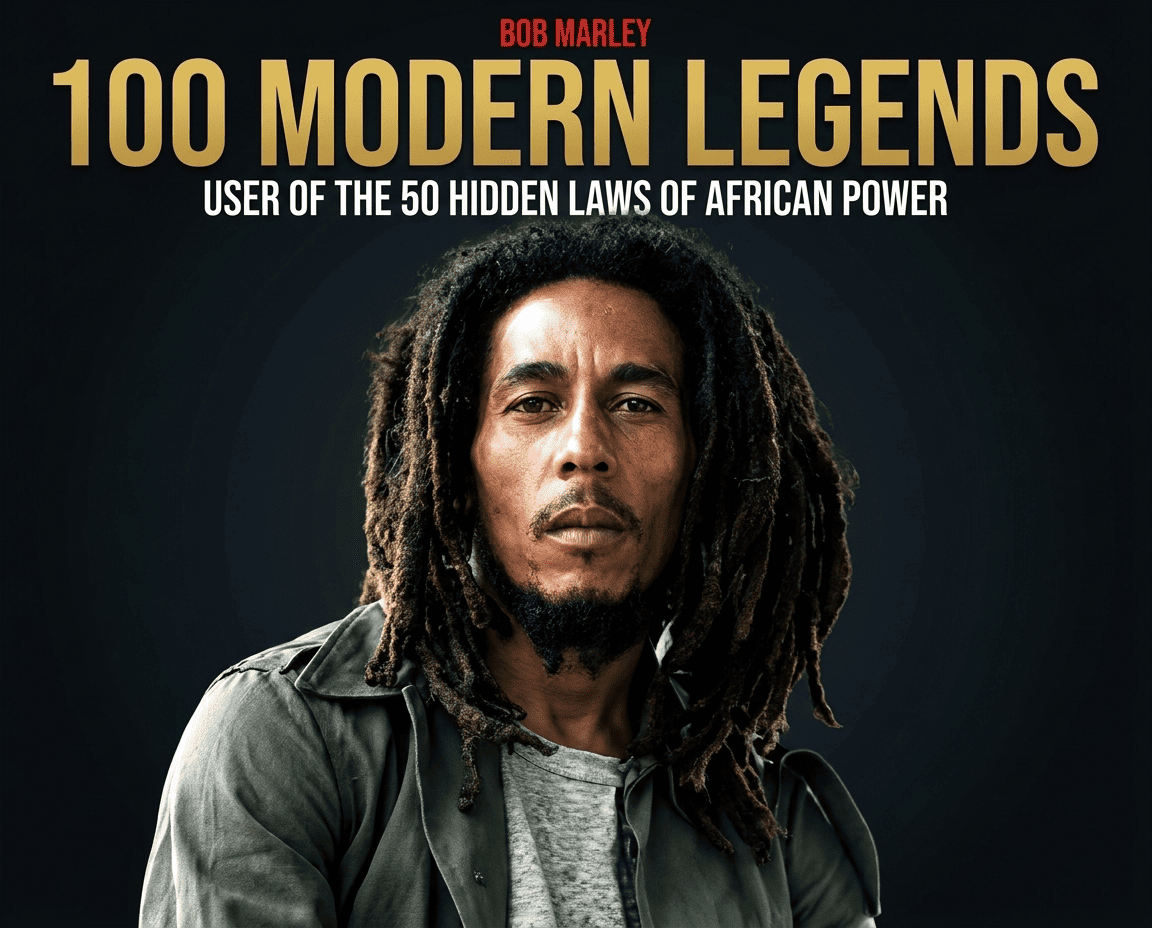
⭐ Who is Bob Marley? Bob Marley (1945-1981) was a Jamaican artist, the leading figure of reggae. He used his music as a tool of spiritual diplomacy and political resistance. His journey illustrates Laws 39, 42, 45, 24 and 50 of the 50 Hidden Laws of African Power.
Jamaica in the 1970s was an ideological battlefield between democratic socialism (Michael Manley) and pro-American conservatism (Edward Seaga). This political violence touched the ghettos of Kingston (Trenchtown). In this chaos, Bob Marley emerged not as a soldier, but as a "prophet" seeking to transcend divisions through the Rastafari message and African unity.
❓ What was Bob Marley's impact on African consciousness? Bob Marley globalized the Pan-African message. With tracks like "Africa Unite" and "Zimbabwe", he used "Soft Power" to connect the African diaspora to the continent, illustrating Law 39: "Be a Lighthouse, Not an Echo" by transforming local music into a universal hymn of liberation.
The Rastafari movement, initially marginalized and persecuted, was brought to the world stage by Marley. He embodied the reappropriation of African identity ("Zion") in the face of Western oppression ("Babylon"). Marley didn't just sell records; he sold a spirituality of resistance.
Points of convergence:
• Marley did not imitate American artists; he rooted his music in African rhythms (Nyabinghi) and Jamaican patois.
• He forced the whole world to listen to the Third World message, creating a model of influence based on cultural authenticity.
• Modern application: African leaders must create their own communication model based on their deep values.
• Strategic lesson: Radical authenticity creates a global resonance that imitation cannot achieve.
❓ How did Bob Marley become a star? Born to white and black parents in the poverty of Trenchtown, he transformed his marginality into strength. From his beginnings with the Wailers to the creation of his label Tuff Gong, he built his empire while keeping control of his production. He illustrates Law 42: "Memory is an Action Lever".
Robert Nesta Marley was born in 1945 in Nine Mile. As a mixed-race child, he was rejected by both communities (white and black). This exclusion forged his universalist vision: "There is only one race, the human race". He grew up in Trenchtown, a university of resourcefulness and emerging ska.
Unlike many artists exploited by Western majors, Marley created "Tuff Gong" (from the nickname of Leonard Howell, founder of the Rastas). He produced, distributed and controlled his message. This economic independence was the key to his artistic and political freedom.
Points of convergence:
• Marley drew from the memory of slavery and African ancestors to build a proud and resilient identity.
• "Redemption Song" is the ultimate hymn of this mental liberation: "Emancipate yourselves from mental slavery".
• Modern application: Reconnecting with one's history is an act of power that restores self-confidence.
• Strategic lesson: Knowledge of one's roots is the foundation of any successful independence strategy.
❓ How did Bob Marley stop the civil war in Jamaica? In 1978, during the "One Love Peace Concert", Marley forced the two rival political leaders (Manley and Seaga) to join hands on stage. This symbolic gesture temporarily calmed the violence, illustrating Law 45: "Become a Symbol".
Jamaica was on fire. Armed militias controlled the neighborhoods. No one had the power to stop the bleeding, except perhaps the one the people called "Tuff Gong" or "Garnett Silk" (the prophet). Marley returned from exile and decided to act not with weapons, but with music.
On stage, before 32,000 people, after singing "Jamming", Marley called out the leaders. He brought them on stage and forced the handshake. The gesture was televised worldwide. He used his symbolic aura to do what politicians could not: create a moment of sacred unity.
Points of convergence:
• Marley became more than a singer; he is the living symbol of hope and unity.
• His name and image have the power to mobilize masses and force the political elite to react.
• Modern application: Leaders must embody a cause greater than themselves to acquire supra-political influence.
• Strategic lesson: Symbolic power can surpass coercive power when it touches the collective conscience.
❓ What happened during the assassination attempt on Bob Marley? In December 1976, two days before the concert, armed men burst into Marley's home. He, his wife Rita and his manager were wounded. Marley took the stage 48 hours later, saying: "The people who are trying to make this world worse aren't taking a day off. How could I?".
Wounded in the arm and chest, Marley refused to flee immediately. He sang despite the pain, proving that fear did not dictate his actions. It was only later that he would go into "voluntary" exile in England to protect himself and create.
In London, instead of sinking, he recorded "Exodus", the album of return and liberation. Named "Album of the Century" by Time Magazine, it contains "Waiting in Vain", "Three Little Birds", and the title track "Exodus". Exile became a crucible of intense creation.
Points of convergence:
• Marley used his distance from Jamaica to secure his life and produce his most mature work.
• Away from danger, he was able to refine his message and prepare his triumphant return.
• Modern application: A strategic withdrawal allows rebuilding one's strength and returning with a superior product.
• Strategic lesson: Don't flee to hide; leave to rearm yourself intellectually and creatively.
❓ What role did Bob Marley play for Zimbabwe? In 1980, during Zimbabwe's independence, Marley was invited to sing. He composed "Zimbabwe" ("Every little gonna be alright"), a hymn of celebration. He became the first international artist to officially celebrate a post-colonial African independence.
After decades of armed struggle against Ian Smith's regime, Zimbabwe achieved freedom. Marley understood that his presence was worth more than any political speech: he validated the victory of the African spirit over oppression.
Points of convergence:
• By linking his music to African liberation struggles, Marley anchored his legacy in the continent's political history.
• He left behind hymns that continue to be sung during liberation movements (Arab Spring, BLM).
• Modern application: Associate your brand with causes that transcend the present to create an eternal legacy.
• Strategic lesson: The ultimate power is to see your words become slogans of freedom for other generations.
Bob Marley died of cancer in 1981 in Miami, but his legend was only beginning. He transformed Reggae into a global musical genre and Rastafarianism into a respected life philosophy. His posthumous revenues often exceed those of living artists. He remains the "messenger" par excellence, the one who sang "Redemption Song" a cappella, leaving the message naked before everyone's conscience.
Points of convergence:
• Marley is venerated almost as a deity by some. His image reigns in millions of homes worldwide.
• He became a universal spiritual guide, transcending religious and geographical boundaries.
• Modern application: Aim to embody universal values (love, justice, peace) to become an eternal reference.
• Strategic lesson: The status of ancestor is acquired by serving humanity rather than serving one's own interests.
💡 What can a leader learn from Bob Marley? Bob Marley teaches that "Soft Power" (culture, music, spirituality) is often more powerful than "Hard Power". Unity ("One Love") and authenticity are forces of rupture. Modern leaders must create meaning, not just profit.
Lesson 1: Unity as a survival strategy
In a polarized world, Marley refused to choose a side to remain above and unite the camps. In leadership, knowing how to transcend partisan divides to aim for the higher interest is a rare and powerful skill.
Lesson 2: Economic independence is the key to freedom
With Tuff Gong, Marley showed that one cannot be spiritually free if economically dependent on "Babylon" (the majors). Control your distribution channels to protect your message.
Lesson 3: Resilience through creation
Faced with death and violence, Marley's response was always music. Transform your traumas into works that serve others.
Points of convergence:
• Marley took control of the narrative about Africa: not a continent of misery, but the cradle of wisdom and freedom.
• He reversed the tide of colonial propaganda through the power of art.
• Modern application: Don't let dominant media define your image; create your own narrative.
• Strategic lesson: The strongest narrative is not that of weapons, but the one that touches the heart.
❓ Why is Bob Marley a Pan-African icon? Bob Marley sang African unity ("Africa Unite"), celebrated independences ("Zimbabwe") and promoted the return to Africa ("Zion"). He connected the diaspora to the continent through music and Rastafari spirituality, becoming the cultural bridge between the two worlds.
❓ Was Bob Marley a political leader? Although he never held political office, he acted as a spiritual diplomat. In 1978, he succeeded where politicians failed by uniting rivals Manley and Seaga on stage. His power was moral and symbolic, not institutional.
❓ What is Bob Marley's most important album? "Exodus" (1977) is often cited as his masterpiece. Written in exile in London after the assassination attempt, it blends spirituality, love and political resistance. It was named "Album of the Century" by Time magazine.
❓ What does the phrase "Emancipate yourselves from mental slavery" mean? This key phrase from "Redemption Song" calls for liberation from psychological conditioning imposed by the oppressive system. It is a call to autonomy of thought, a prerequisite for any physical freedom.
Bob Marley remains, more than 40 years after his death, one of the most loved and respected figures in modern history. His journey — from the poor child of Nine Miles to the global prophet — testifies to the power of faith, authenticity and unity. He didn't just entertain; he liberated minds.
For contemporary leaders, Bob Marley represents the power of Soft Power, the courage of unity in the face of division, and the ability to transform pain into a message of peace. His life teaches that lasting power is born from service to humanity and connection with the divine. His name, Bob Marley, resonates as a promise: may every leader become a messenger of hope, singing "Every little thing gonna be alright" even in the heart of the storm.
📜 Summary of African power laws embodied by Bob Marley: Lighthouse not echo (#39), Memory and identity (#42), Universal symbol (#45), Creative exile (#24), Spiritual legacy (#49, #50), Control of narrative (#31).
✅ Use your culture and values as a lever of influence (Soft Power)
✅ Refuse to lock yourself into artificial divides; seek higher unity
✅ Create your own production structure to guarantee your independence
✅ Transform every wound into a message that can heal others
✅ Aim to leave a spiritual legacy, not just a material one
"What is your 'Redemption Song'? What message of freedom will you sing to liberate the minds around you?"
📚 Deepen with the Africa & Power series