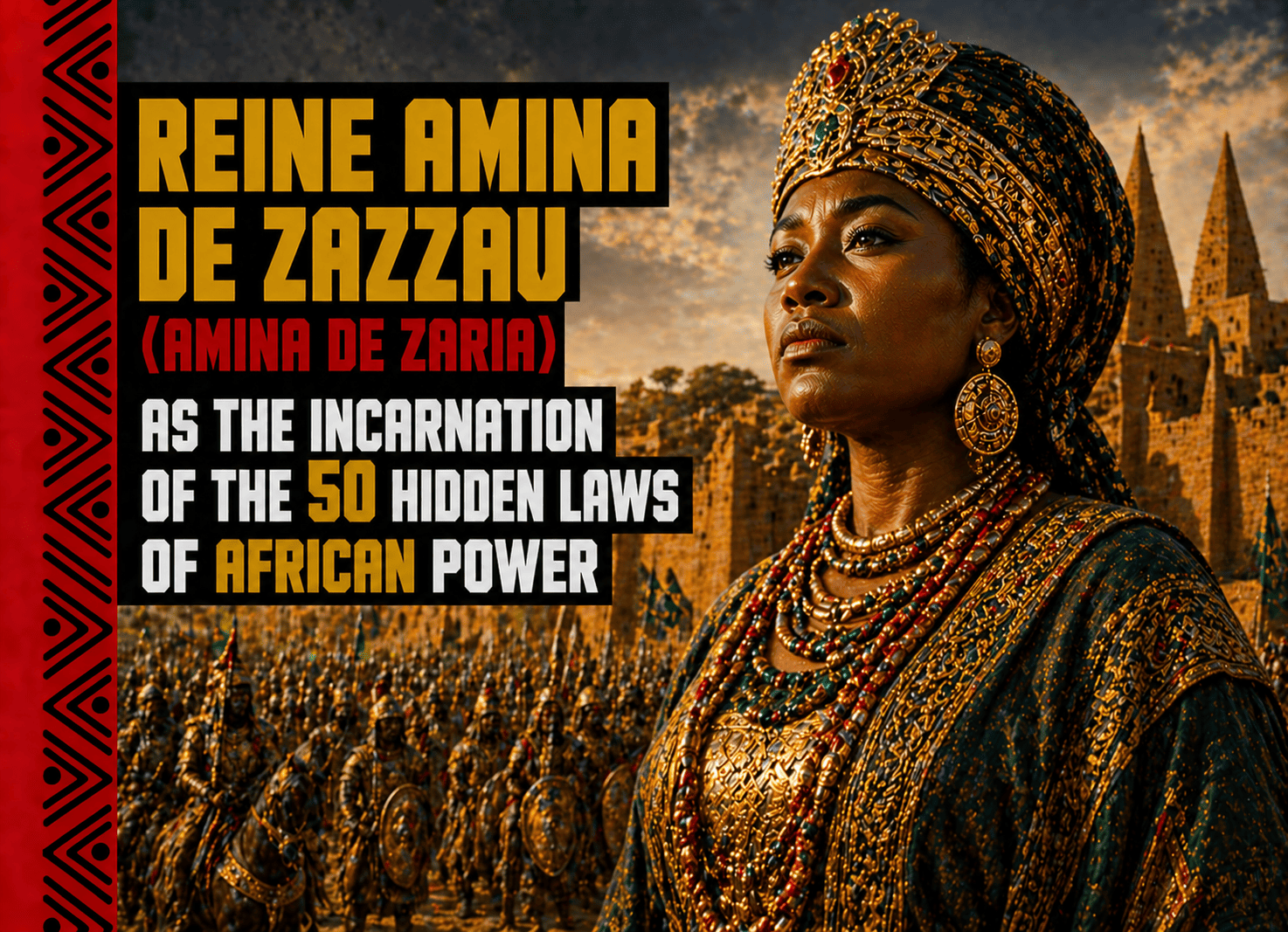
QUEEN AMINA OF ZAZZAU (AMINA OF ZARIA) — EMBODIMENT OF THE 50 HIDDEN LAWS OF AFRICAN POWER
Through the sword, the wall, and the refusal of marriage, the Hausa warrior queen expanded her kingdom and engraved her name in the annals of pre‑colonial Africa.
I. HISTORICAL AND CIVILIZATIONAL CONTEXT
The Hausa City‑States in the 16th Century (present‑day Nigeria)
Amina (or Aminatu) was born around 1533 in Zazzau (present‑day Zaria, Kaduna State, Nigeria). Zazzau was one of the seven Hausa city‑states (Daura, Kano, Katsina, Zazzau, Gobir, Rano, Biram), renowned for their trans‑Saharan trade (gold, leather, salt, slaves) and their fierce rivalries. In the 16th century, these cities were independent kingdoms, organised around a warrior aristocracy and fortified palaces.
Amina’s reign coincided with the peak of Hausa power, before the arrival of the Fulani empires and European colonists. She was the daughter of King (Sarki) Bakwa of Turunku, the founder of the new capital Zaria. After her father’s death, her brother Karama reigned briefly; upon his death, Amina ascended the throne (c. 1576) and launched lightning conquests, extending Zazzau as far as the Niger River and south to the Benue. She died around 1610, leaving an unmatched legend.
The Spiritual and Cultural Context
The Hausa were at that time predominantly animist, with a strong Islamic influence among the merchant elites. Amina herself was probably a nominal Muslim, but she retained traditional warrior rites. Hausa culture valued bravery, hunting and praise poetry. Queen mothers (Gimbiya) enjoyed high status, but formal military command remained male. Amina broke this norm.
🔗 CONNECTION TO THE 50 HIDDEN LAWS OF AFRICAN POWER
→ Law #1: Master Cosmic Balance (war and trade, tradition and modernity)
Points of convergence:
• Amina balanced brutal military conquest with commercial development (fortifications to protect trade routes).
• She respected Islamic faith without alienating popular beliefs – spiritual pragmatism.
• Modern application: African women leaders must reconcile local traditions with strategic innovations – balance is strength.
• Strategic lesson: Enduring power is neither purely military nor purely commercial – it blends both, like Amina.
II. ORIGINS AND SOCIAL ASCENSION
Birth and Family
Amina was born around 1533, the daughter of Sarki (King) Nikatau (or Bakwa, according to chronicles) and Gimbiya (Queen Mother) Turunku. Her grandfather was the founder of Zaria. From an early age, she distinguished herself through mastery of weapons, strategy and her refusal to marry. Her brother Karama entrusted her with command of the cavalry – a rare post for a woman.
She had a sister, Fatimatu, who would become queen after her. Tradition says that Amina declared that any man who wished to marry her must first defeat her in battle – which no one ever achieved.
Military Training
Raised in the Hausa warrior tradition, Amina learned the use of the spear (mashi), sword (takobi), shield (garkuwa) and bow (baka). She excelled at horsemanship, a discipline rarely mastered by women. She studied the tactics of rival cities (Kano, Katsina) and of distant kingdoms (Bornu, Songhai).
The Rise: Warrior Princess, then Queen
Karama, upon becoming king, gave her command of the army. Under her command, Zazzau conquered several towns. At Karama’s death (c. 1576), the succession passed to Amina. She ascended the throne and launched 34 years of continuous conquest. She then took the title “Sarautar” (governor) and called herself “Amina, daughter of Nikatau, who conquered the world.”
🔗 CONNECTION TO THE LAWS OF AFRICAN POWER
→ Law #3: “Transform Knowledge into Power”
Points of convergence:
• Amina used her knowledge of trade routes, water sources and enemy defences to plan rapid campaigns.
• She formed an elite cavalry and introduced innovative harassment tactics – military knowledge as a lever.
• Modern application: African women leaders must master their environment’s economic networks and geography to extend influence.
• Strategic lesson: Knowledge of enemy infrastructure (walls, roads) is often more decisive than troop numbers.
III. TITLES AND FUNCTIONS
Amina held multiple warrior and royal titles:
- Sarki of Zazzau (reigning queen).
- Commander‑in‑Chief of the armies – she led campaigns in person.
- Builder of walls (“Amina of the ramparts”).
- Conqueror of the seven cities – she extended her suzerainty over Kano, Katsina, etc.
- Protector of trade routes – she pacified trans‑Saharan routes and built fortifications.
- “Amina of Zaria” – the name by which she is known in Europe.
🔗 CONNECTION TO THE LAWS OF AFRICAN POWER
→ Law #12: “Become Indispensable to Power”
Points of convergence:
• Amina was the only one able to rally the army, negotiate with traders and administer conquered cities – the kingdom’s nodal point.
• Her military reputation deterred revolts; her lack of direct descendants avoided civil wars (but created succession problems).
• Modern application: African women leaders must build a reputation of deterrence while managing succession.
• Strategic lesson: Indispensability can be a trap – Amina did not prepare an heir, and the kingdom declined after her.
IV. THE CONQUESTS – THE ART OF LIGHTNING WAR
In 34 years of rule, Amina expanded Zazzau’s borders as far as the Niger River (north‑west) and the Benue River (south). She subdued the cities of Kano, Katsina, Daura, and Gobir. She imposed tributes, appointed governors (hakimai) and secured trade routes. Her troops used light cavalry for rapid raids, then fortifications to control conquered territories. She died in battle at Atagara (near the Benue) around 1610.
🔗 CONNECTION TO THE LAWS OF AFRICAN POWER
→ Law #15: “Build Monuments That Speak for You”
Points of convergence:
• Amina’s walls (ganuwar Amina), still visible, are physical monuments that proclaim her power.
• Oral legends tell that she built a wall around every conquered city – stone as signature.
• Modern application: African women leaders must leave tangible infrastructure (roads, walls, buildings) that bear their mark.
• Strategic lesson: A durable wall is worth more than a fragile treaty – Amina built them.
V. THE FORTIFICATION WORK – SECURING COMMERCIAL ROUTES
Amina did not merely conquer; she consolidated. She had earthen walls (ganuwa) built around military camps and cities. These fortifications protected caravans against raiders. They enabled the development of trans‑Saharan trade (salt, leather, cola, gold). Some remains still exist (e.g., Turunku camp).
🔗 CONNECTION TO THE LAWS OF AFRICAN POWER
→ Law #8: “Master Cycles – Time as a Weapon”
Points of convergence:
• Amina alternated cycles of conquest (dry season) with cycles of consolidation (fortifications during the rainy season).
• She planned campaigns according to commercial cycles (caravans) to maximise economic impact.
• Modern application: African women leaders must synchronise actions with natural and economic cycles – timing amplifies effect.
• Strategic lesson: Knowing when to rest and when to strike is a form of time mastery.
VI. THE REFUSAL OF MARRIAGE – THE STRATEGY OF CELIBACY
Amina remained unmarried all her life. Legend says she executed any suitor she defeated. She chose to avoid sharing power with a husband who might compete with her. After her death, the throne passed to her sister Fatimatu, then the kingdom declined. This radical choice illustrates the dilemma of women leaders: sacrificing family life for power.
🔗 CONNECTION TO THE LAWS OF AFRICAN POWER
→ Law #23: “Heal to Rule – The Power of the Healer” (adapted: “Rule without sharing”)
Points of convergence:
• Amina gave up love to “heal” her kingdom from marital interference – celibacy as political therapy.
• She avoided succession rivalries during her lifetime but created a vacuum after her death.
• Modern application: African women leaders may choose not to marry to keep authority, but must prepare the transition.
• Strategic lesson: Personal sacrifice can be a weapon – Amina held power alone but lost dynastic heritage.
VII. DEATH AND POSTHUMOUS LEGACY – THE FORGOTTEN ICON RESURRECTED
Amina died around 1610 on the battlefield (Atagara). Her grave has never been identified. After her death, Zazzau lost its conquests. The Hausa chronicles (Kano Chronicle, Asl al‑Wangariyin) mention her as a mythical figure. In the 19th century, British colonists discovered her story. In the 20th century, Nigerian nationalists (Nnamdi Azikiwe) and feminists (Funmilayo Ransome‑Kuti) rehabilitated her. She became a symbol of African women’s leadership.
🔗 CONNECTION TO THE LAWS OF AFRICAN POWER
→ Law #50: “Transcend Death – The Art of Immortality”
Points of convergence:
• The missing tomb did not erase her memory – on the contrary, the mystery of her death adds to the legend.
• The walls she built, oral tales and history books have resurrected her.
• Modern application: African women leaders must know that their legacy depends not on a tomb, but on works and stories.
• Strategic lesson: Immortality is acquired through monuments (walls) and myths – both are solid.
VIII. LEGACY – THE NATIONAL AND PAN‑AFRICAN ICON
In Nigeria, Amina is a major cultural figure: schools, streets and statues bear her name. The city of Zaria has an equestrian statue of her. Her portrait appears on banknotes (20 naira, 2000 series). Plays, novels, films (e.g., “Amina of Zaria”) celebrate her. She inspires generations of Hausa and Nigerian girls.
🔗 CONNECTION TO THE LAWS OF AFRICAN POWER
→ Law #45: “Become a Symbol – When Your Name Becomes a Movement”
Points of convergence:
• “Amina” is a first name given to millions of girls in Africa – her name embodies female courage.
• Nigerian songs and feminist movements cite her as an example.
• Modern application: African women leaders must aim to become a collective first name – given to children in homage.
• Strategic lesson: A name shared by millions reinforces the symbol – Amina is in the cradle.
IX. SOURCES AND TESTIMONIES
Hausa oral sources: Kano Chronicle (19th‑century version), Zaria chronicles, family traditions.
European sources: Accounts of 19th‑century German and British travellers (Heinrich Barth, Hugh Clapperton).
Archaeological sources: Remains of walls (ganuwa) at Turunku and Kufena, traces of camps.
Secondary sources: Biographies by Joseph Egbuttah (“Queen Amina of Zaria”), works by M. G. Smith.
🔗 CONNECTION TO THE LAWS OF AFRICAN POWER
→ Law #28: “Control Your Narrative – History Belongs to the One Who Writes It”
Points of convergence:
• The Hausa chronicles, written by men, sometimes downplay her conquests; female oral tradition magnifies them.
• European colonists emphasised her “masculinity” (she never married); modern African historians restore her feminine power.
• Modern application: African women leaders must gather their own testimonies, encourage female researchers to rewrite history.
• Strategic lesson: If you don’t tell your story, others will distort it – Amina’s walls are more objective than chronicles.
X. AMINA IN CONTEMPORARY POPULAR CULTURE
Literature: Novels (“Amina, the Warrior Queen”), comic books (“Queen Amina of Zazzau”).
Cinema: Nigerian films (Nollywood) such as “Amina” (2021) and “Lionheart” (reference).
Video games: Appearance in “Age of Empires”, “Civilization”.
Art: Statues in Zaria, Lagos, Abuja.
🔗 CONNECTION TO THE LAWS OF AFRICAN POWER
→ Law #37: “Cultivate Mystery – What Is Hidden Fascinates”
Points of convergence:
• The absence of a certain portrait (medieval iconography) leaves room for imagination – she is depicted as a proud warrior on horseback.
• The mystery of her grave and her loves fuels romanticised narratives.
• Modern application: Leaders may leave their private life in a fog – that fuels fascination.
• Strategic lesson: A legend does not need intimate details; it needs strong symbols – Amina’s walls suffice.
XI. MYSTERIES AND UNSOLVED QUESTIONS
Exact dates of reign: Chronicles diverge (1536‑1610 or 1576‑1610).
Real extent of conquests: Did she really reach the Niger? Archaeologists debate.
Her love for a general: Legend links her to a commander named Daudu, but no historical document confirms it.
Location of her tomb: Lost, perhaps under a modern military camp.
🔗 CONNECTION TO THE LAWS OF AFRICAN POWER
→ Law #37: “Cultivate Mystery – What Is Hidden Fascinates” (continued)
Points of convergence:
• The shadow zones about her private life and the end of her life make her more human and more heroic – the unknown attracts.
• The walls remain, but no one knows exactly where she died – the place of mystery becomes a pilgrimage.
• Modern application: Leaders should not seek to document everything; selective memory sustains myth.
• Strategic lesson: An incomplete story is an endless story – everyone can complete it.
XII. LESSONS AND CONTEMPORARY RELEVANCE
Power is not always shared: Amina chose celibacy to keep authority – some women leaders must make this sacrifice.
Infrastructure as a lasting imprint: Amina’s walls are still visible – build roads, schools, hospitals.
War is only effective if followed by administration: Amina fortified behind every conquest – conquest without consolidation is sterile.
Believe in your ability to govern even as a minority: A woman in a man’s world, she imposed her authority – self‑confidence comes first.
🔗 CONNECTION TO THE LAWS OF AFRICAN POWER
→ Law #5: “Master Multiple Domains – The Power of the Renaissance”
Points of convergence:
• Amina was simultaneously queen, general, builder, economist – an African polymath.
• She combined military force, economic intelligence (trade routes) and diplomacy.
• Modern application: African women leaders must be versatile – women’s leadership demands over‑competence.
• Strategic lesson: The African renaissance requires women capable of managing armies, infrastructure and trade.
CONCLUSION: IMMORTALITY THROUGH WALLS AND MYTH
Queen Amina of Zazzau remains, more than four hundred years after her death, one of the most venerated figures of Nigeria and West Africa. Her journey – warrior princess, unmarried queen, builder of walls – testifies to the power of will, military audacity, and the refusal of gender assignments.
For contemporary Africa and its diaspora, Amina represents the sovereign who expanded her kingdom with the sword and consolidated it with stone. She reminds us that women have always governed and fought on the continent, long before colonial history erased them. Her walls, her legends, her banknotes are invitations: build to last, refuse to submit to norms, and leave tangible traces.
Her name, Amina (“faithful” in Arabic), resonates today as a challenge: may each generation produce its own Amina – those leaders who, through conquest, construction and solitary courage, show that authority has no gender and that the walls they raise speak longer than the treaties they sign.
🔗 SYNTHESIS: QUEEN AMINA OF ZAZZAU AS THE EMBODIMENT OF THE HIDDEN LAWS OF AFRICAN POWER
The 12 Major Laws Embodied by Amina:
- Law #1 (Balance) – War and trade, Hausa tradition and Islamic pragmatism.
- Law #3 (Knowledge as Power) – Knowledge of routes, fortresses and enemy psychology.
- Law #5 (Polymathy) – Sovereign, general, builder, manager – multiple genius.
- Law #8 (Control of Time) – Alternating conquest/consolidation, synchronising with commercial cycles.
- Law #12 (Indispensability) – Only one able to unite and defend Zazzau – focal point.
- Law #15 (Monuments) – Earthen walls (ganuwa) – speaking monuments.
- Law #23 (Heal to Rule) – Route security as economic therapy, celibacy as political remedy.
- Law #28 (Control of Narrative) – Hausa chronicles and oral traditions in tension; her walls speak louder.
- Law #37 (Mystery) – Missing tomb, uncertain love life, real extent of conquests – fertile mysteries.
- Law #42 (Multiplicative Legacy) – Banknotes, films, statues, schools – active heritage.
- Law #45 (Symbol) – “Amina” = female courage, warrior leadership, Hausa pride.
- Law #50 (Immortality) – Walls still standing, living legend, name given to millions.
Practical Application for the Modern Leader:
✅ Dare to command – leadership does not wait for male permission
✅ Build durable infrastructure – your walls will outlive your enemies
✅ Refuse gender constraints – strategic celibacy can liberate power
✅ Consolidate every conquest (economic, political) with institutions
✅ Leave visible traces: your name on a road, a school, a wall
The Amina Challenge for You:
“What wall will you build? What road will you secure? How will you impose your authority without waiting for it to be given?”