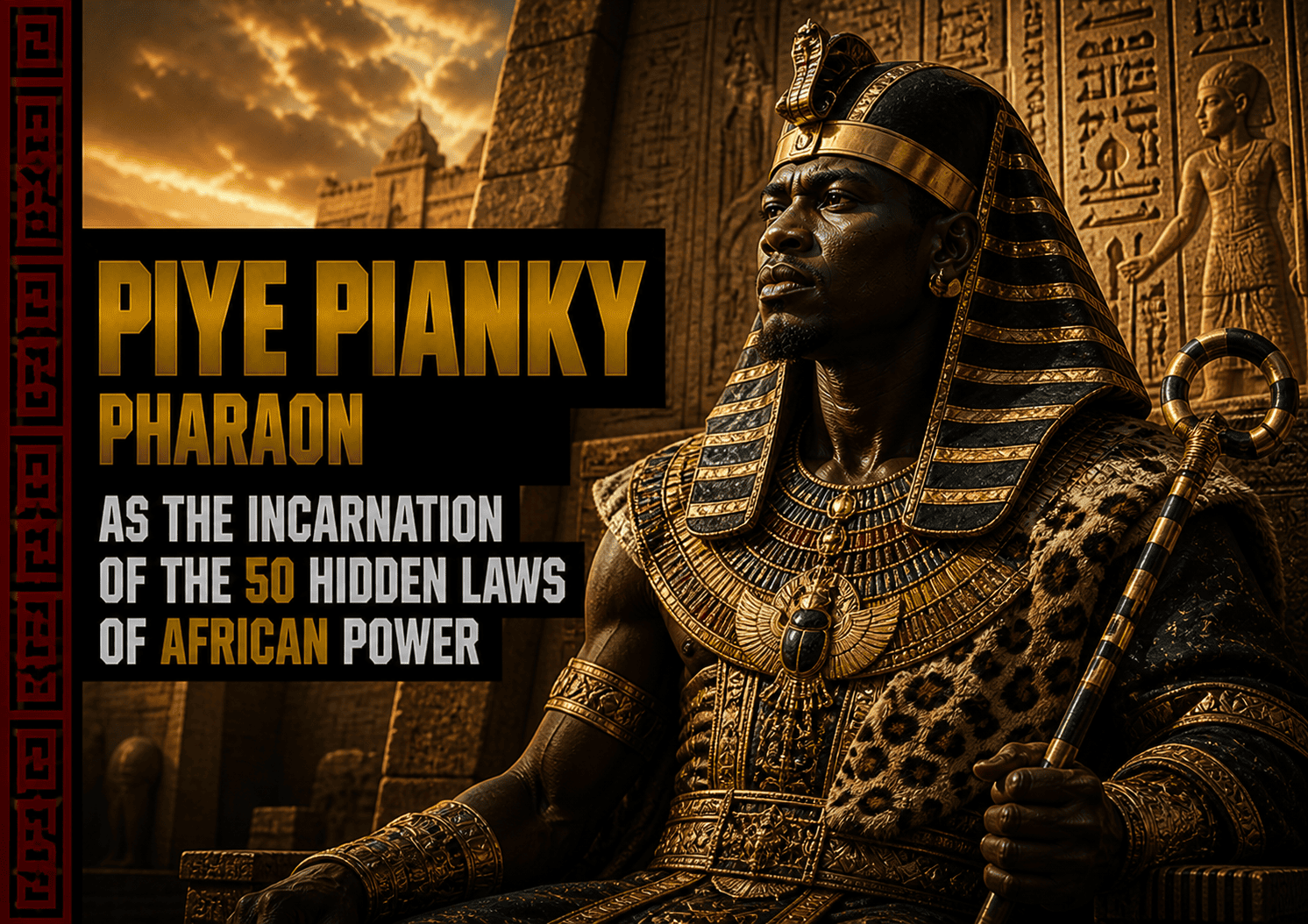
PIYE (PIANKHY) — EMBODIMENT OF THE 50 HIDDEN LAWS OF AFRICAN POWER
Through conquest, piety and restoration, the Kushite pharaoh united the Nile Valley and founded Egypt’s 25th Dynasty.
I. HISTORICAL AND CIVILIZATIONAL CONTEXT
⭐ Who was Piye (Piankhy)? Piye (also known as Piankhy) was a Kushite king who ruled the Kingdom of Kush (Napata) from approximately 744‑714 BCE. He is best known for conquering Egypt and founding the 25th Dynasty, also called the “Black Pharaohs” dynasty. He restored Egyptian temples and presented himself as a devout follower of Amun.
Kush and Egypt in the 8th Century BCE
The Kingdom of Kush, centred at Napata (near present‑day Karima, Sudan), had for centuries been culturally Egyptianised. The Kushites worshipped Egyptian gods, built pyramids and wrote in hieroglyphs. Meanwhile, Egypt was divided and weakened by competing Libyan‑ruled dynasties (22nd‑24th dynasties) and petty kings. Piye saw an opportunity to restore the traditional order under a pious and powerful ruler.
❓ What does the name “Piye” mean? “Piye” is the Kushite name of the pharaoh; “Piankhy” (or Piankhi) is a variant transcription from Egyptian and Assyrian sources. It translates roughly as “the one who belongs to the god” or “the living one”.
The Spiritual and Political Context
Piye was a deeply religious king, devoted to the god Amun of Thebes. He believed it was his divine duty to restore the purity of Egyptian cults, which had been neglected by the squabbling Delta princes. His victory stela (the “Victory Stela” or “Piye’s Victory Stele”) portrays him as a pious conqueror who spared those who surrendered and submitted to his authority, respecting the temple precincts. This fusion of military power and religious legitimation became the hallmark of the 25th Dynasty.
🔗 CONNECTION TO THE 50 HIDDEN LAWS OF AFRICAN POWER
→ Law #1: Master Cosmic Balance (piety and conquest)
Points of convergence:
• Piye balanced military expansion with religious restoration – he conquered Egypt to purify its temples.
• He respected Amun’s authority even over his own army, forbidding attacks on surrendering foes during holy days.
• Modern application: African leaders must justify expansion through moral and spiritual narratives – conquest in the name of order.
• Strategic lesson: Enduring power comes from uniting sword and spirit – Piye’s piety legitimated his empire.
II. ORIGINS AND SOCIAL ASCENSION
❓ How did Piye become king of Kush? Piye succeeded his father Kashta, who had already extended Kushite influence into Upper Egypt (Thebes). Piye was a skilled military leader and a devout follower of Amun. After consolidating Kush, he launched a campaign northward to subdue the fragmented Egyptian rulers, culminating in his conquest of the Nile Delta.
Birth and Family
Piye was born around 750 BCE into the Napatan royal family. His father, Kashta, was the first Kushite king to expand into Thebes, installing his daughter Amenirdis I as God’s Wife of Amun. His mother was Queen Pebatjma. Piye had several sons, including Shabaka (who succeeded him as pharaoh), Shabataka, and Taharqa (future great pharaoh). The family cultivated both Nubian and Egyptian identities.
Education and Military Training
Piye received a typical Kushite royal education: archery (the Kushites were famed archers), chariotry, religious instruction in the Amun cult, reading and writing hieroglyphs, and administration. He also learned the art of siege warfare and riverine tactics along the Nile.
The Rise: Campaign to Unify Egypt (c. 727‑720 BCE)
When the Egyptian prince Tefnakht of Sais formed a coalition in the Delta to resist Kushite influence, Piye marched north. He captured city after city, eventually besieging Memphis. The Victory Stela records that Piye showed mercy to those who opened their gates, but punished those who resisted. Tefnakht fled and later submitted. Piye returned to Napata, leaving local rulers as governors but ensuring loyalty through oaths and hostages.
🔗 CONNECTION TO THE LAWS OF AFRICAN POWER
→ Law #3: “Transform Knowledge into Power”
Points of convergence:
• Piye used his knowledge of Egyptian politics (fragmented dynasties) and religious sentiment to present himself as a liberator.
• He mastered siege warfare, using the Nile fleet and psychological warfare to force surrenders.
• Modern application: African leaders must understand the internal divisions of rival powers to exploit them effectively.
• Strategic lesson: Knowledge of the enemy’s religious and cultural weaknesses can be more powerful than sheer force.
III. TITLES AND FUNCTIONS
❓ What titles did Piye hold? Piye held traditional Egyptian pharaonic titles: “King of Upper and Lower Egypt”, “Son of Ra”, “Lord of the Two Lands”. He was also “Beloved of Amun” and “Ruler of Kush”. His Horus name was “Strong Bull, Appearing in Thebes”.
- King of Upper and Lower Egypt – full pharaonic title.
- Son of Ra (Usimare).
- Beloved of Amun – emphasized his piety.
- Ruler of Kush – maintained Nubian identity.
- Restorer of the Gods’ Shrines – after his conquest.
🔗 CONNECTION TO THE LAWS OF AFRICAN POWER
→ Law #12: “Become Indispensable to Power”
Points of convergence:
• Piye became indispensable as the only ruler able to reunite Egypt and Kush under a legitimate pharaoh.
• He combined military authority, religious legitimacy, and administrative skill – irreplaceable.
• Modern application: African leaders must position themselves as the sole solution to national fragmentation – unity as indispensability.
• Strategic lesson: In a divided land, the unifier becomes indispensable – Piye seized that role.
IV. THE VICTORY STELA – A MONUMENT OF PIETY AND POWER
❓ What is Piye’s Victory Stela? The Victory Stela (found at Gebel Barkal, Napata) is a large granite slab inscribed with Piye’s account of his conquest of Egypt. It describes the campaign, his respect for Amun, and the submission of the Delta princes. It is one of the most important sources for Kushite history.
The stela, over six feet tall, recounts in hieroglyphs how Piye crossed the Nile, captured Hermopolis, and besieged Memphis. It emphasizes Piye’s piety: he refused to attack the city of Hermopolis on the first day of a religious festival. After the victory, he visited the temples of Thebes and gave offerings to Amun. The stela ends with the humiliated princes bowing before him. It is now in the Cairo Museum.
🔗 CONNECTION TO THE LAWS OF AFRICAN POWER
→ Law #15: “Build Monuments That Speak for You”
Points of convergence:
• The Victory Stela is a speaking monument – 2,700 years later, it still tells his story.
• Piye controlled the narrative by inscribing his version of events, omitting defeats and highlighting his piety.
• Modern application: African leaders must erect memorials, stelae (or digital archives) that proclaim their achievements.
• Strategic lesson: A carved stone outlives empires – Piye’s stela remains a primary historical source.
V. THE SIEGE OF MEMPHIS – A STRATEGIC TRIUMPH
Memphis, the traditional capital of Egypt, was heavily fortified. Piye’s forces cut water and food supplies, built siege ramps, and launched attacks from river boats. After a fierce assault, the city fell. Piye entered the temple of Ptah and made offerings, demonstrating his respect for Egyptian religion. He did not sack the city but punished only the leaders who had resisted. The victory sealed his control over Lower Egypt.
🔗 CONNECTION TO THE LAWS OF AFRICAN POWER
→ Law #8: “Master Cycles – Time as a Weapon”
Points of convergence:
• Piye chose the right moment to strike when the Delta princes were divided and unprepared for a Nile‑based invasion.
• He used the Nile flood cycles to move his fleet and isolate Memphis – temporal mastery of the environment.
• Modern application: African leaders must time their interventions to coincide with enemy weaknesses – patience and timing are weapons.
• Strategic lesson: Victory often depends on synchronising action with natural and political cycles – Piye understood this.
VI. RESTORING THE TEMPLES – A PIOUS CONQUEROR
After his conquest, Piye ordered the repair of temples that had been neglected or damaged during the civil wars. He restored the cult of Amun at Karnak and other shrines. He appointed his sister as God’s Wife of Amun, ensuring Kushite control over Thebes’ religious hierarchy. This combination of military conquest and religious patronage made the 25th Dynasty deeply popular in Upper Egypt.
🔗 CONNECTION TO THE LAWS OF AFRICAN POWER
→ Law #23: “Heal to Rule – The Power of the Healer”
Points of convergence:
• Piye “healed” Egypt by restoring temple rituals and ending the chaotic rule of minor kings – religious therapy.
• He used his piety to legitimise his foreign rule – the conqueror became a healer of sacred traditions.
• Modern application: African leaders must address the spiritual and cultural wounds of the people as part of their governance.
• Strategic lesson: Conquering without healing breeds resentment – Piye’s restorations won him allies.
VII. LEGACY – FOUNDER OF THE 25TH DYNASTY
Piye’s successors – Shabaka, Shabataka, and Taharqa – continued to rule Egypt and Kush, resisting Assyrian invasions. Piye himself returned to Napata after his campaign and was buried in a pyramid at El‑Kurru (Sudan). His reign demonstrated that African rulers from the south could govern Egypt legitimately. The 25th Dynasty became known as the “Black Pharaohs”, celebrated for their cultural renaissance and architectural achievements.
🔗 CONNECTION TO THE LAWS OF AFRICAN POWER
→ Law #42: “Create a Legacy That Multiplies Your Power”
Points of convergence:
• Piye founded a dynasty that lasted nearly a century – his power multiplied through his descendants.
• The 25th Dynasty’s cultural revival (archaic style in art, pyramid building) extended his influence.
• Modern application: African leaders must ensure that their institutions and successors amplify their work – dynastic thinking matters.
• Strategic lesson: A single conquest can seed a century of rule – Piye’s legacy outlived him.
VIII. PIYE IN MODERN MEMORY – THE BLACK PHARAOH REVIVED
For centuries, Piye was overshadowed by better‑known Egyptian pharaohs. However, the rediscovery of the Victory Stela in the 19th century and the rise of Pan‑Africanism rehabilitated him. He is now celebrated as a symbol of African power and unity. Exhibitions like “The Black Pharaohs” have popularised his story. Statues and references appear in Afrocentric literature and art.
🔗 CONNECTION TO THE LAWS OF AFRICAN POWER
→ Law #45: “Become a Symbol – When Your Name Becomes a Movement”
Points of convergence:
• “Piye” and “Piankhy” have become symbols of Black excellence and ancient African empire‑building.
• The 25th Dynasty is often cited in Afrocentric historiography as proof of African civilisational capability.
• Modern application: African leaders should aim for their name to be invoked as a symbol of unity and strength.
• Strategic lesson: A forgotten king can become an icon – historical rediscovery is a political act.
IX. SOURCES AND TESTIMONIES
❓ Where is Piye’s Victory Stela now? The Victory Stela is housed in the Egyptian Museum in Cairo (Cairo Museum). A replica is at the Jebel Barkal Museum in Karima, Sudan.
❓ Are there Assyrian records about Piye? Assyrian annals mention the 25th Dynasty kings (Shabaka, Taharqa) but not Piye himself, as his reign predates direct Assyrian conflict with Kush.
- Victory Stela of Piye – primary source (Cairo Museum).
- Biblical references – the 25th Dynasty may be connected to the “Ethiopian” kings mentioned in 2 Kings 19:9 and Isaiah 37:9.
- Kushite royal inscriptions at Jebel Barkal.
- Archaeological evidence – pyramids at El‑Kurru, temple restorations.
- Modern scholarship – works by Timothy Kendall, Robert Morkot, László Török.
🔗 CONNECTION TO THE LAWS OF AFRICAN POWER
→ Law #28: “Control Your Narrative – History Belongs to the One Who Writes It”
Points of convergence:
• Piye had his own monumental stela inscribed – he controlled his official narrative.
• Later Egyptian and Assyrian sources downplayed his role, but archaeology has restored his legacy.
• Modern application: African leaders must inscribe their own histories – monuments, archives, and digital records are the stelae of today.
• Strategic lesson: Even if enemies erase you, a buried stela can resurrect your glory – Piye’s stela was reburied and rediscovered.
X. MYSTERIES AND UNSOLVED QUESTIONS
❓ Where is Piye’s tomb? Piye was buried in a pyramid at El‑Kurru, Sudan (tomb Ku. 5). The pyramid is modest, but the burial chamber contained grave goods and inscriptions.
❓ Why did Piye return to Napata instead of ruling from Egypt? He preferred to remain in Kush, perhaps to consolidate his homeland or because he considered Napata the spiritual centre. Later Kushite pharaohs (Shabaka, Taharqa) moved the capital to Thebes and Memphis.
❓ What happened to the Egyptian princes after Piye’s conquest? The Victory Stela records that Piye allowed the defeated rulers to keep their thrones after swearing allegiance, but some were flogged or humiliated. He left a Kushite garrison at Memphis.
🔗 CONNECTION TO THE LAWS OF AFRICAN POWER
→ Law #37: “Cultivate Mystery – What Is Hidden Fascinates”
Points of convergence:
• The location of his tomb is known, but many details of his reign remain obscure – mystery keeps scholars interested.
• His decision to return to Napata rather than stay in Egypt creates debate – ambiguity fuels interpretation.
• Modern application: Leaders may leave certain strategical choices unexplained – mystery enhances legend.
• Strategic lesson: Not every gesture needs a public reason – Piye’s withdrawal to Napata still puzzles historians, keeping his name alive.
XI. FAQ – FREQUENTLY ASKED QUESTIONS ABOUT PIYE
❓ Was Piye the first Black Pharaoh? Piye was not the first ruler of African origin (Nubian/Kushite) to influence Egypt, but he was the first to conquer Egypt and found a full dynasty. Hence, he is often called the first of the “Black Pharaohs” of the 25th Dynasty.
❓ How tall was Piye? No direct evidence; the Victory Stela depicts him in idealised proportions. Mummies of the 25th Dynasty are not well preserved for stature estimation.
❓ What language did Piye speak? He spoke a Nubian (Cushitic) language at court, but he wrote in Egyptian hieroglyphs for official inscriptions, as was the Kushite tradition.
❓ Are there statues of Piye? Yes, several statues of Piye have been found, notably one from Kawa (now in the British Museum) and fragments from Jebel Barkal.
XII. LESSONS AND CONTEMPORARY RELEVANCE
💡 What can modern Africa learn from Piye? Piye teaches that religious legitimacy, strategic patience, and cultural synthesis can allow peripheral powers to rise and dominate. He shows that military conquest must be followed by restoration and respect for local traditions to ensure lasting rule.
Religious legitimation matters: Piye used piety to justify his conquest – African leaders should ground their authority in values that resonate with their people.
Uniting divided forces: He exploited the fragmentation of the Delta princes – divide and conquer still works.
Respect the conquered culture: He restored Egyptian temples rather than destroying them – assimilation beats oppression.
Leave a record: The Victory Stela is one of the greatest historical documents from Africa – leaders must document their achievements.
🔗 CONNECTION TO THE LAWS OF AFRICAN POWER
→ Law #5: “Master Multiple Domains – The Power of the Renaissance”
Points of convergence:
• Piye was simultaneously general, priest, administrator, builder – a polymath of statecraft.
• He combined Nubian and Egyptian identities – transcultural leadership.
• Modern application: African leaders must be versatile – military, religious, economic, and cultural leadership are all needed.
• Strategic lesson: The African renaissance requires leaders who can bridge cultures and epochs – Piye exemplifies this.
CONCLUSION: IMMORTALITY THROUGH THE VICTORY STELA
Piye (Piankhy) remains, more than 2,700 years after his conquest, a towering figure of ancient African power. His journey – Kushite king, pious conqueror, founder of the 25th Dynasty – testifies to the strength of strategic patience, religious devotion, and cultural synthesis. He proved that a ruler from the African interior could unite the Nile Valley and restore its ancient glories.
For contemporary Africa and its diaspora, Piye represents the unifier who healed a divided land and respected its traditions. His Victory Stela, rediscovered in the 19th century, reminds us that history belongs to those who inscribe it. May every African leader produce a “Victory Stela” – a monument, a law, a legacy – that speaks across centuries.
🔗 SYNTHESIS: PIYE (PIANKHY) AS THE EMBODIMENT OF THE HIDDEN LAWS OF AFRICAN POWER
📜 Summary of the laws embodied by Piye: Balance (#1), Knowledge as Power (#3), Polymathy (#5), Control of Time (#8), Indispensability (#12), Monuments (#15), Healing (#23), Narrative Control (#28), Mystery (#37), Multiplicative Legacy (#42), Symbol (#45), Immortality (#50).
- Law #1 (Balance) – Piety and conquest, mercy and severity, tradition and innovation.
- Law #3 (Knowledge as Power) – Understanding Egyptian politics, religion, and siege tactics.
- Law #5 (Polymathy) – General, priest, administrator, builder – complete leader.
- Law #8 (Control of Time) – Timing the invasion, using Nile floods, patience in siege.
- Law #12 (Indispensability) – Only one able to reunite Egypt and Kush – focal point.
- Law #15 (Monuments) – Victory Stela, pyramids at El‑Kurru – speaking stones.
- Law #23 (Heal to Rule) – Restoring temples, ending civil strife – religious therapy.
- Law #28 (Control of Narrative) – Inscribing his own version of history.
- Law #37 (Mystery) – Reasons for returning to Napata, hazy chronology – fertile mystery.
- Law #42 (Multiplicative Legacy) – The 25th Dynasty, modern Pan‑African revival – active legacy.
- Law #45 (Symbol) – “Black Pharaoh”, African unifier – living concept.
- Law #50 (Immortality) – Victory Stela still read, pyramids still stand – eternal presence.
Practical Application for the Modern Leader:
✅ Legitimise conquest with moral and spiritual purpose – conquer as a restorer, not a destroyer
✅ Respect the culture of the conquered – temples preserved win hearts
✅ Inscribe your achievements – a monument outlives a lifetime
✅ Unite divided forces by offering a common cause – Piye’s piety appealed to all Egyptians
✅ Prepare a dynasty – train successors to multiply your power
The Piye Challenge for You:
“What divided nation or organisation will you reunite? What ‘Victory Stela’ will you leave to history? How will you combine piety and politics to rule legitimately?”