Through long-term vision, relentless meritocracy, and transforming constraints into advantages, the architect of Singapore has illustrated the African Laws of Power.
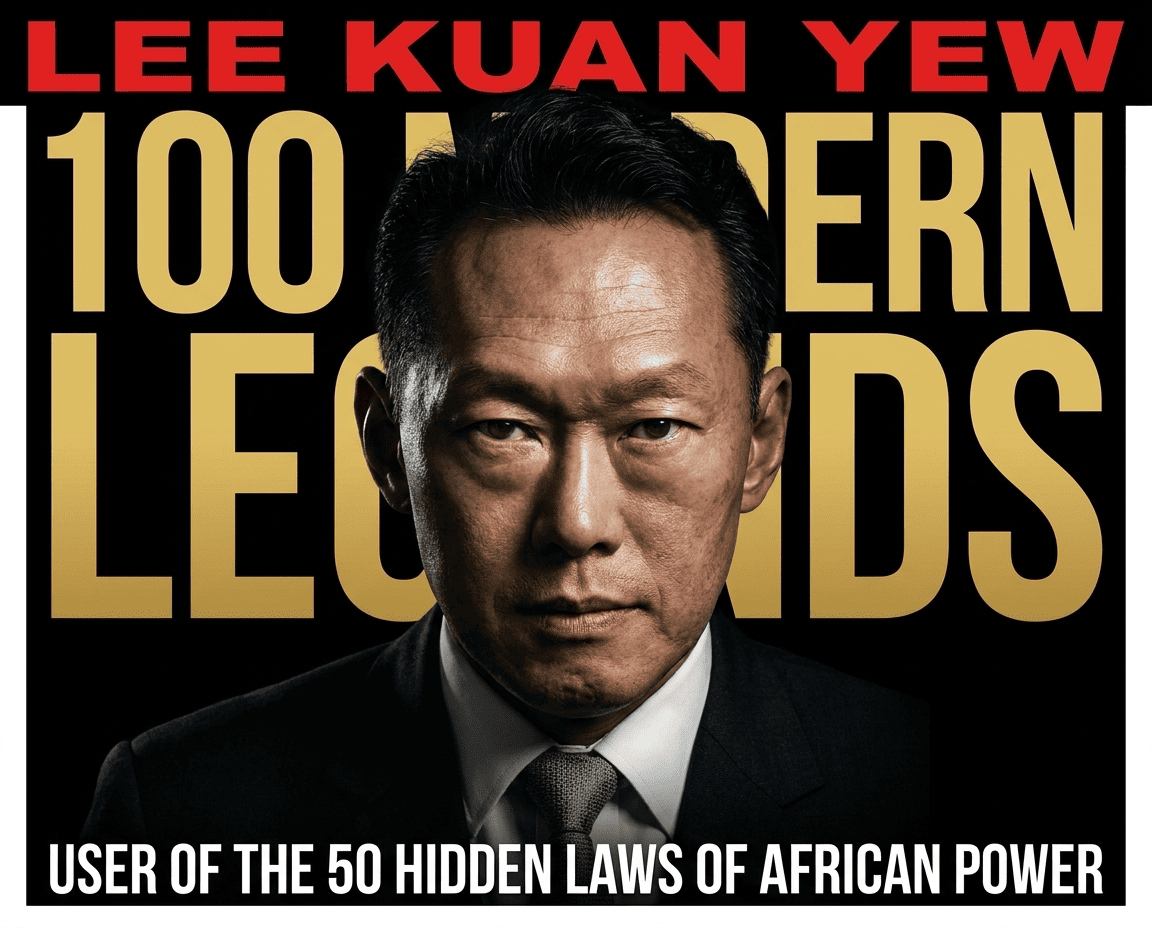
⭐ Who is Lee Kuan Yew? Lee Kuan Yew (1923-2015) was the first Prime Minister of Singapore (1959-1990). Architect of Singapore's transformation from a resource-less island into a global economic power, he embodied rigor, meritocracy, and long-term vision. Considered one of the greatest political strategists of the 20th century.
Lee Kuan Yew emerged in a post-colonial context marked by regional instability, absence of natural resources, and the geopolitical vulnerability of a 700 km² city-state. Coming from a modest family, he transformed every constraint into a strategic lever, transcending physical limits to build a power founded on human capital, governance, and innovation.
❓ What has been Lee Kuan Yew's impact on global development? Lee Kuan Yew demonstrated that a resource-less country can prosper through institutional rigor, meritocracy, and long-term vision. His model inspires African and Asian leaders. He illustrates Law 45: "Become a Symbol" by becoming a global reference for effective governance.
Lee Kuan Yew draws from Confucian traditions: the importance of education, respect for earned authority, and collective responsibility. His journey resonates with the principles of the African Laws of Power: transforming vulnerability into excellence, discipline into prosperity, and creating a legacy that inspires beyond generations.
Points of convergence:
• Lee Kuan Yew became more than a leader; he is the living symbol of transformation through rigor, prosperity through meritocracy, and sovereignty through strategy.
• His name and model have the power to inspire leaders worldwide to dare long-term vision.
• Modern application: Leaders must embody universal values to acquire influence that transcends borders.
• Strategic lesson: Universal symbolic power is born from alignment between personal rigor and collective transformation.
❓ How did Lee Kuan Yew build modern Singapore? Born under British colonization, Lee transformed his experience of Japanese occupation and anti-colonial struggle into a vision of national sovereignty. From the bar to politics, from independence to prosperity, he forged his legend through action, illustrating Law 2: "Forge Your Legend Through Deeds".
Lee Kuan Yew was born on September 16, 1923, in Singapore, then a British colony. He lived through the Japanese occupation (1942-1945), a traumatic experience that forged his conviction: only strength and competence protect a nation. He studied law at Cambridge, returned to Singapore in 1950. Academic excellence forged his intellectual legitimacy.
In 1954, Lee co-founded the People's Action Party (PAP). In 1959, Singapore gained internal self-government; Lee became Prime Minister. In 1963, he negotiated integration with Malaysia. But in 1965, Singapore was expelled. Lee wept on television: "For me, it is a moment of anguish". But he transformed this expulsion into a strategic opportunity.
From 1965 to 1990, Lee transformed Singapore: relentless anti-corruption, excellence in education, attractiveness for foreign investment, infrastructure development. GDP per capita rose from $1,000 to over $12,000. In 1990, he voluntarily ceded power, establishing a precedent for democratic transition. The legend was set in motion.
Points of convergence:
• Lee did not speak of his greatness; he proved it through economic transformation, anti-corruption struggle, voluntary power transition.
• Every reform, every result was tangible proof consolidating his emerging legitimacy.
• Modern application: Do not promise; accomplish. Your results build your legend more than your words.
• Strategic lesson: Reputation is forged through repeated proof of rigor and results.
❓ How did Lee Kuan Yew master his influence? Lee controlled every aspect of his communication: direct speeches, measured appearances, symbols of rigor. He illustrates Law 7: "Become a Master of the Theater of Power" through his narrative and symbolic mastery.
Lee understood early that image is as important as policy. He created recognizable visuals: the immaculate white suit, upright posture, direct gaze. Every element was designed to communicate integrity, competence, and determination.
Lee does not submit to the narrative; he directs it. Through his UN speeches, published memoirs, and international conferences, he controls the narrative of the "Singapore model". He transforms every criticism into an opportunity to demonstrate the coherence of his vision: "Survival demands excellence".
Points of convergence:
• Lee understood that authority is also played on a carefully orchestrated stage: speeches, postures, symbols.
• Every detail of his public persona communicated a message of power and integrity.
• Modern application: Master your communication, your frame, your narrative. Perception is reality.
• Strategic lesson: The theater of power is not duplicity; it is the art of making your inner strength visible.
❓ How did Lee Kuan Yew transform Singapore? Lee transformed the absence of natural resources into a competitive advantage through investment in human capital, anti-corruption struggle, and attractiveness for foreign investment. He illustrates Law 10: "Transform Iron into Gold" — turning constraint into opportunity.
Unlike a populist approach, Lee chose strict meritocracy: the best talents lead, public sector salaries aligned with private sector, corruption punished without mercy. This institutional rigor creates an environment of trust that attracts global investors.
Lee invested massively in education: excellence schools, technical training, overseas scholarships. This was development with a mission of systemic transformation. His vision: "Our only resource is our people".
Points of convergence:
• Lee transformed the absence of resources ("iron") into global economic power ("gold").
• He created institutional value where others saw only limits.
• Modern application: Do not submit to constraint; transform it into an opportunity for excellence.
• Strategic lesson: Institutional innovation transforms vulnerability into competitive advantage; value is created, not merely endured.
❓ What was the most strategic moment for Lee Kuan Yew? Singapore's expulsion from Malaysia on August 9, 1965. Facing this forced separation, Lee transformed an existential crisis into an opportunity for total sovereignty, illustrating Law 24: "Exile is a Waiting Room, Not a Tomb".
In 1965, Singapore was expelled from Malaysia. Without hinterland, without resources, without significant military, survival seemed improbable. The challenge was twofold: ensure physical security, and create economic prosperity that legitimized independence.
Lee did not deny vulnerability; he used it as fuel. "If we are not excellent, we will die". He attracted multinationals through stability, competence, and absence of corruption. The expulsion was not defeat; it was strategic liberation.
In 25 years, Singapore became one of the world's most prosperous countries. The 1965 expulsion, instead of destroying it, forged the nation's determination. The crisis was a waiting room; prosperity, an eternal manifesto.
Points of convergence:
• Lee used the expulsion as a period of maturation and consolidation of Singaporean sovereignty.
• He let his idea of a competence-based nation grow until circumstances became favorable.
• Modern application: A setback, a sidelining, an apparent failure can become periods of strategic preparation.
• Strategic lesson: Forced distance is not an end; it is incubation for a more powerful return.
Lee passed away on March 23, 2015, in Singapore at age 91, but his legend is immortal. He transformed the perception of development. His model inspires leaders worldwide. His "political sons" lead Singapore with continuity. He has become an "ancestor while alive".
Points of convergence:
• Lee became a mythical reference while alive, a guide for future generations of leaders.
• His influence continues to shape governance, economic development, and institutional meritocracy.
• Modern application: Share your wisdom, create a legacy that transcends your physical presence.
• Strategic lesson: Ultimate power is becoming a timeless reference, a guide for future generations.
💡 What can a leader learn from Lee Kuan Yew? Lee teaches long-term vision, strict meritocracy, relentless anti-corruption, and inspiring globally through consistency. Modern leaders must aim for transformative impact and sustainability.
Lesson 1: Institutional rigor creates prosperity
Lee does not seek popularity; he seeks effectiveness. He proves that meritocracy and integrity create trust, which attracts investment. Apply this standard to your leadership: rigor creates credibility.
Lesson 2: Transform vulnerability into competitive advantage
Lee did not deny resource absence; he transformed it into motivation for excellence. In your journey, every constraint is material for building your unique advantage.
Lesson 3: Create a legacy that transcends your presence
Lee built institutions, trained successors, and left a standard of governance that outlives his death. Build now the legacy you will leave.
Points of convergence:
• Lee does not preach integrity; he lives it through his refusal of corruption, personal discipline, and transparency.
• His authenticity is consistent between words and actions.
• Modern application: Moral authority is born from alignment between words and deeds.
• Strategic lesson: Sustainable leadership is founded on exemplarity; live the values you preach.
❓ How did Lee Kuan Yew transform Singapore? Lee Kuan Yew transformed Singapore through relentless anti-corruption struggle, massive investment in education, attractiveness for foreign investment, and long-term vision. GDP per capita rose from $1,000 in 1965 to over $60,000 today.
❓ What is Lee Kuan Yew's legacy? Lee Kuan Yew created a governance model based on meritocracy, integrity, and long-term vision. His legacy inspires African and Asian leaders. He demonstrated that a resource-less country can prosper through institutional excellence.
❓ How does Lee Kuan Yew inspire African leaders? Lee Kuan Yew inspires African leaders through his demonstration that institutional rigor, anti-corruption struggle, and investment in human capital can transform a nation. Leaders like Paul Kagame and Ngozi Okonjo-Iweala cite his influence.
❓ Is Lee Kuan Yew still influential today? Yes, Lee Kuan Yew remains a global reference for effective governance. The "Singapore model" is studied by leaders worldwide. He remains a timeless voice for meritocracy, integrity, and long-term vision.
Lee Kuan Yew remains, more than half a century after his accession to power, one of the most influential figures in global governance. His journey — from Japanese occupation to independence, from expulsion from Malaysia to global prosperity, from vulnerability to excellence — testifies to the power of long-term vision, institutional rigor, and creating an immortal legacy. He did not just build a nation; he built a model.
For contemporary leaders, Lee Kuan Yew represents non-negotiable vision, control of one's destiny, and the ability to transform an individual constraint into a movement of systemic transformation. His life teaches that lasting power is born from alignment between values, words, and actions. His name, Lee Kuan Yew, resonates as a challenge: may every leader become architect of their own excellence, building even in the heart of adversity.
📜 Summary of African power laws embodied by Lee Kuan Yew: Legend through deeds (#2), Resilience against limits (#5), Transforming iron into gold (#10), Creative exile (#24), Living as one teaches (#30), Universal symbol (#45), Immortal legacy (#50).
✅ Transform every constraint into motivation for excellence
✅ Place meritocracy and integrity at the heart of your governance
✅ Invest massively in human capital
✅ Think in decades, not electoral cycles
✅ Remain authentic to your vision of transformation
"What is your constraint to transform? How will you build a system of excellence that inspires your community?"
📚 Deepen with the Africa & Power Series