Chinua Achebe
#2, #7, #15, #30, #40, #50
Chinua Achebe
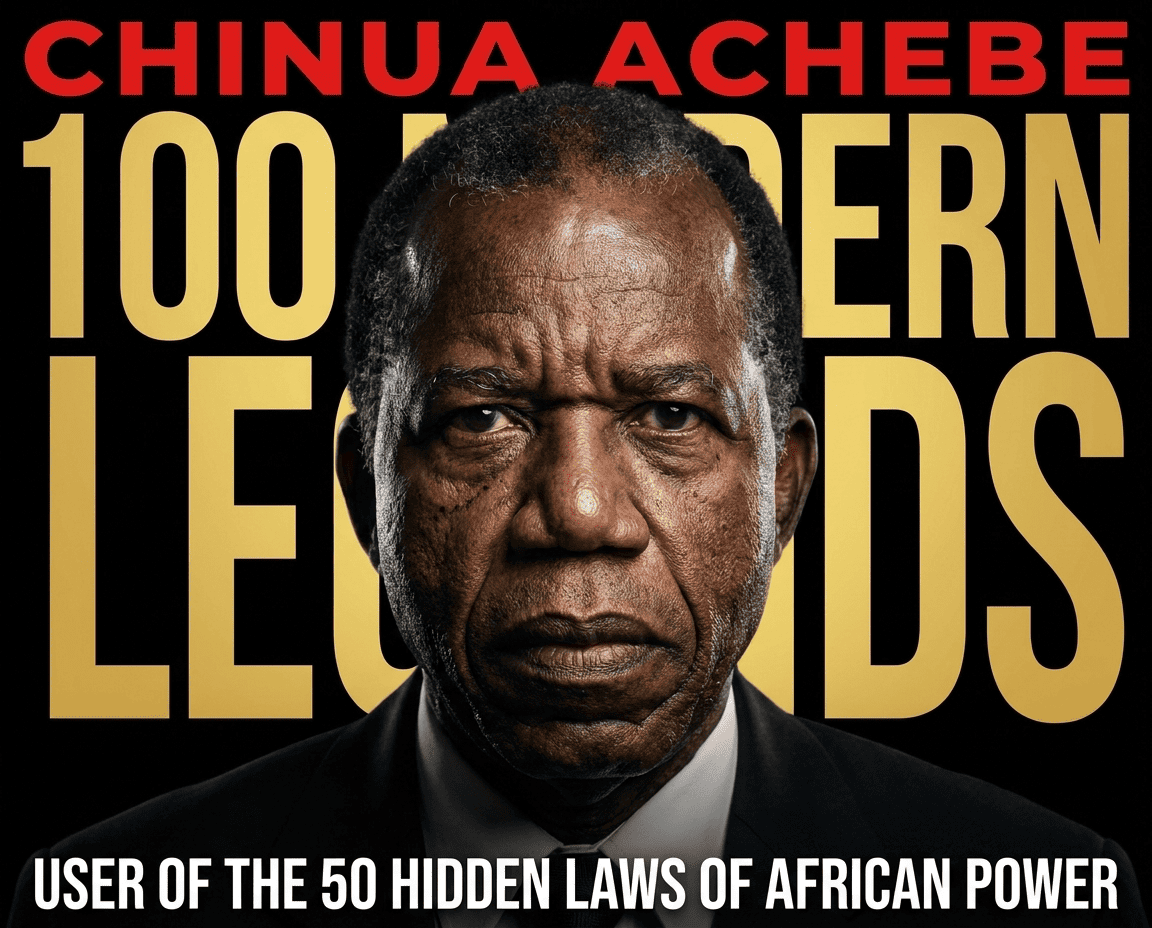
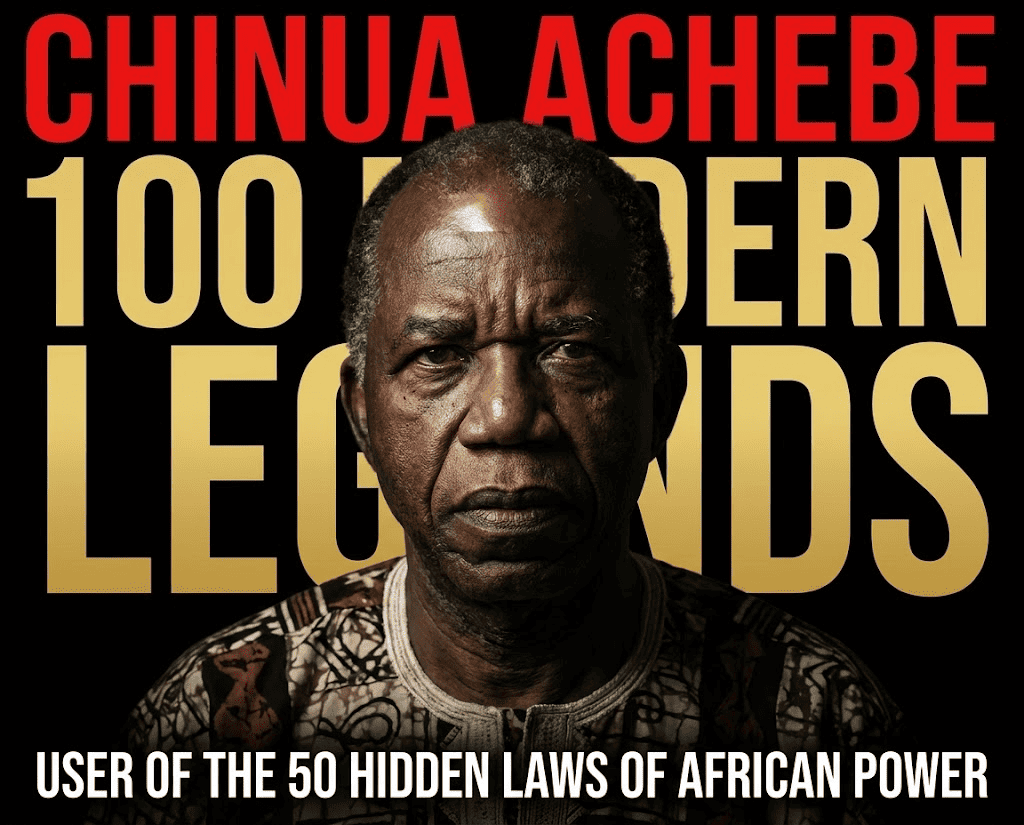
Chinua Achebe is a Nigerian writer who revolutionized African literature by reclaiming the African narrative from colonial distortion. Through his masterpiece "Things Fall Apart" (1958), he demonstrated that Africa had a complex, dignified history before colonization, fundamentally transforming how the world understood Africa and inspiring generations of African writers to tell their own stories.
The Power of Narrative Reclamation
Chinua Achebe's genius lies in understanding one of the most fundamental laws of power: whoever controls the narrative controls reality. For centuries, Africa had been portrayed through the lens of Western colonizers—as a primitive, chaotic continent in need of "civilization." Achebe recognized this narrative trap and made it his life's mission to reclaim the African story.
"Until the lion learns to write, every story will glorify the hunter. It is the story that makes the difference between our suffering and our heroism."
This quote encapsulates Achebe's entire philosophy. He understood that power is not merely military or political—it is narrative. By writing in English (the colonizer's language) but telling African stories, Achebe performed an act of strategic brilliance: he used the master's tools to dismantle the master's house.
Complete Biography: From Ogidi to Global Icon
Early Life & Formation (1930-1948)
Albert Chinualumogu Achebe was born on November 16, 1930, in Ogidi, a village in southeastern Nigeria. His father, Isaiah Okafor Achebe, was one of the first converts to Christianity in the region, while his mother, Janet Anaenechi Ogbanje, came from a respected family. This bicultural background—caught between traditional Igbo culture and Christian missionary influence—would profoundly shape Achebe's worldview and literary vision.
Growing up in colonial Nigeria, young Achebe witnessed the collision of two worlds. The British colonial administration was systematically dismantling traditional African governance structures, replacing them with colonial bureaucracy. In schools run by Christian missionaries, Achebe was taught that African culture was "primitive" and that European civilization was the pinnacle of human achievement. This cognitive dissonance—knowing the richness of his own culture while being told it was worthless—became the driving force behind his literary career.
Achebe was an exceptional student. He attended Government College in Umuahia (1944-1947), one of the most prestigious schools in colonial Nigeria, where he excelled in English literature. His teachers recognized his exceptional talent for writing and encouraged him to pursue further education. In 1948, he enrolled at University College, Ibadan, where he studied English, History, and Theology.
University Years & Intellectual Awakening (1948-1953)
At Ibadan, Achebe underwent a profound intellectual transformation. He was exposed to world literature, critical thinking, and most importantly, he began to articulate his critique of colonial narratives. He read works by European authors who had written about Africa—Joseph Conrad's "Heart of Darkness," for instance—and was appalled by their distorted, dehumanizing portrayals of African people.
During these years, Achebe made a conscious decision: he would become a writer, but not to imitate European literature. Instead, he would write authentically African stories that would challenge colonial narratives and restore African dignity. This was not merely a literary ambition—it was a strategic act of cultural warfare.
Early Career & Broadcasting (1953-1957)
After graduating in 1953, Achebe joined the Nigerian Broadcasting Corporation (NBC) as a Talks Producer. This position, while seemingly modest, was strategically important. The NBC was a platform with significant reach across Nigeria, and Achebe used it to promote African culture and challenge colonial narratives. He produced programs celebrating African music, history, and literature, subtly working to reshape how Nigerians understood their own heritage.
During these years, Achebe was also writing. He worked on his first novel, "Things Fall Apart," which he completed in 1956. The manuscript was rejected by several publishers who believed there was no market for a novel about pre-colonial Africa written from an African perspective. However, in 1957, William Heinemann African Writers Series accepted the manuscript, recognizing its revolutionary potential.
The Publication of "Things Fall Apart" (1958) - The Turning Point
"Things Fall Apart" was published on June 17, 1958, and it immediately changed the landscape of world literature. The novel tells the story of Okonkwo, a respected warrior in the Igbo community, and his tragic encounter with British colonization. What made the novel revolutionary was not just its subject matter, but its perspective: it presented pre-colonial African society as complex, dignified, and fully human.
The novel's opening line—"Okonkwo was a man of action, a man of war"—immediately establishes the protagonist as a figure of dignity and agency, not as the primitive savage that European literature had portrayed. Through Okonkwo's story, Achebe showed that African societies had sophisticated systems of governance, justice, art, and philosophy. The tragedy of colonization was not the "civilizing" of Africa, but the destruction of a complex civilization.
The book was an immediate critical success. It won the Margaret Wrong Memorial Prize in 1959 and was translated into numerous languages. By the 1960s, it had become required reading in schools and universities across Africa, Europe, and North America. More importantly, it gave African writers permission to tell their own stories in their own voices.
The Trilogy & Consolidation of Literary Power (1960-1966)
Following the success of "Things Fall Apart," Achebe published two sequels: "No Longer at Ease" (1960) and "Arrow of God" (1964). Together, these three novels formed a comprehensive narrative arc spanning pre-colonial times through post-independence Nigeria. Each novel deepened his analysis of colonization and its aftermath.
"No Longer at Ease" follows Okonkwo's grandson, Obi Okonkwo, a Western-educated Nigerian struggling to navigate the corruption and moral compromises of post-colonial Nigeria. This novel was crucial because it demonstrated that colonization's damage was not merely historical—it was ongoing, embedded in the psychology and institutions of post-colonial Africa.
"Arrow of God" returns to pre-colonial times, presenting an even more complex portrait of Igbo society. The protagonist, Ezeulu, is a priest caught between traditional religion and Christianity, between community loyalty and personal ambition. The novel shows that African societies were not static or simple—they were dynamic, with internal conflicts and moral complexities.
Political Engagement & Civil War (1966-1970)
In 1966, Nigeria descended into political chaos following a military coup. Achebe, as a prominent Igbo intellectual, became increasingly involved in political activism. When the Biafran War erupted in 1967 (a civil war between the Nigerian federal government and the breakaway state of Biafra), Achebe became an outspoken advocate for Biafran independence.
This was a critical moment in Achebe's life. He was not merely a writer—he was a political actor. He traveled internationally to advocate for Biafra, giving speeches and writing essays. When Biafra was defeated in 1970, Achebe's advocacy had cost him dearly. He was seen as a separatist by the Nigerian government, and his literary career was temporarily sidelined.
Exile & International Prominence (1970-1990)
After the Biafran War, Achebe spent much of the 1970s and 1980s in exile, teaching at universities in the United States and Europe. This period, while painful, allowed him to consolidate his international reputation. He taught at universities including the University of Massachusetts and Cornell University, where he influenced a generation of American and European students to understand African literature and history differently.
During this period, Achebe also published "A Man of the People" (1966), a satirical novel about post-colonial corruption, and numerous essays and short stories. His essay collection "Morning Yet on Creation Day" (1975) became essential reading for understanding African literature and the politics of representation.
Return to Nigeria & Elder Statesman (1990-2013)
In 1990, Achebe returned to Nigeria and was appointed to a professorship at the University of Nigeria, Nsukka. By this time, he was recognized as one of the greatest writers of the 20th century. His influence on African literature was immeasurable—virtually every major African writer who came after him acknowledged his pioneering role.
In 1994, Achebe suffered a stroke that partially paralyzed him, but he continued to write and speak. His final novel, "Anthills of the Savannah" (1987), won the Booker Prize and was widely recognized as a masterpiece. His later essays, collected in "Home and Exile" (2000), offered reflections on his life, his role as a writer, and the ongoing challenges facing Africa.
Achebe died on March 21, 2013, at the age of 82. His death was mourned globally as the loss of one of the greatest writers and thinkers of the modern era. The New York Times called him "the godfather of African literature," and tributes poured in from writers, intellectuals, and political leaders worldwide.
Timeline of Chinua Achebe's Life & Legacy
Achebe's Major Works: A Comparative Analysis
| Work | Year | Setting | Protagonist | Central Theme |
|---|---|---|---|---|
| Things Fall Apart | 1958 | Pre-colonial & colonial Igbo society | Okonkwo (warrior) | Tragedy of colonization & loss of traditional power |
| No Longer at Ease | 1960 | Post-colonial Lagos | Obi Okonkwo (grandson) | Corruption & moral compromise in post-colonial Nigeria |
| Arrow of God | 1964 | Pre-colonial & early colonial Igbo society | Ezeulu (priest) | Conflict between tradition & modernity, religion & politics |
| A Man of the People | 1966 | Post-colonial Nigeria | Odili Samalu (teacher) | Political corruption & satirical critique of post-colonial leadership |
| Anthills of the Savannah | 1987 | Fictional African nation | Multiple perspectives | Power, friendship, & the possibility of democratic transformation |
The Six Laws of Power Embodied by Chinua Achebe
Law #2: Forge Your Legend Through Your Deeds
The Strategic Narrative
Achebe understood that power is built through narrative. He didn't merely write novels—he forged a legend as the writer who reclaimed African dignity. Every book, every essay, every public appearance was a deliberate act of legend-building. He transformed himself from a colonial subject into a global intellectual authority.
Application: Achebe used his deeds (writing revolutionary novels) to forge a legend (the godfather of African literature). This legend gave him immense soft power—the ability to influence how the world understood Africa.
Law #7: Master of the Theater of Knowledge
The Performance of Intellectualism
Achebe was a master of intellectual performance. He understood that being a writer wasn't just about writing books—it was about performing the role of the intellectual on the global stage. His lectures, essays, and public appearances were carefully choreographed performances designed to establish his authority and influence.
Application: By teaching at prestigious universities, publishing in major journals, and giving keynote speeches at international conferences, Achebe performed the role of the global intellectual, thereby becoming one.
Law #15: Crush Your Enemies Completely
The Demolition of Colonial Narratives
Achebe's approach to his enemies (colonial narratives, Western distortions of Africa) was total and uncompromising. He didn't merely critique colonial literature—he demolished it. "Things Fall Apart" was a direct refutation of Joseph Conrad's "Heart of Darkness." By presenting a counter-narrative so powerful that it became the dominant narrative, Achebe crushed the colonial interpretation of Africa.
Application: Rather than engaging in debate with colonial narratives, Achebe simply replaced them with a superior narrative. This is the ultimate victory—not winning an argument, but making the argument irrelevant.
Law #30: Live as You Teach
The Alignment of Life and Principles
Achebe was not merely an intellectual—he was a moral actor. He lived according to his principles. When Biafra was threatened, he didn't merely write about it; he risked his career and safety to advocate for it. His life was a living embodiment of his beliefs about African dignity and self-determination.
Application: Achebe's willingness to sacrifice for his principles gave his words immense credibility. He couldn't be dismissed as a mere theorist because he had proven his commitment through action.
Law #40: Despise the Free
The Value of Intellectual Work
Achebe understood that intellectual work has value and should be compensated. He didn't give away his ideas freely or allow them to be exploited. He carefully managed his intellectual property, ensuring that his works were properly published, translated, and compensated. This wasn't greed—it was a recognition that African intellectual work deserved the same respect and compensation as Western intellectual work.
Application: By demanding proper compensation for his work, Achebe elevated the status of African intellectual labor and challenged the colonial assumption that African contributions were less valuable.
Law #50: Become an Ancestor
The Transcendence of Mortality
Achebe achieved the ultimate power: he became an ancestor. His influence extends far beyond his lifetime. Every African writer who came after him stands on his shoulders. His ideas about narrative, representation, and African dignity continue to shape how the world understands Africa. He achieved a form of immortality through the enduring power of his work.
Application: Achebe's legacy demonstrates that true power is not about wealth or military force—it's about ideas that transcend mortality and continue to shape the world long after the individual is gone.
Impact and Global Influence
Transformation of African Literature
Achebe's greatest impact was the transformation of African literature from a marginal field into a central concern of world literature. Before Achebe, African writers were rare and their work was often dismissed as "exotic" or "primitive." After Achebe, African literature became a major force in global culture.
The evidence is overwhelming: the number of African writers published in major international presses increased exponentially after 1958. Writers like Amos Tutuola, Wole Soyinka, Chimamanda Ngozi Adichie, and countless others benefited from the path Achebe blazed. His success proved that there was a global market for African stories told from African perspectives.
Influence on Post-Colonial Theory
Achebe's work became foundational to post-colonial studies, an entire academic field dedicated to understanding the legacy of colonialism. His novels provided crucial case studies for scholars examining how colonization disrupted African societies and how African intellectuals responded to colonization through cultural production.
Educational Impact
"Things Fall Apart" became one of the most widely taught novels in the world. It is required reading in schools and universities across Africa, Europe, North America, and Asia. This means that millions of people have learned about Africa through Achebe's perspective rather than through colonial narratives. This is an extraordinary achievement in soft power.
Political Inspiration
Achebe's work inspired African independence movements and post-colonial leaders. By restoring African dignity and demonstrating African agency, Achebe provided intellectual and moral support for African self-determination. His work was not merely literary—it was political in the deepest sense.
Frequently Asked Questions About Chinua Achebe
Who is Chinua Achebe?
Answer: Chinua Achebe is a major Nigerian writer of the 20th century, author of the emblematic novel "Things Fall Apart," which revolutionized African literature by offering an authentically African perspective on colonization and pre-colonial African societies. He is widely recognized as the "godfather of African literature."
What is Chinua Achebe's power?
Answer: Achebe's power lies in his ability to reclaim control of the African narrative. He transformed literature into a weapon of cultural resistance and restoration of African dignity, challenging Western colonial narratives and establishing African literature as a major force in world culture.
How did Achebe change African literature?
Answer: Through "Things Fall Apart," Achebe showed that Africa had a history, culture, and complexity before colonization. He gave voice to Africans and challenged dominant colonial narratives, establishing African literature as a major force capable of transforming global consciousness.
What Laws of Power does Achebe embody?
Answer: Achebe embodies Laws 2 (Forge Your Legend), 7 (Master of the Theater), 15 (Crush Your Enemies), 30 (Live as You Teach), 40 (Despise the Free), and 50 (Become an Ancestor).
What is Chinua Achebe's legacy?
Answer: Achebe's legacy is establishing that African literature was a major force capable of transforming consciousnesses and restoring the dignity of an entire continent through authentic storytelling. His influence continues to shape how the world understands Africa and inspires African writers to tell their own stories.
Why is "Things Fall Apart" so important?
Answer: "Things Fall Apart" is crucial because it was the first major novel to present colonization from an African perspective, showing the complexity of pre-colonial African societies and the tragedy of colonial disruption. It fundamentally changed how the world understood Africa.
How did Achebe influence modern African writers?
Answer: Achebe pioneered the use of English to tell African stories, proving that African writers could use colonial languages to reclaim their narratives. He inspired generations of African writers to tell their own stories with authenticity and pride.
What was Achebe's role in African independence?
Answer: Though not a political leader, Achebe was a cultural warrior. His writings provided intellectual foundation for African independence movements by restoring African pride and challenging colonial legitimacy through powerful counter-narratives.
Key Quotes from Chinua Achebe
"Until the lion learns to write, every story will glorify the hunter. It is the story that makes the difference between our suffering and our heroism."
"The imitative man is doomed. The man who can laugh at himself has some hope. The man who can laugh at others and at himself will go far."
"There is no story that is not true. The story of my life is not mine alone to tell. It has to do with many other stories, it is entangled with many other histories."
"If you don't like something, change it. If you can't change it, change your attitude. Don't complain."
"A man who calls his kinsmen 'come' and they do not come, when he goes to dig for them, he finds not a single root."
Discover the 50 Hidden Laws of African Power
Explore how Chinua Achebe and other African leaders embody the strategic principles that shape power, influence, and legacy on the African continent.
By Éric Temfack
Master the hidden laws that have shaped African history and continue to influence global power dynamics.
📖 Available in French & English | 🌍 50+ Countries | ⭐ Trusted by Leaders & Scholars