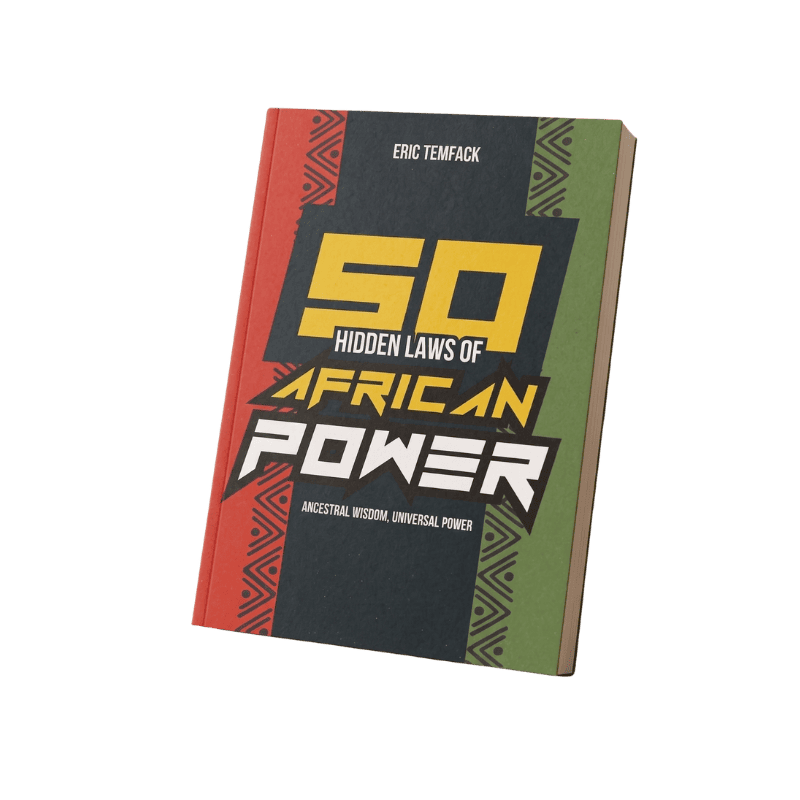
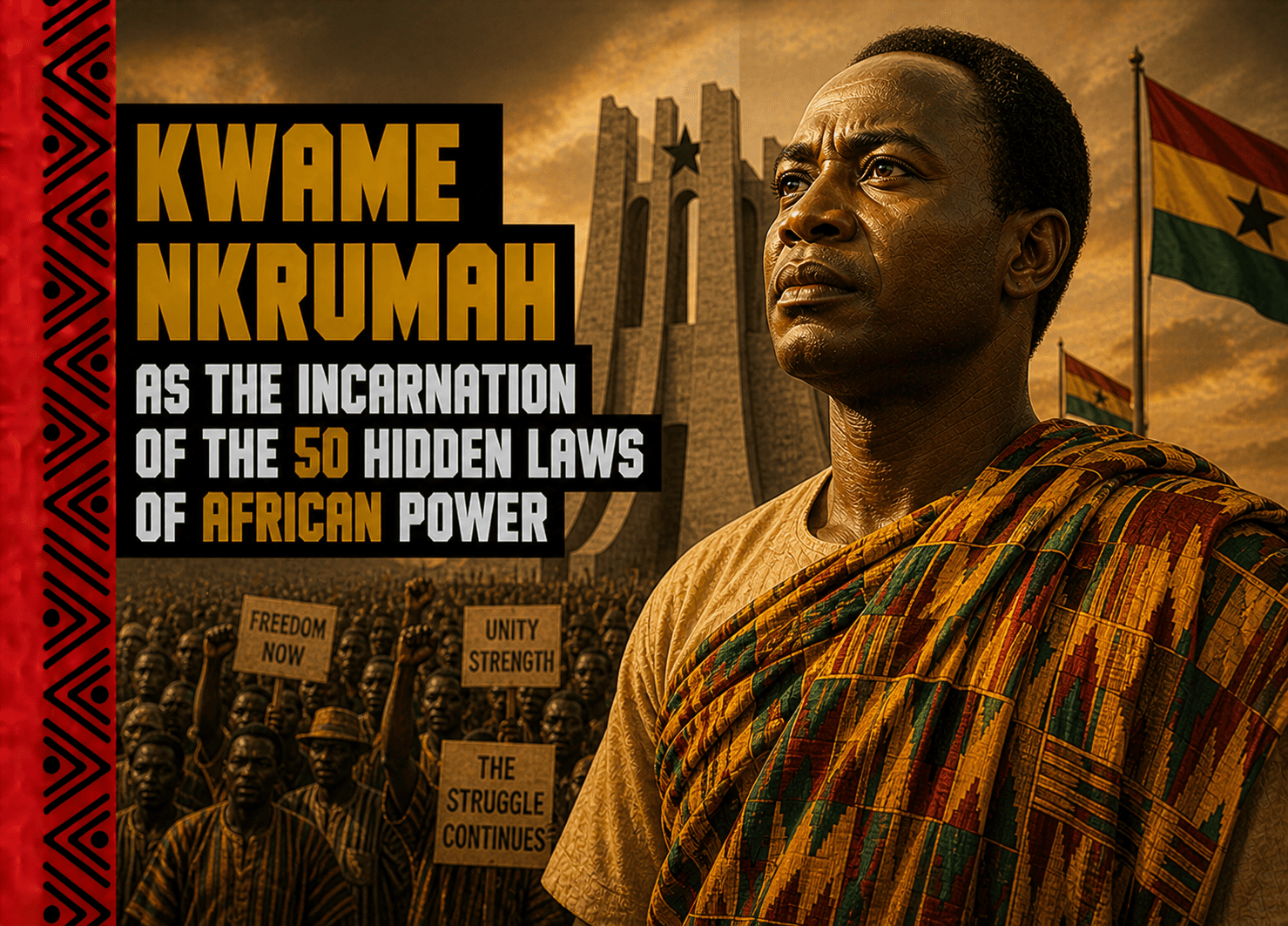
KWAME NKRUMAH — EMBODIMENT OF THE 50 HIDDEN LAWS OF AFRICAN POWER
Through Pan‑African ideology, anti‑colonial struggle, and the vision of a united Africa, the “Messiah of Ghanaian independence” changed the continent’s destiny.
I. HISTORICAL AND CIVILIZATIONAL CONTEXT
West Africa and the End of Colonial Rule (1909‑1972)
Kwame Nkrumah (1909‑1972) is the father of Ghana’s independence (formerly the Gold Coast) and one of the principal architects of modern Pan‑Africanism. He emerged in the post‑World War II period, marked by rising nationalism, the decline of colonial empires (British, French, Belgian), and the emergence of the United States and the USSR as superpowers. The British Gold Coast, rich in cocoa, gold and minerals, was shaken by growing protest movements.
Nkrumah, educated in the United States and England, returned to the Gold Coast in 1947 and took leadership of the Convention People’s Party (CPP). He used a strategy of “positive action” (strikes, civil disobedience) to force the coloniser to negotiate. On 6 March 1957, Ghana became the first sub‑Saharan African country to gain independence, paving the way for dozens more.
The Spiritual and Ideological Context
Nkrumah was influenced by Marxism (reading Lenin, Mao), Christian socialism (raised by Catholic missionaries) and Black diaspora thinkers (Marcus Garvey, W.E.B. Du Bois, George Padmore). He developed a syncretic ideology: Consciencism – a synthesis of traditional African values, socialism and Western liberalism, adapted to the continent’s realities.
His spiritual vision was secular but quasi‑messianic: he saw himself as Africa’s liberator, the “Redeemer” who would unify the continent into a single state (the United States of Africa). This religious dimension of Pan‑Africanism permeated his speeches and actions, earning him the nickname “Osagyefo” (“the saviour”) in Ghana.
🔗 CONNECTION TO THE 50 HIDDEN LAWS OF AFRICAN POWER
→ Law #1: Master Cosmic Balance (Consciencism and African Unity)
Points of convergence:
• Nkrumah balanced foreign influences (Marxism, liberalism) with African traditions – Consciencism as an integrating philosophy.
• He advocated continental unity beyond clans, ethnicities and the artificial nations inherited from colonialism – Africa as a cosmic entity.
• Modern application: African leaders must combine the best external contributions with endogenous values to build durable ideologies.
• Strategic lesson: Supreme power is not military or economic – it is the ability to propose a worldview that unites divided peoples.
II. ORIGINS AND SOCIAL ASCENSION
Birth and Family
Kwame Nkrumah was born on 21 September 1909 in Nkroful, in the south‑west of the Gold Coast (present‑day Ghana). His father, Kofi Ngonloma, was a modest goldsmith and trader; his mother, Elizabeth Nyaniba, was a peasant. He was raised in Nzema culture with traditional beliefs, but also attended the local Catholic school. His name “Kwame” means “born on a Saturday” in Akan tradition. He showed early intelligence and a thirst for learning.
He studied at the Government Training College in Accra to become a teacher, then taught in several Catholic schools. He married late (to Fathia Rizk, a Coptic Egyptian) in 1958 – a symbolic alliance with the Arab‑African world.
Education in the United States and England
In 1935, he sailed for the United States. He studied economics, sociology, philosophy and theology at Lincoln University (Pennsylvania) and later at the University of Pennsylvania. He discovered the works of Marcus Garvey, Du Bois and Marxist writings. He frequented progressive Black circles and sharpened his anti‑colonial thought. In 1945, he moved to London, where he co‑organised the 5th Pan‑African Congress (Manchester) alongside Du Bois and Padmore. There he drafted the “Colonial Challenge” manifesto. This dual training (American through Black networks, British through the empire) gave him a transnational vision.
Return to the Gold Coast and Seizure of Power
Invited in 1947 by Danquah (leader of the United Gold Coast Convention, UGCC), Nkrumah became the party’s general secretary. But his radicalism clashed with the conservative elite. He founded his own party, the Convention People’s Party (CPP), and launched a campaign of “positive action” (strikes, boycotts) in 1950. Arrested, then released after the historic electoral victory of 1951 (the CPP won 34 of 38 seats), he became “Prime Minister of the Gold Coast”. He led the country to independence on 6 March 1957.
🔗 CONNECTION TO THE LAWS OF AFRICAN POWER
→ Law #3: “Transform Knowledge into Power”
Points of convergence:
• Nkrumah used his Western education (economics, philosophy) to deconstruct colonial discourse and propose an African socialist alternative.
• His experience with Black movements in the United States gave him an international support network (Du Bois, Padmore) – relational knowledge as capital.
• Modern application: African leaders must study the coloniser’s systems to turn them against him – knowledge of the enemy’s weapons is a condition of liberation.
• Strategic lesson: Exile and foreign education are not betrayals; they are investments to return armed ideologically.
III. TITLES AND FUNCTIONS
Nkrumah held national, Pan‑African and honorary titles:
- Prime Minister of the Gold Coast (1952‑1957) then of Ghana (1957‑1960) – head of government.
- President of the Republic of Ghana (1960‑1966) – first president after the abolition of the monarchy.
- Leader of the Convention People’s Party (CPP) – single party established in 1964.
- Father of Ghanaian independence – unofficial but universally recognised title.
- Chief Theorist of Pan‑Africanism – author of “Africa Must Unite”, “Consciencism”, “Neo‑Colonialism: The Last Stage of Imperialism”.
- Co‑founder of the Organisation of African Unity (OAU) in 1963 – first conference in Addis Ababa.
- Honorary doctorate from many universities (Moscow, Cairo, etc.).
🔗 CONNECTION TO THE LAWS OF AFRICAN POWER
→ Law #12: “Become Indispensable to Power”
Points of convergence:
• Nkrumah was the only figure who simultaneously embodied anti‑colonial legitimacy (struggle, prison), nation‑building and Pan‑African vision – irreplaceable.
• He established himself as the natural leader of independent Africa, mediator in conflicts, theorist of development.
• Modern application: African leaders must cultivate an intellectual stature (writings, conferences) alongside political power – indispensability also flows from ideas.
• Strategic lesson: Being indispensable means being both the symbol of the past struggle and the compass for the future – Nkrumah mastered both.
IV. THE INDEPENDENCE STRUGGLE – STRATEGY OF POSITIVE ACTION
Influenced by Gandhi but also by labour strikes, Nkrumah invented a mixed method: non‑violence when possible, civil disobedience, but also general strikes and targeted confrontations. His 1950 campaign (call for “positive action”) paralysed the colonial economy; he was imprisoned. But his popularity grew. Becoming Prime Minister, he firmly negotiated independence with London. On 6 March 1957, he proclaimed: “Our independence is meaningless unless it is linked up with the total liberation of Africa.” – a sentence announcing his offensive Pan‑Africanism.
🔗 CONNECTION TO THE LAWS OF AFRICAN POWER
→ Law #23: “Heal to Rule – The Power of the Healer”
Points of convergence:
• Nkrumah presented himself as the healer of colonised Ghana – he healed racial and economic wounds through independence.
• His positive action strategy was a collective social therapy: mobilising the masses to purge the colonial system.
• Modern application: African leaders must know when to use popular non‑violent pressure and when to negotiate – balance is a form of political medicine.
• Strategic lesson: A nation’s healing begins with the restoration of pride – Ghana’s independence healed the soul of all Africa.
V. PRESIDENTIAL RULE (1960‑1966) – MODERNISATION AND MEGA‑PROJECTS
Nkrumah launched a national development programme: Akosombo Dam (hydroelectric power), creation of the Ghana Atomic Energy Commission, construction of academies, schools, hospitals, development of heavy industry. He instituted a one‑party state (1964) and an official ideology, Consciencism. On the diplomatic front, he supported liberation movements (PAIGC, ANC, FRELIMO) and hosted exiles (Du Bois). He promoted a non‑aligned foreign policy leaning toward the socialist East, which earned him Western distrust.
🔗 CONNECTION TO THE LAWS OF AFRICAN POWER
→ Law #8: “Master Cycles – Time as a Weapon”
Points of convergence:
• Nkrumah planned development over seven‑year cycles (seven‑year plans) – he wanted to accelerate industrial time.
• He used the commemoration of independence (6 March) as a cyclical ritual to strengthen national unity – the calendar as a political tool.
• Modern application: African leaders must plan, evaluate and celebrate – regularity builds discipline.
• Strategic lesson: Whoever masters time (the rhythm of commemorations, the pace of reforms) controls collective memory and anticipation.
VI. PAN‑AFRICANISM AND THE ORGANISATION OF AFRICAN UNITY (1963)
Nkrumah was the main architect of the creation of the OAU in May 1963 in Addis Ababa. He advocated immediate continental government (“United States of Africa”) but had to compromise with “moderates” (Houphouët‑Boigny, Tubman) who preferred simple cooperation. The compromise gave birth to the OAU, which had little supranational power. Nkrumah continued to preach unity, funding revolutionary movements (Lumumba, Cabral). He dreamed of a single currency, a continental army.
🔗 CONNECTION TO THE LAWS OF AFRICAN POWER
→ Law #42: “Create a Legacy That Multiplies Your Power”
Points of convergence:
• The OAU (now the African Union) is Nkrumah’s major institutional legacy – though weakened, it still speaks his language.
• His writings (“Africa Must Unite”, “Neo‑Colonialism”) continue to fuel Pan‑African debates – a textual legacy that reactivates.
• Modern application: African leaders must invest in continental institutions and in intellectual production – posthumous influence is played out on both fronts.
• Strategic lesson: A partial political failure (the OAU without a super‑state) can become a seed for future ideologies – Nkrumah lost the battle but won the war of ideas.
VII. THE COUP D’ÉTAT AND EXILE – THE FALL OF THE MESSIAH
On 24 February 1966, while Nkrumah was on a visit to Beijing (mediating in the Vietnam War), the Ghanaian army overthrew him. Officially, the causes were growing authoritarianism (one‑party state, detention of opponents), corruption, economic deterioration and alignment with the East. In reality, Western powers (the CIA) allegedly supported the putsch. Nkrumah took refuge in Guinea, where Sékou Touré named him co‑president. He died in 1972 in Bucharest, in exile, of skin cancer.
🔗 CONNECTION TO THE LAWS OF AFRICAN POWER
→ Law #50: “Transcend Death – The Art of Immortality”
Points of convergence:
• Death in exile, far from Ghana, did not erase his memory – his body repatriated in 1992 received a state funeral.
• His ideas live on through Pan‑African movements, intellectuals (Mbeki, Nkrumahist traditions) – the ideology outlives the leader.
• Modern application: African leaders must know that their political defeat is not necessarily the death of their cause – exile can be a space for ideological production.
• Strategic lesson: Immortality does not depend on finishing caliph in place of the caliph, but on leaving a school of thought – Nkrumah formed a lasting Pan‑Africanism.
VIII. LEGACY AND POSTHUMOUS REHABILITATION – THE PROPHET RESURRECTED
Since the 1990s, Nkrumah has been rehabilitated in Ghana and worldwide. Statues have been erected (the one in Accra, destroyed by the coup, has been restored). The African Union paid tribute to him by creating the Kwame Nkrumah Award for Pan‑African leadership. His writings are studied in universities; his vision of a single currency (the eco) returns to debates. He is considered one of the “founding fathers” of modern Africa, alongside Nasser, Sankara, Mandela and Senghor.
🔗 CONNECTION TO THE LAWS OF AFRICAN POWER
→ Law #45: “Become a Symbol – When Your Name Becomes a Movement”
Points of convergence:
• “Nkrumah” is a given name in several African countries – the name has become a Pan‑African ideal.
• “Nkrumahism” is a political school, a reference for anti‑colonial and anti‑capitalist movements.
• Modern application: African leaders must cultivate symbolic posterity – that their name evokes a value (unity, courage, anti‑colonialism).
• Strategic lesson: A leader may lose power but win eternity – if his name becomes a political project.
IX. SOURCES AND TESTIMONIES
Written sources: Autobiography (“Ghana: The Autobiography of Kwame Nkrumah”, 1957), “Africa Must Unite” (1963), “Consciencism” (1964), “Neo‑Colonialism” (1965).
Archives: National Archives of Ghana, University of Accra library, CPP archives, declassified CIA documents.
Testimonies: Interviews with his collaborators, memoirs of CPP cadres, analyses by George Padmore, W.E.B. Du Bois.
Secondary sources: Biographies by David Birmingham, Kwame Arhin, and Basse’s “Nkrumah and the Pan‑African Dream”.
🔗 CONNECTION TO THE LAWS OF AFRICAN POWER
→ Law #28: “Control Your Narrative – History Belongs to the One Who Writes It”
Points of convergence:
• Nkrumah wrote several books to fix his thought and his legend – he controlled his autobiography.
• After the coup, the putschists’ narrative dominated, but later works by Pan‑African historians restored his status.
• Modern application: African leaders must write as much as they act – books outlive regimes.
• Strategic lesson: Controlling your narrative also means training historians and journalists – Nkrumah neglected this inner guard and his image suffered.
X. NKRUMAH IN CONTEMPORARY CONSCIOUSNESS
Ghanaian national hero: His portrait adorns banknotes, public buildings; the Kwame Nkrumah Mausoleum in Accra is a pilgrimage site.
Pan‑African icon: The African Union dedicated the “Nkrumah” path for young leaders; the African Export‑Import Bank has a Nkrumah award.
Critical debate: Some criticise his authoritarianism, economic mismanagement and failed mega‑projects. Others defend the Cold War context and the attempt at accelerated development.
Popular culture: Songs, plays, documentary films.
🔗 CONNECTION TO THE LAWS OF AFRICAN POWER
→ Law #37: “Cultivate Mystery – What Is Hidden Fascinates”
Points of convergence:
• The shadow zones around the coup (CIA role, real responsibilities of the military) fuel conspiracy theories and mystery – doubt keeps interest alive.
• His death in exile, far from Ghana, gives him a martyr’s aura – the absence of a happy ending makes the story more tragic and therefore more memorable.
• Modern application: Leaders should not seek to dispel all ambiguity about their fall – a measure of the unsaid humanises and complicates the character.
• Strategic lesson: An unresolved mystery (like Western complicity) allows each generation to reinterpret and keep talking about you.
XI. MYSTERIES AND UNSOLVED QUESTIONS
The exact role of the CIA: Declassified documents show assassination attempts and destabilisation, but the real extent remains debated.
The actual state of Ghanaian finances at his departure: Some accuse him of bankruptcy, others of looting by the putschists – archives are partial.
His relationships with other independence fathers: Why did Nkrumah fall out with Danquah, Nasser, etc.? A psychology of a leader too sure of himself?
Successes and failures of the Akosombo Dam: A symbol of modernisation, but also displacements of populations without compensation – mixed results.
🔗 CONNECTION TO THE LAWS OF AFRICAN POWER
→ Law #37: “Cultivate Mystery – What Is Hidden Fascinates” (continued)
Points of convergence:
• Restricted or destroyed archives leave zones of interpretation – each generation of historians proposes its thesis.
• The enigma of Nkrumah’s personal relationships (his marriage to an Egyptian, his changing alliances) fuels romanticised biographies.
• Modern application: Leaders must accept that certain facets of their lives remain obscure – total light kills mystery.
• Strategic lesson: Even the best archives do not tell everything – the unsaid is a space of freedom for posterity.
XII. LESSONS AND CONTEMPORARY RELEVANCE
African unity remains a future project: The African Continental Free Trade Area (AfCFTA) and calls for a single currency are direct legacies of Nkrumah’s ideas.
Economic independence is as important as political independence: Nkrumah understood this (dam, industries). African leaders must today fight for monetary, industrial and digital sovereignty.
The balance between authoritarianism and development: Nkrumah illustrates the dilemma: should freedoms be curbed to accelerate progress? The answer is not binary, but post‑independence management remains a challenge.
Pan‑Africanism must be renewed: Nkrumah failed to convince other African leaders – diplomacy and patience are as necessary as vision.
🔗 CONNECTION TO THE LAWS OF AFRICAN POWER
→ Law #5: “Master Multiple Domains – The Power of the Renaissance”
Points of convergence:
• Nkrumah was simultaneously theorist, political strategist, state manager, diplomat, publisher – a rare polymathy.
• He surrounded himself with intellectuals (Du Bois, Padmore) and technicians – collective intelligence.
• Modern application: African leaders must develop multiple skills (economics, diplomacy, rhetoric) and networks of experts.
• Strategic lesson: The African renaissance requires complete leaders, not narrow specialists – Nkrumah embodies this unfinished ideal.
CONCLUSION: IMMORTALITY THROUGH THE IDEA OF AFRICA
Kwame Nkrumah remains, half a century after his death, the prophet of African unity. His journey – teacher turned president, exile turned hero – testifies to the power of conviction, education and ideology. He opened the path to independence, even if his dream of the United States of Africa has not come true.
For contemporary Africa and its diaspora, Nkrumah represents the intellectual in action, the builder of the OAU (ancestor of the AU), the critic of neo‑colonialism. He leaves us a challenge: overcome inherited borders, build a continental economy and make Pan‑African speech a reality. His name, Kwame (“born on Saturday”), resonates today as an injunction never to stop fighting for unity, dignity and sovereignty.
🔗 SYNTHESIS: KWAME NKRUMAH AS THE EMBODIMENT OF THE HIDDEN LAWS OF AFRICAN POWER
The 12 Major Laws Embodied by Nkrumah:
- Law #1 (Balance) – Consciencism: marriage of socialism, liberalism and African traditions.
- Law #3 (Knowledge as Power) – Study abroad, mobilisation of Black intellectuals – knowledge as anti‑colonial weapon.
- Law #5 (Polymathy) – Theorist, strategist, state‑builder, diplomat – multifaceted genius.
- Law #8 (Control of Time) – Seven‑year plans, cyclical commemorations – calendrical mastery.
- Law #12 (Indispensability) – Only figure able to unite masses and elites – unique pole.
- Law #15 (Monuments) – Akosombo Dam, state buildings – speaking infrastructure.
- Law #23 (Heal to Rule) – Independence as post‑traumatic therapy.
- Law #28 (Control of Narrative) – Autobiographies, books – but loss of control after the coup.
- Law #37 (Mystery) – CIA role, shadow zones of finances – fascinating mystery.
- Law #42 (Multiplicative Legacy) – The OAU/AU, AfCFTA, Nkrumah Prize – active heritage.
- Law #45 (Symbol) – “Nkrumah” = Pan‑Africanism, decolonisation – living concept.
- Law #50 (Immortality) – Mausoleum, statues, universities – persistent presence.
Practical Application for the Modern Leader:
✅ Do not underestimate the power of ideas – write, theorise, publish
✅ Train a generation of cadres – the party school is as important as the army
✅ Dare to undertake mega‑structuring projects – infrastructure can become a national monument
✅ Prepare your succession – Nkrumah did not foresee the military coup
✅ Stay Pan‑African – the nation alone is not enough; the horizon must be continental
The Nkrumah Challenge for You:
“What new ideology do you propose for Africa? How do you work for continental unity, even modestly? If your name becomes an adjective, what will it describe?”