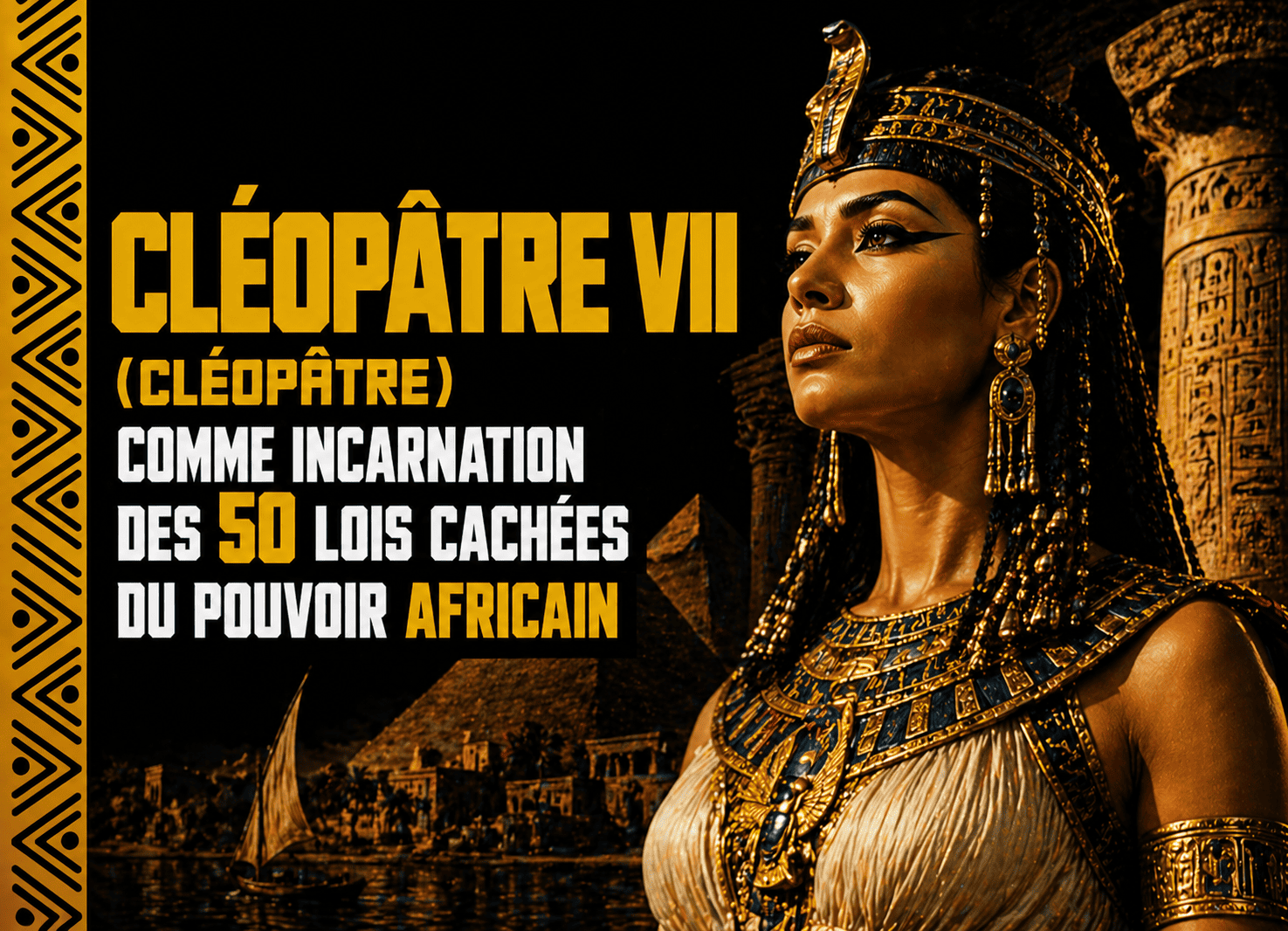
CLEOPATRA VII — EMBODIMENT OF THE 50 HIDDEN LAWS OF AFRICAN POWER
Through intelligence, strategic seduction, and vision, the last queen of Egypt defied Rome and shaped history.
I. HISTORICAL AND CIVILIZATIONAL CONTEXT
Ptolemaic (Lagid) Egypt in the 1st Century BCE
Cleopatra VII Philopator (69‑30 BCE) reigned during one of the most decisive periods in Mediterranean history: the end of the Roman Republic and the rise of the Empire, while Ptolemaic Egypt – the last great Hellenistic kingdom – struggled to preserve its independence against Roman power. Descended from the Ptolemaic dynasty founded by a general of Alexander the Great, Cleopatra was the only ruler of her line to learn the Egyptian language and immerse herself in the culture of Kemet, breaking with the Greco‑Macedonian elite.
Alexandria, the capital founded by Alexander, was then the intellectual, scientific and commercial center of the Mediterranean world. Its Library, Museum, and Lighthouse embodied the synthesis of Greek science and Egyptian heritage. It was in this cosmopolitan crucible that Cleopatra forged her political, linguistic and scientific genius.
The Spiritual and Cosmological Context
Cleopatra consciously appropriated the legacy of the pharaohs: she presented herself as the daughter of Isis, the goddess of royalty and magic, and as the living incarnation of Hathor. She restored Egyptian temples and participated in traditional rituals, thus legitimizing her power in the eyes of the Egyptian majority. At the same time, she mastered Hellenistic culture and appeared as an enlightened sovereign to the Greeks and Romans.
This dual cultural belonging – both heiress of the pharaohs and Hellenistic queen – allowed her to play on multiple symbolic registers and unify her kingdom against the external threat.
🔗 CONNECTION TO THE 50 HIDDEN LAWS OF AFRICAN POWER
→ Law #1: Master Cosmic Balance (Maât / Isis)
Points of convergence:
• Cleopatra balanced Egyptian and Greek heritage, the sacred and the political, pharaonic tradition and Roman diplomacy.
• She embodied both the learned Hellenistic queen and the daughter of Isis, guarantor of cosmic order.
• Modern application: Successful contemporary African leaders synthesize multiple cultural identities without losing their roots.
• Strategic lesson: Enduring power comes from the ability to embody multiple symbolic universes – being Greek to the Greeks, Egyptian to the Egyptians, a queen to all.
II. ORIGINS AND SOCIAL ASCENSION
Birth and Family
Cleopatra VII was born in 69 BCE in Alexandria. She was the daughter of Ptolemy XII Auletes (“the flute player”) and probably Cleopatra V Tryphaena. Although descended from a Macedonian dynasty (descendant of General Lagus), she was the first of her line to master the Egyptian language and take an interest in local cults.
Her father, often contested and exiled, gradually associated her with power. When he died in 51 BCE, Cleopatra, aged 18, became co‑ruler with her young brother Ptolemy XIII, according to Lagid tradition (brother‑sister marriage).
Education and Culture
Cleopatra received one of the most brilliant educations of antiquity. In Alexandria, she studied:
- Greek rhetoric and philosophy (Platonic, Epicurean).
- Mathematics, astronomy and medicine – the legacy of the great Alexandrian scholars.
- Several languages: Egyptian, Greek, Latin, Hebrew, Aramaic, Meroitic (according to Plutarch).
- The art of diplomacy, economics and navigation.
This encyclopedic education made her a complete sovereign, capable of debating philosophy with Romans, commanding a fleet and administering a kingdom.
The Rise to the Throne: Civil War and Exile
Cleopatra soon clashed with the regents of her brother Ptolemy XIII. Driven from power in 49 BCE, she raised an army in Syria. Just then, Julius Caesar landed in Alexandria in 48 BCE, pursuing his rival Pompey. According to legend, Cleopatra had herself rolled up in a carpet and delivered to Caesar. Captivated by her intelligence and determination, Caesar restored her to the throne after a brief Alexandrian war. She became co‑ruler with another brother, Ptolemy XIV, but ruled alone in practice.
🔗 CONNECTION TO THE LAWS OF AFRICAN POWER
→ Law #3: “Transform Knowledge into Power”
Points of convergence:
• Her mastery of languages (especially Latin) and rhetoric allowed her to converse as an equal with Caesar and Antony – knowledge becoming an instrument of political seduction.
• Her knowledge of Alexandrian sciences gave her intellectual credibility that the Romans admired and feared.
• Modern application: African leaders today must master the languages and codes of economic and diplomatic powers to negotiate as equals.
• Strategic lesson: The most advanced education is not a luxury – it is a weapon of deterrence and influence.
III. TITLES AND FUNCTIONS
Cleopatra accumulated royal and divine titles, both in the pharaonic and Hellenistic traditions:
- Pharaoh of Upper and Lower Egypt – Legitimate sovereign according to ancestral rites.
- Daughter of Isis – Religious title placing her under the protection of the great goddess.
- New Isis – She had herself depicted as Isis in temples (notably at Dendera).
- Queen of Kings – Title used during her Antonian period, when she hoped to found an eastern dynasty with Mark Antony.
- Thea Philopator (“Goddess who loves her father”) – Official dynastic title.
- Co‑ruler of the Ptolemies – With her brothers and then with her son Caesarion.
- Patron of letters and sciences – Benefactor of the Library of Alexandria.
This accumulation of sacred and political titles made her the heir of the pharaohs and an actor in Roman politics.
🔗 CONNECTION TO THE LAWS OF AFRICAN POWER
→ Law #12: “Become Indispensable to Power”
Points of convergence:
• Cleopatra was the only sovereign who could offer Caesar and then Antony the alliance of Egypt, the breadbasket and treasury of the Mediterranean – her person was the indispensable vector of that alliance.
• She diversified her sources of legitimacy: Egyptian titles (pharaoh), Greek titles (Hellenistic queen), Roman recognition (ally and lover).
• Modern application: African leaders must cultivate multiple registers of legitimacy – traditional, modern, international.
• Strategic lesson: Indispensability is built by controlling key resources (economic, cultural, military) that no one else can provide.
IV. POLITICAL AND DIPLOMATIC ACHIEVEMENTS
The Alliance with Caesar (48‑44 BCE)
Cleopatra obtained from Caesar:
- Recognition of her throne and the elimination of her rivals (Ptolemy XIII drowned).
- The return of Cyprus to Egyptian control.
- The birth of a son, Caesarion (Ptolemy XV), whom she presented as Caesar’s heir – an immense political gesture.
She stayed in Rome from 46 to 44 BCE, where her scandalous presence (a foreign queen, the dictator’s mistress) prepared public opinion for a possible merging of powers. Caesar’s assassination (44) forced her to return to Egypt.
The Union with Mark Antony (41‑30 BCE)
After the Battle of Philippi (42), Mark Antony, master of the Roman East, summoned Cleopatra. Their meeting at Tarsus is legendary: Cleopatra arrived on a ship with a golden stern, dressed as Aphrodite. Antony fell in love. Their military and romantic alliance produced three children (twins Alexander Helios and Cleopatra Selene, then Ptolemy Philadelphus).
Together they dreamed of restoring Alexander’s empire, with Caesarion as heir. Antony gave Cleopatra eastern territories (Cyprus, Cilicia, Judaea, Arabia), which caused the break with Octavian.
The War against Octavian and the Fall (31‑30)
The naval battle of Actium (31 BCE) turned into a disaster for Antony and Cleopatra. Octavian invaded Egypt. Antony committed suicide; Cleopatra tried to negotiate but failed. According to tradition, she killed herself by the bite of an asp (or poison) on August 12, 30 BCE, refusing to be dragged in Octavian’s triumph. Egypt became a Roman province.
🔗 CONNECTION TO THE LAWS OF AFRICAN POWER
→ Law #23: “The Power of the Healer – Heal and Rule” (adapted: “Seduce to Rule”)
Points of convergence:
• Cleopatra used charisma, intelligence, and self‑staging as political instruments – she “healed” conflicts through strategic seduction.
• She transformed her personal relationships with the two most powerful men in Rome into state alliances.
• Modern application: African leaders know that networking, image, and goodwill capital are as important as brute force.
• Strategic lesson: The leader who masters the art of being loved – or desired – wields a power that weapons cannot replace.
V. ECONOMIC AND ADMINISTRATIVE CONTRIBUTIONS
Despite the Roman wars, Cleopatra kept Egypt as the leading economic power in the Mediterranean:
- Monetary reform – She stabilized Egyptian currency and issued coins with her effigy (the only woman of antiquity to do so on a large scale).
- Control of grain granaries – Egypt was Rome’s main supplier; Cleopatra used this resource as a diplomatic lever.
- Trade development – She encouraged exchanges with India, Arabia and sub‑Saharan Africa via the Red Sea.
- Major works – She restored Egyptian temples (Dendera, Edfu, Philae), reinforcing her image as a pious pharaoh.
🔗 CONNECTION TO THE LAWS OF AFRICAN POWER
→ Law #8: “Master Cycles – Time as a Weapon”
Points of convergence:
• Cleopatra used mastery of agricultural cycles (Nile floods, grain harvests) as an economic and diplomatic lever – whoever controls grain controls Rome.
• She invested in monumental works (temples) that would survive her death and perpetuate her name.
• Modern application: African leaders must think beyond their term – build durable economic and cultural infrastructure.
• Strategic lesson: Controlling vital resources (water, food, energy) confers power that armies cannot always overcome.
VI. SCIENTIFIC AND INTELLECTUAL KNOWLEDGE
Ancient sources (Plutarch, Galen) praise Cleopatra’s erudition. She is said to have:
- Written treatises on pharmacopoeia and cosmetics (not found, but cited by later authors).
- Contributed to research in alchemy and medicine (in the tradition of Alexandrian scholars).
- Studied astronomy and geography, which helped her plan campaigns and alliances.
Her knowledge of at least nine languages allowed her to read sacred texts, converse with foreign ambassadors and negotiate without an interpreter – a decisive advantage against the monolingual Romans.
🔗 CONNECTION TO THE LAWS OF AFRICAN POWER
→ Law #5: “Master Multiple Domains – The Power of the Renaissance”
Points of convergence:
• Cleopatra was not merely a seductress – she was an intellectual, a strategist, an administrator, a philologist.
• Her polymathy allowed her to shine in all circles of power (Roman, Greek, Egyptian).
• Modern application: African leaders must cultivate multiple skills – economics, diplomacy, communication, technology – to avoid being confined to a single register.
• Strategic lesson: Power belongs to those who speak several languages – literally and metaphorically.
VII. DIVINIZATION AND POSTHUMOUS LEGACY
Cleopatra had herself depicted as Isis during her lifetime. After her death, Octavian forbade her official cult, but the Egyptian people continued to venerate her memory. Temples were dedicated to her in Upper Egypt, where she appears alongside the gods.
Cleopatra’s death – and the myth of the serpent (asp) – became the symbol of resistance to foreign domination. She inspired Latin poets (Horace, Propertius), then the Renaissance, Shakespeare’s theatre (“Antony and Cleopatra”), cinema and modern literature. Today she is one of the most famous ancient names, often distorted by the Roman prism.
🔗 CONNECTION TO THE LAWS OF AFRICAN POWER
→ Law #50: “Transcend Death – The Art of Immortality”
Points of convergence:
• Cleopatra chose a spectacular death (poison, asp) that became a founding myth – she turned defeat into eternal legend.
• Her divinization (Isis) guaranteed her a ritual presence in temples long after her political disappearance.
• Modern application: African leaders must mind their exit – a heroic or symbolic end can seal an immortal reputation.
• Strategic lesson: Immortality is achieved not only through victories, but through the manner in which one chooses to disappear.
VIII. INFLUENCE ON WORLD HISTORY AND CULTURE
Cleopatra became the archetype of the oriental queen, at once dangerous, seductive and learned. From ancient mosaics to Hollywood films (Elizabeth Taylor, 1963), she has been continuously represented. African and Afrocentric historians (Cheikh Anta Diop, Molefi Kete Asante) claim Cleopatra as an African queen, emphasizing her Macedonian roots but also her profound Egyptianization. Her reign embodies the last attempt of a sovereign African state against Roman imperialism.
🔗 CONNECTION TO THE LAWS OF AFRICAN POWER
→ Law #45: “Become a Symbol – When Your Name Becomes a Movement”
Points of convergence:
• Cleopatra is no longer a historical person but a universal symbol – the oriental queen, the fatal seductress, the woman of power.
• Every culture, every era reinvents Cleopatra – her name has surpassed her life to become a concept.
• Modern application: African leaders must understand that their posthumous image will be reinterpreted – they can influence this reinterpretation through the works they leave behind.
• Strategic lesson: Supreme power is to become a category of thought – “Cleopatra” evokes luxury, intelligence and tragedy.
IX. SOURCES AND TESTIMONIES
Ancient sources (often hostile): Plutarch (“Parallel Lives”), Appian, Cassius Dio, Suetonius, Corpus Caesarianum.
Egyptian sources: Inscriptions from the temples of Dendera, Edfu, Philae; ostraca and demotic papyri.
Modern archaeological sources: Coin portraits, busts and statues, underwater excavations of Alexandria.
🔗 CONNECTION TO THE LAWS OF AFRICAN POWER
→ Law #28: “Control Your Narrative – History Belongs to the One Who Writes It”
Points of convergence:
• Cleopatra, defeated, could not write her own history – we know her only through her Roman enemies.
• Despite this bias, her legend survived – proof that an image can outlive a hostile narrative.
• Modern application: African leaders must write their own memoirs, create their archives, train their historians – otherwise history will be written by their adversaries.
• Strategic lesson: The battle of memory is as important as the political battle – never let the enemy be the sole narrator.
X. CLEOPATRA IN CONTEMPORARY CONSCIOUSNESS
Since the 1960s, historians have reassessed Cleopatra: no longer a mere seductress, but a competent and cultivated leader. Her media presence is massive – cinema (Elizabeth Taylor, 1963; Netflix documentaries), literature, video games (Assassin’s Creed Origins). She is one of the main drivers of cultural tourism in Egypt.
🔗 CONNECTION TO THE LAWS OF AFRICAN POWER
→ Law #37: “Cultivate Mystery – What Is Hidden Fascinates”
Points of convergence:
• The mystery of her death (asp or poison? tomb never found?) has fuelled debate for 2000 years – the unsaid magnifies legend.
• Her real appearance (what did she look like?) is lost – every era projects its own desires onto her.
• Modern application: Leaders should not reveal everything – leaving an air of mystery nourishes posthumous interest.
• Strategic lesson: An unanswered question is sometimes worth more than all the answers – the Cleopatran enigma is a myth‑producing machine.
XI. MYSTERIES AND UNSOLVED QUESTIONS
The undiscovered tomb: Despite decades of excavations (especially underwater in Alexandria), Cleopatra’s tomb has never been found. Its discovery would be the major archaeological event of the 21st century.
Her real appearance: Coins show her with a hooked nose and strong chin – far from Hollywood standards. The debate remains open.
The true death: Was it really an asp? Medical historians doubt the rapid effectiveness of the venom. Perhaps a compound poison.
🔗 CONNECTION TO THE LAWS OF AFRICAN POWER
→ Law #37: “Cultivate Mystery – What Is Hidden Fascinates” (continued)
Points of convergence:
• The missing tomb, uncertainty about the details of her death, the enigma of her portraits – all shadow zones that make Cleopatra more fascinating.
• Novelists, filmmakers and historians fill the blanks, each creating their own Cleopatra.
• Strategic lesson: If history cannot say everything, it invites dreaming – and dreaming is the most powerful amplifier of legend.
XII. LESSONS AND CONTEMPORARY RELEVANCE
The power of soft power: Cleopatra had no legions, but she had intelligence, culture and charisma – she conquered the two most powerful men in Rome without ever confronting them militarily (until the end).
The importance of personal image: She understood that the leader must stage himself: her arrival at Tarsus is a masterpiece of ancient political marketing.
Knowing how to die rather than submit: Her suicide refused humiliating defeat – she turned her death into a final act of sovereignty.
🔗 CONNECTION TO THE LAWS OF AFRICAN POWER
→ Law #15: “Build Monuments That Speak for You”
Points of convergence:
• Cleopatra did not build pyramids, but she restored temples (Dendera) and left her image carved in stone – speaking monuments.
• Her true monumental work was her own legend – a narrative construction she actively directed.
• Modern application: African leaders must invest in media, archives, authorised biographies – their “immaterial monuments” will survive.
• Strategic lesson: The greatest monument is sometimes a well‑told death, a maintained legend, a cultivated mystery.
CONCLUSION: IMMORTALITY THROUGH LEGEND
Cleopatra VII remains, more than two thousand years after her death, one of the most famous names of African and world antiquity. Her exceptional journey – learned princess, fallen queen, ruthless strategist, tragic lover – testifies to the power of intelligence, charisma and self‑staging.
For contemporary Africa and its diaspora, Cleopatra represents a paradoxical ancestor: heiress of a Greek dynasty but deeply Egyptianised, she embodies the ability of African civilisations to assimilate and transform external influences. Her final failure – the Roman conquest – reminds us that even political genius has limits against brute force.
Her name, Cleopatra (“glory of the father”), resonates today as an invitation: may each generation produce its own Cleopatra – those leaders who, through intellect, culture and the art of strategic seduction, defy empires and leave an immortal imprint.
🔗 SYNTHESIS: CLEOPATRA VII AS THE EMBODIMENT OF THE HIDDEN LAWS OF AFRICAN POWER
The 12 Major Laws Embodied by Cleopatra:
- Law #1 (Maât/Isis) – Balance between Egyptian and Hellenistic heritage, sacred and political.
- Law #3 (Knowledge as Power) – Mastery of languages and sciences as instruments of influence.
- Law #5 (Polymathy) – Queen, scholar, strategist, diplomat, philologist – multiple.
- Law #8 (Control of Time) – Use of agricultural cycles (grain) as a diplomatic lever.
- Law #12 (Indispensability) – Only one who could offer Egypt as an ally to Caesar and Antony.
- Law #15 (Monuments) – Restoration of temples and construction of her own legend.
- Law #23 (Seduce to Rule) – Charisma and love as political instruments.
- Law #28 (Control of Narrative) – Battle lost against Octavian’s propaganda, but legend victorious.
- Law #37 (Mystery) – Tomb unfound, ambiguous death, uncertain face – infinite mystery.
- Law #42 (Multiplicative Legacy) – Artistic, literary, political inspiration for two millennia.
- Law #45 (Symbol) – “Cleopatra” evokes luxury, intelligence and tragedy – a universal concept.
- Law #50 (Immortality) – Lives on in myths, films, books – political defeat, memorial victory.
Practical Application for the Modern Leader:
✅ Use knowledge and languages as negotiating weapons
✅ Stage your person – image is power
✅ Control vital resources (energy, food, finance) to bend the powerful
✅ Cultivate strategic personal allies – sometimes the heart is a political lever
✅ If you must lose, choose an end that seals your legend
The Cleopatra Challenge for You:
“How will you turn your intelligence and culture into influence? What staging of yourself will mark minds? If failure is inevitable, how will you make it a founding myth?”