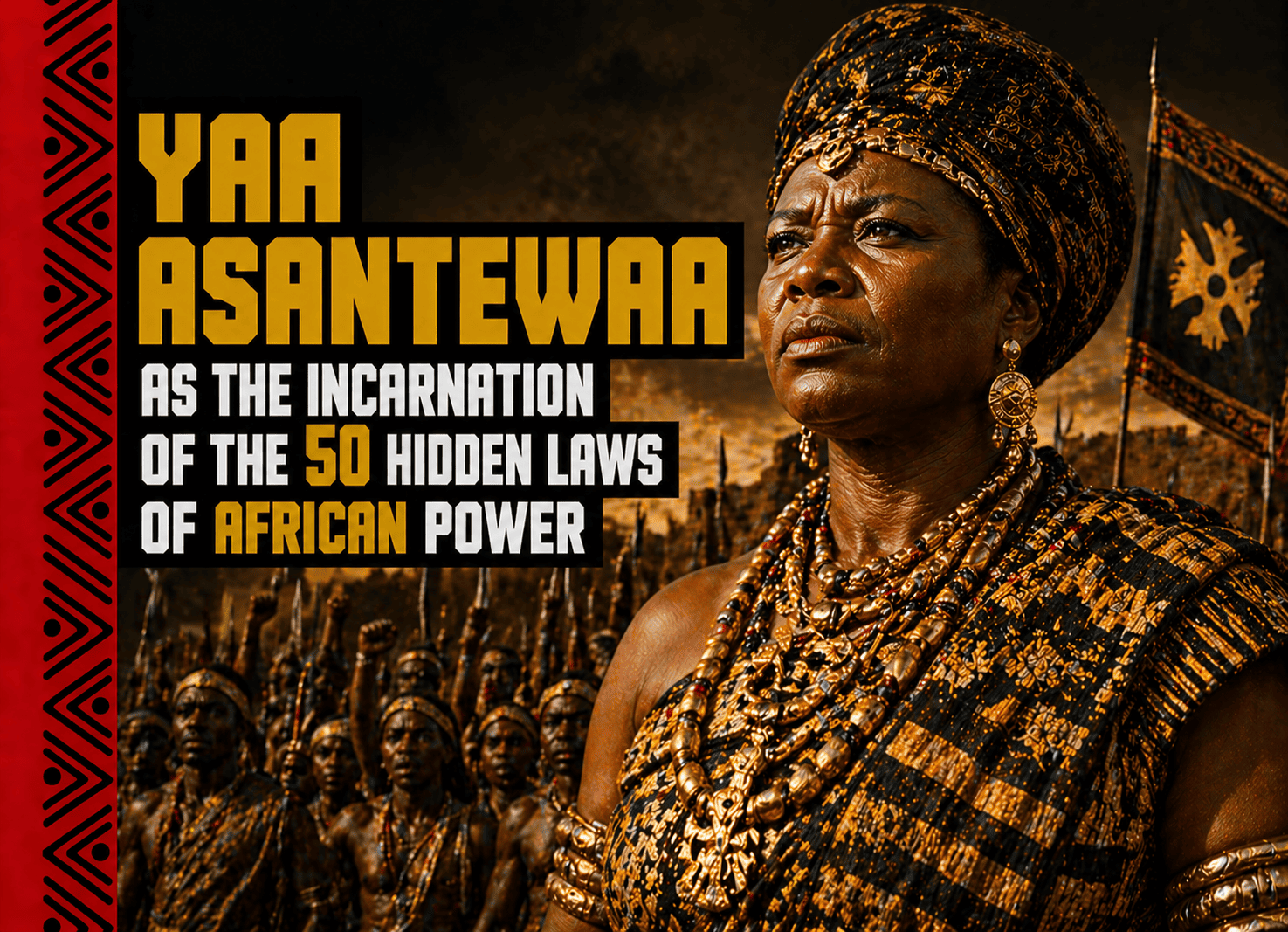
YAA ASANTEWAA — EMBODIMENT OF THE 50 HIDDEN LAWS OF AFRICAN POWER
Through courage, sacred speech, and the War of the Golden Stool, the Queen Mother of the Ashanti defied the British Empire and inspired generations of resisters.
I. HISTORICAL AND CIVILIZATIONAL CONTEXT
The Ashanti Empire and British Colonial Penetration (late 19th – early 20th century)
Yaa Asantewaa (c. 1840‑1921) is one of the most iconic figures of anti‑colonial resistance in West Africa. She was the Queen Mother (Ejisu) of the Ashanti kingdom, a powerful state in present‑day Ghana, renowned for its military organisation, its capital Kumasi, and its sacred symbol: the Golden Stool (Sika Dwa Kofi), believed to contain the soul of the Ashanti nation. After several Anglo‑Ashanti wars (1873‑1896), the British imposed a protectorate and exiled King (Asantehene) Prempeh I in 1896.
In 1900, the British governor Frederick Hodgson demanded the surrender of the Golden Stool, declaring that he intended to sit on it. This sacrilegious affront triggered the War of the Golden Stool (Yaa Asantewaa War). Yaa Asantewaa, taking command of the Ashanti army after the hesitation of the male chiefs, organised a massive rebellion. She was defeated, arrested and exiled to the Seychelles, where she died in 1921. But her action became a founding myth of Ghanaian and Pan‑African resistance.
The Spiritual and Cosmological Context
Ashanti society rests on ancestor worship, belief in a supreme god (Nyame), and respect for sacred objects (the Golden Stool, drums). The Queen Mother (Ohemaa) is the keeper of the royal lineage, advisor to the king, guarantor of traditions. She may, under certain circumstances, assume military command. Yaa Asantewaa embodies this fusion of politics, spirituality and resistance – her speech is not merely political; it is sacred, spoken in the name of the ancestors and the Golden Stool.
🔗 CONNECTION TO THE 50 HIDDEN LAWS OF AFRICAN POWER
→ Law #1: Master Cosmic Balance (Golden Stool and Resistance)
Points of convergence:
• Yaa Asantewaa balanced the traditional role of Queen Mother (advisor, guardian of rites) with the warrior function – she embodied the synthesis of sacred femininity and military command.
• She placed the Golden Stool – the cosmic symbol of Ashanti identity – at the centre of her call to war: defending the sacred object meant defending the balance of the world.
• Modern application: African women leaders must sometimes step beyond prescribed roles to meet existential threats – tradition can evolve.
• Strategic lesson: Enduring power comes from the ability to symbolise a people’s unity around an intangible totem – for the Ashanti, the Golden Stool.
II. ORIGINS AND SOCIAL ASCENSION
Birth and Family
Yaa Asantewaa was born around 1840 in Besease (present‑day Ghana). She belonged to the Ashanti royal lineage. Her brother, Nana Akwasi Afrane Okpese, was the chief of Ejisu (an Ashanti province). She married Nana Owusu Kwabena, a dignitary. The union produced a daughter. Her qualities: intelligence, firmness, eloquence. She managed her brother’s lands and affairs. When her brother died (c. 1880), she became Queen Mother of Ejisu, responsible for nominating the chief.
Education and Traditional Role
Yaa Asantewaa received an oral education – tales, proverbs, Ashanti history. She learned protocol, justice, diplomacy and the art of palaver. She took part in the councils of chiefs (asantehene) and ensured respect for customs. Her reputation for wisdom and courage preceded her. She was a guardian of history and genealogies.
The Rise: From Queen Mother to War Leader
After the exile of King Prempeh I (1896), the British government imposed a resident in Kumasi. In March 1900, Hodgson humiliated the Ashanti chiefs by demanding the Golden Stool. The chiefs hesitated to take up arms. Yaa Asantewaa, convening the council, delivered a famous speech: “If the men do not fight, the women will.” She denounced cowardice. She took command of the Ashanti army, organised the resistance and led the war.
🔗 CONNECTION TO THE LAWS OF AFRICAN POWER
→ Law #3: “Transform Knowledge into Power”
Points of convergence:
• Yaa Asantewaa used her knowledge of rituals, proverbs and the psychology of the chiefs to galvanise hesitant men – traditional speech as a weapon.
• Her knowledge of the terrain and Ashanti tactics allowed her to plan an effective rebellion, trapping the British in their fort.
• Modern application: African women leaders must master oratory and local history – speech mobilises more than the sword.
• Strategic lesson: Knowledge, even traditional (legends, protocols), becomes a political force when used at the right moment – Yaa Asantewaa knew how to awaken pride.
III. TITLES AND FUNCTIONS
Yaa Asantewaa held sacred and warrior titles:
- Queen Mother of Ejisu (Ohemaa) – guardian of the lineage, advisor.
- Guardian of the Golden Stool (diffuse symbolic role).
- Commander‑in‑Chief of the Ashanti army (1900) – assumed war title.
- Leader of anti‑colonial resistance – recognised after her speech.
- Traditional priestess – she invoked the ancestors to legitimise the fight.
🔗 CONNECTION TO THE LAWS OF AFRICAN POWER
→ Law #12: “Become Indispensable to Power”
Points of convergence:
• Yaa Asantewaa was the only one who could rally the divided chiefs – she became the focal point of the resistance.
• She combined customary legitimacy (Queen Mother) and military audacity (commander‑in‑chief) – indispensable to the uprising.
• Modern application: African women leaders must cultivate both traditional authority and modern competence – indispensability lies at that intersection.
• Strategic lesson: In a crisis, the person who dares to embody decision becomes irreplaceable – Yaa Asantewaa dared.
IV. THE WAR OF THE GOLDEN STOOL – IF THE MEN DO NOT FIGHT…
Governor Hodgson, after demanding the Golden Stool, took refuge in the Kumasi fort. Yaa Asantewaa mobilised 10,000 fighters. She besieged the fort for several months. The British sent reinforcements. Despite fierce resistance, superior weapons (cannons, rifles) and famine eventually broke the Ashanti army. Yaa Asantewaa was captured in November 1900, exiled to the Seychelles. But her name remains associated with the most serious insurrection against British authority in the Gold Coast.
🔗 CONNECTION TO THE LAWS OF AFRICAN POWER
→ Law #23: “Heal to Rule – The Power of the Healer” (adapted “Resist to Heal”)
Points of convergence:
• Yaa Asantewaa tried to “heal” the shame of the Ashanti nation (the king’s exile, the humiliation of the Golden Stool) through a war of purification.
• She acted as a doctor of the collective soul – armed resistance as political therapy.
• Modern application: African women leaders may sometimes take up arms (symbolically or literally) to restore a people’s dignity.
• Strategic lesson: Healing a wounded nation may require confrontation – Yaa Asantewaa lost the war but won pride.
V. THE MASTERFUL SPEECH – AN INVOCATION TO RESISTANCE
Before the council of chiefs, Yaa Asantewaa is said to have declared:
“Now I see that some of you are afraid to fight the white soldiers. If you, the men, will not go to battle, then the women will. I tell you: I will lead the battle. I am a woman, but I will not be a silent witness.”
This speech, transmitted orally, has become one of the foundational texts of African female resistance.
🔗 CONNECTION TO THE LAWS OF AFRICAN POWER
→ Law #28: “Control Your Narrative – History Belongs to the One Who Writes It”
Points of convergence:
• Yaa Asantewaa left no writings, but her speech became an oral monument, repeated by griots and historians.
• She reversed the gender stereotype: “women alone? no, they will save honour.”
• Modern application: African women leaders must polish their speeches – a single utterance can become a myth and turn defeat into moral victory.
• Strategic lesson: Mastering oratory means mastering history – Yaa Asantewaa won posterity through her words.
VI. EXILE AND DEATH – SACRIFICE FOR HONOUR
After her capture, Yaa Asantewaa was deported to the Seychelles along with King Prempeh I and other dignitaries. She spent 20 years in captivity, never renouncing her fight. She died in 1921. Her remains were repatriated to Ghana only in 2001, more than 80 years after her death. She was given a royal burial.
🔗 CONNECTION TO THE LAWS OF AFRICAN POWER
→ Law #50: “Transcend Death – The Art of Immortality”
Points of convergence:
• Exile and death far from home did not erase her memory – on the contrary, her sacrifice earned her posthumous veneration.
• The repatriation of her ashes a century later shows the persistence of her legacy – the exile returns as a hero.
• Modern application: African women leaders may be defeated, exiled, but if their cause is just, they will return symbolically.
• Strategic lesson: Immortality does not depend on military victory – it depends on the power of the myth forged by sacrifice.
VII. LEGACY – THE PAN‑AFRICAN AND FEMINIST ICON
Yaa Asantewaa has become a leading figure of feminist and Pan‑African movements. Schools, streets, statues bear her name in Ghana. Her portrait appears on banknotes. “Yaa Asantewaa Day” is celebrated each year. She inspires novels, plays, songs (reggae, hip‑life). She is often cited by leaders like Nkrumah, and later by African feminists who see in her the embodiment of female courage.
🔗 CONNECTION TO THE LAWS OF AFRICAN POWER
→ Law #45: “Become a Symbol – When Your Name Becomes a Movement”
Points of convergence:
• “Yaa Asantewaa” is a first name given to many Ghanaian girls – her name embodies female courage.
• The “Yaa Asantewaa War” has become a founding myth of Ghanaian resistance, taught in all schools.
• Modern application: African women leaders must aim to become a concept – that their name means “resistance and dignity”.
• Strategic lesson: A name that frightens colonisers and inspires the colonised – that is the ultimate power of the symbol.
VIII. YAA ASANTEWAA AND CONTEMPORARY AFRICAN FEMINISM
Theorists like Oyeronke Oyewumi, Ifi Amadiume and activists like Wangari Maathai, Ellen Johnson Sirleaf cite her as an ancestor. She demonstrates that African women did not wait for Western movements to assert themselves. Ghanaian historian Nana Brown rehabilitated her in biographies. Ghanaian cinema has dedicated several films to her.
🔗 CONNECTION TO THE LAWS OF AFRICAN POWER
→ Law #42: “Create a Legacy That Multiplies Your Power”
Points of convergence:
• Biographies, films, schools bearing her name act as “franchises” of her legacy – each medium spreads her memory.
• African feminist movements use her to deconstruct the image of the passive woman – an activist legacy.
• Modern application: African women leaders must leave varied media (films, books, statues) so that their message crosses generations.
• Strategic lesson: A legacy well maintained by cultural and educational institutions multiplies.
IX. SOURCES AND TESTIMONIES
Oral sources: Ashanti traditions, griot narratives, praise songs, testimonies of descendants.
British sources: Colonial archives (reports of Governor Hodgson, correspondence), contemporary newspapers.
Secondary sources: Biographies by Ivor Agyeman‑Duah, A. Adu Boahen, works on the War of the Golden Stool.
Material sources: The Kumasi fort, Ashanti artefacts in the British Museum, the Golden Stool (still kept by the Ashanti).
🔗 CONNECTION TO THE LAWS OF AFRICAN POWER
→ Law #28: “Control Your Narrative – History Belongs to the One Who Writes It” (continued)
Points of convergence:
• Colonial sources describe her as a “rebel”, but oral tradition makes her a heroine – two narratives in struggle.
• African historians have reclaimed her memory and integrated it into the Ghanaian national canon.
• Modern application: African women leaders must fund historical work to counter colonial narratives.
• Strategic lesson: A hero can be distorted by the enemy, but local memory eventually triumphs if cultivated.
X. YAA ASANTEWAA IN CONTEMPORARY POPULAR CULTURE
Music: Ghanaian singers (Gyedu‑Blay Ambolley, reggae) and Pan‑African artists have dedicated songs to her.
Cinema: Ghanaian films (“Yaa Asantewaa” by Kwaw Ansah, 2001).
Theatre: Plays performed in Accra, London, New York.
Education: Her story is taught in primary and secondary schools in Ghana.
🔗 CONNECTION TO THE LAWS OF AFRICAN POWER
→ Law #37: “Cultivate Mystery – What Is Hidden Fascinates”
Points of convergence:
• The absence of a certain photograph of her (there is an unauthenticated portrait) fuels imaginary representations – visual mystery.
• The exact fate of the Golden Stool (the Ashanti claim to have hidden it) adds to the legend – a mysterious object.
• Modern application: Leaders may leave some ambiguity about their appearance or certain details – this nourishes art and interpretation.
• Strategic lesson: Mystery sustains myth – Yaa Asantewaa remains elusive, hence eternal.
XI. MYSTERIES AND UNSOLVED QUESTIONS
Exact date of birth: Uncertain, colonial archives and oral traditions diverge.
Exact number of fighters: Estimates range from several thousand to tens of thousands.
Precise role of the Golden Stool after the war: Still hidden, never seen by outsiders – a permanent mystery.
Whereabouts of her original grave in the Seychelles: Her remains were repatriated, but the initial burial place remains little known.
🔗 CONNECTION TO THE LAWS OF AFRICAN POWER
→ Law #37: “Cultivate Mystery – What Is Hidden Fascinates” (continued)
Points of convergence:
• Biographical shadow zones make her a universal figure – everyone can project their own values onto her.
• The mystery of the Golden Stool (no one knows where it is) strengthens Ashanti veneration – the invisible is more powerful than the visible.
• Modern application: Leaders should sometimes keep some of their “treasures” hidden – secrecy reinforces power.
• Strategic lesson: What is not exposed cannot be stolen – Yaa Asantewaa protected the Golden Stool from humiliation.
XII. LESSONS AND CONTEMPORARY RELEVANCE
Women’s leadership in extreme situations: Yaa Asantewaa shows that in the absence of male leaders, women can step up with audacity.
The importance of symbols: The Golden Stool, an apparently trivial object, galvanised an entire nation – African leaders must identify and protect unifying symbols.
Armed resistance is not always victorious, but it forges memory: The War of the Golden Stool was a military defeat but a moral and historical victory.
Orality as a political tool: Yaa Asantewaa’s speech survived without recording – leaders must master speech and ensure it is repeated.
🔗 CONNECTION TO THE LAWS OF AFRICAN POWER
→ Law #5: “Master Multiple Domains – The Power of the Renaissance”
Points of convergence:
• Yaa Asantewaa was simultaneously Queen Mother (tradition), military strategist, orator and spokesperson of Ashanti faith – a polymathy of resistance.
• She did not confine herself to a single role – her versatility made her morally insurmountable.
• Modern application: African women leaders must cultivate the sacred, speech and action – the African renaissance needs complete women.
• Strategic lesson: A leader who can speak to ancestors and soldiers, to women and chiefs – that one changes history.
CONCLUSION: IMMORTALITY THROUGH SACRIFICE AND SPEECH
Yaa Asantewaa remains, more than a century after her death, one of the most venerated figures in Ghanaian history and Pan‑Africanism. Her journey – Queen Mother turned war leader, exile turned icon – testifies to the power of speech, faith in symbols, and individual courage in the face of injustice.
For contemporary Africa and its diaspora, Yaa Asantewaa represents the absolute resister, one who preferred death or exile to humiliation. She reminds us that honour and dignity are worth more than safety, and that women have always been decisive actors in African history, long before they were given a voice.
Her name, Yaa Asantewaa (born on a Thursday, of the Asante lineage), resonates today as a challenge: may each generation produce its own Yaa Asantewaa – those leaders who, through voice, sacrifice, and defence of sacred symbols, refuse to kneel before the oppressor.
🔗 SYNTHESIS: YAA ASANTEWAA AS THE EMBODIMENT OF THE HIDDEN LAWS OF AFRICAN POWER
The 12 Major Laws Embodied by Yaa Asantewaa:
- Law #1 (Balance) – Synthesis of traditional female role and warrior command.
- Law #3 (Knowledge as Power) – Mastery of proverbs, Ashanti history and rituals to mobilise.
- Law #5 (Polymathy) – Priestess, Queen Mother, strategist, orator – multiple.
- Law #8 (Control of Time) – Launching the war at the critical moment (the humiliation of the Golden Stool).
- Law #12 (Indispensability) – Only one able to rally hesitant chiefs – point of convergence.
- Law #15 (Monuments) – Her speech, her statue, schools – intangible and material monuments.
- Law #23 (Heal to Rule) – Healing of Ashanti honour through war.
- Law #28 (Control of Narrative) – No writings, but griots perpetuating her legend.
- Law #37 (Mystery) – Absence of portrait, uncertain grave, hidden Golden Stool – fertile mysteries.
- Law #42 (Multiplicative Legacy) – Films, schools, songs, statues – active heritage.
- Law #45 (Symbol) – “Yaa Asantewaa” = female courage, anti‑colonial resistance – living concept.
- Law #50 (Immortality) – Repatriation of ashes, annual celebrations – victorious memory.
Practical Application for the Modern Leader:
✅ Never underestimate the power of a well‑placed speech – your words can move armies
✅ Defend your sacred symbols – without them, your people lose their soul
✅ In the absence of male leadership, dare to take over – legitimacy is won by audacity
✅ Demand that your story be taught – memory is a weapon
✅ Even defeated, refuse humiliation – exile can prepare the rebirth of myth
The Yaa Asantewaa Challenge for You:
“What sacred symbol or principle do you refuse to see trampled? Are you ready to speak when the chiefs hesitate? What will be your War of the Golden Stool?”