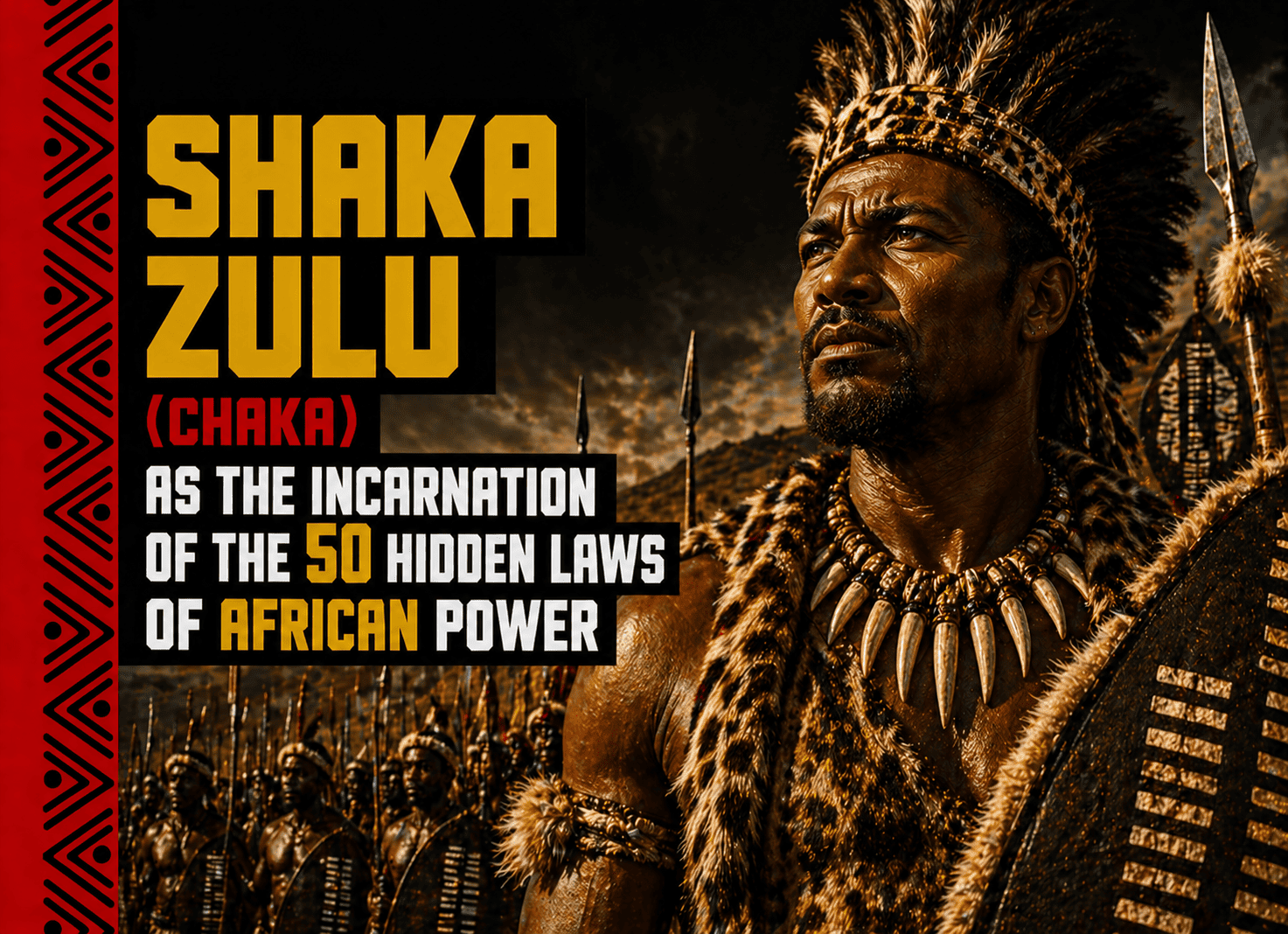
SHAKA ZULU (CHAKA) — EMBODIMENT OF THE 50 HIDDEN LAWS OF AFRICAN POWER
Through military revolution, clan unification, and iron discipline, the “Sun King” of southern Africa forged the Zulu nation.
I. HISTORICAL AND CIVILIZATIONAL CONTEXT
Southern Africa in the Early 19th Century – The Mfecane/Difaqane
Shaka Zulu (c. 1787‑1828) reigned during a turbulent period in southern African history: the rise of warrior kingdoms and the Mfecane (“crushing” in Zulu) or Difaqane (in Sotho), a series of wars, migrations and population displacements triggered by the expansion of the Zulu kingdom. Shaka transformed a small, marginal chiefdom into one of the continent’s most formidable military empires.
At the end of the 18th century, the region was fragmented into rival Nguni clans, often fighting over land and cattle. Europeans (explorers, traders, then British settlers) had not yet penetrated the interior. Through radical tactical and social innovations, Shaka united dozens of clans under Zulu authority, creating a nation that would resist British colonial expansion for nearly six decades.
The Spiritual and Cosmological Context
The Nguni world rested on ancestor worship (amadlozi), respect for hereditary chiefs and beliefs in ritual purity (inhlanje, ukuthakathi – witchcraft). Shaka presented himself as the “Sun King” (uShaka kaSenzangakhona), holding absolute authority but also a sacred dimension. He introduced warrior rituals, war dances and reorganised military life around compulsory service (intanga). He proclaimed himself superior to sorcerers and diviners (izangoma), centralising spiritual power.
This fusion of politics, military and religion made Shaka a total sovereign, whose word was law and whose name inspired fear.
🔗 CONNECTION TO THE 50 HIDDEN LAWS OF AFRICAN POWER
→ Law #1: Master Cosmic Balance (Ancestors and Military Discipline)
Points of convergence:
• Shaka balanced ancestor respect with radical military innovation – he did not break traditions, he redirected them.
• He unified clans with different cults by imposing a common enemy and a Zulu identity.
• Modern application: African leaders must integrate local beliefs into unifying projects without abolishing them.
• Strategic lesson: Sacred power (chief as ancestor mediator) reinforces military power – spiritual legitimacy doubles authority.
II. ORIGINS AND SOCIAL ASCENSION
Birth and Family
Shaka was born around 1787 into the minor Zulu chiefdom, son of Senzangakhona (a minor chief) and Nandi, a woman from a rival clan. His birth was marked by disgrace: the father and in‑laws rejected the child, nicknaming him “Shaka” (intestinal parasite) – an insult. Nandi, expelled, raised him alone in exile, first among the Langeni clan, then later under the powerful chief Dingiswayo of the Mthethwa confederation.
He grew up as an outcast, the object of mockery, but his strength and intelligence set him apart. He never knew his father and hated the Zulu name until he seized power.
Childhood and military training among the Mthethwa
Taking refuge with Dingiswayo, Shaka enlisted as a warrior in the Mthethwa army. He observed and criticised traditional combat methods (throwing the assegai at a distance, disorderly shock). He distinguished himself by his bravery, endurance and innovative ideas. Dingiswayo protected and trained him. Shaka then conceived his new tactics: he replaced the thrown assegai with a short, broad‑bladed stabbing spear (iklwa) for close combat, combined long shields and invented the “buffalo horns” formation. He gained prestige.
The Rise to the Zulu Throne
At the death of his father Senzangakhona (c. 1816), a legitimate son (Sigujana) took the throne. Shaka, with Dingiswayo’s support, assassinated Sigujana and seized power. He then merged the small Zulu clans with the Mthethwa army. When Dingiswayo was killed by the Ndwandwe clan, Shaka took command of the Mthethwa confederation and launched a unification war against the Ndwandwe, defeating them after several campaigns (Battle of Gqokli Hill, decisive c. 1818).
🔗 CONNECTION TO THE LAWS OF AFRICAN POWER
→ Law #3: “Transform Knowledge into Power”
Points of convergence:
• Shaka observed, criticised and improved traditional tactics – empirical military knowledge became a revolution.
• His knowledge of clan psychology allowed him to ally with the conquered by integrating them (amabutho age‑regiment system).
• Modern application: African leaders must turn local knowledge (agricultural, artisanal, military) into strategic competitiveness.
• Strategic lesson: Knowledge of terrain, resources and enemy weaknesses is more decisive than numbers – Shaka won through innovation, not size.
III. TITLES AND FUNCTIONS
Shaka held titles that manifested his absolute authority:
- Inkosi yamaZulu (King of the Zulus) – absolute sovereign.
- uShaka kaSenzangakhona (Shaka son of Senzangakhona) – dynastic name.
- Sun King (metaphorical language used by white chroniclers).
- Chief military reformer – creator of the amabutho system, the iklwa, and shock tactics.
- Lawgiver – forbade marriage during active service, imposed warrior celibacy, regulated cattle distribution.
- Supreme chief of diviners and sorcerers – controlled the punishment of witches and legitimised his policy through “purification”.
This concentration of roles (political, military, religious, judicial) made him an absolute monarch, unprecedented in the region.
🔗 CONNECTION TO THE LAWS OF AFRICAN POWER
→ Law #12: “Become Indispensable to Power”
Points of convergence:
• Shaka was the only one who mastered war, integration of the conquered, and the cult – without him, the empire collapsed.
• He concentrated powers: his generals (indunas) depended entirely on him; no natural heir could replace him.
• Modern application: African leaders sometimes need to centralise to break feudal ties, but beware of dependency.
• Strategic lesson: Indispensability comes at the price of a perilous succession – after Shaka, civil wars.
IV. MILITARY REVOLUTION – THE ZULU ARMY
Tactical innovations: the iklwa, long shield and buffalo horns
Shaka replaced the assegai (throwing spear) with the iklwa – a short, broad‑bladed stabbing spear for close combat. He adopted a large leather shield (isihlangu) almost as long as a man. He trained his warriors to charge in close formation, shields interlocked. The “buffalo horns” tactic:
- Horns – young, fast warriors encircled the enemy on the flanks.
- Chest – main troops who fixed the enemy frontally.
- Flanks/reserves – behind, to smash the enemy lines.
An unstoppable system that annihilated traditional armies.
The amabutho – age regiments
All men from 16 to 40 were enrolled in regiments (amabutho) by age‑group. They could not marry during their service (until royal permission). They slept in military villages (ikanda). Loyalty to the regiment replaced clan origin; each regiment received a name and uniform (feather ornaments). Service was compulsory, discipline ruthless (death for desertion).
🔗 CONNECTION TO THE LAWS OF AFRICAN POWER
→ Law #15: “Build Monuments That Speak for You”
Points of convergence:
• The Zulu army was Shaka’s “living monument” – his military reputation spread far beyond southern Africa.
• The stories of warriors, war songs and dances (ukugiya) perpetuated his myth.
• Modern application: African leaders must create such effective institutions that they speak for themselves – a formidable army is a universal language.
• Strategic lesson: Organisation defeats the enemy more than bravery – Shaka’s genius was the system, not the individual.
V. UNIFICATION AND EXPANSION – THE ZULU KINGDOM
Shaka subdued or eliminated rival clans: Ndwandwe, Qwabe, Hlubi, Mkhize and others. After each victory, he offered assimilation: the conquered joined the amabutho, their chiefs became subordinate indunas. He created an administrative capital, KwaBulawayo (“the place where they kill”), near modern‑day Ulundi. He controlled a territory of 30,000 km² and a population of over 250,000 people within a decade.
The consequences of the Mfecane: millions displaced, kingdoms destroyed (such as the Ngwane mountain kingdom), migrations that reshaped southern Africa (expansion of the Ndebele, Mtethwa). Some historians see a humanitarian tragedy; others, a necessary precondition for the emergence of a Zulu nation capable of resisting colonists.
🔗 CONNECTION TO THE LAWS OF AFRICAN POWER
→ Law #23: “The Power of the Healer – Heal to Rule” (adapted: “Purify to Rule”)
Points of convergence:
• Shaka presented himself as a “doctor” of the social body: he purified the land of witches and traitors through mass executions.
• He integrated the conquered (he “healed” them of their former allegiance) rather than exterminating them all – pragmatism.
• Modern application: Leaders must purge corruption and threats, but also reintegrate repentant adversaries.
• Strategic lesson: Social healing can be brutal, but it aims at post‑war cohesion – Zulu unification is an example.
VI. ADMINISTRATION, ECONOMY AND SOCIETY
Shaka centralised management:
- War economy: cattle confiscated from the defeated were redistributed to loyal regiments (a system of debt and loyalty).
- Ban on marriage for active soldiers: sexual energy converted into martial violence – the amabutho remained celibate until royal permission.
- Summary justice: offences (theft, cowardice, defiance) were punished by death, often by impalement or crushing – terror as a tool of discipline.
- Cult of personality: Shaka had himself depicted in dances, appeared in public with feathers and leopard skin. Foreign envoys had to kneel.
🔗 CONNECTION TO THE LAWS OF AFRICAN POWER
→ Law #8: “Master Cycles – Time as a Weapon”
Points of convergence:
• Shaka mastered agricultural cycles to organise military campaigns in the dry season.
• He imposed a rigid life cycle on warriors (service, delayed marriage) – temporal discipline as an expression of power.
• Modern application: African leaders must plan production and training cycles; regularity builds efficiency.
• Strategic lesson: Whoever controls the time of his soldiers controls their loyalty – forced abstinence is a powerful lever.
VII. ASSASSINATION AND SUCCESSION (1828)
Shaka became increasingly paranoid after the death of his mother Nandi (1827). He imposed suicidal mourning (mass executions). His half‑brothers Dingane and Mhlangana, fearing for their lives, conspired with an induna, Mbopa. They assassinated Shaka in September 1828. Dingane took power, but the Zulu kingdom, already weakened by Shaka’s excesses, faced internal rivalries before confronting the Boers (Battle of Blood River, 1838) and then the British (Anglo‑Zulu War, 1879).
🔗 CONNECTION TO THE LAWS OF AFRICAN POWER
→ Law #50: “Transcend Death – The Art of Immortality”
Points of convergence:
• Shaka died assassinated like many African heroes – his violent end did not prevent posterity.
• The Zulu nation outlived him; he is venerated as a founding ancestor, his iklwa becoming a symbol.
• Modern application: African leaders may die betrayed, but if they created lasting institutions, their name persists.
• Strategic lesson: Immortality is not a peaceful death – it is a memory that traverses ages despite assassination.
VIII. SHAKA’S PLACE IN WORLD MILITARY HISTORY
Shaka’s tactics (buffalo horns, shock charge) have been studied by Western strategists (Churchill, Rommel). The fascination with the “Black Napoleon” pervades colonial and post‑colonial narratives. However, Shaka never faced a European army – his innovations were adapted to traditional African warfare, not firearms. But his military legacy is undeniable: the age‑regiment system inspired resistance movements (such as the AmaZulu in the 1879 Anglo‑Zulu War, where they inflicted a crushing defeat at Isandlwana).
🔗 CONNECTION TO THE LAWS OF AFRICAN POWER
→ Law #42: “Create a Legacy That Multiplies Your Power”
Points of convergence:
• Even dead, Shaka armed his successors – his tactics were used by Dingane and Cetshwayo against settlers.
• His fame surpasses his era; each generation of soldiers rediscovers him.
• Modern application: African leaders must bequeath manuals, doctrines, training schools – intangible heritage.
• Strategic lesson: Legacy is not static; it multiplies each time your methods are studied.
IX. SOURCES AND TESTIMONIES
Zulu oral sources: Songs, izibongo (praise poems) recited by griots/familiars.
European testimonies: Accounts of traders, hunters and missionaries (Henry Francis Fynn, Nathaniel Isaacs) – often exaggerated, hostile or romanticised.
Modern historiography: Works by John Laband, Dan Wylie, Donald Morris (“The Washing of the Spears”).
Archaeological sources: Traces of ikanda villages, battle sites, locations of KwaBulawayo.
🔗 CONNECTION TO THE LAWS OF AFRICAN POWER
→ Law #28: “Control Your Narrative – History Belongs to the One Who Writes It”
Points of convergence:
• European accounts are often biased, but Zulu izibongo (poems) have remained faithful and are still sung today.
• Shaka left no writings, but his deeds are engraved in the collective memory of the Zulus.
• Modern application: African leaders must invest in oral transmission and writing – so that their version survives colonial archives.
• Strategic lesson: History is never neutral – cultivate your own storytellers and historians.
X. SHAKA IN CONTEMPORARY CONSCIOUSNESS
Zulu national hero: In post‑apartheid South Africa, Shaka is often celebrated as a brutal but brilliant unifier. His name adorns streets, statues, even beers (Chaka brand).
Cinema and television: Several series and films (“Shaka Zulu”, 1986, with Henry Cele; controversial Netflix series project).
Literature: Thomas Mofolo’s novel (1925, “Chaka”) blending history and myth.
Debate on his black legend: Some historians criticise the image of the “bloodthirsty monster” forged by colonists and exacerbated by an oral tradition that itself glorified him.
🔗 CONNECTION TO THE LAWS OF AFRICAN POWER
→ Law #45: “Become a Symbol – When Your Name Becomes a Movement”
Points of convergence:
• “Chaka” evokes martial ferocity, forced unity and Zulu rebirth – a name heavy with myth.
• He is invoked by South African political formations (IFP, Zulu movement).
• Modern application: African leaders must watch the posthumous use of their name – it can be appropriated.
• Strategic lesson: A symbol never fully belongs to the person; it becomes a political weapon.
XI. MYSTERIES AND UNSOLVED QUESTIONS
Burial site: Shaka was buried quickly, perhaps near the Umhlatuze River. His tomb has never been authenticated.
The real scale of the Mfecane massacres: Figures vary; some historians accuse colonial exaggeration, others estimate hundreds of thousands of deaths.
The real role of women and griots: Did Shaka have too influential a mother? Sources diverge.
His alleged homosexuality: British chronicles mention relationships with young men; the Zulus deny it. A mystery.
🔗 CONNECTION TO THE LAWS OF AFRICAN POWER
→ Law #37: “Cultivate Mystery – What Is Hidden Fascinates”
Points of convergence:
• The lost tomb, shadow zones about his sexuality, uncertainty about the Mfecane – all mysteries that nourish the legend.
• Contradictory accounts from Europeans and griots make Shaka elusive, hence eternal.
• Modern application: Leaders can profit from ambiguity – never reveal everything about yourself.
• Strategic lesson: Legend needs unsaid things – otherwise light kills the myth.
XII. LESSONS AND CONTEMPORARY RELEVANCE
The audacity of military innovation: Shaka did not win with superior weapons but by changing the rules of combat – innovate, sometimes break tradition.
Unification through discipline: A state can be created by force, but discipline alone is not enough – an epic and rewards are also needed.
The imperative of prepared succession: Shaka had no consensual heir; his kingdom resisted but tore itself apart – succession is as important as conquest.
The cult of personality is fragile: Shaka became paranoid, isolated, was assassinated – fear is not a sustainable foundation of power.
🔗 CONNECTION TO THE LAWS OF AFRICAN POWER
→ Law #5: “Master Multiple Domains – The Power of the Renaissance” (double‑edged)
Points of convergence:
• Shaka excelled in tactics, military organisation and psychology of terror, but failed at lasting diplomacy and post‑war management.
• His war specialisation made him vulnerable as soon as war ended – weakness of the one‑dimensional leader.
• Modern application: African leaders must cultivate multiple talents; warrior (or economic) skill alone is not enough.
• Strategic lesson: Genius in one domain can coexist with blindness in another – balance is the key.
CONCLUSION: IMMORTALITY THROUGH FIRE AND IRON
Shaka Zulu remains, nearly two hundred years after his death, one of the most controversial and fascinating figures in African history. His journey – a rejected child, turned military reformer, assassinated absolute king – testifies to the power of will, tactical innovation, and the ability to recreate a nation. Yet his brutal reign reminds us that terror and paranoia eventually destroy the builder.
For contemporary Africa and its diaspora, Shaka represents both the founding hero (the Zulu nation) and the warning against unchecked power. He embodies the ambition to transcend clan divisions and build a common destiny, but also the dangers of absolute centralisation. He is the “Lion” who conquered with the buffalo horns, but who ended up torn apart by his own.
His name, uShaka (“the intestinal parasite” turned “sun king”), resonates as a double challenge: build unity through force, but also plan for the after; innovate to the end, but never cut yourself off from the people; die a hero, but ensure that your legacy survives assassination.
🔗 SYNTHESIS: SHAKA ZULU AS THE EMBODIMENT OF THE HIDDEN LAWS OF AFRICAN POWER
The 12 Major Laws Embodied by Shaka:
- Law #1 (Balance) – Ancestors and military innovation; Zulu unity built on cult.
- Law #3 (Knowledge as Power) – Transformation of traditional warrior tactics into a war machine.
- Law #5 (Polymathy) – Tactical genius, social reformer, lawgiver, but poor diplomat – imbalance.
- Law #8 (Control of Time) – Seasonal rhythms, warrior life discipline (delayed marriage).
- Law #12 (Indispensability) – Monopoly on legitimate violence and wealth distribution.
- Law #15 (Monuments) – The Zulu army, the izibongo – living monuments.
- Law #23 (Heal to Rule) – Purification through war and terror, but failure to heal his own court.
- Law #28 (Control of Narrative) – Zulu griots versus white chroniclers – narrative battle.
- Law #37 (Mystery) – Lost tomb, ambiguous sexuality, exaggerated atrocities – permanent mystery.
- Law #42 (Multiplicative Legacy) – The Zulus survive, his tactics inspire even Western generals.
- Law #45 (Symbol) – “Shaka” = Zulu warrior, brutal unification, South African national pride.
- Law #50 (Immortality) – Films, novels, statues, songs – each generation invents its own Shaka.
Practical Application for the Modern Leader:
✅ Dare to reform deeply, even when tradition resists
✅ Unite around a strong project, but do not forget succession institutions
✅ Terror is a tool, not a doctrine – do not imprison yourself in it
✅ Leave behind poems, songs, manuals – oral memory is powerful
✅ Beware your own paranoia – the hero too isolated becomes a target
The Shaka Challenge for You:
“What radical innovation will you introduce in your field? How will you unify your communities around a strong identity? Will you be able to prepare your succession, or will you die like Shaka, betrayed by your own?”