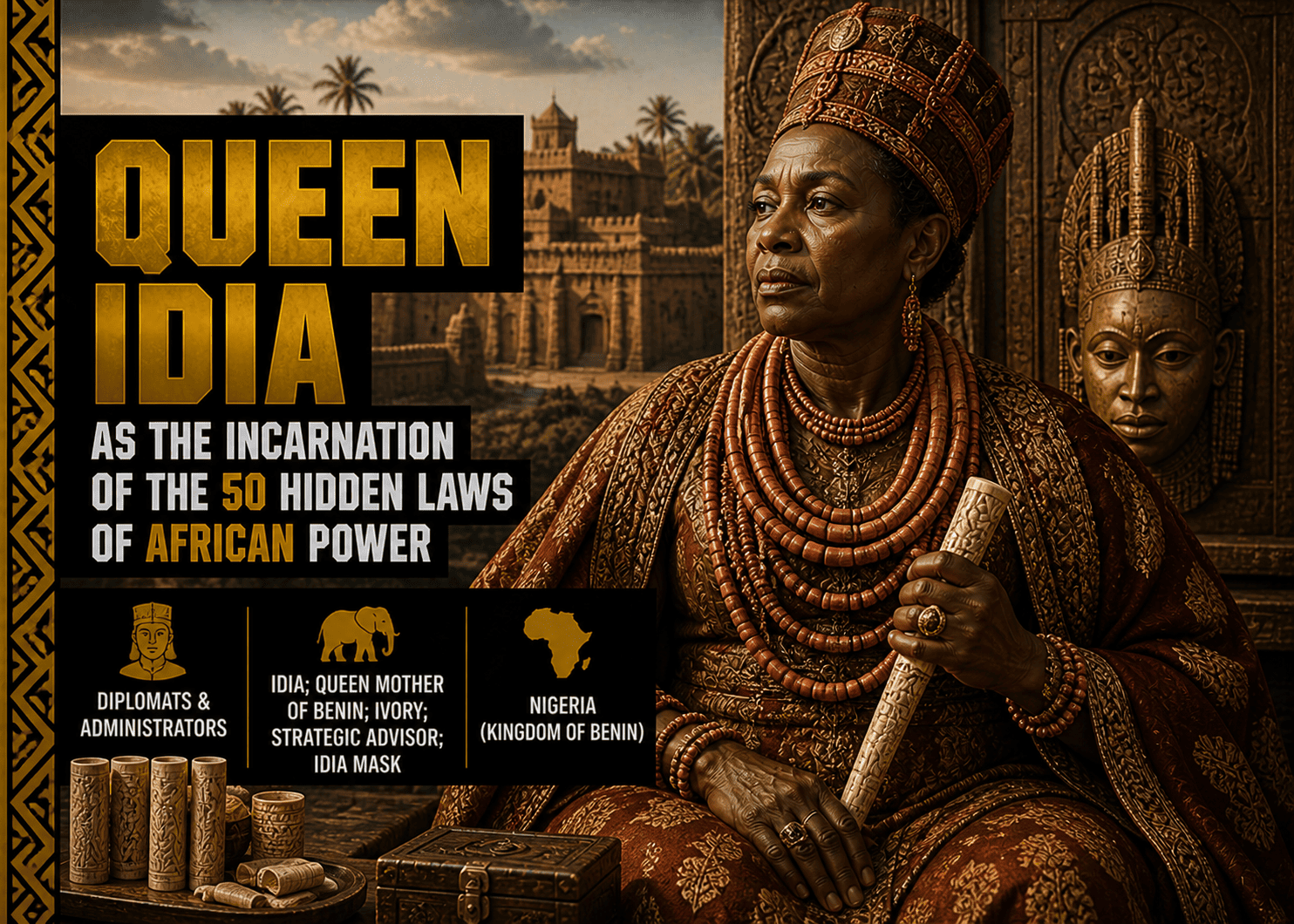
QUEEN IDIA — EMBODIMENT OF THE 50 HIDDEN LAWS OF AFRICAN POWER
Through war, diplomacy, and spirituality, the king’s mother shaped the Benin Empire and inspired generations of women.
I. HISTORICAL AND CIVILIZATIONAL CONTEXT
⭐ Who was Queen Idia? Queen Idia (16th century) was the Queen Mother (Iyoba) of the Benin Kingdom (in present‑day Nigeria). Wife of Oba Ozolua and mother of Oba Esigie, she played a decisive role in the civil war between Esigie and his half‑brother Arhuaran, saved her son from assassination, commanded armies, and became a major political and spiritual advisor. She is one of the first women in West African history to be immortalised in art (the famous ivory masks of the Queen Mother).
The Benin Empire in the 16th Century – a powerful and organised state
The Benin Kingdom was a prosperous empire, famous for its walls, palaces and bronze art. At the death of Oba Ozolua (c. 1504), a succession war broke out between his two sons: Esigie (Idia’s son) and Arhuaran (son of another wife). Idia, gifted with political and military genius, organised the resistance, gathered troops, and enabled Esigie to ascend the throne. She became the first “Iyoba” (Queen Mother) to receive her own palace and a hereditary title.
❓ What does “Iyoba” mean? “Iyoba” means “Queen Mother” in the Edo language. It is an honorary title created for Idia, who became the first woman to receive a separate palace and royal insignia. Since then, every Oba of Benin appoints an Iyoba – his own mother – granting her lands, chieftaincies, and a political role.
Spiritual and Cultural Context
Benin religion combined ancestor worship, nature deities, and mystical forces (“medicines”). Idia was renowned for her healing and priestly skills. She used her ritual knowledge to protect her son, to make war amulets, and to neutralise her enemies’ spells. This dual competence – military and spiritual – made her a near‑legendary figure.
🔗 CONNECTION TO THE 50 HIDDEN LAWS OF AFRICAN POWER
→ Law #1: Master Cosmic Balance (war and spirituality)
Points of convergence:
• Idia balanced warfare (command of armies) with the sacred (rites, healing, amulets) – a warrior queen and priestess.
• She united Benin’s clans around her son through diplomacy and faith – balance between the political and the religious.
• Modern application: African women leaders must know how to combine military force with spiritual authority – complete power is multiple.
• Strategic lesson: Enduring power comes from synthesising concrete action with symbolic legitimacy – Idia embodied this.
II. ORIGINS AND SOCIAL ASCENSION
❓ How did Idia become Queen Mother? Idia was the wife of Oba Ozolua and mother of Esigie. After her husband’s death, her son Esigie was challenged by his half‑brother Arhuaran. Idia organised the resistance, personally commanded troops, and secured Esigie’s victory. In recognition, her son granted her the title Iyoba, a palace, servants, royal insignia (including the famous ivory mask), and an official role in government.
Birth and Youth
Precise sources on her birth are sparse. Idia was probably born in the first half of the 15th century into a noble family of the Benin Kingdom. She was educated in Benin traditions: knowledge of medicinal herbs, rituals, warfare, and diplomacy. From an early age, she showed talents for leadership and negotiation.
Marriage to Oba Ozolua
She married Oba Ozolua, a warrior king who expanded Benin’s territory. From this union was born Prince Esigie. Idia established herself as a wise advisor, foreseeing succession conflicts.
The Rise: Civil War and Victory
Upon Ozolua’s death, Arhuaran, backed by powerful chiefs, tried to eliminate Esigie. Idia saved her son from an ambush, raised an army, and personally led the fighting. The decisive battle took place near the capital, Benin City. Idia is said to have fought on the frontline, wearing her famous ivory headdress. Esigie won and became Oba.
🔗 CONNECTION TO THE LAWS OF AFRICAN POWER
→ Law #3: “Transform Knowledge into Power”
Points of convergence:
• Idia used her knowledge of medicinal plants (pharmacopoeia) to heal the wounded and make war “medicines” – botanical knowledge as a weapon.
• Her mastery of rituals and chief psychology enabled her to win over the hesitant.
• Modern application: African women leaders must value endogenous knowledge (traditional medicine, local engineering) as levers for autonomy.
• Strategic lesson: Ground knowledge (healing, protective magic) can be as decisive as brute force – Idia proved it.
III. TITLES AND FUNCTIONS
❓ What titles did Idia hold? She was “Iyoba” (Queen Mother) – a title created for her – “commander‑in‑chief of the armies”, “political advisor”, “high priestess”, and “healer”. Benin art often depicts her with a horned headdress and a pearl collar, insignia of her rank.
- Iyoba (Queen Mother) – honorary title and political office.
- Commander‑in‑Chief – led troops alongside her son.
- Advisor to the Oba – influenced political decisions.
- High Priestess – responsible for sacred rites.
- Healer – expert in pharmacopoeia and “medicines”.
- Diplomat – negotiated alliances with local chiefs.
🔗 CONNECTION TO THE LAWS OF AFRICAN POWER
→ Law #12: “Become Indispensable to Power”
Points of convergence:
• Idia became indispensable to her son: without her, he would have lost the war and the throne – she was the regime’s keystone.
• She held multiple roles: mother, general, priestess, negotiator – irreplaceable.
• Modern application: Women leaders must acquire multiple skills (military, diplomatic, ritual) to become irreplaceable.
• Strategic lesson: Indispensability is won by solving crises that no one else can solve – Idia saved the Benin Kingdom.
IV. A WARRIOR QUEEN – COMMANDING ON THE BATTLEFIELD
❓ Did Idia really fight in battle? Benin oral traditions and reliefs depict her leading her troops in person, adorned with royal insignia (horned headdress, pearl collar). She was no symbolic figure; she commanded the army, attended war councils, and charged alongside the warriors.
Her most famous military action occurred during Arhuaran’s rebellion. She is said to have personally killed the rebel leader or inflicted a decisive defeat. Her courage inspired the troops. Later, she accompanied Esigie on campaigns against the Igala, Nupe, and other enemies of Benin. She was the first woman to receive the title of “commander‑in‑chief”.
🔗 CONNECTION TO THE LAWS OF AFRICAN POWER
→ Law #15: “Build Monuments That Speak for You”
Points of convergence:
• The ivory masks portraying her (including the one in the British Museum) are “speaking monuments” – they spread her image and power worldwide.
• The palace reliefs in Benin City depict her as a warrior – art as propaganda.
• Modern application: African women leaders must commission official portraits, statues, artworks – the image fixes the legend.
• Strategic lesson: An ivory portrait travels farther than a battlefield – artworks are silent ambassadors.
V. HEALER AND PRIESTESS – THE POWER OF THE INVISIBLE
Idia excelled in making amulets (igwe) and protective “medicines”. She prepared ointments to heal wounds, potions to strengthen warriors, and rituals to thwart enemy spells. Her palace housed shrines where she consulted oracles and performed ancestor cults. This spiritual role gave her an authority that military chiefs did not challenge.
🔗 CONNECTION TO THE LAWS OF AFRICAN POWER
→ Law #23: “Heal to Rule – The Power of the Healer”
Points of convergence:
• Idia “healed” her son Esigie by protecting him with amulets and treating wounds – medicine as a tool of legitimation.
• She purified sacred spaces and reassured the troops – spiritual therapy boosted morale.
• Modern application: African women leaders must understand popular beliefs to unite the masses – religious anchoring is a lever.
• Strategic lesson: Whoever heals body and mind wins unshakeable trust – Idia wielded this double power.
VI. THE QUEEN MOTHER IVORY MASK – AN ICON OF AFRICAN ART
❓ What is the famous Idia mask? An ivory carving depicting Queen Idia’s face, crowned with a horned headdress and wearing a pearl collar. It was made by Benin artisans in the 16th century. Four examples exist (British Museum, Metropolitan Museum of Art, etc.). This mask became the emblem of the World Festival of Black Arts (FESMAN) and features on the logo of the African Development Bank.
The mask symbolises the alliance between political power, military might and spirituality. The horns evoke strength and protection; the pearl collar, royal rank. It is one of the most photographed objects of African art.
🔗 CONNECTION TO THE LAWS OF AFRICAN POWER
→ Law #15: “Build Monuments That Speak for You” (continued)
Points of convergence:
• Idia’s mask is an intangible monument – its image is used by international institutions (AfDB, UNESCO).
• Every reproduction (stamps, posters, logos) spreads the queen’s name.
• Modern application: African women leaders should associate themselves with memorable artworks – a mask can become a continental symbol.
• Strategic lesson: A well‑designed artwork is more powerful than a treaty – Idia’s mask has crossed centuries.
VII. THE IYOBA INSTITUTION – INSTITUTIONALISED FEMALE POWER
Esigie formalised his mother’s role by creating the title of Iyoba, granting her a palace, lands, servants, and a seat on the royal council. Every new Oba now appoints his own mother as Iyoba. This was a major political innovation in an empire where women were often confined to domestic roles. The Iyoba commands a portion of the army, collects her own revenues, and can intervene in dynastic disputes.
🔗 CONNECTION TO THE LAWS OF AFRICAN POWER
→ Law #42: “Create a Legacy That Multiplies Your Power”
Points of convergence:
• The Iyoba institution has survived to this day – an active institutional legacy.
• The title has allowed hundreds of women to exercise political power – a multiplying legacy.
• Modern application: African women leaders must bequeath institutions (councils, ministries, positions) rather than only memories.
• Strategic lesson: An official position outlasts a lifetime – Idia created a post that immortalises her.
VIII. LEGACY – FROM BENIN ART TO MODERN FEMINISM
Idia is a major figure of Pan‑Africanism and African feminism. Her mask is displayed in the world’s greatest museums. She is cited by “Black is Beautiful” movements, historians (Bolanle Awe, Nwando Achebe), and contemporary artists. In Nigeria, streets, schools, and organisations bear her name. Her story is taught in national history textbooks.
🔗 CONNECTION TO THE LAWS OF AFRICAN POWER
→ Law #45: “Become a Symbol – When Your Name Becomes a Movement”
Points of convergence:
• “Idia” is a first name given in Nigeria today – her name evokes courage and female strength.
• Her mask is used by the African Development Bank as a logo – a Pan‑African symbol.
• Modern application: Women leaders must aim for their name to become a brand of resistance and leadership.
• Strategic lesson: A name associated with a continental financial institution gains practical immortality – Idia adorns the AfDB’s logo.
IX. SOURCES AND TESTIMONIES
❓ Where can you see Idia’s mask today? The British Museum (London) holds one example, the Metropolitan Museum of Art (New York) another, the Ethnological Museum of Berlin a third, and the National Museum of Nigeria (Lagos) the fourth. Copies are displayed in several African museums.
- Oral sources: Benin traditions, court chroniclers (Oba Eweka), court songs.
- Material sources: Ivory masks, Benin palace reliefs, bronzes.
- Written sources: British colonial archives, studies of Benin art (William Fagg, Paula Ben‑Amos).
- Secondary sources: “The Art of Benin” (Paula Girshick), “Idia: The Warrior Queen of Benin” (children’s book).
🔗 CONNECTION TO THE LAWS OF AFRICAN POWER
→ Law #28: “Control Your Narrative – History Belongs to the One Who Writes It”
Points of convergence:
• Idia’s story was preserved by oral tradition, less altered than colonial chronicles – griots as living archives.
• Europeans looted her masks, but these objects became witnesses to her glory – plunder did not erase memory.
• Modern application: African women leaders must record oral traditions and compare them with Western archives – memory is a reconquest.
• Strategic lesson: A stolen object can become an ambassador – Idia’s masks speak of her in the British Museum.
X. MYSTERIES AND UNSOLVED QUESTIONS
❓ Where is Idia’s tomb? She is believed to be buried in the Iyoba palace in Benin City, but the site has never been archaeologically identified. Some traditions speak of a secret cave in the Iwebo quarter.
❓ Why do depictions of Idia have horns? The horns symbolise strength, spiritual power, and protection against evil spells. They also refer to the buffalo war god.
❓ Is there reliable evidence of her existence? The evidence is primarily artistic (ivories, bronzes) and oral traditions. Written European sources are later. Her historicity is, however, accepted by Benin specialists.
🔗 CONNECTION TO THE LAWS OF AFRICAN POWER
→ Law #37: “Cultivate Mystery – What Is Hidden Fascinates”
Points of convergence:
• The unlocated tomb and vague details of her birth feed legends – mystery makes her greater.
• The ivory masks, with no written explanation, have given rise to multiple interpretations.
• Modern application: Women leaders may leave parts of their private lives undocumented – enigma strengthens heroisation.
• Strategic lesson: Biographical vagueness allows each generation to reinterpret – Idia remains an open figure.
XI. FAQ – FREQUENTLY ASKED QUESTIONS ABOUT QUEEN IDIA
❓ What was Idia’s relationship with the Portuguese? During Esigie’s reign, Benin traded with the Portuguese (ivory, pepper, cloth). Idia is said to have advised her son in these exchanges, never submitting to Portuguese tutelage.
❓ Why did Idia’s mask become a Pan‑African symbol? At the first World Festival of Black Arts (FESMAN, 1966), the mask was chosen as the emblem. It symbolises the beauty, strength and creativity of Africa. The African Development Bank adopted it as its logo.
❓ Is there a film about Idia? No Hollywood feature, but documentaries (BBC, “The Art of Benin”) and Nigerian animations exist. Series projects are underway.
XII. LESSONS AND CONTEMPORARY RELEVANCE
💡 What can Africa learn from Queen Idia? Idia teaches that an African woman can command armies, de facto rule an empire, and leave a global artistic legacy. She shows the importance of female leadership in times of crisis, the alliance of spiritual and military power, and the need to institutionalise official roles for women. Contemporary leaders must draw inspiration from her audacity, her versatility, and her use of art as a tool of memory.
Women’s leadership in crisis: Idia saved her son and the empire – women must dare to take up arms and speak out.
Art as soft power: Idia’s masks still speak – every leader should leave a work of art for posterity.
Institutionalise women’s roles: By creating the Iyoba title, she paved the way for generations – women must push for official positions.
The union of the sacred and the political: Her spiritual credibility strengthened her authority – the religious dimension is not to be neglected.
🔗 CONNECTION TO THE LAWS OF AFRICAN POWER
→ Law #5: “Master Multiple Domains – The Power of the Renaissance”
Points of convergence:
• Idia was simultaneously warrior, priestess, diplomat, mother, advisor – a female polymath.
• She combined military force, medicinal knowledge, ritual art, and political strategy – a holistic vision.
• Modern application: African women leaders must be versatile – the continent’s renaissance needs complete women.
• Strategic lesson: A queen can be both mother and warrior, gentle and inflexible – Idia broke gender stereotypes.
CONCLUSION: IMMORTALITY THROUGH THE IVORY MASK
Idia remains, five centuries after her death, one of the most iconic figures of African women’s leadership. Her journey – king’s wife, king’s mother, warrior, healer, institution‑builder – testifies to the power of intelligence, courage, and faith. She did not rule alone, but she ruled through influence, the sword, and prayer.
For contemporary Africa and its diaspora, Idia represents the Queen Mother who turned a chaotic succession into a prosperous empire, and whose face carved in ivory still shines. She reminds us that African women have always been political, military and spiritual actors, long before written history silenced them. Her name, Idia, resonates as a challenge: may every African woman today dare to wear the horns of power, may every leader know how to blend maternal tenderness with command firmness, and may art become the memorial of their deeds.
🔗 SYNTHESIS: QUEEN IDIA AS THE EMBODIMENT OF THE HIDDEN LAWS OF AFRICAN POWER
📜 Summary of the laws embodied by Idia: Balance (#1), Knowledge as Power (#3), Polymathy (#5), Control of Time (#8), Indispensability (#12), Monuments (#15), Healing through ritual (#23), Narrative Control (#28), Mystery (#37), Multiplicative Legacy (#42), Symbol (#45), Immortality (#50).
- Law #1 (Balance) – War and spirituality, diplomacy and seduction, mother and chief.
- Law #3 (Knowledge as Power) – Knowledge of medicinal plants, rituals, military tactics.
- Law #5 (Polymathy) – Warrior, priestess, healer, diplomat – complete genius.
- Law #8 (Control of Time) – Anticipating civil war, using ritual cycles.
- Law #12 (Indispensability) – Only person who could save Esigie and the empire – focal point.
- Law #15 (Monuments) – Ivory masks, reliefs, palace – tangible and intangible monuments.
- Law #23 (Heal to Rule) – Healing bodies and minds – complete therapy.
- Law #28 (Control of Narrative) – Benin oral traditions vs colonial accounts – double reading.
- Law #37 (Mystery) – Unknown tomb, vague birth, magical details – powerful mysteries.
- Law #42 (Multiplicative Legacy) – Iyoba institution, influence on African art – active legacy.
- Law #45 (Symbol) – “Idia” = warrior woman, queen mother, Pan‑African icon – living concept.
- Law #50 (Immortality) – Masks in the British Museum, AfDB logo – eternal presence.
Practical Application for the Modern Leader:
✅ Dare to command – a woman can lead armies and govern
✅ Master local knowledge – pharmacopoeia and rites are weapons
✅ Bequeath institutions – an official title will survive your death
✅ Commission art – a mask, statue, fresco carries your message
✅ Cultivate mystery – a lost tomb or shadow zones enlarge the legend.
The Queen Idia Challenge for You:
“What institution will you create so that women after you have official power? What ‘mask’ (artwork, logo) will you leave so that your image spans centuries?”