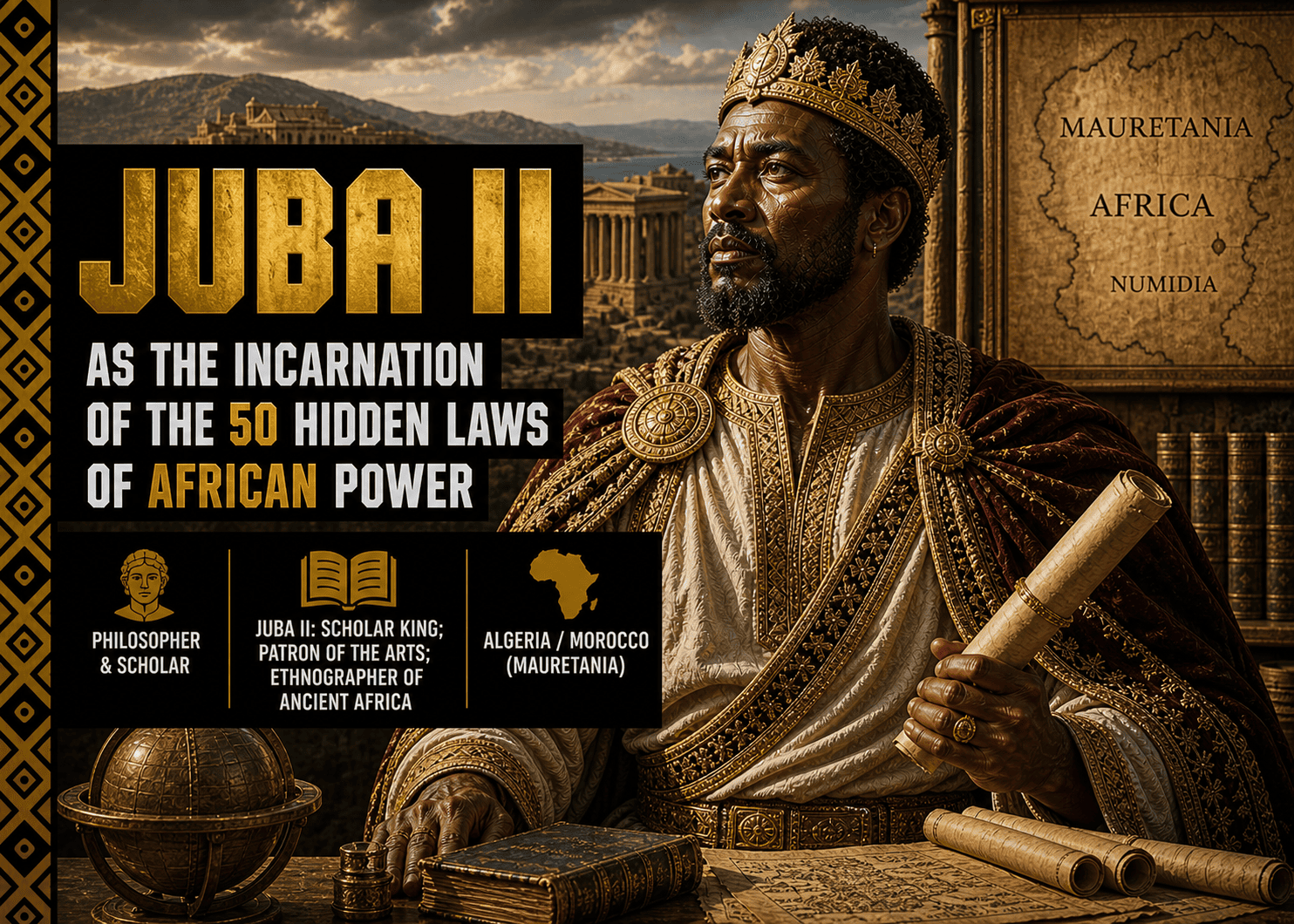
JUBA II — EMBODIMENT OF THE 50 HIDDEN LAWS OF AFRICAN POWER
Through scholarship, diplomacy, and state‑building, the scholar‑king of Mauretania united Africa with Rome without losing his soul.
I. HISTORICAL AND CIVILIZATIONAL CONTEXT
⭐ Who was Juba II? Juba II (c. 48 BCE – 23 CE) was the last king of Numidia (30‑25 BCE) and then ruler of Mauretania (25 BCE – 23 CE), a vast kingdom covering parts of modern‑day Algeria and Morocco. He is famed for his immense learning: a prolific writer in Greek and Latin, historian, geographer, botanist, and patron of the arts. Raised in Rome as a hostage, he became one of Emperor Augustus’s closest friends. He married Cleopatra Selene II, daughter of Cleopatra VII and Mark Antony, and founded a dynasty that left its mark on ancient North Africa.
North Africa at the Turn of the Era – between Carthage, Rome and the Berber Kingdoms
After the fall of Carthage (146 BCE), North Africa was divided between the Numidian kingdom (an ally then a client of Rome) and scattered Roman colonies. The Roman civil wars (Caesar vs Pompey) tore the region apart. Juba II’s father, Juba I, king of Numidia, chose the wrong side (Pompey) and was defeated by Caesar at the Battle of Thapsus (46 BCE). He committed suicide, and his kingdom was annexed. The young Juba II, about five years old, was taken to Rome as a hostage and a prized captive.
❓ What does the name “Juba” mean? “Juba” is the Latinised form of a Berber name, probably “Yuba” or “Yuva”, meaning “king” or “chief”. The name was borne by several Numidian rulers. Juba II added “Gaius Julius” to his name to honour his Roman protectors.
Economic and Cultural Context
Mauretania was rich in grain, Tyrian purple (a prized dye), timber, and sea products, making it a strategic region for Mediterranean trade. Juba II turned it into a prosperous kingdom, exporting to Rome, Spain, and Italy. He struck high‑quality gold coinage and developed trade with interior Africa.
🔗 CONNECTION TO THE 50 HIDDEN LAWS OF AFRICAN POWER
→ Law #1: Master Cosmic Balance (knowledge and power, Africa and Rome)
Points of convergence:
• Juba II balanced political subordination (client king of Rome) with cultural independence (Greek scholarship, Berber pride).
• He combined economic power (coinage, agriculture, trade) with intellectual radiance (library, written works).
• Modern application: African leaders must know how to combine mastery of foreign languages and networks with deep roots in local cultures.
• Strategic lesson: Enduring power comes from balancing external influence (alliance with the powerful) with internal construction (cultures, institutions).
II. ORIGINS AND SOCIAL ASCENSION
❓ How did Juba II, a hostage in Rome, become a king? After his father’s defeat, Juba II was taken to Rome and raised in the household of Julius Caesar, then of Octavia (Augustus’s sister). He received the best possible education, became a Roman citizen, and befriended Octavian (the future Emperor Augustus). In 30 BCE, Augustus, grateful for his services at the Battle of Actium, restored him to the throne of Numidia, and in 25 BCE gave him the enlarged kingdom of Mauretania.
Birth and Lineage
Juba II was born around 48 BCE at Hippo (present‑day Annaba, Algeria). He was the only son of Juba I, king of Numidia, and descended from the dynasty of Numidian kings, a Berber line that went back to Massinissa. Orphaned at age five, he was taken as a hostage to Rome. Far from being mistreated, he was welcomed into Caesar’s household and later raised by Octavia, Augustus’s sister. There he mingled with the Roman elite and received an exceptional education.
Education and Training
In Rome, Juba II studied Greek and Latin, perfected his knowledge of rhetoric, philosophy, history, geography, and mathematics. Plutarch described him as “one of the most gifted rulers of his time.” By age twenty, he had already written a treatise on Roman archaeology. He also learned the art of war alongside Octavian, notably at the Battle of Actium (31 BCE). This dual culture – Berber by blood, Greco‑Roman by education – made him a unique king.
The Rise: From Numidia to Mauretania
In 30 BCE, Augustus restored Juba II as king of Numidia. But five years later, in 25 BCE, he took that kingdom away (making it a Roman province) and gave him Mauretania instead – a much larger territory (present‑day Morocco and Algeria). This transfer was not a demotion: Augustus trusted Juba to control a frontier region and turn it into a prosperous client state.
🔗 CONNECTION TO THE LAWS OF AFRICAN POWER
→ Law #3: “Transform Knowledge into Power”
Points of convergence:
• Juba II used his knowledge of languages (Latin, Greek, Punic, Berber) to dialogue with three worlds – African, Greek, Roman.
• His military training and loyalty to Augustus won him the emperor’s trust – knowledge acquired in Rome became a diplomatic asset.
• Modern application: African leaders must master the languages and codes of foreign powers without denying their roots.
• Strategic lesson: Exile (or captivity) can be an opportunity for learning – Juba II turned a hereditary defeat into a springboard.
III. TITLES AND FUNCTIONS
❓ What titles did Juba II hold? Juba II was king of Numidia (30‑25 BCE), king of Mauretania (25 BCE – 23 CE), honorary duumvir in Spain, Roman citizen, “friend and ally of the Roman people”. He was also a writer, historian, geographer and botanist.
- King of Numidia – 30‑25 BCE (5 years).
- King of Mauretania – 25 BCE – 23 CE (48 years).
- Roman citizen – full name: Gaius Iulius Iuba (to honour Caesar).
- Honorary duumvir – civil magistrate of the Roman colonies in Spain (Gades, Carthago Nova).
- Scholar and author – many treatises (Libyca, Arabica, Similitudes…).
- Patron of the arts and sciences – head of an intellectual school.
🔗 CONNECTION TO THE LAWS OF AFRICAN POWER
→ Law #12: “Become Indispensable to Power”
Points of convergence:
• Juba II was the only African ruler who could speak as an equal with Augustus and his generals – his erudition and loyalty made him indispensable to Rome’s African balance.
• As a client king, he combined the functions of sovereign, ambassador, military advisor and intellectual – a pivot‑king.
• Modern application: African leaders must make themselves indispensable by offering rare skills (linguistic, cultural, economic expertise) that powers cannot find elsewhere.
• Strategic lesson: Indispensability is built through mastery of multiple fields (languages, history, diplomacy) – a one‑dimensional leader is always replaceable.
IV. CLEOPATRA SELENE II – THE UNION OF TWO WORLDS
❓ Who was Cleopatra Selene II, Juba II’s wife? Cleopatra Selene II (40 BCE – 5 BCE / 5 CE) was the daughter of Cleopatra VII, queen of Egypt, and the Roman triumvir Mark Antony. Taken in by Octavia after her parents’ defeat, she was raised in Rome. Augustus gave her in marriage to Juba II around 25 BCE, formalising the alliance between the Numidian dynasty and the Lagid heritage. She ruled as co‑sovereign and was often depicted on Mauretanian coins.
This marriage was a diplomatic masterstroke by Augustus. It joined the most educated Numidian king with a most prestigious Egyptian princess. Selene exercised considerable influence on Juba II’s policies: she encouraged artistic patronage, Hellenistic architecture, and trade expansion. The couple transformed their capital, Caesarea (Cherchell), into a “new Alexandria”, blending Egyptian, Greek and Roman styles.
🔗 CONNECTION TO THE LAWS OF AFRICAN POWER
→ Law #15: “Build Monuments That Speak for You”
Points of convergence:
• The capital Caesarea, with its forums, theatres, baths and temples, is a living monument of the royal couple – every building speaks their name.
• The coins struck with their effigy spread their image as enlightened rulers throughout the Mediterranean basin.
• Modern application: African leaders must invest in cultural architecture (museums, universities, libraries) as monuments of their vision.
• Strategic lesson: A successful capital city is a true “speaking monument” – Juba II made Caesarea a showcase of his power.
V. LITERARY WORK – A KING DEDICATED TO KNOWLEDGE
❓ What books did Juba II write? Juba II was a prolific author. His known works include: “Roman Archaeology” (2 books), “Similitudes” (comparisons between Greeks and Romans, 15 books), “History of Painting” (8 books), “History of Theatre” (17 books), “Libyca” (3 books), “Arabica”, “On Assyria” (2 books), a translation of “Hanno’s Periplus”, “On Euphorbion” (pamphlet). Unfortunately, all his writings are lost; only about one hundred citations survive, mainly in Pliny the Elder (65 references), Plutarch, Athenaeus and Galen.
Juba II is cited 65 times in Pliny the Elder’s Natural History, who considered him an authority on geography, zoology and botany. He assembled a huge library at Caesarea, attracting Greek, Roman, Egyptian and Punic scholars. He named the plant Euphorbia after his physician Euphorbus. The botanist Linnaeus later dedicated the genus Jubaea (palm) to him in homage.
🔗 CONNECTION TO THE LAWS OF AFRICAN POWER
→ Law #42: “Create a Legacy That Multiplies Your Power”
Points of convergence:
• The library of Caesarea and the citations of his works in ancient texts ensured Juba II’s intellectual posterity – active legacy.
• The botanical genera (Jubaea, Euphorbia) recall his name to every botanist – scientific legacy.
• Modern application: African leaders must invest in libraries, archives and scientific research – knowledge is a form of immortality.
• Strategic lesson: A scholar‑king outlasts a warrior‑king – Euphorbia plants still bear his name two millennia later.
VI. GEOGRAPHICAL EXPEDITIONS – DISCOVERING THE CANARY ISLANDS
❓ Did Juba II discover the Canary Islands? According to Pliny the Younger, Juba II sent a naval expedition to the “Fortunate Isles”, which discovered the Canary Islands and Madeira. He named them “Canaries” (from Latin canis, dog) because the expedition found large fierce dogs there. He identified and named five islands: Canaria (Gran Canaria), Nivaria (Tenerife), Capraria, Iunonia Maior (La Palma) and Ombrios (El Hierro). These discoveries had a lasting influence on ancient cartography.
This expedition illustrates Juba II’s interest in scientific exploration. He also sent missions into the Atlas Mountains and perhaps to the sources of the Nile. These explorations provided data for his geographical writings (Libyca). Pliny the Elder made extensive use of this information.
🔗 CONNECTION TO THE LAWS OF AFRICAN POWER
→ Law #8: “Master Cycles – Time as a Weapon”
Points of convergence:
• Juba II used the long time of exploration to accumulate geographical knowledge – science as a long‑term project.
• He timed his expeditions with favourable seasons and logistical preparation – mastery of maritime cycles.
• Modern application: African leaders must plan long‑term scientific and exploration projects – results may not be immediate, but they mark history.
• Strategic lesson: A king who explores and names territories writes his name on the map – Juba II christened islands for eternity.
VII. THE ROYAL MAUSOLEUM OF MAURETANIA – THE LAST DWELLING
❓ Where is Juba II’s tomb? Juba II and Cleopatra Selene II were buried in the Royal Mausoleum of Mauretania (“Tomb of the Christian Woman”), located in Algeria between Tipaza and Cherchell. It is a Numidian‑style monument, 40 metres high, dating from the 3rd century BCE or the time of Juba. The tomb has been emptied of its funerary furniture; the remains of the rulers have never been found.
This mausoleum, called “Kbour‑er‑Roumia” (tomb of the Christian woman), impresses by its size and architecture blending local, Greek and Hellenistic influences. Tradition attributes it to Juba II, but archaeologists have not been able to confirm its funerary purpose for lack of furniture. It remains a symbol of the power of Mauretania under Juba II.
🔗 CONNECTION TO THE LAWS OF AFRICAN POWER
→ Law #50: “Transcend Death – The Art of Immortality”
Points of convergence:
• Even if the tomb is empty, the monument speaks – it testifies to the grandeur of Juba II’s kingdom.
• The mystery surrounding the actual remains strengthens the legend – the absence of physical proof does not erase memory.
• Modern application: African leaders must bequeath mausoleums, statues or monuments – stone outlives dynasties.
• Strategic lesson: An empty burial can feed myths – the tomb of Juba II is a national pilgrimage site in Algeria.
VIII. LEGACY – THE FATHER OF AFRICAN NATURAL HISTORY
Today, Juba II is recognised as one of the greatest intellectuals of the ancient world. His library inspired generations of scholars. Botanical names (Jubaea, Euphorbia regis‑jubae, etc.) perpetuate his memory. In Algeria and Morocco, streets, schools and squares bear his name. The recent rediscovery of his work by Algerian researchers (e.g. Stéphanie Guédon) places him back at the centre of African history. He is often cited as a precursor of Mediterranean and African unity.
🔗 CONNECTION TO THE LAWS OF AFRICAN POWER
→ Law #45: “Become a Symbol – When Your Name Becomes a Movement”
Points of convergence:
• “Juba” is a given name in North Africa – it evokes learning and sovereignty.
• The genus Jubaea (Chilean palm) recalls his contribution to botany – a scientific name as immortality.
• Modern application: African leaders should aim for their name to be associated with a discipline, a genus, or an innovation.
• Strategic lesson: A plant that bears your name lasts longer than a statue – Juba II still reigns in herbaria.
IX. SOURCES AND TESTIMONIES
❓ Where can one see statues of Juba II today? Busts of Juba II are preserved at the Louvre (Paris), the Archaeological Museum of Cherchell (Algeria), the Ny Carlsberg Glyptotek (Copenhagen) and the National Museum of Madrid. Coins bearing his effigy can be seen at the Bibliothèque nationale de France.
- Ancient sources: Pliny the Elder (Natural History), Plutarch, Strabo, Athenaeus, Philostratus, Galen.
- Epigraphic sources: Inscriptions from Caesarea (Cherchell) and Volubilis, Mauretanian coins.
- Archaeological sources: Site of the capital Caesarea, baths, forum, theatre, Mausoleum of Mauretania.
- Secondary sources: Stéphanie Guédon, “Juba II: l’Afrique au défi de Rome” (2025); Duane W. Roller, “The World of Juba II and Kleopatra Selene” (2003).
🔗 CONNECTION TO THE LAWS OF AFRICAN POWER
→ Law #28: “Control Your Narrative – History Belongs to the One Who Writes It”
Points of convergence:
• Juba II wrote his own history in Greek and Latin – he controlled the narrative of his life, even as a client king.
• The citations of his works in Pliny and other authors made him a reference – writing as a weapon of posterity.
• Modern application: African leaders must write their memoirs, publish essays, build digital archives – personal narrative resists external manipulation.
• Strategic lesson: If you do not control your story, others will – Juba II chose the pen as a weapon.
X. MYSTERIES AND UNSOLVED QUESTIONS
❓ Why are Juba II’s works lost? No one knows for certain. His library may have burned during invasions or been scattered. The early Church may have neglected pagan texts. Only quotations in Pliny, Plutarch and other ancient authors survive.
❓ Did Juba II really send an expedition to America? Pseudoscientific theories (Frank Joseph) claim a Numidian fleet reached Illinois. No serious archaeological evidence supports this. The scientific community rejects it.
❓ What was Juba II’s Berber name? In late Arabic and Berber sources, he is called “Yuba wis sin” (Juba the second). The name “Yuba” (ⵢⵓⴱⴰ) remains an Amazigh first name still used in the Maghreb.
🔗 CONNECTION TO THE LAWS OF AFRICAN POWER
→ Law #37: “Cultivate Mystery – What Is Hidden Fascinates”
Points of convergence:
• The lost works of Juba II excite the imagination of scholars – every rediscovered quotation is a treasure.
• The un‑identified tomb (even though the mausoleum stands) fuels legends – the funerary void becomes a mystery.
• Modern application: Leaders may voluntarily leave shadow zones in their lives – enigma keeps posthumous interest alive.
• Strategic lesson: A lost work is sometimes more fascinating than a recovered one – Juba II remains a literary mystery.
XI. FAQ – FREQUENTLY ASKED QUESTIONS ABOUT JUBA II
❓ What was Juba II’s religion? He probably practised Roman polytheism but respected local Berber and Egyptian cults. No evidence of conversion to Judaism or Christianity.
❓ Did Juba II have children? Yes, from his first marriage with Cleopatra Selene: Ptolemy of Mauretania (who succeeded him) and a daughter (perhaps Drusilla). From his second marriage with Glaphyra he had no children.
❓ Why is Juba II less famous than other African kings (Massinissa, Cleopatra)? Because he was overshadowed by the military glory of some (Hannibal, Massinissa) and the romanticism of Ptolemaic Egypt. But historians are rehabilitating him as a genius of diplomatic intelligence.
XII. LESSONS AND CONTEMPORARY RELEVANCE
💡 What can Africa learn from Juba II? Juba II teaches that a hostage can become a respected sovereign, that a client king can remain an independent intellectual. He shows the importance of education, language mastery, diplomatic alliances, and scientific patronage. Today’s African leaders must become “modern Juba IIs”: train a cultivated elite, dialogue with world powers while preserving local specificities, and bequeath lasting works (books, universities, museums).
Education as a lever of power: Juba II turned his captivity into a school – leaders must fund elite education.
Culture as soft power: He conquered Rome by his books, not by arms – cultural diplomacy is a major weapon.
Build lasting institutions: The library and capital Caesarea survived – educational and cultural infrastructure are political legacies.
Alliance without submission: He was Augustus’s friend while remaining a king – never a vassal. Knowing how to cooperate without abdicating.
🔗 CONNECTION TO THE LAWS OF AFRICAN POWER
→ Law #5: “Master Multiple Domains – The Power of the Renaissance”
Points of convergence:
• Juba II was simultaneously king, diplomat, historian, geographer, botanist, patron – an exceptional polymath.
• He combined Africa (Berber roots) and Europe (Roman education, Greek culture), literature and sciences, war and peace.
• Modern application: African leaders must be versatile – the continent’s renaissance needs leaders able to think about economics, science, art and diplomacy simultaneously.
• Strategic lesson: The most powerful king of ancient North Africa was not the most warlike, but the most learned – the power of knowledge exceeds that of armies.
CONCLUSION: IMMORTALITY THROUGH KNOWLEDGE AND STONE
Juba II remains, two thousand years after his death, one of the most fascinating African rulers. His journey – hostage prince, scholar king, builder of Caesarea – testifies to the power of education, diplomacy and culture. He did not conquer vast empires, but he turned Mauretania into a prosperous kingdom, an ally of Rome, and proud of its African roots.
For contemporary Africa and its diaspora, Juba II represents the model of the intellectual leader – one who governs by the book as much as by the sword. He reminds us that Africa does not need to invent heroes for itself; it already has them, men who knew how to blend Greek learning with Berber wisdom, Cordovan mathematics with Nilotic science. His name, Juba II, resonates as a challenge: may every African leader today know how to wield the pen as skilfully as the tool, negotiation as well as construction, and inscribe his passage in libraries as well as in marble.
🔗 SYNTHESIS: JUBA II AS THE EMBODIMENT OF THE HIDDEN LAWS OF AFRICAN POWER
📜 Summary of the laws embodied by Juba II: Balance (#1), Knowledge as Power (#3), Polymathy (#5), Control of Time (#8), Indispensability (#12), Monuments (#15), Healing through culture (#23), Narrative Control (#28), Mystery (#37), Multiplicative Legacy (#42), Symbol (#45), Immortality (#50).
- Law #1 (Balance) – Africa and Rome, Berber tradition and Hellenism, war and science.
- Law #3 (Knowledge as Power) – Mastery of languages (Berber, Latin, Greek, Punic), writing of encyclopaedias.
- Law #5 (Polymathy) – King, historian, geographer, botanist, patron – a complete genius.
- Law #8 (Control of Time) – Canary expeditions, the library, study over decades.
- Law #12 (Indispensability) – The only African to advise Augustus and converse as an equal.
- Law #15 (Monuments) – Caesarea (Cherchell), mausoleum, forums, theatres – speaking monuments.
- Law #23 (Heal to Rule) – Culture as “healing” from the shock of civil wars – unity through knowledge.
- Law #28 (Control of Narrative) – His books spread his vision – he controlled his image.
- Law #37 (Mystery) – Empty tomb, lost works, phantom expeditions – fertile mysteries.
- Law #42 (Multiplicative Legacy) – Pliny the Elder, Galen, Jubaea (palm), Euphorbia – active scientific legacy.
- Law #45 (Symbol) – “Juba II” = intellectual excellence, enlightened African sovereignty.
- Law #50 (Immortality) – His name graces herbaria, his citations traverse millennia – eternal presence.
Practical Application for the Modern Leader:
✅ Invest in education and languages – knowledge is the most discreet and lasting weapon
✅ Create cultural institutions (libraries, museums, universities) – they will outlive your reign
✅ Master diplomatic alliances – know how to cooperate with powers without becoming a vassal
✅ Document your actions – write, archive, publish – written records defy oblivion
✅ Be multidisciplinary – a complete leader is worth more than a narrow specialist.
The Juba II Challenge for You:
“What ‘Caesarea library’ will you build for your people? Will you, like Juba II, turn initial captivity into a work of scholarship and global radiance?”