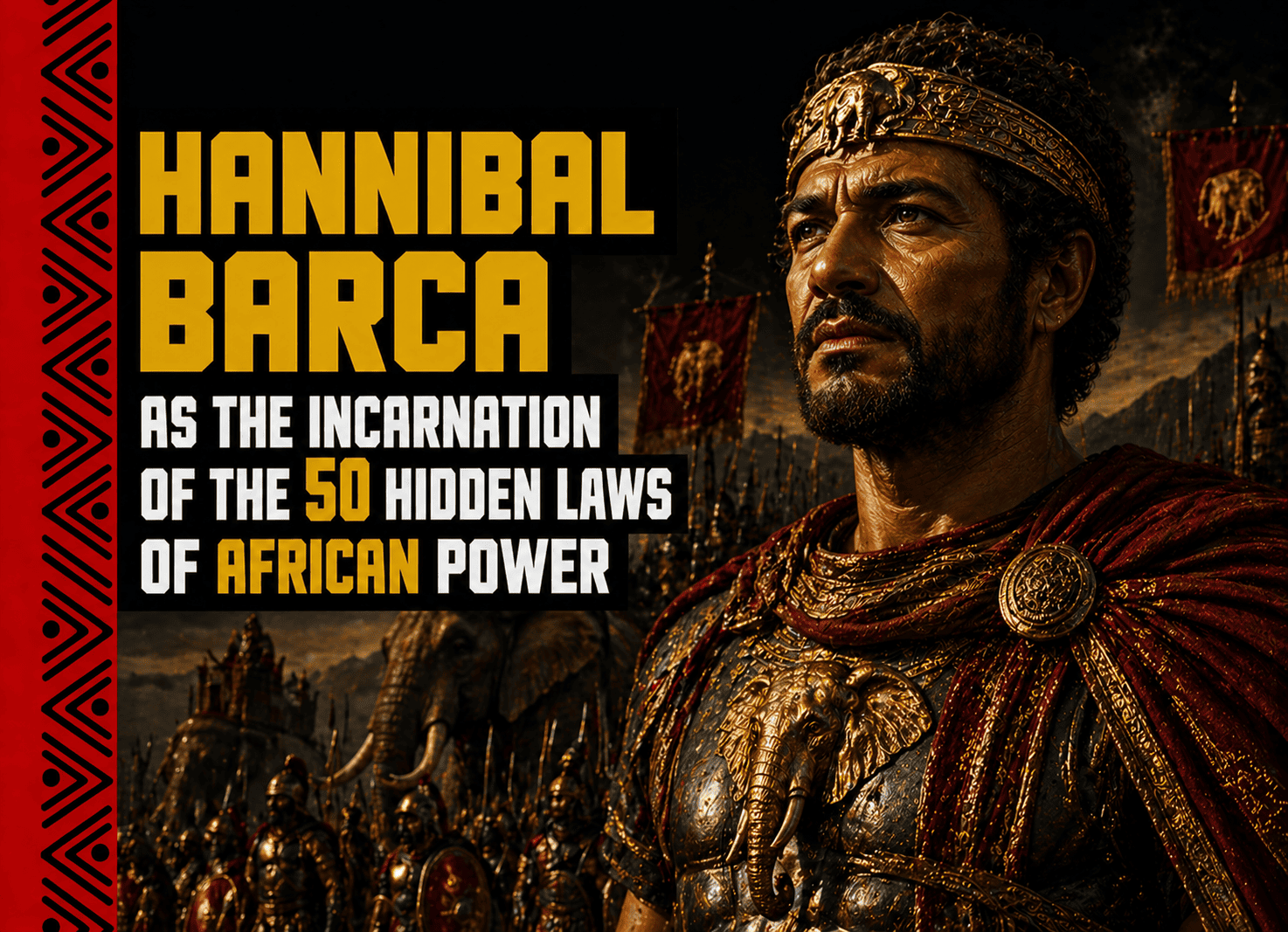
HANNIBAL BARCA — EMBODIMENT OF THE 50 HIDDEN LAWS OF AFRICAN POWER
Through cunning, strategy, and an iron will, the son of Carthage defied Rome and inspired modern warfare.
I. HISTORICAL AND CIVILIZATIONAL CONTEXT
Carthage and the Mediterranean in the 3rd Century BCE
Hannibal Barca (247‑183 BCE) is one of the greatest military strategists in history, hailing from the powerful city‑state of Carthage – a Phoenician colony on the coast of present‑day Tunisia. Carthage was then one of the wealthiest and most influential metropolises in the Mediterranean, controlling western trade routes and possessing a maritime empire stretching from North Africa to Spain and the Mediterranean islands.
The rivalry with the expansionist, ruthless Roman Republic degenerated into three conflicts: the Punic Wars. Hannibal, commander‑in‑chief of the Carthaginian armies during the Second Punic War (218‑201 BCE), is remembered for his daring crossing of the Alps with war elephants and his string of crushing victories against Rome, culminating in the Battle of Cannae (216 BCE), one of the absolute tactical masterpieces of military history.
The Spiritual and Cultural Context
Carthage, though deeply influenced by its Phoenician roots (cults of Baal, Tanit, Melqart), was also a melting pot of Libyan, Numidian, Greek and Egyptian influences. Hannibal was steeped in this composite culture, but his family – the Barcids – had local African ancestry, with some historians suggesting his mother may have been a Numidian princess. He spoke several languages (Punic, Greek, possibly Libyan) and knew Greek and Hellenistic tactics.
At the age of nine, he swore an oath before the altar of Baal to eternally hate Rome – a religious and political act that sealed his destiny. This sacred dimension of the oath (the famous “Hannibalic Oath”) permeated his entire career: war was not merely a clash of legions, but an almost religious mission to save Carthage from annihilation.
🔗 CONNECTION TO THE 50 HIDDEN LAWS OF AFRICAN POWER
→ Law #1: Master Cosmic Balance (Baal and Strategy)
Points of convergence:
• Hannibal balanced the sacred (oath, piety) with the pragmatic (alliances with Gallic tribes, espionage, cunning).
• He embodied African resistance to Roman imperialism – Carthage as “Africa standing up” against the invader.
• Modern application: African leaders must combine moral principles (oaths, traditions) and tactical flexibility to resist domination.
• Strategic lesson: Enduring power comes from balancing faith in one’s cause with adaptable means – Hannibal never swore to destroy Rome by the same method twice.
II. ORIGINS AND SOCIAL ASCENSION
Birth and Family
Hannibal was born in 247 BCE in Carthage (present‑day Tunisia). He was the eldest son of the great general Hamilcar Barca, hero of the First Punic War. His name “Hannibal” means “Grace of Baal” (the Phoenician god). The Barca family was one of the most powerful in the Carthaginian oligarchy, hostile to Rome and favoring expansion in Spain to compensate for Sicilian losses.
His father took him to Spain as a child, where he grew up in military camps. Three of his brothers – Hasdrubal, Mago, and another Hasdrubal (called the Fair) – would become generals alongside him. He married a Iberian‑Celtiberian princess, Imilce, to consolidate alliances in Hispania.
Education and Training
Hannibal received a rigorous and encyclopedic military education:
- Greek strategy and tactics (study of Alexander the Great, Epaminondas).
- Command of multi‑national forces (Carthaginians, Numidians, Iberians, Gauls).
- Geography and climatology of the Alps and Italy.
- Languages: Punic, Greek, Latin (learned later), likely Libyan and Celtic.
- Military engineering (construction of siege machines, logistics).
This hands‑on training, supplemented by the study of classics, made him an exceptional leader of men, capable of lightning decisions and unparalleled cunning.
The Rise to Supreme Command
At 26, after the assassination of his brother‑in‑law Hasdrubal (Hamilcar’s successor), the Spanish army acclaimed Hannibal as commander‑in‑chief. The reluctant Carthaginian government confirmed his authority. He spent two years consolidating Hispania, allying with Gallic tribes, and planning the invasion of Italy. In 218 BCE, he triggered the Second Punic War by seizing Saguntum, a Roman ally.
🔗 CONNECTION TO THE LAWS OF AFRICAN POWER
→ Law #3: “Transform Knowledge into Power”
Points of convergence:
• Mastery of foreign languages (Greek, Celtic) allowed Hannibal to negotiate alliances and spy on enemies without interpreters.
• His knowledge of logistics and engineering turned a handicap – the Alpine crossing – into a legendary feat.
• Modern application: African leaders must invest in language and technology training to turn the tables on established powers.
• Strategic lesson: Accumulated knowledge is useless without the ability to adapt it in times of crisis – Hannibal improvised and combined.
III. TITLES AND FUNCTIONS
Hannibal held multiple titles within the Carthaginian state and army:
- Commander‑in‑Chief of the Carthaginian armies (Imperator / Strategos autokrator).
- Governor of Carthaginian Hispania (administration of mines, recruitment).
- Supreme Commander of the allied forces (Carthaginians, Numidians, Iberians, Gauls).
- Strategist of the Second Punic War (conceiver of the overall strategy).
- Suffete (supreme magistrate) of Carthage after 196 BCE – he reformed the city’s finances and politics.
These titles reflect the extent of his authority: he was at once military chief, colonial administrator, diplomat and reformer.
🔗 CONNECTION TO THE LAWS OF AFRICAN POWER
→ Law #12: “Become Indispensable to Power”
Points of convergence:
• Hannibal was the only general capable of uniting Berber, Iberian, Gallic and Phoenician troops – without him, the army disintegrated.
• He accumulated roles: strategist, logistician, diplomat, engineer, war leader.
• Modern application: African leaders must be versatile to survive in hostile environments – narrow specialization is vulnerable.
• Strategic lesson: Indispensability is built through mastery of varied domains – the general who also knows how to reform the economy (like Hannibal after the war) remains in power.
IV. THE GREAT BATTLES – MASTERPIECES OF STRATEGY
The Crossing of the Alps (218 BCE)
Departing from Spain with about 50,000 infantry, 9,000 cavalry and 37 war elephants, Hannibal crossed the Rhône, then the Alps in autumn. Snowy passes, mountain tribe ambushes, hunger and cold reduced his army to 26,000 men, but he surprised Rome, which thought invasion impossible. It remains one of the greatest logistical feats of antiquity.
The Battles of Ticinus, Trebia and Lake Trasimene (218‑217 BCE)
Hannibal won three successive victories against unprepared Roman armies. At Lake Trasimene, he used fog and defiles to annihilate the army of Consul Flaminius – a massive ambush. He demonstrated perfect knowledge of terrain and enemy psychology.
The Battle of Cannae (216 BCE) – The Absolute Masterpiece
With 40,000 infantry and 10,000 cavalry, Hannibal faced 86,000 Romans. He deployed his troops in a crescent formation, strong wings and weak centre. The Romans pushed into the centre and were then enveloped on both sides by Numidian and Gallic cavalry. This double encirclement – the “pincer” – resulted in over 50,000 Romans killed, 20,000 captured. Considered the model of tactical annihilation, Cannae is still studied in all military academies.
🔗 CONNECTION TO THE LAWS OF AFRICAN POWER
→ Law #15: “Build Monuments That Speak for You”
Points of convergence:
• Hannibal’s battles are “tactical monuments” – masterpieces that traverse millennia and still teach.
• His cunning, feints, and terrain knowledge are the “stones” of his military immortality.
• Modern application: African leaders should leave exemplary deeds – reforms, speeches, memorable operations – that become case studies.
• Strategic lesson: A single brilliant action (Cannae) can secure an eternal reputation – one decisive victory beats a long string of mediocre successes.
V. THE ROMAN COUNTER‑OFFENSIVE AND FINAL DEFEAT
The Strategy of Avoidance – Fabius Cunctator
After Cannae, Rome refused pitched battle. Dictator Fabius Maximus applied the “Fabian strategy”: harass Hannibal without engaging, starve him by cutting supply lines. Hannibal wandered in southern Italy for 15 years, unable to take Rome for lack of siege engines and sufficient forces.
The Battle of Zama (202 BCE)
The Roman general Scipio Africanus, after conquering Spain and landing in Africa, forced Carthage to recall Hannibal. At Zama, Hannibal, with poorly trained elephants and less cavalry, was defeated. Scipio had studied his tactics and turned them against him. Carthage surrendered, and Hannibal went into exile.
🔗 CONNECTION TO THE LAWS OF AFRICAN POWER
→ Law #23: “The Power of the Healer – Heal to Rule” (adapted: “Patience to Rule”)
Points of convergence:
• Fabius “healed” Rome by applying a strategy of passive resistance – he endured rather than fought.
• Hannibal, despite his tactical genius, lacked long‑term strategic patience: he did not force the siege of Rome nor destroy the Roman project through diplomacy.
• Modern application: African leaders must know when to strike and when to wait – strength alone is not enough.
• Strategic lesson: Lasting healing of a political system takes time – Hannibal’s haste cost him final victory.
VI. POLITICAL REFORM AND EXILE (after 201 BCE)
After the peace, Hannibal turned to domestic politics. Elected suffete (supreme magistrate), he fought the corrupt oligarchy, reformed finances, purged the administration, and prepared economic recovery. But his enemies denounced him to Rome. Forced to flee, he wandered the Mediterranean: to King Antiochus III of Syria (where he advised an incompetent king), then to Crete, and finally to Bithynia (modern‑day Turkey). Hunted by the Romans, he committed suicide in 183 BCE by taking poison he carried with him – he refused to surrender.
🔗 CONNECTION TO THE LAWS OF AFRICAN POWER
→ Law #50: “Transcend Death – The Art of Immortality”
Points of convergence:
• Hannibal chose poison over captivity – he turned his death into an act of sovereignty.
• His name outlived Carthage’s defeat: Napoleon, Patton, modern strategists study him – immortality through tactics.
• Modern application: African leaders may sometimes accept a dramatic end to preserve their legacy – exile and sacrifice can magnify legend.
• Strategic lesson: Better to die free than live in chains – Hannibal’s suicide sealed his image as a stoic hero.
VII. WORLDWIDE MILITARY LEGACY
Hannibal is studied by all great military leaders: Julius Caesar, Napoleon Bonaparte, Dwight Eisenhower, Norman Schwarzkopf. His double‑envelopment tactic (pincer) lies at the heart of the German Blitzkrieg. The French school of strategy (Baron de Jomini) placed him above Alexander. He embodies the archetype of tactical genius victim of mediocre political strategy.
🔗 CONNECTION TO THE LAWS OF AFRICAN POWER
→ Law #42: “Create a Legacy That Multiplies Your Power”
Points of convergence:
• Each generation of strategists rediscovers Hannibal – his influence grows over time.
• His works are not in stone but in books, military academies, doctrines – an intangible legacy.
• Modern application: African leaders must bequeath ideas (schools of thought) rather than only buildings.
• Strategic lesson: Immortality is acquired by teaching your methods – Cannae is an open book.
VIII. HANNIBAL AS AN AFRICAN SYMBOL
In Afrocentric historiography (Cheikh Anta Diop, John Henrik Clarke), Hannibal is claimed as an “African general” who resisted Roman imperialism. Carthage was an African power; its Numidian (Berber) soldiers were the elite of its cavalry. He himself may have had mixed Phoenician‑Berber ancestry. This rehabilitation illustrates the drive to restore Africa’s heroes, darkened by European narratives.
🔗 CONNECTION TO THE LAWS OF AFRICAN POWER
→ Law #28: “Control Your Narrative – History Belongs to the One Who Writes It”
Points of convergence:
• The European narrative downplayed Hannibal’s Africanity – African historians now reclaim him.
• Yet his legend survived without institutional support – proof that a life’s power can surpass archives.
• Modern application: African leaders must write their own history, but also inspire scholars to reinterpret it.
• Strategic lesson: If you don’t tell your story, others will – Hannibal was fortunate that his actions spoke for themselves.
IX. SOURCES AND TESTIMONIES
Ancient sources (written by the Roman victors): Polybius (Greek historian, reliable), Livy (Roman, more romanticized), Appian, Plutarch (Life of Fabius and Scipio), Cornelius Nepos.
Archaeological sources: Punic inscriptions, coins bearing Hannibal’s likeness, traces of the Alpine crossing (camp debris), excavations of Carthage and Zama.
Modern studies: Works by Serge Lancel, Dexter Hoyos, John Keegan on strategy.
🔗 CONNECTION TO THE LAWS OF AFRICAN POWER
→ Law #28: “Control Your Narrative – History Belongs to the One Who Writes It” (continued)
Points of convergence:
• All our sources are Roman (victors) ⇒ Hannibal is seen through the enemy’s eyes. Yet his genius shines through.
• The Romans themselves admired him – they could not hide the tactical evidence.
• Modern application: Even your enemies will eventually respect your skills if you are excellent – the victor himself writes your praise.
• Strategic lesson: Be so brilliant that your adversaries cannot erase your name.
X. HANNIBAL IN CONTEMPORARY POPULAR CULTURE
Cinema, TV, video games: He appears in “Hannibal – Rome’s Worst Nightmare”, the series “Rome”, games like “Total War”, “Civilization”, “Age of Empires”.
Literature: Novels by Ross Leckie, David Anthony Durham, comic books (“The Eagles of Rome”).
Symbol of African resistance: He is often cited by Pan‑African movements as a precursor of unity against Western imperialism.
🔗 CONNECTION TO THE LAWS OF AFRICAN POWER
→ Law #45: “Become a Symbol – When Your Name Becomes a Movement”
Points of convergence:
• “Hannibal” immediately evokes cunning, courage, defiance of power – it is a common noun.
• It is used as a pseudonym by rebel leaders (Hannibal in “Raiders of the Lost Ark”, the terrorist Hannibal in “Manhunter”).
• Modern application: African leaders should aim for their first name to become a brand – synonymous with resistance or wisdom.
• Strategic lesson: The ultimate power is to become a name that people give to their children – Hannibal already is.
XI. MYSTERIES AND UNSOLVED QUESTIONS
The exact oath: What exactly did young Hannibal swear? The scope of his commitment?
The precise location of his death: Libyssa, in Bithynia, but the tomb has never been formally identified.
What he would have done if he had taken Rome: He had no coherent plan to govern Italy – this strategic weakness fuels debate.
His real appearance: No certain portrait, only posthumous coins.
🔗 CONNECTION TO THE LAWS OF AFRICAN POWER
→ Law #37: “Cultivate Mystery – What Is Hidden Fascinates”
Points of convergence:
• The lost tomb, the original oath, the absence of a portrait – all mysteries that fuel legends.
• Counterfactuals (“what if he had taken Rome?”) animate strategists’ debates for 2,000 years.
• Modern application: Leaders should sometimes leave their ultimate intentions ambiguous – the unfinished or debatable makes a life more interesting.
• Strategic lesson: A well‑placed mystery can make an existence greater than reality – Hannibal, master of the enigma.
XII. LESSONS AND CONTEMPORARY RELEVANCE
Tactical genius is not enough without political strategy: Hannibal won battles but lost the war – a leader must have an exit plan and lasting allies.
The importance of logistics: His final failure came from the inability to supply his army in Italy – economic and industrial power matters.
Knowing when to stop: After Cannae, he did not march on Rome – sometimes caution overrides audacity.
The legacy of a loser can surpass that of the victor: Scipio Africanus is forgotten by the general public; Hannibal remains an icon – a well‑lived defeat becomes a moral victory.
🔗 CONNECTION TO THE LAWS OF AFRICAN POWER
→ Law #5: “Master Multiple Domains – The Power of the Renaissance” (double‑edged)
Points of convergence:
• Hannibal is a tactical genius, but a less able political and logistical strategist – polymathy must be balanced.
• He lacked long‑term diplomatic skills and a post‑war vision.
• Modern application: African leaders must excel not only on the ground (economic, military) but also in administration and communication.
• Strategic lesson: One exceptional skill is not enough if others are deficient – Hannibal warns us.
CONCLUSION: IMMORTALITY THROUGH TACTICS
Hannibal Barca remains, more than two thousand years after his death, one of the greatest war leaders in history. His genius for ambush, encirclement and the use of diverse forces revolutionized military art. Though Carthage lost the war, Hannibal won posterity.
For contemporary Africa and its diaspora, Hannibal represents the symbol of African resistance to imperialism. He proves that an African state, out‑equipped and out‑numbered, can hold its own against a world superpower through intelligence, cunning and courage. His final failure reminds us that war is not only about battles, but about resources, alliances and tenacity.
His name, Hannibal (“Baal has been gracious to me”), resonates today as a challenge: may each generation produce its own Hannibal – those strategists who, through tactical innovation and a spirit of sacrifice, stand up to the Goliaths of their time.
🔗 SYNTHESIS: HANNIBAL BARCA AS THE EMBODIMENT OF THE HIDDEN LAWS OF AFRICAN POWER
The 12 Major Laws Embodied by Hannibal:
- Law #1 (Balance) – Punic faith and pragmatism, cunning and courage, tactical failure and memorial victory.
- Law #3 (Knowledge as Power) – Languages, geography, psychology – everything is knowledge to destroy the enemy.
- Law #5 (Polymathy) – General, diplomat, engineer, reformer – but uneven across domains.
- Law #8 (Control of Time) – Patience for 15 years in Italy, but haste at Zama – time poorly mastered.
- Law #12 (Indispensability) – Only one able to unite Carthaginians, Numidians, Gauls, Iberians.
- Law #15 (Monuments) – His battles are school lessons – intangible monuments.
- Law #23 (Heal to Rule) – Fails to “heal” Carthage’s internal divisions – a major flaw.
- Law #28 (Control of Narrative) – Romans write his history, but his genius pierces the veil.
- Law #37 (Mystery) – Lost tomb, uncertain exact oath – eternal mystery.
- Law #42 (Multiplicative Legacy) – Every general studies Cannae – a growing legacy.
- Law #45 (Symbol) – “Hannibal” = cunning and resistance – a universal name.
- Law #50 (Immortality) – Books, films, games – the loser lives longer than the victor (Scipio).
Practical Application for the Modern Leader:
✅ Master the terrain – geography, culture, adversary’s psychology
✅ Cultivate the unexpected – audacity sometimes pays more than caution
✅ Learn logistics – without supply, no lasting victory
✅ Know when to stop – after Cannae, Hannibal should have negotiated or besieged Rome
✅ Even defeated, leave such a brilliant mark that it overshadows the victor
The Hannibal Challenge for You:
“What is your ‘crossing of the Alps’ – the audacity that will change the balance of power? How will you turn your defeats into legends?”