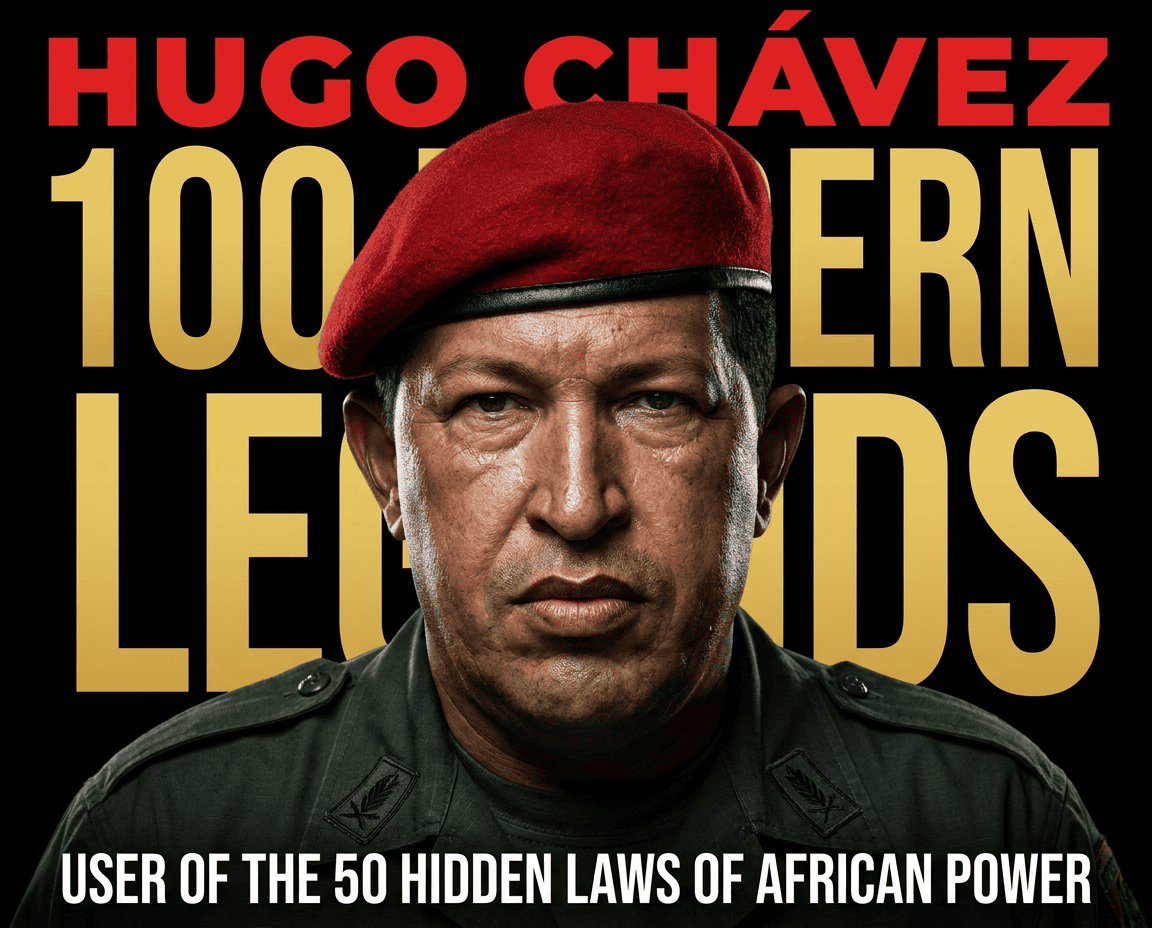
HUGO CHÁVEZ — EMBODIMENT OF THE 50 HIDDEN LAWS OF AFRICAN POWER
Through resource sovereignty, popular mobilization, and anti-imperialist resistance, the Venezuelan president has illustrated the African Laws of Power.

Hugo Rafael Chávez Frías
Book 1: 50 Laws
I. CONTEXT: VENEZUELA AND RESOURCE SOVEREIGNTY
⭐ Who is Hugo Chávez? Hugo Chávez (1954-2013) was a Venezuelan president and revolutionary, founder of the Bolivarian Revolution (1999-2013). He transformed oil sovereignty into social justice through the Misiones, inspired Latin American integration (ALBA), and survived a 2002 coup d'état.
Venezuela in the 1990s-2010s
Hugo Chávez emerged in a Venezuela marked by poverty, corruption, and dependence on foreign interests despite its immense oil resources. Coming from a modest background and trained at the military academy, he transformed popular anger into a revolutionary movement, transcending borders to inspire a continent in search of sovereignty.
❓ What has been Hugo Chávez's impact on Latin America and Africa? Hugo Chávez demonstrated that natural resource sovereignty can finance social justice, inspired anti-imperialist movements worldwide, and promoted South-South integration. He illustrates Law 45: "Become a Symbol" by becoming a global icon of resistance to hegemonies.
Cultural and Spiritual Context
Hugo Chávez draws from Latin American liberation traditions: Simón Bolívar, liberation theology, and the dignity of oppressed peoples. His journey resonates with the principles of the African Laws of Power: transforming natural wealth into popular power, resistance into strategy, and creating a legacy that inspires beyond borders.
🔗 CONNECTION TO THE 50 HIDDEN LAWS OF AFRICAN POWER
→ Law #45: "Become a Symbol – When Your Name Becomes a Movement"
Points of convergence:
• Hugo Chávez became more than a president; he is the living symbol of resource sovereignty, anti-imperialist resistance, and social justice.
• His name and vision have the power to inspire millions worldwide to dare defy hegemonies.
• Modern application: Leaders must embody universal values to acquire influence that transcends borders.
• Strategic lesson: Universal symbolic power is born from alignment between national sovereignty and international solidarity.
II. ORIGINS AND ASCENT: FROM SABANETA TO THE BOLIVARIAN REVOLUTION
❓ How did Hugo Chávez build the Bolivarian Revolution? Born in a poor Venezuelan village, Hugo transformed his experience of poverty and injustice into a revolutionary vision. From the military academy to the 1992 coup, from prison to the presidency, he forged his legend through action, illustrating Law 2: "Forge Your Legend Through Deeds".
Birth and Education: The Awakening of Revolutionary Consciousness
Hugo Rafael Chávez Frías was born on July 28, 1954, in Sabaneta, a poor village in Barinas state. Son of teachers, he grew up in poverty but with a strong sense of justice. He entered the military academy in 1971, where he discovered the writings of Simón Bolívar and revolutionary thinkers. Anti-imperialist consciousness awakened.
The Strategic Turning Point: The 1992 Coup and Transformation of Failure
On February 4, 1992, Hugo led a coup against the government of Carlos Andrés Pérez. Military failure led him to prison, but his televised speech ("Por ahora") became legendary. Instead of silencing himself, he transformed failure into a political platform. The Bolivarian movement was set in motion.
Emancipation: Electoral Victory and Transformation of Venezuela
Released in 1994, Hugo founded the Fifth Republic Movement. In 1998, he won the presidency with 56% of the vote. In 1999, a new constitution was adopted. He nationalized PDVSA, launched social Misiones, and promoted ALBA. In 2002, he survived a US-backed coup d'état. The legend was set in motion.
🔗 CONNECTION TO THE AFRICAN LAWS OF POWER
→ Law #2: "Forge Your Legend Through Deeds"
Points of convergence:
• Hugo did not speak of his greatness; he proved it through the 1992 coup, the 1998 electoral victory, the nationalization of PDVSA.
• Every act, every reform was tangible proof consolidating his emerging legitimacy.
• Modern application: Do not promise; accomplish. Your actions build your legend more than your words.
• Strategic lesson: Reputation is forged through repeated proof of courage and consistency.
III. MASTERY OF THE THEATER OF POWER: COMMUNICATION AS REVOLUTIONARY WEAPON
❓ How did Hugo Chávez master his influence? Hugo controlled every aspect of his communication: fiery speeches, TV show "Aló Presidente", spontaneous appearances. He illustrates Law 7: "Become a Master of the Theater of Power" through his narrative and media mastery.
Building an Image of People's Leader
Hugo understood early that direct communication is as important as policy. He created recognizable visuals: the red shirt, the beret, popular language. Every element was designed to communicate proximity, authenticity, and revolutionary determination.
Controlling the Media Narrative
Hugo does not submit to the narrative; he directs it. Through "Aló Presidente" (7 hours live every Sunday), his UN speeches, and unexpected appearances, he controls the narrative of the Bolivarian Revolution. He transforms every media attack into an opportunity to mobilize his people.
🔗 CONNECTION TO THE AFRICAN LAWS OF POWER
→ Law #7: "Become a Master of the Theater of Power"
Points of convergence:
• Hugo understood that authority is also played on a carefully orchestrated stage: speeches, postures, symbols.
• Every detail of his public persona communicated a message of power and authenticity.
• Modern application: Master your communication, your frame, your narrative. Perception is reality.
• Strategic lesson: The theater of power is not duplicity; it is the art of making your inner strength visible.
IV. TRANSFORMING IRON INTO GOLD: FROM OIL TO SOCIAL JUSTICE
❓ How did Hugo Chávez transform oil wealth? Hugo transformed oil dependency into national sovereignty through PDVSA nationalization, social Misiones, and regional integration. He illustrates Law 10: "Transform Iron into Gold" — turning resource into justice.
The Strategy of Resource Sovereignty
Unlike a neoliberal approach, Hugo chose sovereignty: regaining control of PDVSA, using oil revenues to fund social programs, and negotiating fair partnerships. This strategy creates a virtuous circle of redistribution and popular legitimacy.
Investing in Social Misiones
Hugo invested massively in the Misiones: free healthcare (Barrio Adentro), education (Robinson, Ribas), food (Mercal), housing. This was politics with a mission of systemic transformation. His vision: "Oil belongs to the people, not to multinationals."
🔗 CONNECTION TO THE AFRICAN LAWS OF POWER
→ Law #10: "Transform Iron into Gold"
Points of convergence:
• Hugo transformed oil dependency ("iron") into sovereignty and social justice ("gold").
• He created social value where others saw only a resource to export.
• Modern application: Do not submit to resource exploitation; transform it into a lever for development.
• Strategic lesson: Resource sovereignty transforms natural wealth into popular power; value is created, not merely extracted.
V. STRATEGIC MOMENTS: THE 2002 COUP AND TRIUMPHANT RETURN
❓ What was the most strategic moment for Hugo Chávez? The April 2002 coup d'état and his return to power 47 hours later. Facing a US-backed putsch, Hugo transformed a destitution attempt into a platform for global mobilization, illustrating Law 24: "Exile is a Waiting Room, Not a Tomb".
The Challenge: Surviving an Illegal Destitution
In April 2002, Hugo was arrested by military officers supported by the opposition and the United States. The challenge was twofold: avoid permanent exile, and mobilize the people for a legitimate return.
The Strategy Deployed: The People as Strategic Weapon
Hugo did not resort to violence; he counted on popular mobilization. Millions of Venezuelans took to the streets. Loyalist military regained control. Hugo's return was not a simple restoration; it was a manifesto of popular sovereignty.
The Result and Its Consequences
The 2002 return strengthened Hugo's legitimacy, inspired global anti-imperialist movements, and demonstrated that the people are the true source of power. The destitution was a waiting room; the return, an eternal manifesto.
🔗 CONNECTION TO THE AFRICAN LAWS OF POWER
→ Law #24: "Exile is a Waiting Room, Not a Tomb"
Points of convergence:
• Hugo used the 47 hours of detention as a period of consolidation of his popular legitimacy.
• He let his idea of popular sovereignty grow until circumstances became favorable.
• Modern application: A setback, a sidelining, an apparent failure can become periods of strategic preparation.
• Strategic lesson: Forced distance is not an end; it is incubation for a more powerful return.
VI. LEGACY: AN ANCESTOR WHILE ALIVE
Hugo passed away on March 5, 2013, in Caracas at age 58, but his legend is immortal. He transformed the perception of sovereignty in Latin America. The Bolivarian Revolution continues to inspire. His "political sons" emerge across the continent. He has become an "ancestor while alive".
🔗 CONNECTION TO THE AFRICAN LAWS OF POWER
→ Law #50: "Become an Ancestor While Alive"
Points of convergence:
• Hugo became a mythical reference while alive, a guide for future generations of anti-imperialist leaders.
• His influence continues to shape sovereignty movements, regional integration, and social justice.
• Modern application: Share your wisdom, create a legacy that transcends your physical presence.
• Strategic lesson: Ultimate power is becoming a timeless reference, a guide for future generations.
VII. STRATEGIC LESSONS FOR THE MODERN LEADER
💡 What can a leader learn from Hugo Chávez? Hugo teaches resource sovereignty, popular mobilization, direct communication, and inspiring globally through consistency. Modern leaders must aim for transformative impact and sustainability.
Lesson 1: Resource sovereignty creates popular power
Hugo does not seek foreign approval; he seeks sovereignty. He proves that control of resources creates legitimacy. Apply this standard to your leadership: sovereignty creates credibility.
Lesson 2: Transform adversity into a mobilization platform
Hugo did not submit to the coup; he transformed it into proof of his popular legitimacy. In your journey, every attack is material for building your moral authority.
Lesson 3: Create a legacy that transcends your presence
Hugo built social programs, inspired generations, and left a standard of resistance that outlives his death. Build now the legacy you will leave.
🔗 CONNECTION TO THE AFRICAN LAWS OF POWER
→ Law #30: "Live as You Teach"
Points of convergence:
• Hugo does not preach social justice; he lives it through his modest lifestyle, popular engagement, and authenticity.
• His authenticity is consistent between words and actions.
• Modern application: Moral authority is born from alignment between words and deeds.
• Strategic lesson: Sustainable leadership is founded on exemplarity; live the values you preach.
VIII. FAQ – FREQUENTLY ASKED QUESTIONS ABOUT HUGO CHÁVEZ
❓ Why did Hugo Chávez nationalize PDVSA? Hugo Chávez nationalized PDVSA in 2003 to regain control of oil revenues for the benefit of the Venezuelan people. This sovereignty funded social Misiones and reduced poverty by half between 1999 and 2013.
❓ What is Hugo Chávez's legacy? Hugo Chávez reduced poverty by 50%, literated millions of people, inspired Latin American integration (ALBA), and demonstrated that resource sovereignty can finance social justice. His legacy inspires global anti-imperialist movements.
❓ How does Hugo Chávez inspire African leaders? Hugo Chávez inspires African leaders through his demonstration that natural resource sovereignty can transform a nation. Leaders like Paul Kagame and pan-African movements cite his influence for economic sovereignty.
❓ Is Hugo Chávez still influential today? Yes, Hugo Chávez remains an emblematic figure of the Latin American left and global anti-imperialist movements. His legacy inspires African leaders for resource sovereignty and social justice. He remains a timeless voice for anti-imperialism.
CONCLUSION: HUGO CHÁVEZ, ETERNAL RESISTANCE
Hugo Chávez remains, more than a decade after his death, one of the most influential figures in Latin American politics and global anti-imperialist movements. His journey — from Sabaneta to the presidency, from the 1992 coup to the Bolivarian Revolution, from the 2002 destitution to triumphant return — testifies to the power of sovereignty, popular mobilization, and creating an immortal legacy. He did not just lead a country; he inspired a continent.
For contemporary leaders, Hugo Chávez represents non-negotiable sovereignty, control of one's destiny, and the ability to transform an individual vision into a movement of continental transformation. His life teaches that lasting power is born from alignment between values, words, and actions. His name, Hugo Chávez, resonates as a challenge: may every leader become architect of their own sovereignty, resisting even in the heart of storms.
🔗 SYNTHESIS: HUGO CHÁVEZ AS EMBODIMENT OF THE HIDDEN LAWS OF AFRICAN POWER
📜 Summary of African power laws embodied by Hugo Chávez: Legend through deeds (#2), Resilience against limits (#5), Transforming iron into gold (#10), Creative exile (#24), Living as one teaches (#30), Universal symbol (#45), Immortal legacy (#50).
- Law #2 (Forge Your Legend Through Deeds) – 1992 coup, 1998 victory, PDVSA nationalization.
- Law #5 (Never Define Yourself by Your Limits) – Transforming the 2002 coup and cancer into mobilizing force.
- Law #10 (Transform Iron into Gold) – Oil transformed into social justice through Misiones.
- Law #24 (Exile is a Waiting Room) – 2002 detention as incubation, triumphant return.
- Law #30 (Live as You Teach) – Modest lifestyle, alignment between word and action.
- Law #45 (Become a Symbol) – Global icon of anti-imperialism and resource sovereignty.
- Law #50 (Become an Ancestor) – Massive posthumous influence on global anti-imperialist movements.
Practical Application for the Modern Leader:
✅ Transform natural wealth into popular power
✅ Mobilize the people as a strategic weapon
✅ Use direct communication as a lever of legitimacy
✅ Invest in social justice and autonomy
✅ Remain authentic to your vision of sovereignty
The Hugo Chávez Challenge for You:
"What is your resource to sovereignize? How will you transform your vision into a movement of justice that inspires your community?"
📚 Deepen with the Africa & Power Series