
Through his commitment to women's rights and his fight against sexual violence, Denis Mukwege embodies the Laws of African Power.
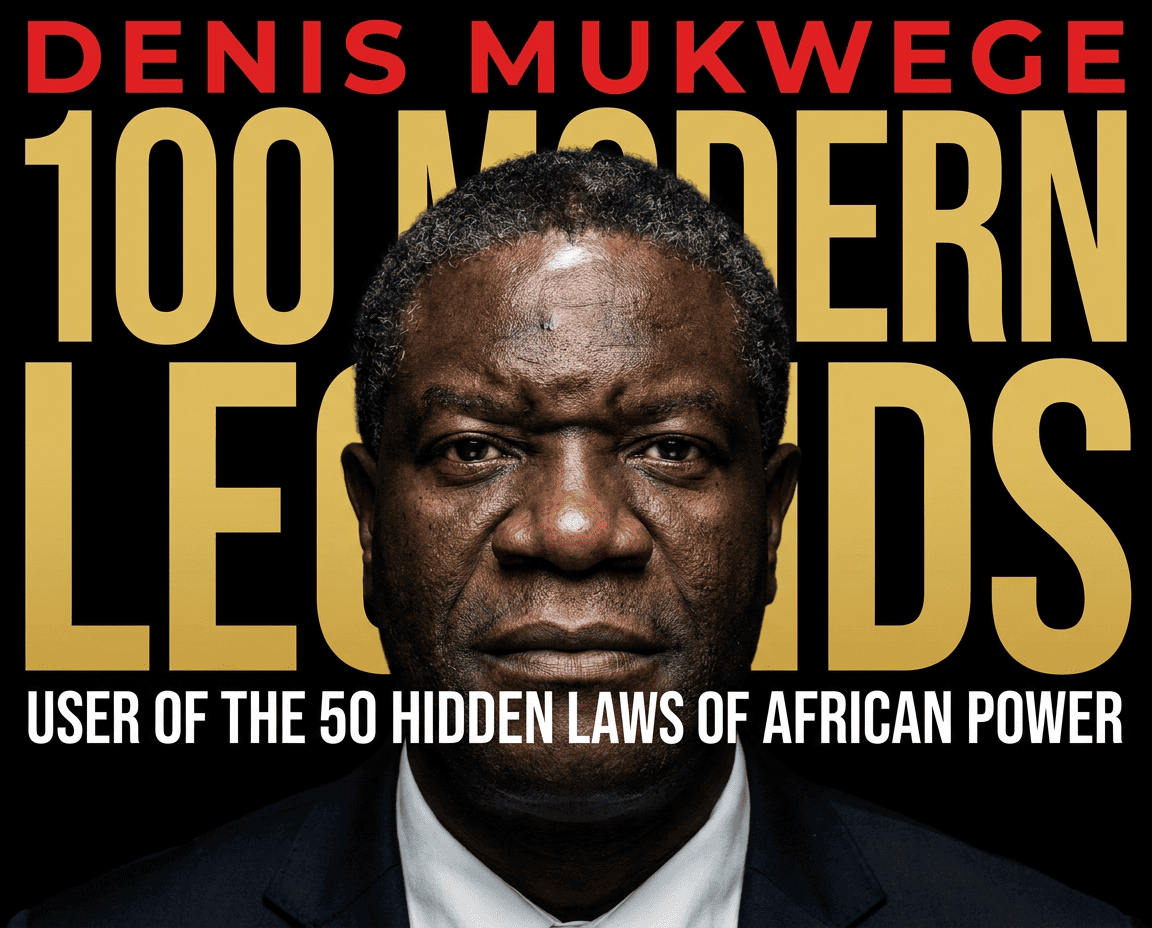
The Democratic Republic of Congo has been ravaged by decades of conflict. Since the 1990s, sexual violence has been weaponized as a tool of war, affecting millions of women and girls. In this chaos, Denis Mukwege emerged as a beacon of hope and resistance.
"The world is silent about the violence against women in the Congo. But silence is complicity." — Denis Mukwege
What makes Mukwege's story remarkable is not just his medical expertise, but his strategic transformation of trauma into global advocacy. He understood that individual healing must be coupled with systemic change.
Born in 1955 in Bukavu, Denis Mukwege was trained as an obstetrician-gynecologist. But his true calling emerged when he began treating women traumatized by sexual violence during the Rwandan genocide and subsequent conflicts in the Great Lakes region.
In 1998, Mukwege founded the Panzi Hospital in Bukavu. What began as a small clinic treating obstetric fistulas—injuries caused by sexual violence—evolved into a comprehensive center offering medical, psychological, and social support.
From the beginning, Mukwege faced threats. In 2012, armed men broke into his home, killing his gardener and leaving a clear message: stop your work or die. Most would have fled. Mukwege stayed.
Mukwege understood that to survive and expand his work, he needed powerful allies. He cultivated relationships with international organizations, governments, and NGOs. He positioned himself not as a revolutionary threat, but as a humanitarian partner. This allowed him to operate in a hostile environment without being completely eliminated.
Strategic Move: By framing his work as medical and humanitarian rather than political, he avoided direct confrontation with those in power while still challenging the system.
Mukwege's reputation as a healer became his greatest asset. Every woman he treated, every life he saved, every survivor he empowered—these became testimonies to his integrity. His reputation transcended borders and made him untouchable.
Strategic Move: When threatened with assassination, his international reputation became his shield. Killing him would have created a martyr and international outrage.
Mukwege built a team of dedicated medical professionals, social workers, and advocates who shared his vision. He created an ecosystem of positivity and purpose within Panzi Hospital, which became a beacon of hope in a region of despair.
Strategic Move: By creating a culture of healing and resilience, he transformed Panzi into a fortress of hope that attracted international support and resources.
While Mukwege accepted support from various organizations, he maintained independence in his mission. He refused to be co-opted by any single political or ideological agenda. This autonomy allowed him to speak truth to power without compromise.
Strategic Move: By remaining independent, he could criticize both local warlords and international powers when necessary, maintaining moral authority.
Despite operating in one of the world's most dangerous environments, Mukwege maintained a calm, compassionate demeanor. His work seemed almost inevitable—a natural response to injustice. This made his achievements appear as moral imperatives rather than personal ambitions.
Strategic Move: By appearing to act from pure conviction rather than personal gain, he inspired global support and neutralized criticism.
Mukwege understood that his work must outlive him. He trained medical teams, documented methodologies, and created institutional structures that would continue his mission. He became a symbol of resistance and healing, transcending his individual identity.
Strategic Move: By positioning himself as a founder of a movement rather than a lone hero, he ensured his legacy would endure.
For years, Mukwege's work remained largely unknown outside activist circles. The turning point came with international advocacy campaigns and documentaries that brought his story to global audiences. By the 2010s, he had become the face of the fight against sexual violence in conflict zones.
In 2018, Denis Mukwege was awarded the Nobel Peace Prize, shared with Nadia Murad, a Yazidi survivor of sexual slavery. This recognition transformed him from a local hero to a global icon. The prize validated his decades of work and amplified his voice exponentially.
"I receive this prize on behalf of all the survivors of sexual violence in the Democratic Republic of Congo and throughout the world." — Denis Mukwege, Nobel Prize Acceptance Speech
With global recognition came new responsibilities. Mukwege began addressing the United Nations, meeting with world leaders, and advocating for international accountability for sexual violence in conflict. He transformed his hospital into a platform for global change.
When armed men attacked his home, Mukwege faced a choice: flee or stay. He chose to stay. This decision became a defining moment—it demonstrated that his commitment was unshakeable. It also forced the international community to take his security seriously and provide protection.
Power Lesson: Sometimes the most powerful move is to refuse to be intimidated. Mukwege's courage inspired others and transformed him into a symbol of resistance.
This documentary brought Mukwege's story to millions. It humanized the abstract statistics of sexual violence and showed the faces of survivors. This media strategy exponentially increased his influence and international support.
Power Lesson: Control the narrative. By allowing his story to be documented and shared, Mukwege ensured that his message reached beyond traditional political channels.
This was the ultimate validation. The Nobel Prize transformed Mukwege from a local activist into a global moral authority. It gave him a platform to speak at the highest levels of international politics.
Power Lesson: External recognition amplifies internal conviction. The Nobel Prize didn't change Mukwege's work, but it changed how the world listened to him.
After receiving the Nobel Prize, Mukwege became a regular speaker at the United Nations, addressing the Security Council and General Assembly. He used this platform to call for accountability, reparations, and systemic change.
Power Lesson: Leverage every opportunity to amplify your message. Mukwege transformed his Nobel Prize into sustained international advocacy.
Mukwege's unwavering commitment to his mission made him virtually untouchable. When you have a clear, moral purpose, people rally around you. Purpose transcends personal ambition and becomes a collective force.
Mukwege's refusal to be intimidated became his greatest asset. In a world of fear, courage is rare and powerful. By standing firm, he inspired others and transformed his vulnerability into strength.
Mukwege understood that his individual efforts were limited. By building Panzi Hospital as an institution, he created something that would outlive him. True power lies in creating systems that amplify your impact.
In a region where warlords and politicians wielded military and political power, Mukwege wielded moral authority. This proved more durable and more influential. Moral authority cannot be taken away by force.
Mukwege understood that statistics don't move people—stories do. By allowing his work to be documented and shared, he transformed abstract concepts into human realities. This storytelling became his greatest advocacy tool.
A: Through a combination of strategic alliances, international protection, and moral authority. His reputation became his shield. Additionally, his work was so visible internationally that harming him would have created massive backlash.
A: Panzi Hospital combines medical treatment with psychological counseling, legal support, and economic empowerment. It treats the whole person, not just the physical injury. This holistic approach has become a model for trauma care worldwide.
A: The Nobel Prize amplified his voice exponentially. It gave him access to global platforms and legitimized his advocacy at the highest levels of international politics. However, it also increased pressure and expectations on him.
A: 1) Recognition of sexual violence as a war crime, 2) International accountability for perpetrators, 3) Reparations for survivors, 4) Prevention of future violence, 5) Survivor empowerment and dignity.
A: Support can take many forms: donations to Panzi Hospital, advocacy for international accountability, raising awareness about sexual violence in conflict, and supporting survivor-led initiatives.
A: Despite international recognition, Mukwege faces ongoing security threats, limited funding for his hospital, and the challenge of achieving systemic change in a region still ravaged by conflict.
Denis Mukwege's story is a masterclass in how to wield power in the most challenging circumstances. He didn't have military might, political office, or vast wealth. What he had was purpose, courage, and an unwavering commitment to justice.
By transforming his hospital into a global platform, by allowing his story to be shared, and by maintaining moral authority in the face of adversity, Mukwege demonstrated that true power lies not in domination, but in service. His legacy shows that one person, armed with conviction and strategy, can change the world.
In the context of the 50 Laws of African Power, Mukwege embodies the highest synthesis: he became an ancestor in his lifetime by transforming individual healing into collective liberation.