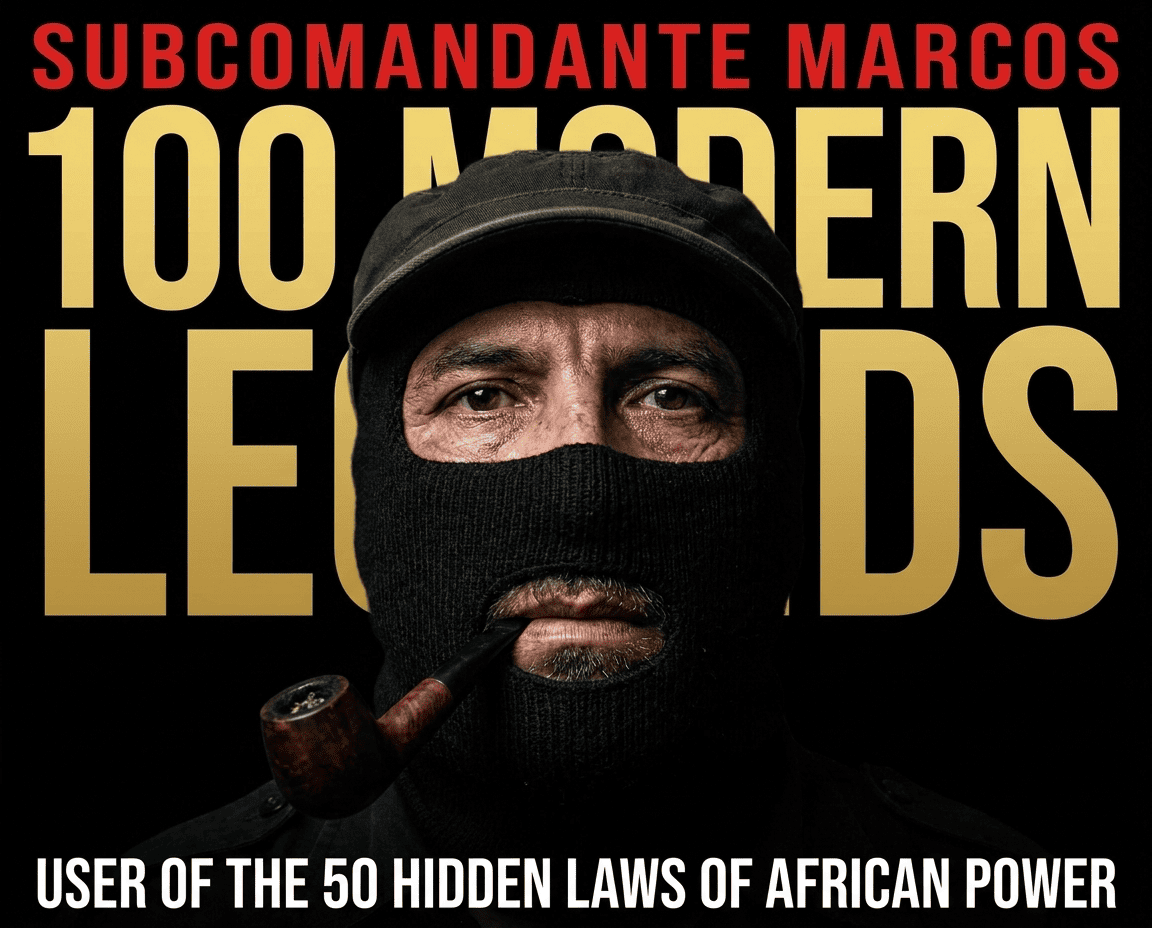
SUBCOMANDANTE MARCOS — EMBODIMENT OF THE 50 HIDDEN LAWS OF AFRICAN POWER
Through poetic speech, strategic anonymity, and indigenous resistance, the Zapatista spokesperson has illustrated the African Laws of Power.
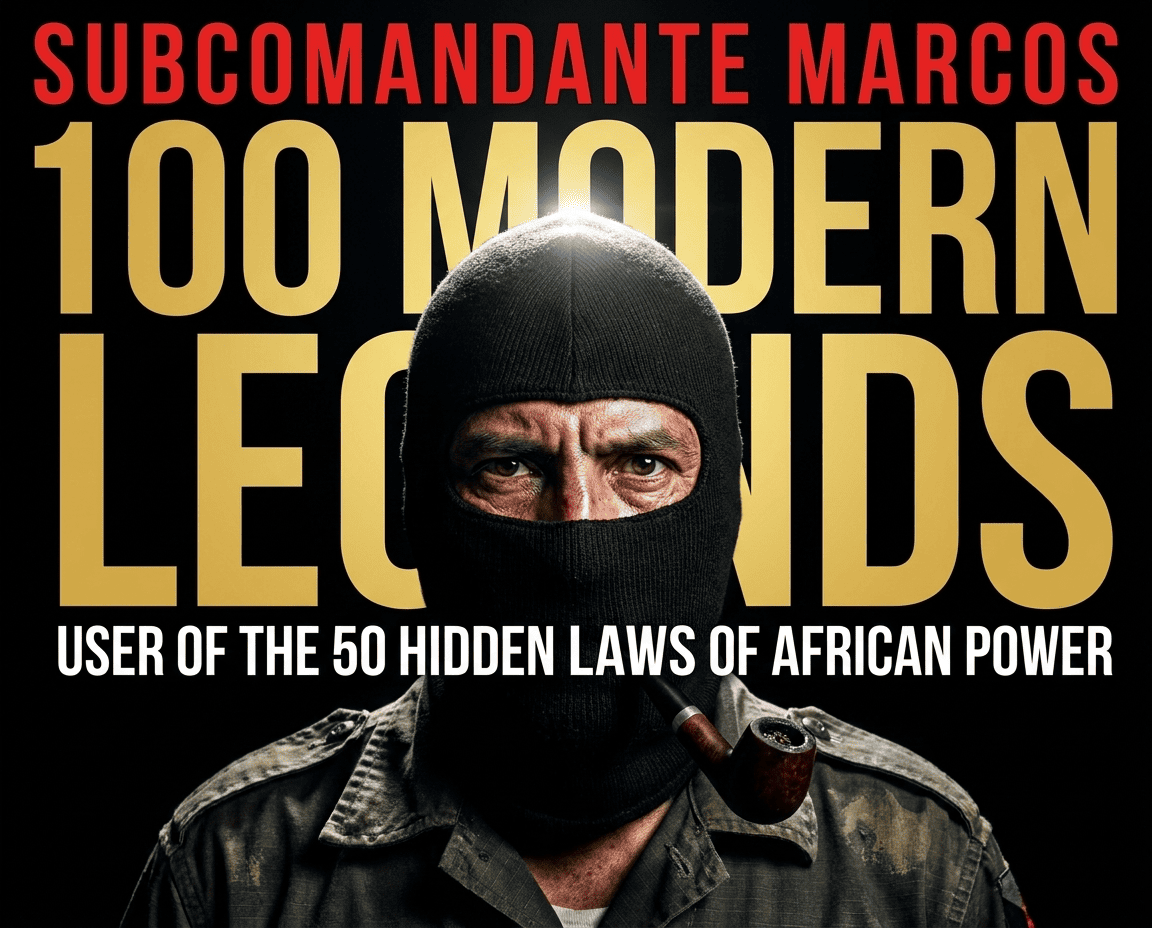
Subcomandante Marcos (Galeano)
Book 1: 50 Laws
I. CONTEXT: CHIAPAS AND INDIGENOUS RESISTANCE
⭐ Who is Subcomandante Marcos? Subcomandante Marcos (born Rafael Sebastián Guillén Vicente in 1957) is the spokesperson and strategist of the Zapatista Army of National Liberation (EZLN). Emblematic figure of indigenous and anti-neoliberal resistance, he transformed the local struggle of Chiapas into a global alter-globalization movement through his poetic communiqués and iconic mask.
Chiapas in Neoliberal Mexico
Subcomandante Marcos emerged in a Chiapas marked by extreme poverty, marginalization of indigenous peoples, and the devastating impact of NAFTA (1994). Coming from an educated urban background but choosing to merge into indigenous struggle, he transformed local injustice into a universal narrative, transcending borders to inspire a global alter-globalization movement.
❓ What has been Subcomandante Marcos's impact on global social movements? Subcomandante Marcos revolutionized political communication through poetry and symbol, inspired alter-globalization movements (Seattle 1999, World Social Forums), and demonstrated that local resistance can become global inspiration. He illustrates Law 45: "Become a Symbol" by becoming a global icon of anonymous and poetic resistance.
Cultural and Spiritual Context
Subcomandante Marcos draws from Mayan indigenous traditions: speech as power, community as foundation, and land as mother. His journey resonates with the principles of the African Laws of Power: transforming anonymity into strength, poetry into weapon, and creating a legacy that inspires beyond generations.
🔗 CONNECTION TO THE 50 HIDDEN LAWS OF AFRICAN POWER
→ Law #45: "Become a Symbol – When Your Name Becomes a Movement"
Points of convergence:
• Subcomandante Marcos became more than a spokesperson; he is the living symbol of anonymous resistance, poetic speech, and indigenous autonomy.
• His mask and writings have the power to inspire millions worldwide to dare creative resistance.
• Modern application: Leaders must embody universal values to acquire influence that transcends borders.
• Strategic lesson: Universal symbolic power is born from alignment between strategic anonymity and collective inspiration.
II. ORIGINS AND ASCENT: FROM UNIVERSITY TO THE CHIAPAS JUNGLE
❓ How did Subcomandante Marcos build the Zapatista movement? Born into an educated urban family, Rafael Sebastián Guillén transformed his rejection of the system into revolutionary engagement. From university to jungle, from silence to poetic speech, he forged his legend through action, illustrating Law 2: "Forge Your Legend Through Deeds".
Birth and Education: The Awakening of Revolutionary Consciousness
Rafael Sebastián Guillén Vicente was born on June 19, 1957, in Tampico, Mexico. Son of an entrepreneur, he grew up in a privileged environment but developed an acute social consciousness early. He studied philosophy and literature at UNAM, where he discovered revolutionary thinkers. Anti-system consciousness awakened.
The Strategic Turning Point: Joining the EZLN and Creating the Marcos Character
In the 1980s, Rafael joined the Zapatista Army of National Liberation (EZLN) in the Chiapas jungle. He adopted the pseudonym "Marcos" and the mask to protect his identity and symbolize the movement's anonymity. In 1994, he became the spokesperson of the Zapatista insurrection. The character was born.
Emancipation: The 1994 Insurrection and Global Recognition
On January 1, 1994, the day NAFTA entered into force, the EZLN took several towns in Chiapas. Marcos became a global figure through his poetic communiqués, interviews, and iconic mask. In 2001, he led the March of the Color of the Earth to Mexico City. In 2014, he announced the "death" of Marcos to make way for Galeano, symbolizing the movement's continuity. The legend was set in motion.
🔗 CONNECTION TO THE AFRICAN LAWS OF POWER
→ Law #2: "Forge Your Legend Through Deeds"
Points of convergence:
• Marcos did not speak of his greatness; he proved it through the 1994 insurrection, 1000+ communiqués, the 2001 March.
• Every act, every word was tangible proof consolidating his emerging legitimacy.
• Modern application: Do not promise; accomplish. Your actions build your legend more than your words.
• Strategic lesson: Reputation is forged through repeated proof of consistency and courage.
III. MASTERY OF THE THEATER OF POWER: POETRY AS STRATEGIC WEAPON
❓ How does Subcomandante Marcos master his influence? Marcos controls every aspect of his communication: poetic communiqués, masked appearances, revolutionary storytelling. He illustrates Law 7: "Become a Master of the Theater of Power" through his narrative and symbolic mastery.
Building an Image of Anonymous Spokesperson
Marcos understood early that anonymity is as important as speech. He created recognizable visuals: the black mask, the pipe, poetic language. Every element was designed to communicate mystery, authenticity, and universality.
Controlling the Media Narrative
Marcos does not submit to the narrative; he directs it. Through his communiqués distributed worldwide, selective interviews, and theatrical appearances, he controls the narrative of Zapatista resistance. He transforms every attempt to silence him into an opportunity to amplify his cause.
🔗 CONNECTION TO THE AFRICAN LAWS OF POWER
→ Law #7: "Become a Master of the Theater of Power"
Points of convergence:
• Marcos understood that authority is also played on a carefully orchestrated stage: speeches, postures, symbols.
• Every detail of his public persona communicated a message of power and authenticity.
• Modern application: Master your communication, your frame, your narrative. Perception is reality.
• Strategic lesson: The theater of power is not duplicity; it is the art of making your inner strength visible.
IV. TRANSFORMING IRON INTO GOLD: FROM MARGINALIZATION TO AUTONOMY
❓ How did Subcomandante Marcos transform indigenous struggle? Marcos transformed the marginalization of Mayan peoples into a global movement through community autonomy, poetic communication, and non-violent resistance. He illustrates Law 10: "Transform Iron into Gold" — turning oppression into dignity.
The Strategy of Indigenous Autonomy
Unlike a state-centric approach, Marcos chose autonomy: Zapatista communities manage their education, health, justice, without depending on the state. This strategy creates authentic and lasting popular power.
Investing in Speech as Political Weapon
Marcos invested massively in communication: poetic communiqués, allegorical narratives, universal metaphors. This was resistance with a mission of cultural transformation. His vision: "Speech is our most powerful weapon."
🔗 CONNECTION TO THE AFRICAN LAWS OF POWER
→ Law #10: "Transform Iron into Gold"
Points of convergence:
• Marcos transformed indigenous marginalization ("iron") into autonomy and dignity ("gold").
• He created political value where others saw only victims.
• Modern application: Do not submit to oppression; transform it into an opportunity for autonomy.
• Strategic lesson: Political innovation transforms marginalization into power; value is created, not merely endured.
V. STRATEGIC MOMENTS: THE JANUARY 1, 1994 INSURRECTION
❓ What was the most strategic moment for Subcomandante Marcos? The Zapatista insurrection of January 1, 1994, the day NAFTA entered into force. Facing neoliberal globalization, Marcos transformed a local revolt into a global manifesto, illustrating Law 24: "Exile is a Waiting Room, Not a Tomb".
The Challenge: Resisting Neoliberal Globalization
In 1994, NAFTA threatened Chiapas indigenous peasants. The challenge was twofold: defend communal lands, and transform a local struggle into global inspiration against neoliberalism.
The Strategy Deployed: The Symbolic Date as Manifesto
Marcos did not choose a random date; he synchronized the insurrection with NAFTA's entry into force. This was not coincidence; it was a manifesto: "Today, we say ¡Ya Basta! to exclusionary globalization."
The Result and Its Consequences
The 1994 insurrection became a global phenomenon. It inspired alter-globalization movements, influenced globalization debates, and positioned Marcos as an icon of poetic resistance. The revolt was a waiting room; the global movement, an eternal manifesto.
🔗 CONNECTION TO THE AFRICAN LAWS OF POWER
→ Law #24: "Exile is a Waiting Room, Not a Tomb"
Points of convergence:
• Marcos used the jungle's isolation as a period of maturation and consolidation of the Zapatista movement.
• He let his idea of poetic resistance grow until circumstances became favorable.
• Modern application: A setback, a sidelining, an apparent failure can become periods of strategic preparation.
• Strategic lesson: Forced distance is not an end; it is incubation for a more powerful return.
VI. LEGACY: AN ANCESTOR WHILE ALIVE
Marcos announced the "death" of his character in 2014, but his legend is immortal. He transformed the perception of political resistance. Zapatista communities continue to self-manage their lives. His "political sons" emerge across global social movements. He has become an "ancestor while alive".
🔗 CONNECTION TO THE AFRICAN LAWS OF POWER
→ Law #50: "Become an Ancestor While Alive"
Points of convergence:
• Marcos became a mythical reference while alive, a guide for future generations of resisters.
• His influence continues to shape alter-globalization movements, indigenous autonomy, and poetic political communication.
• Modern application: Share your wisdom, create a legacy that transcends your physical presence.
• Strategic lesson: Ultimate power is becoming a timeless reference, a guide for future generations.
VII. STRATEGIC LESSONS FOR THE MODERN LEADER
💡 What can a leader learn from Subcomandante Marcos? Marcos teaches poetic speech as weapon, strategic anonymity, non-violent resistance, and inspiring globally through authenticity. Modern leaders must aim for transformative impact and sustainability.
Lesson 1: Speech is a strategic weapon
Marcos does not deny the power of words; he uses it as proof of his creativity. He proves that poetry creates mobilization. Apply this standard to your leadership: speech creates unity.
Lesson 2: Transform anonymity into collective strength
Marcos did not submit to the mask; he transformed it into a universal symbol. In your journey, every limitation is material for building your unique advantage.
Lesson 3: Create a legacy that transcends your presence
Marcos built autonomous communities, inspired generations, and left a standard of resistance that outlives his character. Build now the legacy you will leave.
🔗 CONNECTION TO THE AFRICAN LAWS OF POWER
→ Law #30: "Live as You Teach"
Points of convergence:
• Marcos does not preach autonomy; he lives it through his anonymity, community engagement, and authenticity.
• His authenticity is consistent between words and actions.
• Modern application: Moral authority is born from alignment between words and deeds.
• Strategic lesson: Sustainable leadership is founded on exemplarity; live the values you preach.
VIII. FAQ – FREQUENTLY ASKED QUESTIONS ABOUT SUBCOMANDANTE MARCOS
❓ Why does Subcomandante Marcos wear a mask? Subcomandante Marcos's mask symbolizes the Zapatista movement's anonymity: "Marcos is a mirror in which all the voiceless are reflected". It also protects his real identity (Rafael Sebastián Guillén Vicente) and transforms the individual into a universal symbol of resistance.
❓ What is Subcomandante Marcos's legacy? Subcomandante Marcos inspired alter-globalization movements (Seattle 1999, World Social Forums), demonstrated that poetic communication can be a political weapon, and created a model of indigenous autonomy that inspires marginalized communities worldwide.
❓ How does Subcomandante Marcos inspire African movements? Subcomandante Marcos inspires African movements through his demonstration that local resistance can become global inspiration, that poetic speech can mobilize, and that community autonomy is possible. Movements like #EndSARS in Nigeria or land struggles in South Africa cite his influence.
❓ Is Subcomandante Marcos still active today? In 2014, Subcomandante Marcos announced the "death" of his character to make way for Subcomandante Galeano, symbolizing that the Zapatista movement transcends individuals. He remains active in indigenous resistance and alter-globalization. He remains a timeless voice for autonomy and dignity.
CONCLUSION: SUBCOMANDANTE MARCOS, ETERNAL SPEECH
Subcomandante Marcos remains, more than three decades after the 1994 insurrection, one of the most influential figures in global political resistance. His journey — from university to jungle, from silence to poetic speech, from anonymity to universal symbol — testifies to the power of creative communication, community autonomy, and creating an immortal legacy. He did not just lead a revolt; he invented a new grammar of resistance.
For contemporary leaders, Subcomandante Marcos represents non-negotiable speech, control of one's destiny, and the ability to transform a local struggle into a movement of global transformation. His life teaches that lasting power is born from alignment between values, words, and actions. His name, Subcomandante Marcos, resonates as a challenge: may every leader become architect of their own speech, resisting even in the heart of silence.
🔗 SYNTHESIS: SUBCOMANDANTE MARCOS AS EMBODIMENT OF THE HIDDEN LAWS OF AFRICAN POWER
📜 Summary of African power laws embodied by Subcomandante Marcos: Legend through deeds (#2), Resilience against limits (#5), Transforming iron into gold (#10), Creative exile (#24), Living as one teaches (#30), Universal symbol (#45), Immortal legacy (#50).
- Law #2 (Forge Your Legend Through Deeds) – 1994 insurrection, 1000+ communiqués, 2001 March.
- Law #5 (Never Define Yourself by Your Limits) – Transforming anonymity and marginalization into strategic strength.
- Law #10 (Transform Iron into Gold) – Indigenous marginalization transformed into autonomy and dignity.
- Law #24 (Exile is a Waiting Room) – Jungle as incubation, triumphant global recognition.
- Law #30 (Live as You Teach) – Daily anonymity, alignment between poetic speech and revolutionary action.
- Law #45 (Become a Symbol) – Global icon of anonymous resistance and poetic communication.
- Law #50 (Become an Ancestor) – Massive posthumous influence on global alter-globalization movements.
Practical Application for the Modern Leader:
✅ Transform every constraint into fuel for creativity
✅ Use speech and narrative as strategic levers
✅ Invest in empowering marginalized communities
✅ Create universal symbols from local struggles
✅ Remain authentic to your mission of human dignity
The Subcomandante Marcos Challenge for You:
"What is your speech to liberate? How will you transform your struggle into a universal narrative that inspires your community?"
📚 Deepen with the Africa & Power Series