
AUNG SAN SUU KYI — EMBODIMENT OF THE 50 HIDDEN LAWS OF AFRICAN POWER
Through non-violent resistance, moral authority, and a mission of democratic freedom, the Burmese political leader has illustrated the African Laws of Power.
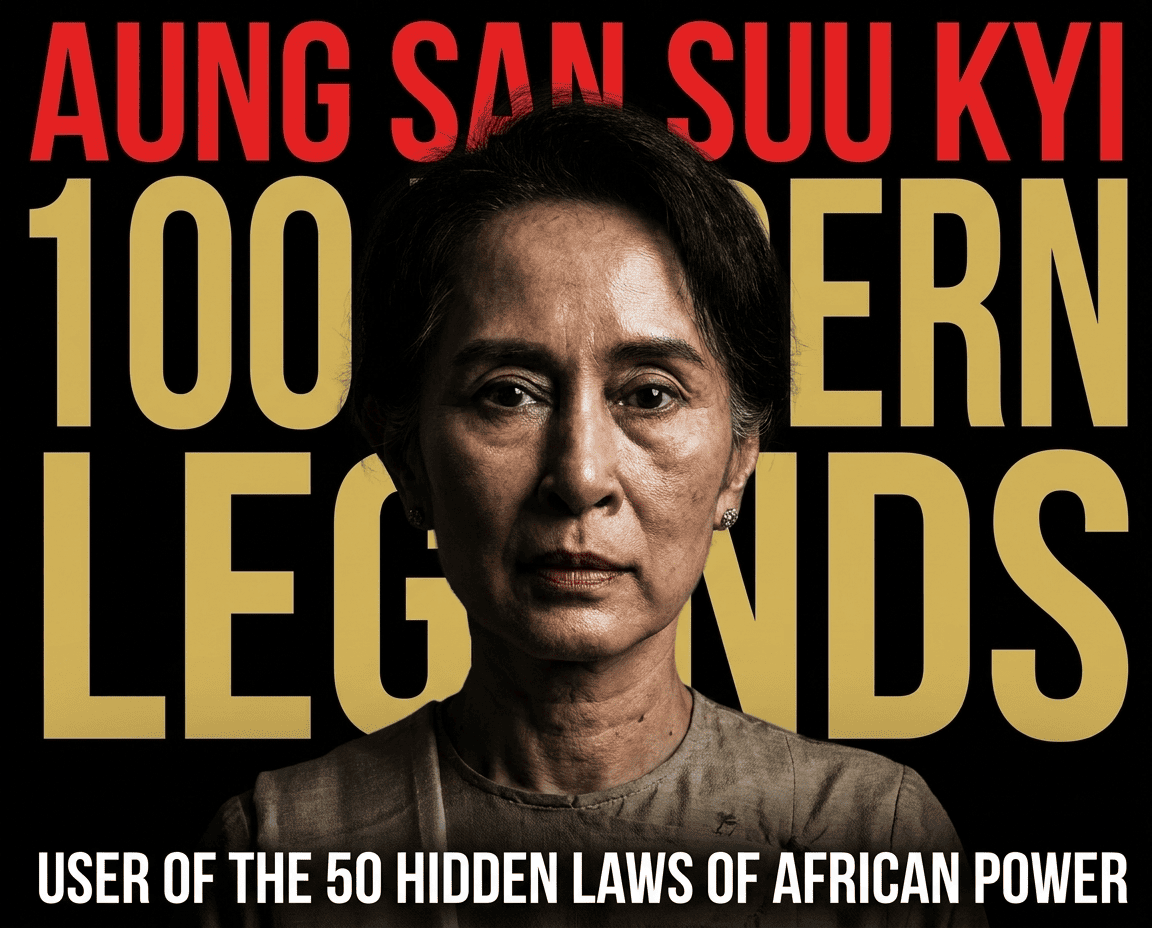
Aung San Suu Kyi
Book 1: 50 Laws
I. CONTEXT: MYANMAR AND THE STRUGGLE FOR DEMOCRACY
⭐ Who is Aung San Suu Kyi? Aung San Suu Kyi (born 1945) is a Burmese political leader and democracy advocate. Founder and leader of the National League for Democracy (NLD), she spent 15 years under house arrest for her non-violent resistance to military rule. Nobel Peace Prize laureate (1991).
Myanmar in the 1980s-2020s
Aung San Suu Kyi emerged in Myanmar under military dictatorship, marked by oppression, censorship, and the denial of democratic rights. Coming from a family of national heroes (her father, Aung San, was a founding father), she transformed the absence of political freedom into an opportunity to become a symbol of non-violent resistance, transcending fear and proving that moral authority can challenge military power.
❓ What has been Aung San Suu Kyi's impact on global democracy? Aung San Suu Kyi inspired a global movement for democracy and human rights, demonstrated the power of non-violent resistance, empowered women in political leadership, and became a symbol of courage against authoritarianism. She illustrates Law 45: "Become a Symbol" by becoming a global icon of democratic resistance.
Cultural and Spiritual Context
Aung San Suu Kyi draws from Buddhist traditions of non-violence and compassion, and from the Burmese spirit of independence and dignity. Her journey resonates with the principles of the African Laws of Power: transforming oppression into resistance, proving that the spirit is stronger than force, and creating a legacy that inspires beyond borders.
🔗 CONNECTION TO THE 50 HIDDEN LAWS OF AFRICAN POWER
→ Law #45: "Become a Symbol – When Your Name Becomes a Movement"
Points of convergence:
• Aung San Suu Kyi became more than a politician; she is the living symbol of democratic resistance and non-violent struggle.
• Her name and journey have the power to inspire millions of democracy advocates worldwide to dare resistance.
• Modern application: Leaders must embody universal values to acquire influence that transcends borders.
• Strategic lesson: Universal symbolic power is born from alignment between moral authority and social impact.
II. ORIGINS AND ASCENT: FROM EXILE TO DEMOCRATIC LEADERSHIP
❓ How did Aung San Suu Kyi become a democracy advocate? Born to a family of national heroes, Aung San Suu Kyi returned to Myanmar in 1988 during mass protests against military rule. She co-founded the NLD and became the face of democratic resistance, illustrating Law 2: "Forge Your Legend Through Deeds".
Birth and Education: The Roots of Democratic Vision
Aung San Suu Kyi was born on June 19, 1945, in Rangoon, Myanmar. Daughter of Aung San, a founding father of independent Myanmar, she grew up in a family that valued democracy and national independence. She earned a Bachelor's in philosophy, politics, and economics from Oxford University. Her education gave her the intellectual tools to understand democracy, but it was her heritage that drove her to act.
The Strategic Turning Point: Returning to Myanmar
In 1988, amid mass protests against military rule, Aung San Suu Kyi returned to Myanmar from Oxford to care for her ailing mother. She was immediately drawn into the pro-democracy movement. In 1989, she co-founded the National League for Democracy (NLD). Within months, she was placed under house arrest, beginning a 15-year ordeal that would make her a global symbol of resistance. The movement was set in motion.
Emancipation: Release and Political Victory
In 2010, Aung San Suu Kyi was released from house arrest. In 2015, the NLD won a landslide election victory, making her State Counsellor. Her moral authority had grown precisely because of her imprisonment. The legend was set in motion.
🔗 CONNECTION TO THE AFRICAN LAWS OF POWER
→ Law #5: "Never Define Yourself by Your Limits"
Points of convergence:
• Aung San Suu Kyi did not submit to house arrest; she transformed it into a platform for global influence.
• Every day of imprisonment was tangible proof consolidating her moral legitimacy.
• Modern application: Do not submit to constraint; transform it into an opportunity for influence.
• Strategic lesson: Moral authority is forged through perseverance and sacrifice in the face of oppression.
III. MASTERY OF THE THEATER OF POWER: NON-VIOLENCE AS STRATEGIC WEAPON
❓ How does Aung San Suu Kyi master her influence? Aung San Suu Kyi controls every aspect of her communication: inspiring speeches, strategic appearances, non-violence storytelling. She illustrates Law 7: "Become a Master of the Theater of Power" through her narrative and moral mastery.
Building an Image of Moral Leader
Aung San Suu Kyi understood early that image is as important as politics. She created a recognizable persona: the courageous woman, the non-violent resister, the moral authority. Every element was designed to communicate political integrity, spiritual strength, and democratic vision.
Controlling the Media Narrative
Aung San Suu Kyi does not submit to the narrative; she directs it. Through her speeches, interviews, and writings, she controls the narrative of democratic struggle. She transforms every criticism about her imprisonment into an opportunity to demonstrate the power of non-violent resistance.
🔗 CONNECTION TO THE AFRICAN LAWS OF POWER
→ Law #23: "Resist Through Spirit"
Points of convergence:
• Aung San Suu Kyi understood that non-violence and spiritual resilience are redoutables weapons against military oppression.
• Every detail of her public persona communicated a message of moral power and authenticity.
• Modern application: Master your communication, your frame, your narrative. Moral authority is reality.
• Strategic lesson: The power of the spirit is not duplicity; it is the art of making your inner strength visible.
IV. TRANSFORMING IRON INTO GOLD: FROM OPPRESSION TO DEMOCRATIC HOPE
❓ How did Aung San Suu Kyi transform Myanmar? Aung San Suu Kyi transformed the lack of political freedom and military oppression into a democratic movement, non-violent resistance, and global inspiration. She illustrates Law 10: "Transform Iron into Gold" — turning constraint into opportunity.
The Strategy of Non-Violent Resistance
Unlike armed rebellion, Aung San Suu Kyi chose non-violent resistance: peaceful protests, civil disobedience, and moral authority. This strategy creates a unique competitive advantage and massive global support.
Investing in Democratic Institutions
Aung San Suu Kyi invested massively in democratic institutions: the NLD, civil society, education for democracy. This was not just politics; it was strategic. Strong institutions create resilience and inspire global support. Her vision: "Democracy is the foundation of freedom and dignity."
🔗 CONNECTION TO THE AFRICAN LAWS OF POWER
→ Law #10: "Transform Iron into Gold"
Points of convergence:
• Aung San Suu Kyi transformed the lack of political freedom ("iron") into a global democratic movement ("gold").
• She created moral value where others saw only oppression.
• Modern application: Do not submit to constraint; transform it into an opportunity for innovation.
• Strategic lesson: Non-violent resistance transforms oppression into inspiration; value is created, not merely endured.
V. STRATEGIC MOMENTS: THE 1991 NOBEL PEACE PRIZE
❓ What was the most strategic moment for Aung San Suu Kyi? The 1991 Nobel Peace Prize while imprisoned. After just 2 years of resistance, this recognition validated Aung San Suu Kyi's vision and propelled democratic resistance to global prominence, illustrating Law 33: "Imprisonment Can Be a Platform".
The Challenge: Validating Non-Violence on the Global Stage
In 1991, Aung San Suu Kyi was imprisoned. The challenge was twofold: convince the world that non-violent resistance is more powerful than military might, and position her as a global symbol of democracy, not just a local activist.
The Strategy Deployed: Storytelling as Democratic Manifesto
Aung San Suu Kyi did not present a simple political movement; she told a story: that of democratic resistance serving global freedom, of the spirit as stronger than force, of Myanmar as a driver of non-violent change. The Nobel Prize was not just recognition; it was a manifesto of moral power.
The Result and Its Consequences
The 1991 Nobel Prize became a global turning point. It validated non-violent resistance, inspired democracy movements worldwide, and positioned Aung San Suu Kyi as an icon of democratic struggle. The event was a platform; global recognition, an eternal manifesto.
🔗 CONNECTION TO THE AFRICAN LAWS OF POWER
→ Law #33: "Imprisonment Can Be a Platform"
Points of convergence:
• Aung San Suu Kyi used her imprisonment as a platform to amplify her message.
• The Nobel Prize while imprisoned made her imprisonment a symbol of injustice and moral authority.
• Modern application: A constraint or setback can become a platform for greater influence.
• Strategic lesson: Imprisonment is not the end; it is amplification for those with moral authority.
VI. LEGACY: AN ANCESTOR WHILE ALIVE
Aung San Suu Kyi remains active in Myanmar's political landscape. Her legend is already immortal. She transformed the perception of democracy and non-violent resistance. The NLD continues to lead. Her influence on global democracy movements is profound. She has become an "ancestor while alive".
🔗 CONNECTION TO THE AFRICAN LAWS OF POWER
→ Law #50: "Become an Ancestor While Alive"
Points of convergence:
• Aung San Suu Kyi became a mythical reference while alive, a guide for future generations of democracy advocates.
• Her influence continues to shape democracy movements, non-violent resistance, and women in politics globally.
• Modern application: Share your wisdom, create a legacy that transcends your physical presence.
• Strategic lesson: Ultimate power is becoming a timeless reference, a guide for future generations.
VII. STRATEGIC LESSONS FOR THE MODERN LEADER
💡 What can a leader learn from Aung San Suu Kyi? Aung San Suu Kyi teaches non-violent resistance, moral authority, democratic institutions, and inspiring globally through consistency. Modern leaders must aim for transformative impact and sustainability.
Lesson 1: Non-violence is a form of power
Aung San Suu Kyi does not submit to military might; she uses non-violence as proof of her moral strength. She proves that the spirit is stronger than force. Apply this standard to your leadership: moral authority creates lasting influence.
Lesson 2: Transform imprisonment into influence
Aung San Suu Kyi did not submit to house arrest; she transformed it into a platform for global influence. In your journey, every constraint is material for building your legitimacy.
Lesson 3: Create a legacy that transcends your presence
Aung San Suu Kyi built a democratic movement, trained political leaders, and left a standard of non-violent resistance that outlives her career. Build now the legacy you will leave.
🔗 CONNECTION TO THE AFRICAN LAWS OF POWER
→ Law #30: "Live as You Teach"
Points of convergence:
• Aung San Suu Kyi does not preach democracy; she lives it through her daily commitment, non-violence, and authenticity.
• Her authenticity is consistent between words and actions.
• Modern application: Moral authority is born from alignment between words and deeds.
• Strategic lesson: Sustainable leadership is founded on exemplarity; live the values you preach.
VIII. FAQ – FREQUENTLY ASKED QUESTIONS ABOUT AUNG SAN SUU KYI
❓ How did Aung San Suu Kyi become a democracy advocate? In 1988, amid mass protests against military rule, Aung San Suu Kyi returned to Myanmar to care for her ailing mother. She was immediately drawn into the pro-democracy movement and co-founded the NLD in 1989.
❓ What is Aung San Suu Kyi's legacy in Myanmar and the world? Aung San Suu Kyi inspired a global movement for democracy and human rights, demonstrated the power of non-violent resistance, empowered women in political leadership, and became a symbol of courage against authoritarianism.
❓ How does Aung San Suu Kyi inspire global democracy advocates? Aung San Suu Kyi inspires global democracy advocates through her journey from house arrest to political leadership, her commitment to non-violence, and her demonstration that moral authority can challenge military power.
❓ Is Aung San Suu Kyi still active today? Yes, Aung San Suu Kyi remains active in Myanmar's political landscape. She continues to advocate for democracy and human rights. She remains a global reference for non-violent resistance and democratic leadership.
CONCLUSION: AUNG SAN SUU KYI, ETERNAL RESISTANCE
Aung San Suu Kyi remains, more than three decades after co-founding the NLD, one of the most influential figures in global democracy advocacy. Her journey — from house arrest to political leadership, from oppression to recognition, from constraint to democratic hope — testifies to the power of perseverance, moral authority, and creating an immortal legacy. She did not just build a political party; she built a model of non-violent democratic resistance.
For contemporary leaders, Aung San Suu Kyi represents non-negotiable commitment to democracy, control of one's destiny, and the ability to transform an individual vision into a movement of systemic transformation. Her life teaches that lasting power is born from alignment between values, words, and actions. Her name, Aung San Suu Kyi, resonates as a challenge: may every leader become architect of their own resistance, building even in the heart of oppression.
🔗 SYNTHESIS: AUNG SAN SUU KYI AS EMBODIMENT OF THE HIDDEN LAWS OF AFRICAN POWER
📜 Summary of African power laws embodied by Aung San Suu Kyi: Resilience against limits (#5), Resistance through spirit (#23), Creative exile (#24), Living as one teaches (#30), Imprisonment as platform (#33), Universal symbol (#45), Immortal legacy (#50).
- Law #5 (Never Define Yourself by Your Limits) – Transforming house arrest into global influence.
- Law #23 (Resist Through Spirit) – Non-violent resistance and spiritual resilience against military oppression.
- Law #24 (Exile is a Waiting Room) – Years of imprisonment as incubation, triumphant release and political victory.
- Law #30 (Live as You Teach) – Daily non-violence, alignment between word and action.
- Law #33 (Imprisonment Can Be a Platform) – House arrest amplified her message and exposed regime brutality.
- Law #45 (Become a Symbol) – Global icon of democratic resistance and non-violent struggle.
- Law #50 (Become an Ancestor) – Massive posthumous influence on global democracy movements.
Practical Application for the Modern Leader:
✅ Transform every constraint into fuel for moral influence
✅ Place non-violence at the heart of your resistance
✅ Build democratic institutions, not just movements
✅ Invest in empowering marginalized voices
✅ Remain authentic to your vision of democratic transformation
The Aung San Suu Kyi Challenge for You:
"What constraint will you transform? How will you build a model of non-violent resistance that inspires your community?"
📚 Deepen with the Africa & Power Series