Through courage in the face of violence, transforming trauma into a global movement, and commitment to education, the Pakistani activist has illustrated the African Laws of Power.
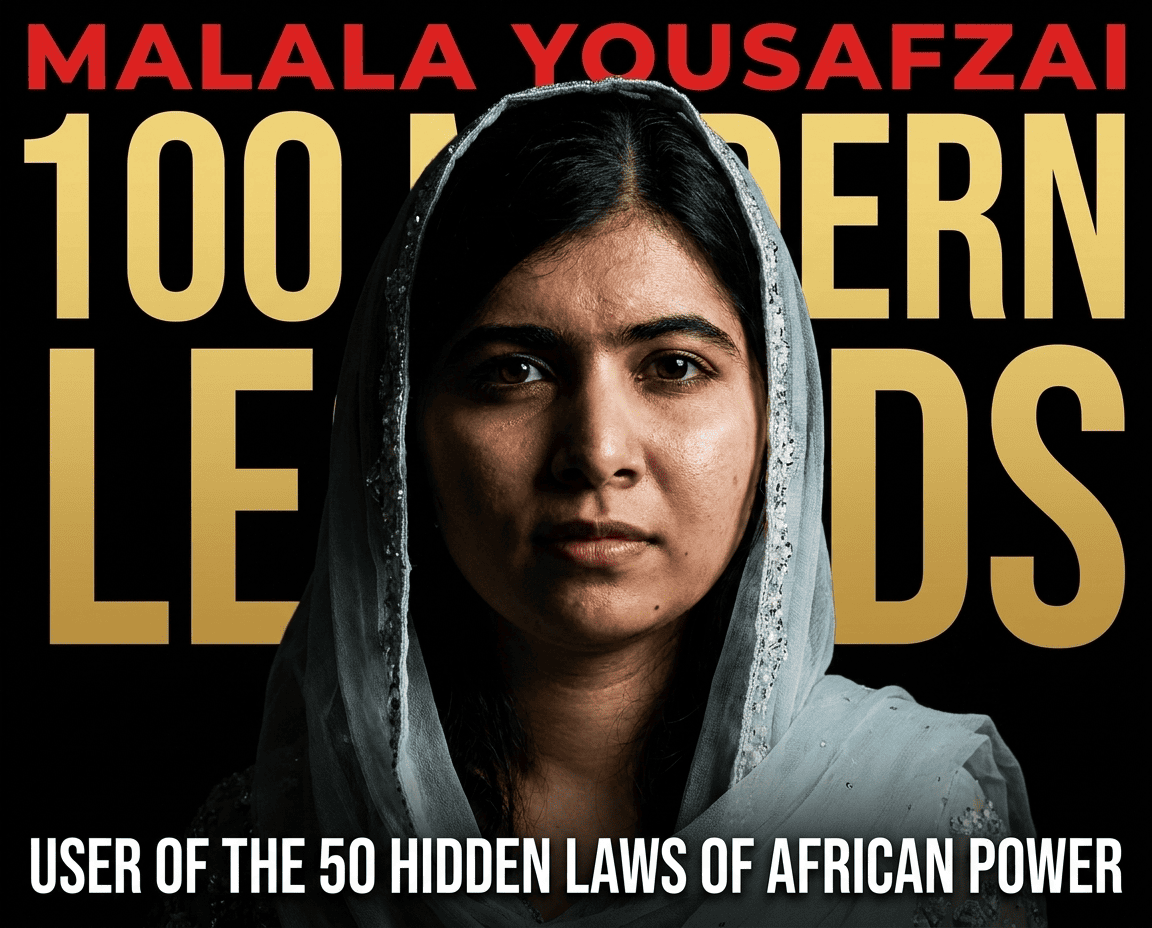
⭐ Who is Malala Yousafzai? Malala Yousafzai (born 1997) is a Pakistani activist for girls' education. Survivor of a Taliban assassination attempt in 2012 at age 15, she became the youngest Nobel Peace Prize laureate (2014) and co-founder of the Malala Fund. She continues her studies at Oxford University.
Malala Yousafzai emerged in a Pakistan marked by political instability, the rise of religious fundamentalism in the Swat Valley, and inequalities in girls' access to education. Coming from a modest but educated family, she transformed her local experience into a global platform for girls' rights, transcending cultural and religious borders.
❓ What has been Malala Yousafzai's impact on the world? Malala Yousafzai globalized the struggle for girls' education, inspired millions of young activists, and influenced education policies in 130+ countries through the Malala Fund. She illustrates Law 45: "Become a Symbol" by becoming a global icon of youthful courage and education as a universal right.
Malala Yousafzai draws from traditions of peaceful resistance and the importance of education in Islam: "Seeking knowledge is an obligation upon every Muslim". Her journey resonates with the principles of the African Laws of Power: transforming violence into determination, education into liberation, and creating a legacy that inspires beyond generations.
Points of convergence:
• Malala Yousafzai became more than an activist; she is the living symbol of youthful courage, resilience in the face of violence, and education as a universal right.
• Her name and story have the power to inspire millions of young people worldwide to dare to defend their rights.
• Modern application: Leaders must embody universal values to acquire influence that transcends borders.
• Strategic lesson: Universal symbolic power is born from alignment between personal courage and collective cause.
❓ How did Malala Yousafzai become a global icon? Born in Pakistan's Swat Valley, Malala transformed her anonymous blog about girls' education into a global movement. From the Taliban attack to the Nobel Prize, she forged her legend through action, illustrating Law 2: "Forge Your Legend Through Deeds".
Malala Yousafzai was born on July 12, 1997, in Mingora, Swat Valley, Pakistan. Daughter of an educator, Ziauddin Yousafzai, she grew up in a family that valued education for girls. At age 11, she began blogging anonymously for BBC Urdu about life under Taliban occupation. Writing became her weapon of resistance.
On October 9, 2012, at age 15, Malala was the victim of an assassination attempt by the Taliban: a bullet passed through her head on a school bus. She miraculously survived after treatment in Pakistan then the United Kingdom. Instead of silencing herself, she transformed her trauma into a global platform: "They thought a bullet would silence us, but nothing changed."
In 2014, at age 17, Malala became the youngest Nobel Peace Prize laureate. She co-founded the Malala Fund, which invests in girls' education in 130+ countries. She graduated from Oxford in 2020. The legend was set in motion.
Points of convergence:
• Malala did not speak of her greatness; she proved it through her courage against the Taliban, her global advocacy, her Nobel Prize.
• Every speech, every Malala Fund investment was tangible proof consolidating her emerging legitimacy.
• Modern application: Do not promise; accomplish. Your actions build your legend more than your words.
• Strategic lesson: Reputation is forged through repeated proof of courage and consistency.
❓ How does Malala Yousafzai master her influence? Malala controls every aspect of her communication: inspiring speeches, strategic appearances, authentic personal storytelling. She illustrates Law 7: "Become a Master of the Theater of Power" through her narrative and media mastery.
Malala understood early that authenticity is as important as the message. She created recognizable visuals: the traditional headscarf, determined gaze, calm but firm voice. Every element was designed to communicate youth, courage, and universality.
Malala does not submit to the narrative; she directs it. Through her UN speeches, global interviews, and her book "I Am Malala", she controls the narrative of the struggle for girls' education. She transforms every attempt to silence her into an opportunity to amplify her cause.
Points of convergence:
• Malala understood that authority is also played on a carefully orchestrated stage: speeches, postures, symbols.
• Every detail of her public persona communicated a message of power and authenticity.
• Modern application: Master your communication, your frame, your narrative. Perception is reality.
• Strategic lesson: The theater of power is not duplicity; it is the art of making your inner strength visible.
❓ How did Malala Yousafzai transform adversity into impact? Malala transformed an assassination attempt into a global movement for education through the Malala Fund, political advocacy, and inspiring young activists. She illustrates Law 10: "Transform Iron into Gold" — turning violence into systemic change.
Unlike a purely humanitarian approach, Malala chooses education as a systemic lever: an educated girl transforms her family, her community, her nation. This long-term vision creates exponential and lasting impact.
Malala invested massively in empowering girls: scholarships, teacher training, advocacy for education policies. This was activism with a mission of systemic transformation. Her vision: "One book, one pen, one teacher can change the world."
Points of convergence:
• Malala transformed violence and threat ("iron") into a global movement for education ("gold").
• She created systemic value where others saw only victims.
• Modern application: Do not submit to adversity; transform it into an opportunity for change.
• Strategic lesson: Social innovation transforms violence into liberation; value is created, not merely endured.
❓ What was the most strategic moment for Malala Yousafzai? Her speech at the United Nations General Assembly on July 12, 2013, her 16th birthday. Before world leaders, she declared: "One child, one teacher, one book and one pen can change the world". This moment illustrates Law 24: "Exile is a Waiting Room, Not a Tomb".
In 2013, Malala was 16. She had just survived an attack, left her country, and become a global symbol. The challenge was twofold: not be reduced to victim status, and transform her experience into a lever for political change.
Malala did not deliver a simple speech; she delivered a manifesto for universal education. She linked her personal story to a universal cause, transforming her vulnerability into moral strength. The speech was not a testimony; it was a call to global action.
The 2013 speech went viral worldwide. It inspired millions of young people, influenced education policies, and positioned Malala as the moral leader of her generation. The event was a waiting room; the global movement, an eternal manifesto.
Points of convergence:
• Malala used her forced exile in the UK as a period of maturation and consolidation of her movement.
• She let her idea of universal education grow until circumstances became favorable.
• Modern application: A setback, a sidelining, an apparent failure can become periods of strategic preparation.
• Strategic lesson: Forced distance is not an end; it is incubation for a more powerful return.
Malala remains active, but her legend is already immortal. She transformed the perception of youth activism. The Malala Fund continues to invest in girls' education. Her "political daughters" emerge worldwide. She has become an "ancestor while alive".
Points of convergence:
• Malala became a mythical reference while alive, a guide for future generations of activists.
• Her influence continues to shape education policies, girls' empowerment, and youth activism.
• Modern application: Share your wisdom, create a legacy that transcends your physical presence.
• Strategic lesson: Ultimate power is becoming a timeless reference, a guide for future generations.
💡 What can a leader learn from Malala Yousafzai? Malala teaches courage in the face of violence, strategic use of media, building a global movement, and inspiring through personal example. Modern leaders must aim for transformative impact and sustainability.
Lesson 1: Personal courage creates moral authority
Malala does not deny her fear; she acts despite it. She proves that courage creates credibility. Apply this standard to your leadership: authenticity creates trust.
Lesson 2: Transform your experience into a universal cause
Malala did not submit to her trauma; she transformed it into a platform for girls' rights. In your journey, every trial is material for building your mission.
Lesson 3: Create a legacy that transcends your presence
Malala built a global fund, inspired generations, and left a standard of courage that outlives her youth. Build now the legacy you will leave.
Points of convergence:
• Malala does not preach education; she lives it through her daily commitment, pursuing her own studies, and her authenticity.
• Her authenticity is consistent between words and actions.
• Modern application: Moral authority is born from alignment between words and deeds.
• Strategic lesson: Sustainable leadership is founded on exemplarity; live the values you preach.
❓ Why did Malala Yousafzai receive the Nobel Peace Prize? Malala Yousafzai received the 2014 Nobel Peace Prize (shared with Kailash Satyarthi) for her struggle against the suppression of children's education and for the right of all children to education. She became the youngest laureate in history at age 17.
❓ What is Malala Yousafzai's legacy? Malala Yousafzai co-founded the Malala Fund, which invests in girls' education in 130+ countries, inspired millions of young activists, and influenced global education policies. Her legacy is proof that youthful courage can transform the world.
❓ How does Malala Yousafzai inspire young African women? Malala Yousafzai inspires young African women through her courage in the face of adversity, her demonstration that education is a universal right, and her proof that young people can influence global policies. Activists like Amika George (UK) and girls educated by the Malala Fund in Africa cite her influence.
❓ Is Malala Yousafzai still active today? Yes, Malala Yousafzai remains active as an activist for girls' education. After graduating from Oxford in 2020, she continues to lead the Malala Fund and influence global education policies. She remains a timeless voice for girls' rights and universal education.
Malala Yousafzai remains, more than a decade after the Taliban attack, one of the most influential figures in global activism and girls' rights. Her journey — from Swat Valley to the UN, from assassination attempt to Nobel Prize, from victim to global leader — testifies to the power of personal courage, education as liberation, and creating an immortal legacy. She did not just defend education; she embodied its transformative power.
For contemporary leaders, Malala Yousafzai represents non-negotiable courage, control of one's destiny, and the ability to transform an individual experience into a movement of global transformation. Her life teaches that lasting power is born from alignment between values, words, and actions. Her name, Malala Yousafzai, resonates as a challenge: may every leader become architect of their own courage, speaking even in the heart of violence.
📜 Summary of African power laws embodied by Malala Yousafzai: Legend through deeds (#2), Resilience against limits (#5), Transforming iron into gold (#10), Creative exile (#24), Living as one teaches (#30), Universal symbol (#45), Immortal legacy (#50).
✅ Transform every trial into fuel for change
✅ Link your personal experience to a universal cause
✅ Use media and storytelling as strategic levers
✅ Invest in empowering the most marginalized
✅ Remain authentic to your mission of transformation
"What is your universal cause? How will you transform your experience into a movement of change that inspires your community?"
📚 Deepen with the Africa & Power Series