Through warfare, diplomacy and empire-building, the Oba of the Kingdom of Benin became a legend of West Africa.
⭐ Who was Ozolua the Conqueror? Ozolua, born Prince Okpame and later called Ozolua n'Ibaromi (Ozolua the Conqueror), was the fifteenth Oba of the Kingdom of Benin, reigning from 1483 to 1514. He is considered the greatest warrior-king in Benin's history. He considerably expanded the kingdom's frontiers through war and strengthened ties with the Portuguese Empire. He claimed over 200 military victories, earning him his nickname. He remains a major figure in the region's folklore and celebrations.
The Kingdom of Benin (located in present-day Nigeria) was one of the most powerful and best-organized states in pre-colonial West Africa. Founded by the Edo people, it had attained a high level of artistic, political, and military development. The capital, Benin City, was protected by immense walls and moats. The Oba (king) held absolute power there, at once political, judicial, economic, and spiritual. By Ozolua's time, the kingdom was already a major regional force, notably thanks to his father, Ewuare the Great.
❓ What does the name "Ozolua" mean? The full name is Ozolua n'Ibaromi, which means "Ozolua the Conqueror" in the Edo language. This title was bestowed upon him after his numerous military victories – over 200 battles according to his own statements to the Portuguese. His birth name was Prince Okpame, third and youngest son of Oba Ewuare the Great.
Ozolua's reign coincided with the arrival of the first Portuguese explorers on the West African coast. In 1485, the Portuguese explorer João Afonso d'Aveiro entered Benin City. Ozolua immediately grasped the strategic importance of this encounter: the Portuguese possessed firearms, technology he needed to pursue his expansion. He thus engaged in shrewd diplomacy with Lisbon, going so far as to propose conversion to Christianity in exchange for weapons.
Points of convergence:
• Ozolua balances the brute force of his military conquests with subtle diplomacy towards the Portuguese – the alliance of sword and word.
• He navigates between preserving Edo identity and opening up to foreign technologies.
• Modern application: African leaders must know how to wield military power and international negotiation – one cannot go without the other.
• Strategic lesson: The true conqueror knows when to fight and when to negotiate; Ozolua mastered both.
❓ How did Prince Okpame become Oba of Benin? Okpame was the third and youngest son of Ewuare the Great, who had considerably expanded the kingdom. After Ewuare's death in 1473, his eldest son Esi was assassinated by a poisoned arrow during his coronation. The second son, Olua, reigned for seven years amid discord. After a three-year interregnum, the Uzama (chiefs) appointed Okpame as Oba in 1483. He then took the name Ozolua.
Prince Okpame grew up in the shadow of his father Ewuare, one of the greatest Obas in Benin's history. Ewuare had already laid the foundations of an empire: he had rebuilt Benin City, established hereditary succession, and led victorious military campaigns. The young Okpame learned the art of war and the importance of centralizing power from his father. He is also said to have traveled in neighboring territories, notably among the Owan, where he is traditionally considered the ancestor of the Ora peoples.
After the troubled reigns of his brothers and the interregnum, Okpame was appointed Oba in 1483 (some sources say 1480 or 1481). From his accession, he launched a systematic military expansion. His ambition was to restore and surpass the greatness of his father's reign.
Points of convergence:
• Ozolua inherited a kingdom weakened by assassinations and internal dissensions following Ewuare's death. He reestablished central authority by crushing the warlords who had declared themselves independent.
• He transformed a period of fragmentation into an era of maximum expansion.
• Modern application: African leaders must know how to rebuild national unity after periods of division – the greatest builders are born from chaos.
• Strategic lesson: Power is not given, it is seized in moments of weakness.
❓ What titles did Ozolua hold and what did they mean? He primarily held the title of Oba of the Kingdom of Benin, which made him the absolute sovereign, simultaneously political chief, military commander, supreme judge, and spiritual leader. His nickname Ozolua n'Ibaromi (Ozolua the Conqueror) was an honorific title earned on the battlefield. Tradition also calls him "the greatest warrior-king of Benin."
Points of convergence:
• After the chaotic reigns of his brothers, Ozolua established himself as the only one capable of maintaining the kingdom's unity and making it prosper.
• His ability to accumulate military victories and diplomatic successes made him irreplaceable in the eyes of the chiefs and the people.
• Modern application: African leaders must make themselves indispensable by proving their effectiveness in resolving crises.
• Strategic lesson: Indispensability arises from demonstrated competence: no one challenges the one who wins.
❓ What were Ozolua's conquests? Ozolua extended the frontiers of the Kingdom of Benin from the Niger River in the east to Lagos in the west. He led victorious campaigns against neighboring kingdoms: Owo, Ijebu, Ondo, as well as many city-states in the region. He also subdued the territories of the Esan people. In total, he claimed over 200 military victories and consolidated his authority through a complex network of matrimonial and diplomatic alliances.
Ozolua was not merely a brutal warrior; he was a strategist. He understood that simple conquest was not enough: one had to consolidate. He established a vassalage system in which defeated kingdoms retained some autonomy but had to pay tribute to Benin City. He also used a complex network of diplomatic marriages to bind the elites of the subjected territories to the Benin crown.
One of Ozolua's most famous campaigns was the war against Uromi and Uzea, in Esan country. After repeated provocations from the local chief Agba N'Ojie, Ozolua marched on Uromi. The war was fierce and ended at Uzea, where Ozolua directly confronted the rebel chief. Accounts diverge on the immediate outcome of this battle, but it left a lasting mark on the region's collective memory.
Points of convergence:
• Ozolua understood that in an environment of rival city-states, military power was the primary diplomatic argument.
• His 200 victorious battles were not merely a show of force: they were a message to other rulers.
• Modern application: African leaders must sometimes show their strength to deter adversaries; peace is often achieved through military credibility.
• Strategic lesson: An enemy only respects what it fears; Ozolua's reputation for ferocity was worth an army.
❓ How did Ozolua negotiate with the Portuguese? In 1485, the Portuguese explorer João Afonso d'Aveiro entered Benin City, marking the beginning of direct diplomatic relations between Benin and Portugal. Ozolua was fascinated by firearms. The Portuguese told him that the arms trade was only possible with Christian allies. Ozolua then sent an ambassador to Lisbon in the early 1500s to propose missionary activity and a royal conversion in exchange for weapons. The Portuguese refused the deal but sent missionaries in 1514 – who soon departed, as the kingdom was not interested in Christianity without the military quid pro quo.
Ozolua was the first West African ruler to send an ambassador to a European court. He also received the first Portuguese ambassador, João Afonso d'Aveiro, in 1486. This early diplomatic exchange shows that Ozolua considered Portugal as an equal, not a superior. Benin already had an embassy in Lisbon – a historical fact that contradicts the colonial narrative of an isolated Africa.
Points of convergence:
• Ozolua immediately identifies what the Portuguese want (souls to convert, Christian allies) and uses this knowledge as a negotiating lever.
• He proposes conversion to Christianity – not out of conviction, but as a bargaining chip to obtain firearms.
• Faced with the Portuguese refusal, he does not yield: he dismisses the missionaries, showing he will not have conditions dictated to him.
• Modern application: African leaders must negotiate on an equal footing with foreign powers, never sacrificing their fundamental interests.
• Strategic lesson: The conversion proposed by Ozolua was not submission, but a tactical maneuver to obtain the military technology he needed.
❓ What happened after Ozolua's death? At the end of his reign, Ozolua left two powerful sons who disputed the succession: Esigie controlled Benin City, while Arhuaran (or Arualan) was based in Udo, a city of almost equal importance located about 30 km away. Legend has it that, in his old age, Ozolua mistakenly named Arhuaran chief of Udo instead of Edo (Benin City), causing confusion and war between the two brothers. Esigie, aided by his mother Idia, eventually triumphed. Arhuaran, defeated, threw himself into a lake with all his possessions.
Idia, wife of Ozolua and mother of Esigie, played a decisive role in this succession war. Described as a great warrior, she mobilized an army around Esigie. Her political advice, mystical powers, and medical knowledge were considered decisive. In recognition, Esigie created the title of Iyoba (Queen Mother), a major political office that endured in the kingdom. Idia is today world-famous thanks to the celebrated ivory pendant mask representing her.
Points of convergence:
• The union of Ozolua and Idia, and later the creation of the Iyoba title by Esigie, show how power is transmitted and strengthened through family alliances.
• Idia, wife of Ozolua, becomes the archetype of the African Queen Mother: advisor, warrior, spiritual figure.
• Modern application: African leaders must build strong family and matrimonial alliances; dynastic stability is a political asset.
• Strategic lesson: A poorly prepared succession can plunge an empire into civil war; Ozolua experienced this bitter truth.
❓ How did Ozolua die? Several contradictory versions of Ozolua's death exist. According to some sources, he died of natural causes around 1520. According to historian Adrian Hastings, he was deposed in 1504 and assassinated by disgruntled military chiefs, as the promise of firearms had not materialized. Another tradition reports that he was killed in Esan country, during a war against Uromi, either by a poisoned arrow or beheaded by Chief Agba N'Ojie. The uncertainty surrounding his death adds to his legend.
Points of convergence:
• Ozolua's death is shrouded in mystery: political assassination, military defeat, or natural death? Versions diverge.
• Some accounts speak of a poisoned arrow, others of beheading, yet others of deposition by his own chiefs – this fog sustains the myth.
• Modern application: Leaders can leave a degree of shadow over the end of their life or reign – mystery is a magnet for legends.
• Strategic lesson: An uncertain death opens the door to epic tales; Ozolua survives in collective memory because his end remains a subject of debate.
Ozolua's legacy is multifaceted. Militarily, he brought the Kingdom of Benin to its maximum territorial extension, paving the way for the reigns of his successors Esigie and Orhogbua. Diplomatically, he established the first lasting contacts between a West African state and a European power. Culturally, he is commemorated in traditional Edo festivals, notably the Igue ceremony, where the Ugha Ozolua (Ozolua's courtyard) plays a central role. He is considered the ancestor of the Owan/Ora peoples. Bronze plaques depicting Ozolua in war dress are preserved in museums around the world, including the Museum of Black Civilizations in Dakar, the British Museum, and the Art Institute of Chicago.
Points of convergence:
• "Ozolua the Conqueror" has become an archetype of the African warrior-king, celebrated in folklore, art, and the collective memory of the Edo people.
• His name is associated with the golden age of Benin's expansion, a reference for all subsequent rulers.
• Modern application: African leaders must aspire for their name to become synonymous with an era, a value, an achievement.
• Strategic lesson: Posterity belongs to those who have accomplished things large enough that one can no longer utter their name without evoking their work.
❓ What are the historical sources on Ozolua? Sources include the oral traditions collected by the Benin court historians (notably Jacob Egharevba), the Portuguese archives (diplomatic correspondence, travel accounts of João Afonso d'Aveiro), the historic bronze plaques that adorned the royal palace of Benin City, and contemporary studies such as those by Noelle Watson, Toyin Falola, Adrian Hastings, and Isidore Okpewho.
Points of convergence:
• Ozolua controlled his narrative in his lifetime by declaring to the Portuguese that he had won over 200 battles.
• The bronze plaques commissioned by the Benin court immortalized his image as a warrior-king.
• Modern application: African leaders must document their achievements and actively shape their image with foreign interlocutors.
• Strategic lesson: It is not only what you do, but what you say you have done that forges your reputation; Ozolua understood this.
❓ Where is Ozolua's tomb? As with many ancient Obas of Benin, the exact location of his burial remains uncertain. One tradition claims he was buried in Esan country, at Uzea, where he would have died. Other sources point to Benin City. The absence of a tomb identified with certainty adds to the mystery.
❓ Did Ozolua really go to Portugal? At least one historical source indicates that Ozolua himself may have traveled to Portugal at some point during his reign. If confirmed, he would be one of the first African heads of state to have visited Europe. However, most historians remain cautious on this point.
❓ Did Ozolua introduce bronze casting to Benin? Some traditions assert that Ozolua introduced bronze casting to Benin by calling upon a great bronzesmith named Iguehae. The exact dating of the introduction of this technique remains debated, but Ozolua's reign coincides with a period of artistic flourishing.
Points of convergence:
• The gray areas surrounding Ozolua's life and death – unknown tomb, uncertain trip to Portugal, exact circumstances of his death – fuel a fertile imagination.
• Each generation can reinterpret his story, which guarantees his continued presence in collective memory.
• Modern application: Leaving parts of one's biography in shadow is sometimes more strategic than explaining everything; people's imagination does the rest.
• Strategic lesson: A king whose tomb is unknown is a king who can always return – mystery is a form of presence.
❓ Is Ozolua the greatest Oba in Benin's history? He is certainly the greatest warrior-king. His father Ewuare the Great is more known for his domestic reforms and the rebuilding of Benin City, while Ozolua embodies maximum military expansion. The two complement each other: Ewuare laid the foundations, Ozolua built the empire.
❓ What is the link between Ozolua and the Owan people? Ozolua is traditionally considered the ancestor of the Owan/Ora peoples. Before becoming Oba, Prince Okpame is said to have stayed in this region. Departing for Benin City, he is said to have left one of his sons, Oguan, as the founder of the Ora lineage.
❓ Why is Ozolua important for contemporary Africa? He embodies the capacity of pre-colonial African states to negotiate on an equal footing with European powers. He shows that Africa did not "wait" for Europeans to build powerful, organized, and expansionist kingdoms. His story is an antidote to the colonial narrative.
💡 What can Africa learn from Ozolua the Conqueror? Ozolua teaches that military power must be coupled with diplomatic intelligence. He shows that an African leader can deal with foreign powers without being dominated. He reminds us that conquest is not enough: one must consolidate through matrimonial alliances, treaties, and institutions. Finally, his story warns against the dangers of a poorly prepared succession – even the greatest conqueror can see his legacy threatened by a civil war between his own sons.
Force without diplomacy is blind: Ozolua did not content himself with winning; he negotiated with Portugal from a position of strength.
Consolidate after conquering: The network of diplomatic marriages and vassalage treaties survived his death.
Prepare your succession: The war between Esigie and Arhuaran shows that the greatest weakness of a conqueror is often the future he leaves behind.
Control the image: The bronze plaques and the declarations to the Portuguese forged the legend of Ozolua the Conqueror.
Points of convergence:
• Ozolua is at once warlord, diplomat, international negotiator, empire builder, and spiritual figure.
• He masters the art of war, the art of negotiation, and the art of political communication.
• Modern application: African leaders must be versatile; the continent's renaissance requires personalities capable of excelling on multiple fronts.
• Strategic lesson: A king who only knows how to wage war will eventually die by the sword; Ozolua also knew how to negotiate, build, and consolidate.
Ozolua the Conqueror remains, more than five centuries after his death, one of the most fascinating figures in the history of West Africa. Son of a great king, brother of two unfortunate kings, he took power in a weakened kingdom and turned it into a feared empire. By the strength of his arms and the finesse of his diplomacy, he brought Benin to its territorial peak and established the first contacts on an equal footing with a European power.
For contemporary Africa, Ozolua is proof that African leaders were never passive in the face of history. They conquered, negotiated, and built long before the arrival of Europeans. His name, Ozolua n'Ibaromi – Ozolua the Conqueror – resonates as a challenge to the current generations: will you extend the influence of your people, as he extended the frontiers of his?
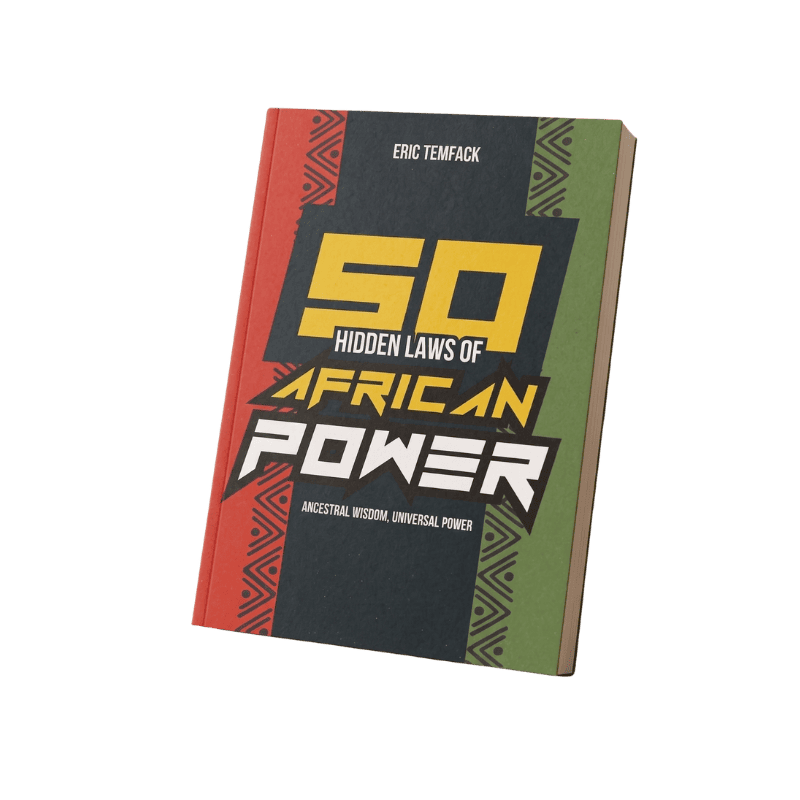
📜 Summary of the laws embodied by Ozolua: Cosmic Balance (#1), Polymathy (#5), Force as Language (#7), Indispensability (#12), Negotiation (#16), Sacred Alliances (#19), Control of Narrative (#28), Chaos into Order (#32), Mystery (#37), Symbol (#45).
✅ Always combine military (or economic) strength with diplomatic intelligence
✅ Consolidate your conquests through lasting alliances and institutions
✅ Prepare your succession with care – a poorly transmitted empire is a lost empire
✅ Negotiate with foreign powers on an equal footing, never sacrificing your vital interests
✅ Control your image and your narrative; ensure your name becomes a legend.
"What territory – geographical, economic, intellectual – will you conquer today for your people? And how will you forge your own conqueror's nickname?"
50 LOIS CACHEES DU POUVOIR AFRICAIN
Hello ! Tu as des questions concernant le livre {50 lois cachées}?
Parle avec l'auteur ici
En ligne | Politiques de confidencialité
Contacter l'auteur 📱