
Through athletic excellence, community empowerment and the transformation of poverty into empire, the king of modern basketball illustrated the African Power Laws.
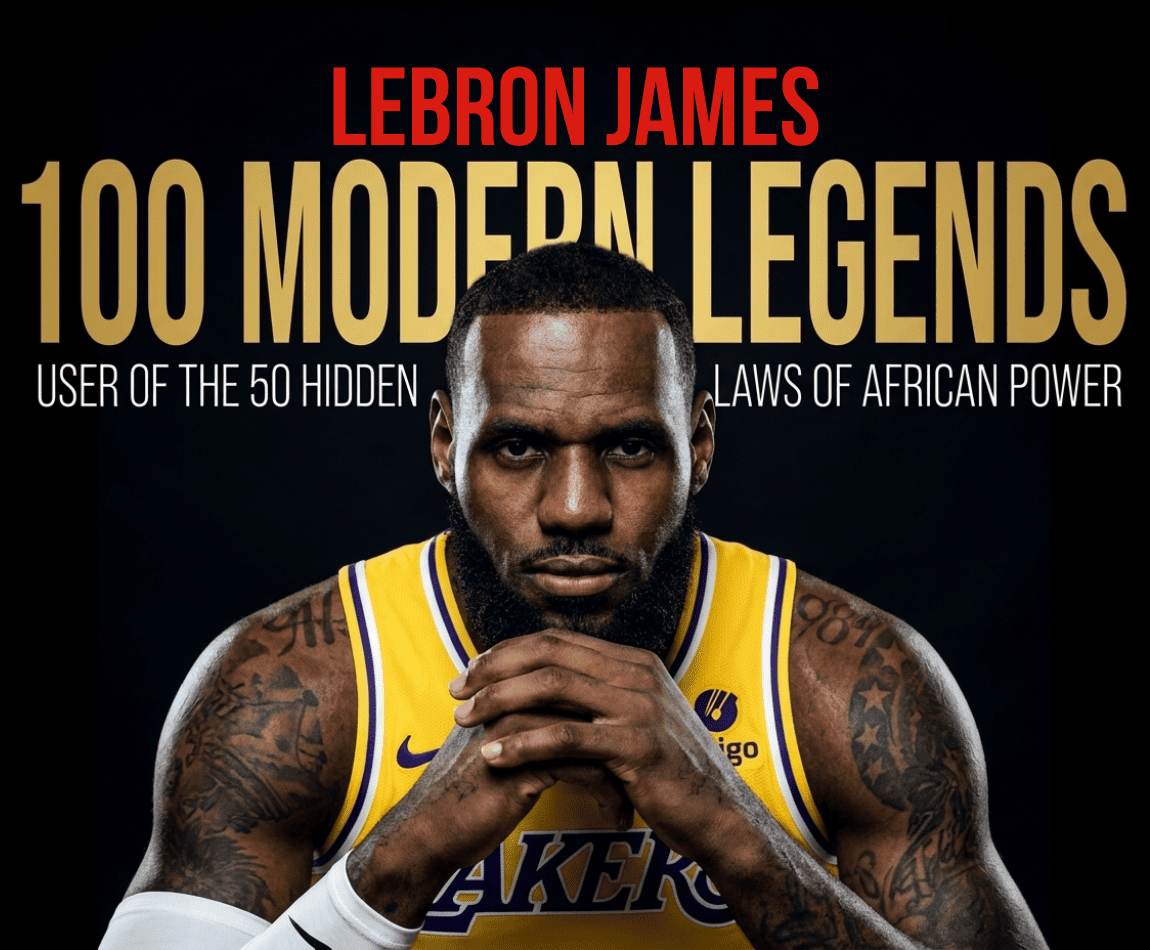
⭐ Who is LeBron James? LeBron James (born 1984) is an American basketball player, four-time NBA champion. He used his platform for community empowerment, education and investment in black entrepreneurship. His journey illustrates Laws 2, 5, 10, 24, 30, 45 and 50 of the 50 Hidden Laws of African Power.
LeBron James emerged in an urban America marked by poverty, gang violence and racial inequality. Akron, Ohio, his hometown, is a microcosm of these challenges. Coming from a single-parent black family, LeBron transformed basketball into a platform for social mobility and community pride.
❓ What was LeBron James' impact on the black community? LeBron James created the I PROMISE School in Akron for underprivileged children, invested in black businesses, and used his platform for social activism (More Than A Vote). He illustrates Law 30: "Live as You Teach" by aligning his actions with his values.
LeBron draws from the heritage of the African diaspora: resilience in the face of adversity, importance of community, excellence as an act of resistance. He does not reject his roots; he sublimates them on the court, transforming basketball into an expression of black power and community unity.
Points of convergence:
• LeBron does not preach community empowerment; he lives it by creating the I PROMISE School.
• His authenticity is consistent between his words on the court and his actions off the court.
• Modern application: Moral authority is born from alignment between words and actions.
• Strategic lesson: Durable leadership is based on exemplarity; live the values you preach.
❓ How did LeBron James become a global star? Born in poverty in Akron, LeBron transformed his lack of resources into a driver of excellence. From his beginnings in high school to his Sports Illustrated cover at 17 ("The Chosen One"), he forged his legend through acts, illustrating Law 2: "Forge Your Legend Through Acts".
LeBron Raymone James was born on December 30, 1984 in Akron, Ohio. His mother, Gloria James, was 16 at his birth; his father is absent. They lived in precariousness, often changing housing. LeBron found refuge in basketball, a sport that became his escape and his social elevator.
At 15, LeBron dominated high school basketball. In 2002, Sports Illustrated covered him with the title "The Chosen One" — a self-fulfilling prophecy. At 18, he was drafted #1 by the Cleveland Cavaliers, becoming the youngest player to sign a max rookie contract. The legend was underway.
Points of convergence:
• LeBron did not speak of his greatness; he proved it game after game, season after season.
• Each title, each record was tangible proof that consolidated his myth under construction.
• Modern application: Do not promise; accomplish. Your results build your legend more than your words.
• Strategic lesson: Reputation is forged through repeated proof of excellence and courage.
❓ What is LeBron James' "The Decision"? In 2010, LeBron announced live on ESPN his departure from the Cavaliers to the Miami Heat. This gesture, heavily criticized at the time, illustrated Law 24: "Exile is a Waiting Room, Not a Grave" — a strategic exile to return stronger.
In 2010, LeBron was free to choose his team. Instead of following traditional advice, he organized a TV special ("The Decision") to announce his choice. The gesture was heavily criticized, but it marked a turning point: LeBron took control of his career, not the franchises.
In Miami, LeBron won two NBA titles (2012, 2013) and refined his leadership. In 2014, he returned to Cleveland with a mission: bring a title to his hometown. In 2016, he achieved the impossible: come back from 3-1 down against the Warriors in the NBA Finals. The exile had borne fruit.
Points of convergence:
• LeBron used his departure from Cleveland as a period of maturation and learning.
• He let his idea grow in his absence until circumstances became favorable.
• Modern application: A setback, a sidelining, a public failure can become periods of strategic preparation.
• Strategic lesson: Forced distance is not an end; it is an incubation for a more powerful return.
❓ How did LeBron James build his commercial empire? LeBron transformed his athletic talent into a commercial empire through SpringHill Company (production), Blaze Pizza, Fenway Sports Group, and investments in startups. He illustrates Law 10: "Transform Iron into Gold" — transforming a name into a commercial empire.
Unlike many athletes who depend on brands, LeBron created SpringHill Company in 2020 with Maverick Carter. He produces films, series, digital content. This economic independence is the key to his artistic and political freedom.
LeBron invests in black-founded businesses (Uninterrupted, SpringHill), supports black entrepreneurship, and uses his platform to amplify marginalized voices. It's business with a social mission.
Points of convergence:
• LeBron transformed his athletic talent ("iron") into a global commercial empire ("gold").
• He created exponential value where others saw only an endorsement contract.
• Modern application: Do not sell your raw talent; transform it into a brand, a system, a legacy.
• Strategic lesson: Commercial innovation transforms talent into empire; value is created, not simply extracted.
❓ What was the most strategic moment in LeBron James' career? The 2016 NBA Finals against the Warriors. Down 3-1, LeBron and the Cavaliers came back to win the title. He illustrates Law 5: "Never Define Yourself by Your Limits" — transforming adversity into triumph.
Cleveland had not won a major title since 1964. LeBron, returning from exile, carried the hope of a city. The Warriors were favorites, with 73 wins in the regular season. The challenge was immense: win against history and against statistics.
LeBron did not seek individual glory; he elevated his teammates. His block on Iguodala in Game 7 is legendary. He scored 27 points, 11 rebounds, 11 assists in the Finals. The Cavaliers won 93-89. LeBron lifted the trophy, tears in his eyes: "Cleveland, this is for you!"
The 2016 victory consecrated LeBron as one of the greatest in history. But more importantly: it inspired an entire generation of young blacks to believe that the impossible is possible. LeBron proved that resilience and faith in community can triumph over adversity.
Points of convergence:
• LeBron refused to let himself be defined by the 3-1 deficit; he transformed it into motivation.
• He transformed stigmas (criticism, pressure) into a source of excellence.
• Modern application: A disability, a modest origin, a criticism can become sources of innovation.
• Strategic lesson: Turn the stigma around; transform adversity into fuel for excellence.
LeBron is still active in the NBA, but his legend is already immortal. He transformed basketball into a platform of community empowerment. The I PROMISE School educates hundreds of underprivileged children. His investments create jobs in the black community. He became an "ancestor while still living".
Points of convergence:
• LeBron became a mythical reference in his lifetime, a guide for future generations.
• His influence continues to shape sports, entrepreneurship and movements for equality.
• Modern application: Share your wisdom, create a legacy that transcends your physical presence.
• Strategic lesson: The ultimate power is to become a timeless reference, a guide for future generations.
💡 What can a leader learn from LeBron James? LeBron teaches athletic excellence, controlling one's career, investing in one's community, and transforming talent into commercial empire. Modern leaders must aim for economic independence and social impact.
Lesson 1: Control your destiny
LeBron depends on no franchise. He chooses his teams, controls his brand, produces his content. Apply this requirement to your work: control your distribution channels to protect your message.
Lesson 2: Transform your origins into strength
LeBron never hid his poverty; he used it as fuel. In your journey, every obstacle is material to build your excellence.
Lesson 3: Create a legacy that transcends your presence
LeBron created a school, inspired generations, and left a standard of excellence that survive his career. Build now the legacy you will leave.
Points of convergence:
• LeBron became more than a basketball player; he is the living symbol of black empowerment and community resilience.
• His name and image have the power to mobilize masses and force the elite to react.
• Modern application: Leaders must embody a cause greater than themselves to acquire supra-political influence.
• Strategic lesson: Symbolic power can surpass coercive power when it touches the collective conscience.
❓ How many NBA titles has LeBron James won? LeBron James has won 4 NBA titles: 2 with the Miami Heat (2012, 2013), 1 with the Cleveland Cavaliers (2016), and 1 with the Los Angeles Lakers (2020). He has also been elected Finals MVP 4 times.
❓ What is the I PROMISE School? The I PROMISE School is a free public school founded by LeBron James in Akron, Ohio, in 2018. It offers complete education, meals, family support, and a path to university for underprivileged children.
❓ How does LeBron James support black entrepreneurship? LeBron invests in black-founded businesses (SpringHill Company, Uninterrupted), supports startups through his investment company, and uses his platform to amplify marginalized voices.
❓ What is LeBron James' legacy? LeBron transformed basketball into a platform of community empowerment, inspired generations of young blacks, and created a model of athlete-entrepreneur-activist. His cultural and social legacy is global and timeless.
LeBron James remains, more than two decades after his debut, one of the most influential figures in global popular culture. His journey — from the poor child of Akron to the king of basketball, from "The Chosen One" to the entrepreneur-activist — testifies to the power of resilience, excellence and the creation of an immortal legacy. He didn't just win games; he won lives.
For contemporary leaders, LeBron James represents control of one's destiny, non-negotiable excellence, and the ability to transform individual talent into a collective movement. His life teaches that lasting power is born from alignment between values, words and actions. His name, LeBron James, resonates as a challenge: may every leader become architect of their own empire, singing "Strive for Greatness" even in the heart of storms.
📜 Summary of African power laws embodied by LeBron James: Legend through acts (#2), Resilience in the face of limits (#5), Transforming iron into gold (#10), Creative exile (#24), Live as you teach (#30), Universal symbol (#45), Immortal legacy (#50).
✅ Control your production and distribution channels
✅ Transform your modest origins into a driver of success
✅ Use your platform for causes that transcend your interests
✅ Transform your talent into an independent economic system
✅ Remain authentic to your cultural roots
"What is your 'Strive for Greatness'? How will you transform your talent into an independent empire that serves your community?"
📚 Deepen with the Africa & Power series