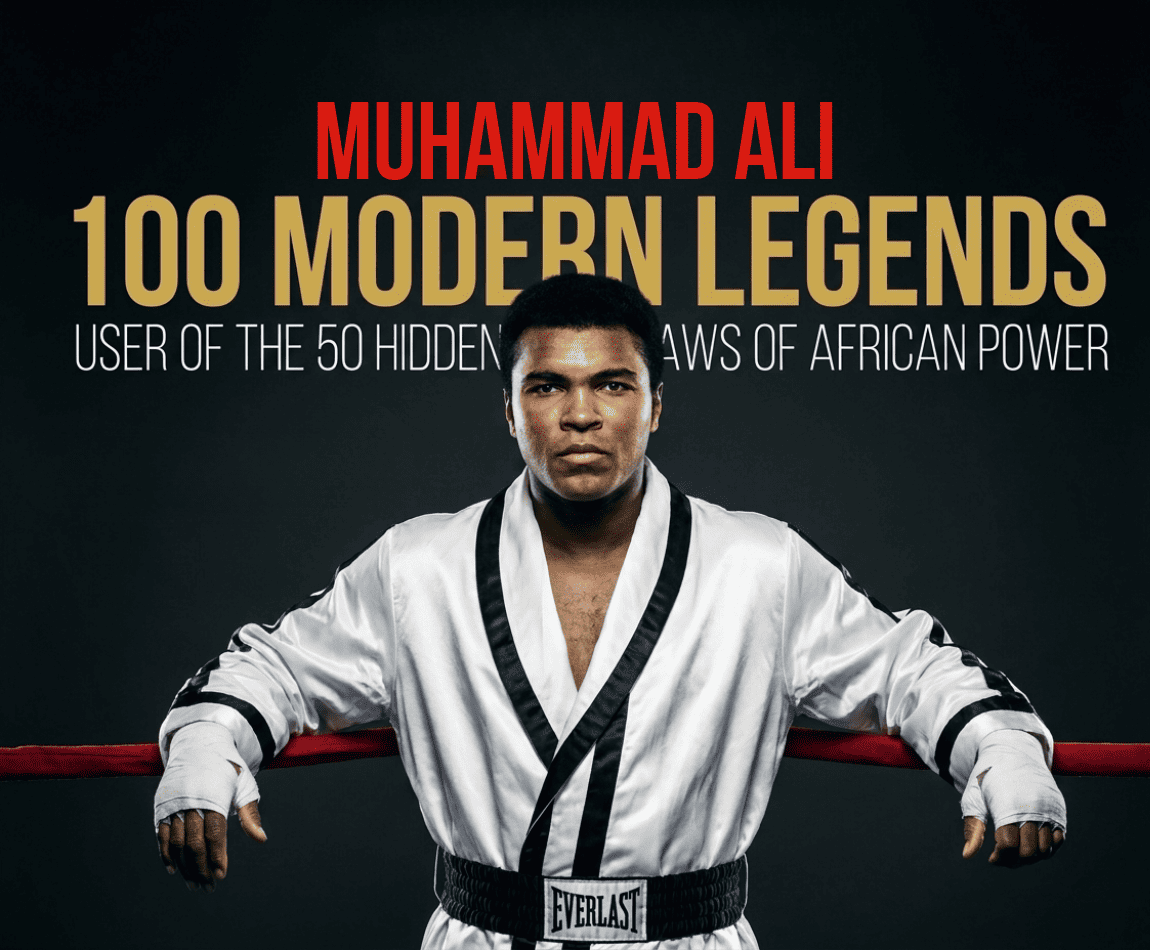
MUHAMMAD ALI — EMBODIMENT OF THE 50 HIDDEN LAWS OF AFRICAN POWER
Through excellence, psychological warfare, resilience against injustice and radical alignment between values and actions, the greatest boxer in history illustrated the African Power Laws.
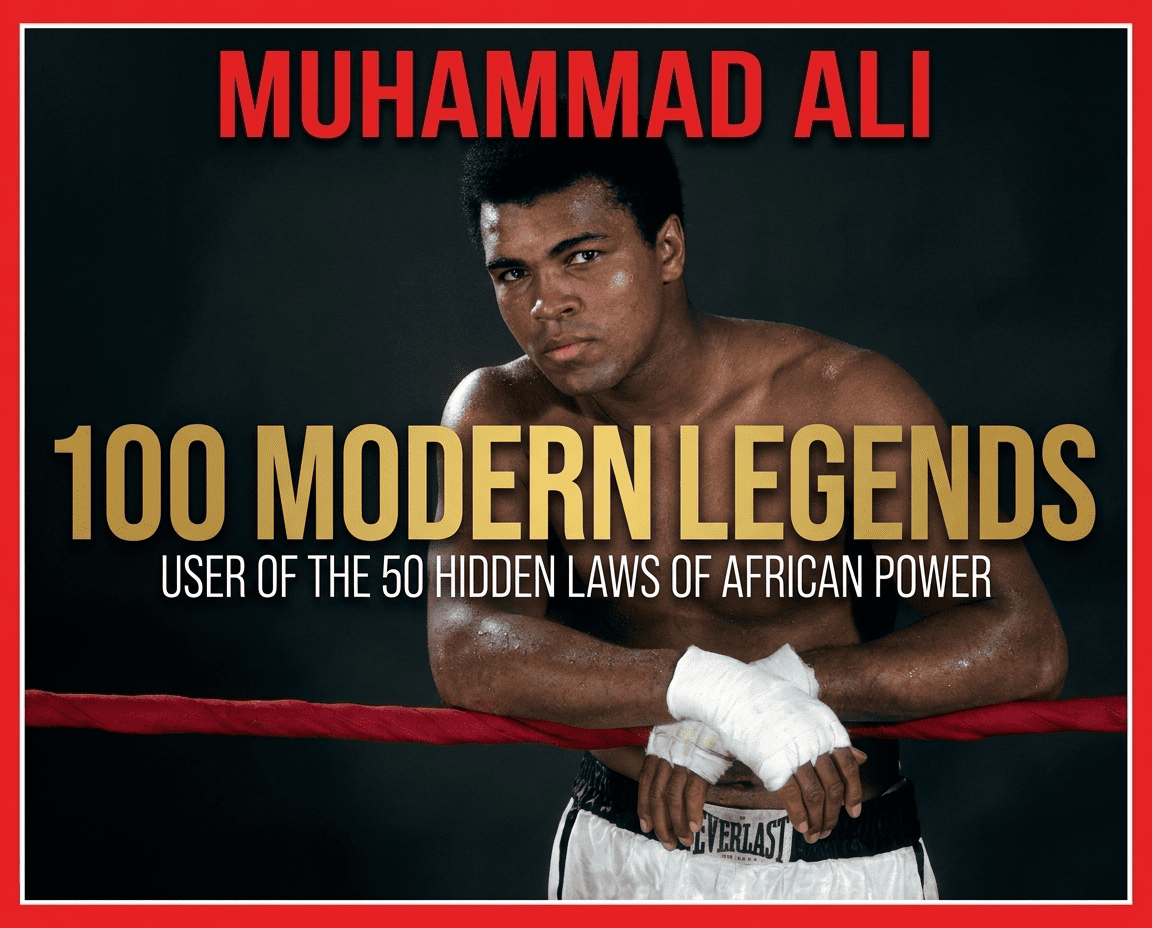
Muhammad Ali (Cassius Clay)
Book 1: 50 Laws
I. CONTEXT: AMERICA IN THE 1960S-1970S
⭐ Who is Muhammad Ali? Muhammad Ali (1942-2016) was an American boxer, three-time heavyweight world champion. Known for his unique style, civil rights activism and refusal of the Vietnam War, he illustrates Laws 2, 5, 7, 8, 24, 30 and 45 of the 50 Hidden Laws of African Power.
The sporting and social landscape of the era
Muhammad Ali emerged in an America torn between racial segregation, the civil rights struggle and military escalation in Vietnam. Sport was one of the few spaces where black athletes could access national visibility, but they remained subject to the codes of white elites. Ali would break these codes by refusing to separate his talent from his convictions.
❓ What was Muhammad Ali's impact beyond the ring? Ali transformed sport into a platform for political resistance and black pride. His refusal of the Vietnam War, his name change and his humanitarian engagement make him a global icon of conscience and authenticity, illustrating Law 45: "Become a Symbol".
The Spiritual and Cultural Context
Conversion to Islam (Nation of Islam then Sunni) was not merely religious for Ali; it was an act of identity reappropriation. Abandoning "Cassius Clay" (a name inherited from slavery) for "Muhammad Ali" was a declaration of personal and cultural sovereignty.
🔗 CONNECTION WITH THE 50 HIDDEN LAWS OF AFRICAN POWER
→ Law #45: "Become a Symbol – When Your Name Becomes a Movement"
Points of convergence:
• Ali understood that his name, style and words could embody a cause greater than himself.
• He became the living symbol of black dignity, peaceful resistance and uncompromising excellence.
• Modern application: Leaders must aim for their identity to become a banner of universal values.
• Strategic lesson: A well-embodied symbol survives the individual and inspires entire generations.
II. ORIGINS AND ASCENT: FROM STOLEN BIKE TO GLOBAL SUMMIT
❓ How did Muhammad Ali become champion? It all started at age 12 with a stolen bike and a meeting with officer Joe Martin. From the Olympic gold medal (Rome 1960) to the world title against Sonny Liston (1964), Ali forged his legend through acts, illustrating Law 2: "Forge Your Legend Through Acts".
Birth, family and first spark
Born Cassius Marcellus Clay Jr. on January 17, 1942 in Louisville, Kentucky, he grew up in a modest African-American family. At age 12, his bike was stolen. Furious, he went to the police to report the thief and met officer Joe Martin, a boxing coach, who offered to teach him to defend himself. The spark was immediate.
Fulminant rise and Rome 1960
In a few years, he dominated amateur tournaments, won two Golden Gloves, and won the gold medal at the Rome Olympics in 1960. He turned professional the same year, developing a revolutionary style for a heavyweight: dancer's speed, light footwork, high guard, extreme anticipation.
The strategic turning point: Ali vs Liston (1964)
Facing the fearsome Sonny Liston, considered invincible, Ali (then Cassius Clay) used psychological warfare: provocations, poems, round predictions. He won in the 7th round by abandonment, becoming the youngest heavyweight champion in history at 22. The legend was born.
🔗 CONNECTION WITH THE AFRICAN POWER LAWS
→ Law #2: "Forge Your Legend Through Acts"
Points of convergence:
• Ali did not speak of his greatness; he proved it ring after ring, round after round.
• Each victory was tangible proof that consolidated his myth under construction.
• Modern application: Do not promise; accomplish. Your results build your legend more than your words.
• Strategic lesson: Reputation is forged through repeated proof of excellence and courage.
III. MASTERY OF THE THEATER OF POWER: PSYCHOLOGICAL WARFARE
❓ How did Muhammad Ali dominate his opponents mentally? Ali used poetry, public predictions, calculated provocations and unshakable confidence to break his opponents' minds before the first bell. He illustrates Law 7: "Become a Master of the Theater of Power".
The art of strategic provocation
"Float like a butterfly, sting like a bee." His phrases were not mere slogans; they were psychological weapons. By announcing the round of victory, dancing around his opponents, staring at them without blinking, Ali created a climate of uncertainty and doubt in the opponent before the fight even began.
Control of media narrative
Ali understood that media amplify perception. He made himself indispensable to journalists, offered punchy quotes, controlled his image and transformed every press conference into a spectacle. He did not undergo the narrative; he directed it.
🔗 CONNECTION WITH THE AFRICAN POWER LAWS
→ Law #7: "Become a Master of the Theater of Power"
Points of convergence:
• Ali understood that authority is also played out on a carefully orchestrated stage: looks, posture, words, silence.
• Every detail of his public persona communicated a message of superiority and invincibility.
• Modern application: Master your non-verbal communication, your setting, your narrative. Perception is a reality.
• Strategic lesson: The theater of power is not duplicity; it is the art of making your inner strength visible.
IV. EXILE AS A WAITING ROOM: THE REFUSAL OF THE VIETNAM WAR
❓ Why was Muhammad Ali stripped of his title? In 1967, he refused induction into the U.S. Army for religious and anti-imperialist reasons. Stripped of his boxing license, passport and title for 3.5 years, he illustrates Law 24: "Exile is a Waiting Room, Not a Grave".
The radical choice and its consequences
"I ain't got no quarrel with them Vietcong." This phrase cost him everything: title, license, income, initial public support. He became the most hated man in America, then, gradually, the most respected.
Reconstruction in silence
During his forced exile (1967-1970), Ali did not collapse. He gave lectures on campuses, advocated for civil rights, refined his life philosophy and prepared his physical and mental return. The "exile" became a strategic waiting room where his legend matured.
The triumphant return
In 1970, the Supreme Court overturned his conviction. Ali returned hungrier, more strategic, more aware of his historical role. He faced Frazier, Foreman, and reconquered the world title, proving that strategic patience pays off.
🔗 CONNECTION WITH THE AFRICAN POWER LAWS
→ Law #24: "Exile is a Waiting Room, Not a Grave"
Points of convergence:
• Ali used his exclusion as a period of ideological and physical maturation.
• He let his idea grow in his absence until circumstances became favorable.
• Modern application: A setback, a sidelining, a public failure can become periods of strategic preparation.
• Strategic lesson: Forced distance is not an end; it is an incubation for a more powerful return.
V. KEY STRATEGIC MOMENTS: THE PATIENCE OF THE BAOBAB AND THE "ROPE-A-DOPE"
❓ What was Muhammad Ali's most strategic fight? The "Rumble in the Jungle" (1974) against George Foreman. Facing a younger, stronger opponent, Ali used the "rope-a-dope" tactic: absorb blows against the ropes, let Foreman exhaust himself, then strike at the critical moment. He illustrates Law 8: "Cultivate the Patience of the Baobab".
The challenge: Defeating the invincible George Foreman
Foreman was considered the most powerful puncher in history. Ali, at 32, was given 4-to-1 underdog odds. The challenge was not physical; it was tactical and psychological.
The deployed strategy: Rope-a-dope
Ali invented a counter-intuitive strategy in real time: lean against the ropes, protect his head, let Foreman punch until exhaustion. It was a masterclass in active patience, energy management and fight reading. In the 8th round, Foreman was drained. Ali struck. KO. The title was reconquered.
The result and its consequences
The victory in Kinshasa became a symbol of African resistance against brute force. Ali proved that strategic intelligence and patience defeat raw power. The "rope-a-dope" entered the universal lexicon of strategy.
🔗 CONNECTION WITH THE AFRICAN POWER LAWS
→ Law #8: "Cultivate the Patience of the Baobab"
Points of convergence:
• Ali did not give in to haste against a stronger opponent; he waited, observed, absorbed, then struck at the optimal moment.
• Active patience is not submission; it is mastery of tempo and the opponent's energy.
• Modern application: Facing a more powerful competitor or situation, do not force. Let the adversary exhaust themselves, then act with precision.
• Strategic lesson: Victory belongs to those who master time, not just force.
VI. LIVE AS YOU TEACH: ALIGNMENT BETWEEN VALUES AND ACTIONS
❓ How did Muhammad Ali live his convictions? Ali refused to separate his faith, his activism and his art. Even afflicted with Parkinson's disease from the 1980s onward, he remained a public figure engaged for peace, human rights and humanitarian diplomacy. He illustrates Law 30: "Live as You Teach".
Integrity as armor
Ali never preached what he did not live. His refusal of Vietnam, his support for marginalized communities, his public forgiveness of Joe Frazier, his diplomatic missions to Iraq, Afghanistan or Africa, everything was consistent. This radical integrity earned him universal respect, even from his former detractors.
The fight against illness and transmission
Afflicted with Parkinson's, probably linked to blows received, Ali did not hide. He used his visibility to raise awareness, fund research, and inspire through his courage in the face of vulnerability. He transformed his fragility into moral strength.
🔗 CONNECTION WITH THE AFRICAN POWER LAWS
→ Law #30: "Live as You Teach"
Points of convergence:
• Ali never divorced his words from his actions. His moral authority was uncontestable because it was lived.
• Assumed vulnerability (illness) did not diminish his power; it humanized and strengthened it.
• Modern application: Alignment between values and actions is the most difficult form of leadership to contest.
• Strategic lesson: Moral authority is born from radical consistency between what you say and what you do.
VII. STRATEGIC LESSONS FOR THE MODERN LEADER
💡 What can a leader learn from Muhammad Ali? Ali teaches mastered psychological warfare, strategic patience in the face of force, radical alignment between values and actions, and the transformation of exile into rebirth. Modern leaders must cultivate courage of convictions, mental discipline and absolute consistency.
Lesson 1: Confidence is built through preparation
Ali did not bet at random; he announced rounds after hours of studying the opponent. Your confidence must rest on obsessive preparation, not arrogance.
Lesson 2: Let the adversary exhaust themselves before striking
The "rope-a-dope" is a managerial metaphor: do not react to every attack. Let criticisms, competitors or crises consume their energy, then intervene with precision when they are vulnerable.
Lesson 3: Your consistency is your greatest strength
Ali lost millions and his reputation for his convictions, before regaining them a hundredfold. Align your decisions with your fundamental values; this is the foundation of lasting authority.
🔗 CONNECTION WITH THE AFRICAN POWER LAWS
→ Law #49: "Your Legacy is Your Last Act of Power"
Points of convergence:
• Ali built a legacy that transcends sport: justice, peace, human dignity.
• His influence continues to guide movements for equity and moral courage.
• Modern application: Build now the legacy you will leave, not just the success you accumulate.
• Strategic lesson: The ultimate power is to continue to inspire after your departure, through the moral trace you leave.
VIII. FAQ – FREQUENTLY ASKED QUESTIONS ABOUT MUHAMMAD ALI
❓ Why did Muhammad Ali change his name? Born Cassius Clay, he adopted "Muhammad Ali" in 1964 after his conversion to Islam. It was an act of identity reappropriation, rejecting a name inherited from slavery to affirm his cultural and spiritual sovereignty.
❓ What is the "rope-a-dope"? Tactic invented by Ali during the fight against George Foreman (1974). He leaned against the ropes, protected his head, let the opponent punch until exhaustion, then counter-attacked. It is a lesson in active patience and management of the opponent's energy.
❓ Did Muhammad Ali regret his refusal of Vietnam? No. He always affirmed that it was the most difficult but the most just choice of his life. This refusal forged his global moral authority and made him an icon of conscience.
❓ What is Muhammad Ali's legacy? Ali transcended sport to become a global symbol of courage, dignity, peaceful resistance and alignment between values and actions. His legacy continues to inspire movements for justice and authenticity.
CONCLUSION: MUHAMMAD ALI, THE FIGHTER OF THE SPIRIT
Muhammad Ali remains, nearly half a century after his last fight, the absolute reference of conscious courage. His journey — from Louisville child to world champion, from exile to modern prophet, from athlete to peace ambassador — testifies to the power of alignment, strategic patience and mastered psychological warfare. He did not just win fights; he won consciences.
For contemporary leaders, Muhammad Ali represents courage of convictions, mental discipline in the face of adversity, and the ability to transform exile into rebirth. His life teaches that lasting power is born from radical consistency between words and actions. His name, Muhammad Ali, resonates as a challenge: may every leader find their "round 8", the one where patience, preparation and unshakable conviction transform the impossible into legend.
🔗 SYNTHESIS: MUHAMMAD ALI AS EMBODIMENT OF THE HIDDEN LAWS OF AFRICAN POWER
📜 Summary of African power laws embodied by Muhammad Ali: Legend through acts (#2), Theater of power (#7), Strategic patience (#8), Exile as waiting room (#24), Live as you teach (#30), Become a symbol (#45), Immortal legacy (#49, #50).
- Law #2 (Forge Your Legend Through Acts) – Victories ring after ring, tangible proof of excellence.
- Law #7 (Master the Theater of Power) – Psychological warfare, poetry, media control, stage presence.
- Law #8 (Cultivate the Patience of the Baobab) – Rope-a-dope, tempo management, strike at optimal moment.
- Law #24 (Exile is a Waiting Room) – 3.5 years stripped, return stronger and wiser.
- Law #30 (Live as You Teach) – Radical consistency between faith, activism and public actions.
- Law #45 (Become a Symbol) – Name, style and convictions became global banner of dignity.
- Law #49/50 (Legacy & Ancestor) – Massive posthumous influence on justice, peace and authentic leadership.
Practical Application for the Modern Leader:
✅ Prepare obsessively before acting or communicating
✅ Let crises or adversaries consume their energy before intervening with precision
✅ Radically align your decisions with your fundamental values
✅ Transform exclusions or setbacks into periods of strategic maturation
✅ Build a moral legacy, not just a material track record
The Muhammad Ali Challenge for You:
"What is your 'round 8'? What fight will you win not by brute force, but by patience, preparation and unshakable conviction?"
📚 Deepen with the Africa & Power series