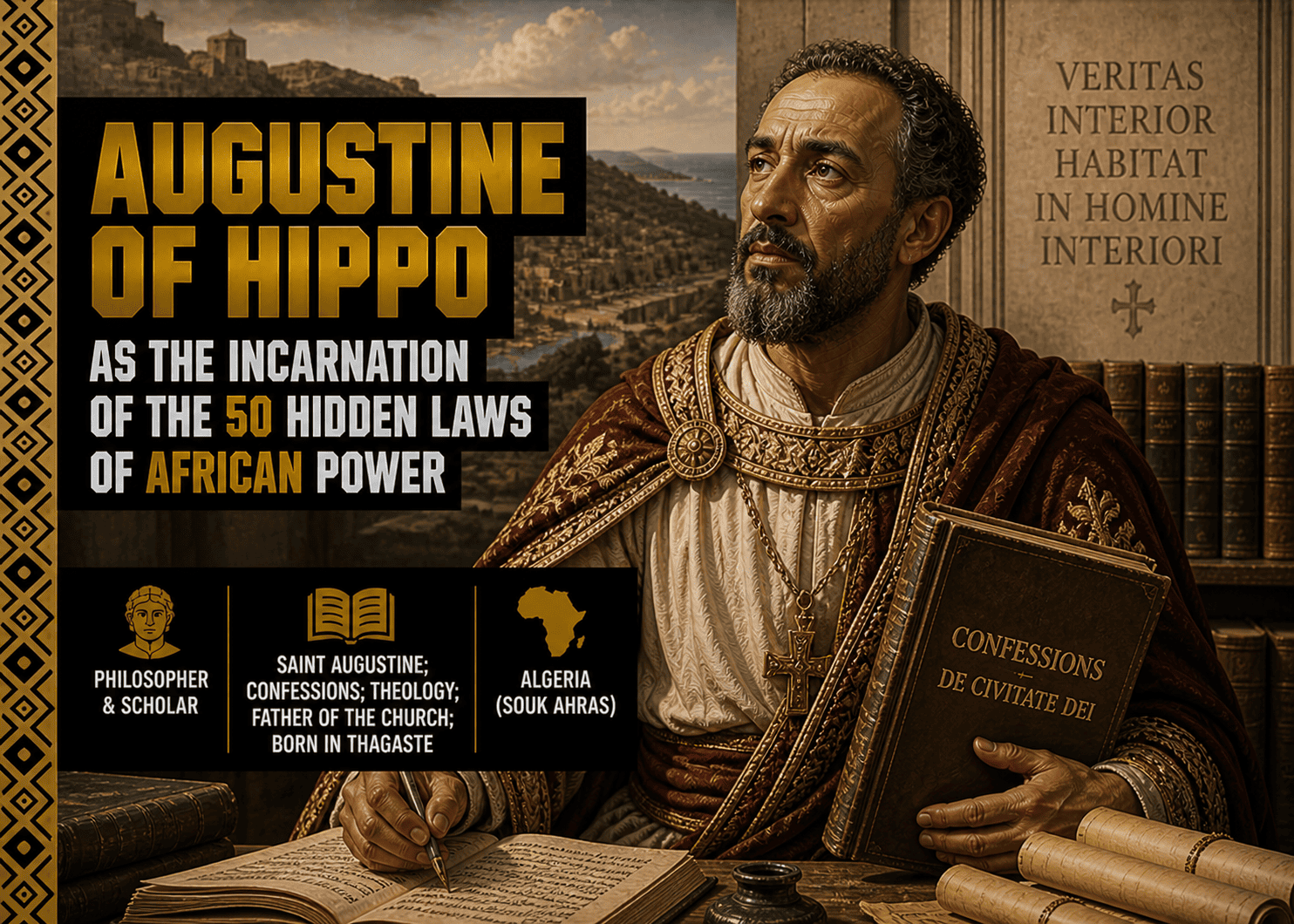
AUGUSTINE OF HIPPO — EMBODIMENT OF THE 50 HIDDEN LAWS OF AFRICAN POWER
Through the pen, rhetoric, and conversion, the Church Father forged a thought that has dominated the West for sixteen centuries.
I. HISTORICAL AND CIVILIZATIONAL CONTEXT
⭐ Who was Augustine of Hippo? Augustine (354‑430 CE), born in Thagaste (present‑day Souk Ahras, Algeria), is one of the greatest theologians and philosophers of Christendom. Bishop of Hippo (modern‑day Annaba), he shaped Western thought with his major works: “Confessions”, “The City of God”, “On the Trinity”. He is considered a Father of the Latin Church and one of the principal architects of the synthesis between Christianity and Platonic philosophy.
Roman Africa in the 4th Century – between Rome, Carthage and the Berbers
Augustine was born in Roman Africa, a prosperous province of the Empire. Carthage was the cultural capital, while the countryside was populated by Romanised Berbers. The region had been Christian for several centuries, but was torn by schisms (Donatism). Augustine, from a modest family, received a high‑level Latin education thanks to the support of local notables. He studied rhetoric in Carthage, then taught in Rome and Milan. It was in this crucible of cultures (Roman, Berber, Christian) that his thought was formed.
❓ What does “Augustine of Hippo” mean? “Augustine” is his Latin name (Aurelius Augustinus). “Hippo” refers to the city where he was bishop, Hippo Regius (present‑day Annaba, Algeria). “of Hippo” distinguishes him from other saints of the same name.
Religious and Intellectual Context
The 4th century was marked by the Christianisation of the Roman Empire (Edict of Milan, 313). But Christianity was torn by controversies: Arianism, Donatism, Pelagianism. Augustine, born to a Christian mother, Monica, and a pagan father, Patricius, had a turbulent youth (concubinage, adherence to Manichaeism). His conversion in 386 in Milan, under the influence of Bishop Ambrose, was a turning point. He returned to Africa, became a priest and then bishop of Hippo in 395, fighting heresies until his death.
🔗 CONNECTION TO THE 50 HIDDEN LAWS OF AFRICAN POWER
→ Law #1: Master Cosmic Balance (faith and reason, Africa and Rome)
Points of convergence:
• Augustine balanced Christian faith with Platonic philosophy – a synthesis that dominated medieval thought.
• He reconciled his African identity (Berber origins) with his Roman culture – a balance between two worlds.
• Modern application: African leaders must today harmonise endogenous traditions with external contributions.
• Strategic lesson: Enduring power comes from the ability to integrate opposing systems of thought – Augustine did it with Neoplatonism and Christianity.
II. ORIGINS AND SOCIAL ASCENSION
❓ How did Augustine, son of a small landowner, become a bishop? Through his intellectual genius and mastery of rhetoric. He studied in Carthage, taught in Rome and Milan, where he met Bishop Ambrose. His conversion in 386 led him back to Africa. Ordained a priest in 391, he became bishop of Hippo in 395, imposing his theological stature on the entire West.
Birth and Family
Augustine was born on 13 November 354 in Thagaste (present‑day Souk Ahras, Algeria). His father, Patricius, was a small landowner and pagan; his mother, Monica, was a fervent Christian, later canonised. He had at least one brother, Navigius, and a sister, Perpetua. Though modest, the family received support from a wealthy patron, Romanianus, which allowed Augustine to pursue his studies.
Education and Training in Rhetoric
Augustine studied first in Thagaste, then in Madaura (present‑day M’Daourouch), and finally in Carthage where he developed a passion for philosophy and rhetoric. He read Cicero, which awakened his love of wisdom. He adhered to Manichaeism (a dualist religion) for nine years. He taught rhetoric in Carthage, then in Rome and Milan. In Milan he discovered Neoplatonism (via Victorinus’s translations) and converted to Christianity in 386, under Ambrose’s influence.
The Rise: From Rhetorician to Bishop
After his conversion, Augustine gave up his teaching career and retired to Cassiciacum (a friend’s villa). He was baptised at Easter 387 by Ambrose. Returning to Africa, he went to Hippo to found a monastic community, but the crowd acclaimed him a priest against his will (391). In 395, he succeeded Bishop Valerius and became coadjutor bishop, then bishop of Hippo, remaining so until his death in 430, as the Vandals besieged the city.
🔗 CONNECTION TO THE LAWS OF AFRICAN POWER
→ Law #3: “Transform Knowledge into Power”
Points of convergence:
• Augustine used his mastery of Latin rhetoric to convert audiences and refute heresies – speech as a weapon.
• His knowledge of pagan philosophies (Platonism) allowed him to dialogue with Roman elites and Christianise ancient thought.
• Modern application: African leaders must master the cultural codes of powerful nations to impose their ideas.
• Strategic lesson: An intellectual exile (studies in Carthage, Rome, Milan) can be transformed into priceless knowledge capital – Augustine turned rhetoric into episcopal power.
III. TITLES AND FUNCTIONS
❓ What titles did Augustine of Hippo hold? He was a rhetorician, teacher, priest, bishop, Church Father, Doctor of the Church (called “Doctor of Grace”). He is also considered a philosopher, theologian and saint. His main works are “Confessions”, “The City of God”, “On the Trinity” and “On the Predestination of the Saints”.
- Rhetorician – professor of rhetoric in Carthage, Rome and Milan.
- Priest – ordained in 391 in Hippo.
- Bishop of Hippo – from 395 to 430.
- Father of the Latin Church – recognised by Catholic tradition.
- Doctor of the Church – official title since 1298.
- Patron saint of theologians – feast day 28 August.
🔗 CONNECTION TO THE LAWS OF AFRICAN POWER
→ Law #12: “Become Indispensable to Power”
Points of convergence:
• Augustine became the indispensable theological authority of his time – his writings were cited by popes, councils and kings.
• He held multiple roles: pastor, controversialist, philosopher, administrator – indispensable to the African Church.
• Modern application: African leaders must build an intellectual and moral authority that makes them irreplaceable.
• Strategic lesson: Indispensability comes not from force but from the ability to solve others’ problems – Augustine fought the heresies of his time.
IV. THE CONFESSIONS – A SPIRITUAL AUTOBIOGRAPHY
❓ What is Augustine’s most famous book? “Confessions” (397‑401). It is a spiritual autobiography in which he recounts his youth, his mistakes, his conversion, and his reflections on memory, time, and God. It is one of the first introspective narratives in Western literature, a model of the genre.
The “Confessions” are not only a literary masterpiece; they are a weapon of persuasion. Augustine lays out his journey from sin to grace, demonstrating that the human will can be saved by divine intervention. The book influenced centuries of theology, psychology, and literature (Rousseau, Proust, Bergson). It remains Augustine’s most widely read text.
🔗 CONNECTION TO THE LAWS OF AFRICAN POWER
→ Law #15: “Build Monuments That Speak for You”
Points of convergence:
• “Confessions” is a literary monument – millions of readers across centuries have discovered Augustine through this book.
• The account of his conversion is an “inner monument” that shaped Western spirituality.
• Modern application: African leaders must write their autobiography or have it written – a well‑crafted book is an accessible form of immortality.
• Strategic lesson: A personal narrative can become a universal classic – Augustine turned his life into a work of art.
V. THE CITY OF GOD – DEFENDING CHRISTIANITY AGAINST THE PAGANS
❓ Why did Augustine write “The City of God”? In 410, Rome was sacked by Alaric’s Visigoths. Pagans accused Christians of causing the disaster by abandoning the ancestral gods. Augustine responded in 22 books (413‑427): he distinguishes two cities, the Earthly City (founded on self‑love) and the Heavenly City (founded on love of God). The fall of Rome is only a worldly event; the true homeland of Christians lies elsewhere.
This work is an immense historical, political and theological fresco. It laid the foundations for the philosophy of history and the doctrine of evil. It was cited by all Western political thinkers (Thomas Aquinas, Machiavelli, Bossuet, etc.).
🔗 CONNECTION TO THE LAWS OF AFRICAN POWER
→ Law #23: “Heal to Rule – The Power of the Healer”
Points of convergence:
• Augustine “heals” Christian conscience in a time of crisis – he explains that the fall of an earthly city does not shake faith.
• He uses a philosophy of history to reassure the faithful – therapy through narrative.
• Modern application: African leaders must offer meaningful narratives in times of crisis – interpreting events is an act of power.
• Strategic lesson: True power is not about conquering but about giving meaning to catastrophes – Augustine turned the sack of Rome into proof of the superiority of the City of God.
VI. THE CONTROVERSIALIST – THE ART OF CONVINCING AND EXCLUDING
Augustine spent much of his episcopacy fighting heresies: Manichaeism (dualism), Donatism (African schism), Pelagianism (denial of original sin). He used all the tools of rhetoric: treatises, sermons, letters, councils. He often appealed to the force of the state (calling on Roman authorities) to suppress the Donatists, justifying “coercion” in religious matters – a doctrine that influenced the Inquisition.
🔗 CONNECTION TO THE LAWS OF AFRICAN POWER
→ Law #28: “Control Your Narrative – History Belongs to the One Who Writes It”
Points of convergence:
• Augustine systematically demonised his adversaries (Manichaeans, Donatists, Pelagians) in his writings – he controlled the theological narrative.
• His works became the norm; heresies were largely erased from collective memory.
• Modern application: African leaders must mind their controversy – whoever defines the adversary wins the narrative battle.
• Strategic lesson: History is written by the victors – Augustine defeated his enemies with the pen and politics.
VII. THE DOCTRINE OF GRACE – ABSOLUTE DIVINE POWER
In his controversy against Pelagius (a British monk who denied original sin and claimed that man could save himself by his own efforts), Augustine developed a theology of predestination. According to him, divine grace is free, irresistible, and does not depend on human merits. This doctrine dominated Western theology (taken up by Calvin) and made Augustine the “Doctor of Grace”.
🔗 CONNECTION TO THE LAWS OF AFRICAN POWER
→ Law #8: “Master Cycles – Time as a Weapon”
Points of convergence:
• Augustine conceived time in “Confessions” (Book XI) – he distinguishes past, present and future by the mind’s attention. This is a philosophical revolution.
• His doctrine of predestination inscribes human history within an eternal divine cycle – time is no longer pagan‑cyclical but linear and oriented.
• Modern application: African leaders must master the narrative of time – whoever defines the meaning of history dominates minds.
• Strategic lesson: The conception of time is power – Augustine imposed a linear vision that shaped the West.
VIII. LEGACY – THE INTELLECTUAL BEACON OF THE WEST
Augustine is cited by all great medieval thinkers (Thomas Aquinas, Anselm, Bonaventure), moderns (Descartes, Pascal, Malebranche) and contemporaries (Hannah Arendt, Jean‑Luc Marion, Paul Ricœur). He was declared a Doctor of the Church in 1298. His relics were first kept in Sardinia, then in Pavia (San Pietro in Ciel d’Oro). In Algeria, a shrine is dedicated to him in Annaba. He is the patron saint of theologians, printers, and philosophers.
🔗 CONNECTION TO THE LAWS OF AFRICAN POWER
→ Law #42: “Create a Legacy That Multiplies Your Power”
Points of convergence:
• Augustine’s work (over 5 million words) has been copied, commented on, taught for 1,600 years – an effective legacy.
• His thought founded medieval universities, the Protestant Reformation, Jansenism – a multiplying legacy.
• Modern application: African leaders must leave a dense written body of work – books travel and resist regimes.
• Strategic lesson: Intellectual immortality surpasses political immortality – Augustine lost his bishopric but won eternity.
IX. SOURCES AND TESTIMONIES
❓ Where can one see Augustine’s original manuscripts? No autograph manuscripts survive. The oldest copies date from the 6th century (Codex Einsidlensis, Codex Palatinus). The Bibliothèque nationale de France, the Vatican Library and the Bodleian Library (Oxford) hold medieval copies.
- Major works: Confessions, The City of God, On the Trinity, On the Predestination of the Saints, Sermons, Letters.
- Ancient sources: Possidius (Augustine’s biography), council records.
- Archaeological sources: Basilica of Hippo (Annaba), ruins of Thagaste (Souk Ahras), monastic environments.
- Secondary sources: Peter Brown (“Augustine of Hippo”), Serge Lancel (“Saint Augustine”), Jean‑Luc Marion (“In the Self’s Place”).
🔗 CONNECTION TO THE LAWS OF AFRICAN POWER
→ Law #28: “Control Your Narrative – History Belongs to the One Who Writes It” (continued)
Points of convergence:
• Augustine dictated his complete bibliography in his “Retractations” – he controlled the narrative of his own work.
• Possidius, his disciple, wrote a biography that fixed his legend.
• Modern application: African leaders must bequeath authorised bibliographies and biographies – posthumous control is crucial.
• Strategic lesson: If you do not have your life written by a faithful disciple, an enemy will do it – Augustine chose Possidius.
X. MYSTERIES AND UNSOLVED QUESTIONS
❓ Where are Augustine’s relics? One part is in Pavia (San Pietro in Ciel d’Oro). Another part (his arm) is kept in Annaba (Algeria) in the Basilica of St Augustine. Some relics were reportedly lost during invasions.
❓ Why did Augustine have a child (Adeodatus) out of wedlock? He lived in concubinage with an unknown woman (whose name we do not know) for fifteen years. Their son Adeodatus was born in Carthage. Adeodatus died young, around 389. Augustine speaks of this episode in his Confessions with regret and honesty.
❓ Was Augustine Berber? He was of Romano‑African stock, spoke Latin, and likely had local Berber ancestors. He also used Punic in his sermons to reach rural populations. His identity is typically North African of the Roman period.
🔗 CONNECTION TO THE LAWS OF AFRICAN POWER
→ Law #37: “Cultivate Mystery – What Is Hidden Fascinates”
Points of convergence:
• The shadow zones of his life (the concubine’s name, Adeodatus’s childhood) fuel fictionalised biographies and debates.
• The dispersal of his relics and uncertainty over some authentications have not weakened his cult.
• Modern application: Leaders may leave certain details of their private life veiled – mysterious intimacy fascinates.
• Strategic lesson: A saint can have a troubled past – conversion erases sins, but doubt about precise facts reinforces myth.
XI. FAQ – FREQUENTLY ASKED QUESTIONS ABOUT AUGUSTINE OF HIPPO
❓ What is Augustine’s famous saying about time? “What then is time? If no one asks me, I know; if I wish to explain it to someone who asks, I know not.” (Confessions, Book XI).
❓ Did Augustine invent the notion of original sin? He systematised it from Paul’s epistles, opposing Pelagius’s thesis. It is a pillar of Catholic theology.
❓ Why is Augustine so important for Africa? Because he proves that Roman Africa produced a universal thought that nourished all of Christendom. He is a source of pride for Algerians, Tunisians and Berbers.
XII. LESSONS AND CONTEMPORARY RELEVANCE
💡 What can Africa learn from Augustine of Hippo? Augustine teaches that intellectual formation (rhetoric, philosophy) is the first lever of power. He shows the importance of personal conversion as a driver of change. He reminds us that Africa can produce universal minds, capable of dialoguing with the greatest civilisations of their time. African leaders must invest in education, language mastery, and the production of foundational texts.
Rhetoric as a weapon of domination: Augustine turned his training as a rhetorician into episcopal power – speaking well, writing well, arguing well are political skills.
Autobiography as a tool of legitimation: The Confessions forged his image as a repentant sinner – a leader must know how to tell his own transformation story.
Controversy as a strategy: He systematically attacked his adversaries, defining them as heretics – controlling language means controlling power.
Local roots and universal openness: African by birth, he wrote in Latin and dialogued with Greece and Rome – the alliance between roots and radiance.
🔗 CONNECTION TO THE LAWS OF AFRICAN POWER
→ Law #5: “Master Multiple Domains – The Power of the Renaissance”
Points of convergence:
• Augustine was simultaneously theologian, philosopher, bishop, administrator, polemicist – an exceptional polymath.
• He combined Greek thought (Plato, Plotinus), Latin culture (Cicero) and Christian faith – a creative syncretism.
• Modern application: African leaders must be versatile – Africa needs complete thinkers, not narrow specialists.
• Strategic lesson: The African renaissance requires intellectuals able to link tradition and modernity, faith and reason – Augustine offers a model.
CONCLUSION: IMMORTALITY THROUGH THE BOOK AND THOUGHT
Augustine of Hippo remains, sixteen centuries after his death, the most influential African mind in Western history. His journey – child prodigy in Algeria, rhetorician in Carthage, convert in Milan, bishop of Hippo – testifies to the power of intelligence, rhetoric and faith. He conquered no territory, but he conquered minds.
For contemporary Africa and its diaspora, Augustine represents the figure of the universal thinker born on African soil, whose ideas have crossed centuries and continents. He reminds us that Africa is not only a continent of natural resources, but a crucible of thought, theology and philosophy. His name, Augustine of Hippo, resonates as a challenge: may today’s Africa produce its own Augustines – those minds capable of combining academic rigour, oratory art, and a vision of the world that enlightens humanity.
🔗 SYNTHESIS: AUGUSTINE OF HIPPO AS THE EMBODIMENT OF THE HIDDEN LAWS OF AFRICAN POWER
📜 Summary of the laws embodied by Augustine: Balance (#1), Knowledge as Power (#3), Polymathy (#5), Control of Time (#8), Indispensability (#12), Monuments (#15), Healing through narrative (#23), Narrative Control (#28), Mystery (#37), Multiplicative Legacy (#42), Symbol (#45), Immortality (#50).
- Law #1 (Balance) – Faith and reason, Africa and Rome, pagan and Christian.
- Law #3 (Knowledge as Power) – Mastery of Latin rhetoric, Greek philosophies, Scriptures.
- Law #5 (Polymathy) – Rhetorician, philosopher, theologian, bishop, controversialist – complete genius.
- Law #8 (Control of Time) – Theory of time (Confessions XI) and a linear vision of history.
- Law #12 (Indispensability) – The only theologian who could synthesise Christianity and ancient philosophy.
- Law #15 (Monuments) – Confessions, The City of God – immortal literary monuments.
- Law #23 (Heal to Rule) – Response to the sack of Rome (City of God) – moral healing of a traumatised people.
- Law #28 (Control of Narrative) – Retractations, biography by Possidius – mastery of his legend.
- Law #37 (Mystery) – Vague private life (concubine, Adeodatus), dispersed relics – fertile mysteries.
- Law #42 (Multiplicative Legacy) – Influence on Thomas Aquinas, Luther, Calvin, Pascal, Heidegger – active legacy.
- Law #45 (Symbol) – “Augustine” = Christian philosophy, North African intellectual excellence.
- Law #50 (Immortality) – His books have been read continuously for 1,600 years – eternal presence.
Practical Application for the Modern Leader:
✅ Master the art of speech and writing – a well‑constructed speech is worth armies
✅ Tell your own conversion story – narratives of transformation inspire
✅ Define your adversaries through language – whoever names the heretic wins the controversy
✅ Write, write, write – a dense bibliography is a cathedral of thought
✅ Be universal – locally rooted, yet open to the world.
The Augustine of Hippo Challenge for You:
“What foundational book will you write? How will you turn your own story (failures, repentances) into a legend of wisdom?”