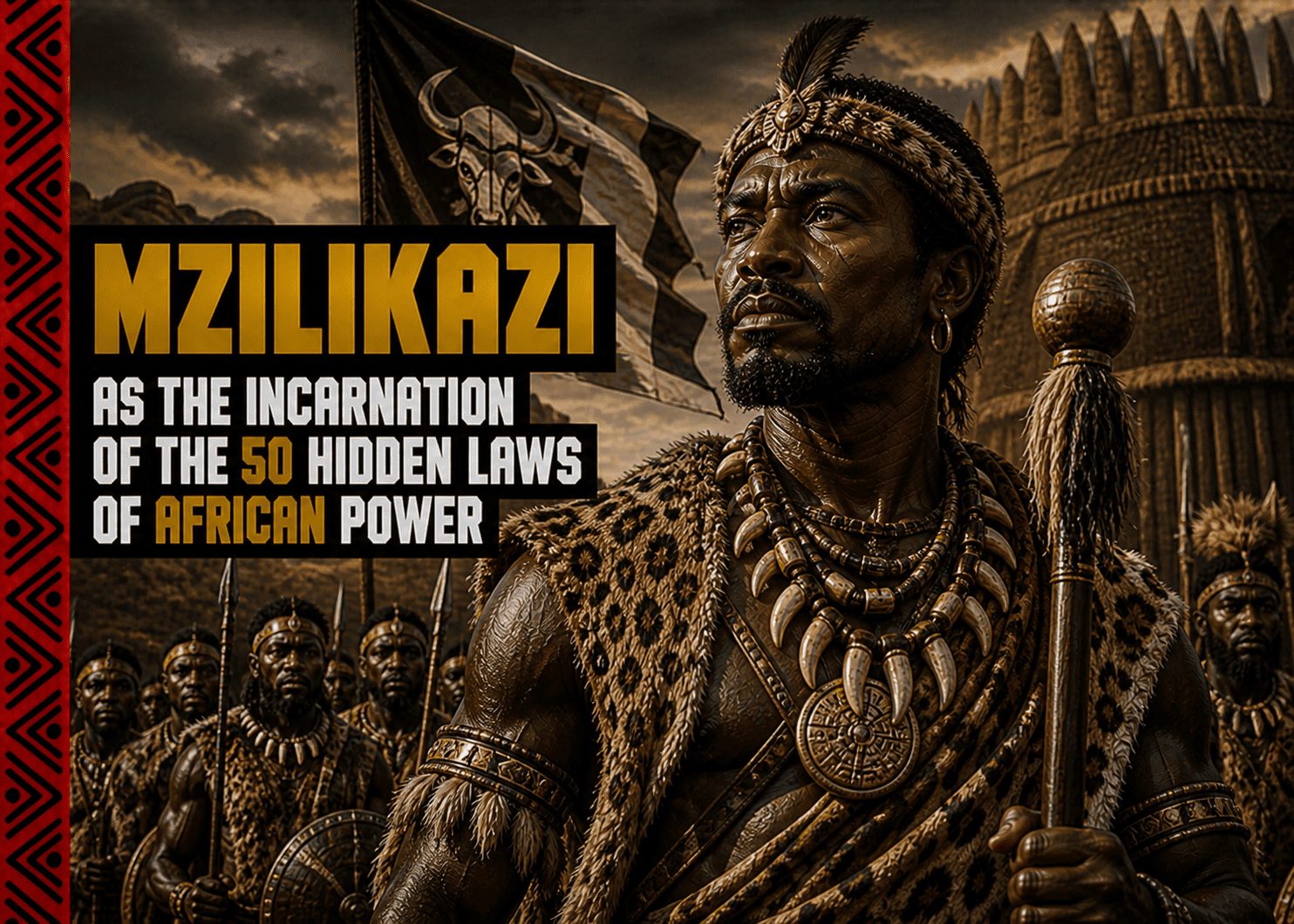
MZILIKAZI — EMBODIMENT OF THE 50 HIDDEN LAWS OF AFRICAN POWER
Through the sword, migration, and political wisdom, the Zulu‑turned‑king founded the Matabele Empire in the heart of southern Africa.
I. HISTORICAL AND CIVILIZATIONAL CONTEXT
⭐ Who was Mzilikazi? Mzilikazi (c. 1790‑1868), also known as Mosilikatze or Moselekatse, was a Zulu military commander, a lieutenant of Shaka, who rebelled against his king and founded the Ndebele (Matabele) kingdom in present‑day Zimbabwe. His name means “the great path” or “the great river of blood”. He is considered one of the greatest military strategists of southern Africa after Shaka.
Southern Africa in the Early 19th Century – The Mfecane and the Rise of the Zulu
At the beginning of the 19th century, the region underwent a profound transformation under the impetus of King Shaka, who unified the Zulu clans and forged a formidable army. This upheaval, known as the Mfecane (“the crushing”), triggered population displacements and widespread conflicts. Mzilikazi, belonging to the Khumalo clan, became one of Shaka’s best lieutenants. But a quarrel with the Zulu king drove him to rebellion.
❓ What does “Mzilikazi” mean? In Zulu, “Mzilikazi” means “the great road”. Another interpretation translates it as “the great river of blood”, in reference to his bloody military career. Europeans sometimes transcribed it as “Mosilikatze” or “Moselekatse”.
The Cultural and Religious Context
Mzilikazi was a warrior chief steeped in Nguni traditions (age‑regiments, ancestor worship). While imposing military despotism, he respected ancestral beliefs. By the end of his migration, he integrated into the Mwali religion of the Matobo Hills, gained access to sacred shrines, and was buried there according to traditional rites. He was also open to European missionaries, without renouncing his autocratic power.
🔗 CONNECTION TO THE 50 HIDDEN LAWS OF AFRICAN POWER
→ Law #1: Master Cosmic Balance
Points of convergence:
• Mzilikazi balanced the military power inherited from Shaka with the integration of conquered peoples (Sotho, Shona, Kalanga) – an empire built on force AND assimilation.
• He combined Zulu warrior tradition with respect for local sanctuaries – religion as a tool of unification.
• Modern application: African leaders must know how to integrate diverse ethnic groups while preserving a strong central command.
• Strategic lesson: Enduring power comes from balancing force with the ability to create allies among the vanquished.
II. ORIGINS AND SOCIAL ASCENSION
❓ How did Mzilikazi leave Shaka? Mzilikazi, Shaka’s lieutenant, was sent on an expedition against the Sotho king Ranisi. But he kept the loot for himself and refused to hand it over to Shaka. In 1823, fearing the Zulu king’s revenge, he fled with 200 to 300 warriors, launching an odyssey of more than 20 years and 800 km.
Birth and Education
Mzilikazi was born around 1790 near Mkuze, in Zululand (present‑day KwaZulu‑Natal, South Africa). He was the son of Mashobane kaMangethe, chief of the Khumalo clan, and his mother Cikose Ndiweni was an Amangwe princess. Orphaned when his father was assassinated, he entered Shaka’s service and distinguished himself as a regiment (ibutho) commander. There he learned Zulu military organisation, the use of the assegai and iron discipline.
Military Culture
Mzilikazi excelled in the art of warfare, perfected through contact with Shaka. He would later take with him elite corps, the famous Zulu “buffalo horns”, and the renowned ability to march 50 km a day. He preserved the amabutho (age‑regiment) system and knew how to adapt it to the ethnic groups he integrated.
The Rise: The Great Migration (1823‑1840)
Fleeing Zululand, Mzilikazi and his 2,000 to 5,000 followers crossed Mozambique, then the Transvaal. He subdued the Sotho, Tswana, Pedi and southern Ndebele peoples, incorporating boys and girls into his army. After ravaging a vast territory, he was driven out of the Marico valley by the Boers in 1837. He moved north, crossed the Limpopo, and after a detour to Zambia, finally settled in south‑western Zimbabwe. He then founded the Ndebele kingdom (Matabeleland) with its capital at Bulawayo.
🔗 CONNECTION TO THE LAWS OF AFRICAN POWER
→ Law #3: “Transform Knowledge into Power”
Points of convergence:
• Mzilikazi exploited his knowledge of Zulu tactics (speed, age‑regiments) to defeat superior numbers.
• He studied the terrain, possible alliances and routes to travel thousands of kilometres without being annihilated.
• Modern application: African leaders must learn organisational techniques from the strongest to build and then become autonomous.
• Strategic lesson: A long retreat is not a defeat if it allows rebirth elsewhere – Mzilikazi turned flight into empire‑founding.
III. TITLES AND FUNCTIONS
❓ What titles did Mzilikazi hold? He was successively Shaka’s general, chief of the Khumalo, Inkosi (king) of the Northern Ndebele, and after his death, “Father of the Ndebele nation”. His most famous title is Umthwakazi, the founder of the Mthwakazi kingdom.
- Induna (general) of Shaka – commander of an elite regiment.
- Inkosi (king) of the Ndebele – founder of the Matabele kingdom.
- Conqueror of the Transvaal – subdued many Sotho and Tswana clans.
- Signatory of the peace with the Boers – treaty of 1852.
- Guardian of the sacred Matobo Hills – protector of the Mwari shrines.
🔗 CONNECTION TO THE LAWS OF AFRICAN POWER
→ Law #12: “Become Indispensable to Power”
Points of convergence:
• Mzilikazi became the only leader capable of gathering the fragments of the Mfecane into a coherent nation – without him, the Ndebele would not have survived.
• He held the roles of strategist, administrator, judge and religious leader – indispensable to the kingdom’s balance.
• Modern application: African leaders must create institutions that depend on their authority, but also train a future generation.
• Strategic lesson: Indispensability ensures stability, but it must be accompanied by a prepared succession – the succession war after his death proves this.
IV. MILITARY ORGANISATION – A WAR MACHINE
❓ How did Mzilikazi organise his army? He adopted the Zulu model of age‑regiments (amabutho), each village housing a specific regiment. The army numbered up to 5,000 to 15,000 warriors, structured into three divisions: Zansi (Zulu‑origin elite), Enhla (incorporated Sotho), and Lozwi (descendants of conquered Shona).
This hierarchy allowed Mzilikazi to turn disparate ethnic groups into a homogeneous, loyal force. Young men were enrolled, and marriage was forbidden until the “royal stick” was granted. This discipline forged an exceptional morale that repeatedly repelled the Boers of the Transvaal.
🔗 CONNECTION TO THE LAWS OF AFRICAN POWER
→ Law #15: “Build Monuments That Speak for You”
Points of convergence:
• The Matabele army was a “living monument”: each regiment bore the king’s name, each victory burnished his prestige.
• The remains of royal kraals, fortresses and battle sites still testify to his military power.
• Modern application: African leaders must bequeath strong institutions (army, schools, administration) rather than just statues – these are the functional monuments of memory.
• Strategic lesson: A well‑organised institution outlives its founder; the Ndebele continued the war after Mzilikazi.
V. THE REIGN – MASTER OF BULAWAYO AND THE MATOBO HILLS
The capital Bulawayo symbolised the kingdom’s peak. Mzilikazi established his royal kraal (khaya) there, surrounded by a circle of his wives’ huts. He controlled gold, ivory and trade routes to the coast. He welcomed missionaries (Robert Moffat) and explorers (David Livingstone). He signed peace with the Transvaal in 1852. But the discovery of gold in 1867 triggered an influx of European prospectors that he could not master.
🔗 CONNECTION TO THE LAWS OF AFRICAN POWER
→ Law #8: “Master Cycles – Time as a Weapon”
Points of convergence:
• Mzilikazi alternated phases of war and consolidation – time is an ally when you know how to wait.
• He seized the opportunity of the gold discovery to enhance his prestige, but did not anticipate the European influx – time can become an enemy.
• Modern application: African leaders must anticipate economic cycles; a resource discovered too quickly can destroy rather than build.
• Strategic lesson: Mastering time also means controlling the diffusion of information about one’s wealth – Mzilikazi failed to manage the gold rush.
VI. THE ART OF GOVERNING – ASSISTED FEDERALISM
Mzilikazi governed by entrusting local chiefs (izinduna) with provincial administration, but all regiments and taxes converged on him. He established a class system: the Zansi (elite) formed the warrior aristocracy, the Enhla (mixed) formed the central reservoir, and the Lozwi (subdued) were the tribute‑payers. This stratification, questionable from an egalitarian perspective, ensured the kingdom’s stability for nearly half a century.
🔗 CONNECTION TO THE LAWS OF AFRICAN POWER
→ Law #42: “Create a Legacy That Multiplies Your Power”
Points of convergence:
• Mzilikazi’s institutions survived until the kingdom’s fall to the British in 1893‑1894 – a legacy lasting 50 years.
• The capital Bulawayo, still today Zimbabwe’s second city, bears the imprint of his spatial organisation.
• Modern application: African leaders must bequeath conceptual frameworks (constitution, territorial division) that guide the nation long after them.
• Strategic lesson: A legacy is all the more durable when it becomes embedded in everyday administration – Mzilikazi built a state, not merely an army.
VII. THE KING’S DEATH – LEGENDS AND RITUAL PRACTICES
Mzilikazi died on 9 September 1868 at Ingama (Matabeleland), probably exhausted by age (nearly 80). His death had been preceded by that of his favourite queen, Loziba Thebe. His death was kept secret for a few days, then announced publicly. Two months of national mourning were decreed. He was buried in a sacred cave on Entumbane hill in the Matobo Hills, following Ndebele rites. Black cows were sacrificed to allow the king’s spirit to join his ancestors. Access to his tomb is now guarded, but the site has fallen into disrepair since colonial times.
🔗 CONNECTION TO THE LAWS OF AFRICAN POWER
→ Law #50: “Transcend Death – The Art of Immortality”
Points of convergence:
• The secret tomb and burial rites (sealed cave) turned Mzilikazi into a protective ancestor – the invisible reinforces the myth.
• His death did not cause the immediate collapse of the kingdom; his son Lobengula succeeded him and maintained unity.
• Modern application: African leaders must prepare institutional succession, and also a posthumous narrative that keeps their moral authority alive.
• Strategic lesson: A tomb whose access is controlled magnifies the legend – Mzilikazi linked his end to the sacredness of the Matobo Hills.
VIII. LEGACY – THE FATHER OF THE ZIMBABWEAN NATION
In Zimbabwe, Mzilikazi is venerated as the founder of the Ndebele nation. Streets, high schools and localities bear his name. His likeness appears on stamps and banknotes. The Matabele kingdom he created resisted both Boer expansion and early British incursions. His successor, Lobengula, faced the British South Africa Company; but even after colonial defeat, the Ndebele people preserved the memory of their founder.
🔗 CONNECTION TO THE LAWS OF AFRICAN POWER
→ Law #45: “Become a Symbol – When Your Name Becomes a Movement”
Points of convergence:
• “Mzilikazi” is a given name in southern Africa – his name embodies resistance and warrior honour.
• Political organisations have claimed his legacy to defend Ndebele identity against Shona domination.
• Modern application: African leaders should aim for their name to become a rallying point and a bond of unity.
• Strategic lesson: A name taught in schools and chanted in popular gatherings is a posthumous victory – Mzilikazi won.
IX. SOURCES AND TESTIMONIES
Oral sources: Ndebele traditions, epic poems of izimbongi (griots), legends of the Entumbane cave.
Written sources: Missionary journals (Robert Moffat, David Livingstone), trader chronicles, British colonial archives.
Archaeology: Military sites in the Matobo Hills, remains of royal kraals, traces of battles against the Boers.
Secondary sources: Works by Peter Becker (“Path of Blood”), John S. Galbraith, Julian Cobbing.
❓ Was Mzilikazi’s tomb ever found? Yes, it lies in a cave at Entumbane in the Matobo Hills, but access is controlled and the burial has been desecrated several times. An Ndebele regiment still guards the site.
🔗 CONNECTION TO THE LAWS OF AFRICAN POWER
→ Law #28: “Control Your Narrative – History Belongs to the One Who Writes It”
Points of convergence:
• European missionaries often depicted Mzilikazi as a “bloodthirsty tyrant”, while Ndebele traditions celebrate him as a liberator – the battle of the narrative.
• Modern African historians have rebalanced the view by highlighting his statecraft genius.
• Modern application: African leaders must fund local historians so that their portrait is not dominated by colonial archives.
• Strategic lesson: The victor writes history, but oral history can resist – Mzilikazi remained alive in Ndebele memory.
X. MYSTERIES AND UNSOLVED QUESTIONS
❓ Why did Mzilikazi flee Shaka? Versions diverge: refusal to hand over loot, suspicion of conspiracy, or simple personal rivalry. The precise causes of the rupture between the two men are still debated.
❓ Why was his tomb vandalised? During the colonial period, looters broke into the cave in search of gold and royal objects. The tomb is now neglected, though still sacred to the Ndebele.
❓ What did Mzilikazi look like? British missionaries describe a tall, imposing man with a powerful voice. No authenticated contemporary portrait exists; depictions are reconstructions.
🔗 CONNECTION TO THE LAWS OF AFRICAN POWER
→ Law #37: “Cultivate Mystery – What Is Hidden Fascinates”
Points of convergence:
• The shadow zones about the details of his break with Shaka and his death fuel decades of research.
• The absence of a certain portrait and the desecration of his tomb have not weakened his legend; on the contrary, mystery makes it elusive.
• Modern application: Leaders may leave certain aspects of their lives vague – shadow maintains curiosity.
• Strategic lesson: A poorly documented end of life fuels hypotheses and keeps interest alive – Mzilikazi remains enigmatic.
XI. FAQ – FREQUENTLY ASKED QUESTIONS ABOUT MZILIKAZI
❓ Was Mzilikazi Zulu or Ndebele? He belonged to the Khumalo clan, spoke isiNguni, and was culturally Zulu in origin. But after his migration, the people he founded are called Ndebele (or Matabele). He is the father of the Ndebele nation.
❓ Why are the Ndebele called Matabele? “Matabele” is an English corruption of the word Ndebele (the people behind the mountain). The Ndebele call themselves amaNdebele.
❓ Is there a film about Mzilikazi? He appears in historical documentaries (BBC, “The Story of Africa”) and in local South African series, but no international feature film is dedicated to him.
XII. LESSONS AND CONTEMPORARY RELEVANCE
💡 What can Africa learn from Mzilikazi? Mzilikazi teaches that a leader can build from nothing, in exile, to found a nation. He shows the importance of tactical flexibility (abandon territories to conquer new ones), the integration of conquered peoples, and the need for a centralised administration. His final failure in the face of the gold rush reminds us of the threat that uncontrolled mining discoveries pose.
Necessity of training cadres: Mzilikazi structured his army into several corps, but the succession was disputed – leaders must prepare for the after.
Geographical mobility as an asset: Defeating the Boers was not possible, but outflanking them was – knowing when to yield to bounce back.
Control of resources: Gold attracted colonists; management of extractive resources conditions sovereignty.
Spiritual leverage: Religious anchoring (Matobo Hills, Mwali cult) strengthened national unity.
🔗 CONNECTION TO THE LAWS OF AFRICAN POWER
→ Law #5: “Master Multiple Domains – The Power of the Renaissance”
Points of convergence:
• Mzilikazi was simultaneously general, diplomat, administrator, religious leader – a warrior polymath.
• He combined knowledge of Zulu tactics, the psychology of the vanquished, and spatial vision to found a state.
• Modern application: African leaders must be versatile; the contemporary world demands complete leaders, not narrow specialists.
• Strategic lesson: The African renaissance needs leaders capable of wielding the sword, the law, faith and economics – Mzilikazi offers a model.
CONCLUSION: IMMORTALITY THROUGH MYTH AND INSTITUTION
Mzilikazi remains, a century and a half after his death, a monument of southern African history. His journey – rejected Zulu lieutenant, leader of a twenty‑year odyssey, builder of a kingdom three times larger than his original adversary – testifies to the power of will, strategic intelligence, and the ability to integrate human diversity. He left no monumental peace treaty, but a nation still standing.
For contemporary Africa and its diaspora, Mzilikazi represents the symbol of resilience: one who fails (against Shaka, then against the Boers) but refuses to disappear. His march north was a retreat, but he turned it into a conquest. His name, Mzilikazi (“the great path”), resonates as a challenge: may every African leader know how to turn exile into opportunity, diversity into strength, and war into a state.
🔗 SYNTHESIS: MZILIKAZI AS THE EMBODIMENT OF THE HIDDEN LAWS OF AFRICAN POWER
📜 Summary of the laws embodied by Mzilikazi: Balance (#1), Knowledge as Power (#3), Polymathy (#5), Control of Time (#8), Indispensability (#12), Monuments (#15), Healing through integration (#23), Narrative Control (#28), Mystery (#37), Multiplicative Legacy (#42), Symbol (#45), Immortality (#50).
- Law #1 (Balance) – Military force and assimilation, Zulu tradition and local cults.
- Law #3 (Knowledge as Power) – Transferring Zulu tactics, adapting to new terrains.
- Law #5 (Polymathy) – Warrior, diplomat, administrator, state‑builder – a complete leader.
- Law #8 (Control of Time) – Alternating wars and peace, managing the arrival of Boers and prospectors.
- Law #12 (Indispensability) – Only unifier of the Ndebele – focal point of national existence.
- Law #15 (Monuments) – Bulawayo, royal kraals, sacred tomb – historical monuments.
- Law #23 (Heal to Rule) – Integrating conquered peoples rather than exterminating them – social “healing”.
- Law #28 (Control of Narrative) – Oral traditions vs colonial archives – double narrative.
- Law #37 (Mystery) – Desecrated tomb, unexplained break with Shaka, absence of portrait – founding mysteries.
- Law #42 (Multiplicative Legacy) – Ndebele people still present, influence on modern Zimbabwe – active legacy.
- Law #45 (Symbol) – “Mzilikazi” = Ndebele resistance, Zimbabwean pride – living concept.
- Law #50 (Immortality) – His name and kingdom still inhabit the Matobo Hills – eternal presence.
Practical Application for the Modern Leader:
✅ Dare to cross borders – geographical mobility can become power
✅ Integrate the vanquished – a mono‑ethnic empire is fragile
✅ Structure administration – regiments are not enough, institutions are not enough either
✅ Control resources – gold attracts both enemies and friends
✅ Bequeath a symbolic tomb – a pilgrimage site reinforces national unity.
The Mzilikazi Challenge for You:
“What ‘great road’ will you blaze for your people? Will you, like Mzilikazi, turn a retreat into a rebirth?”