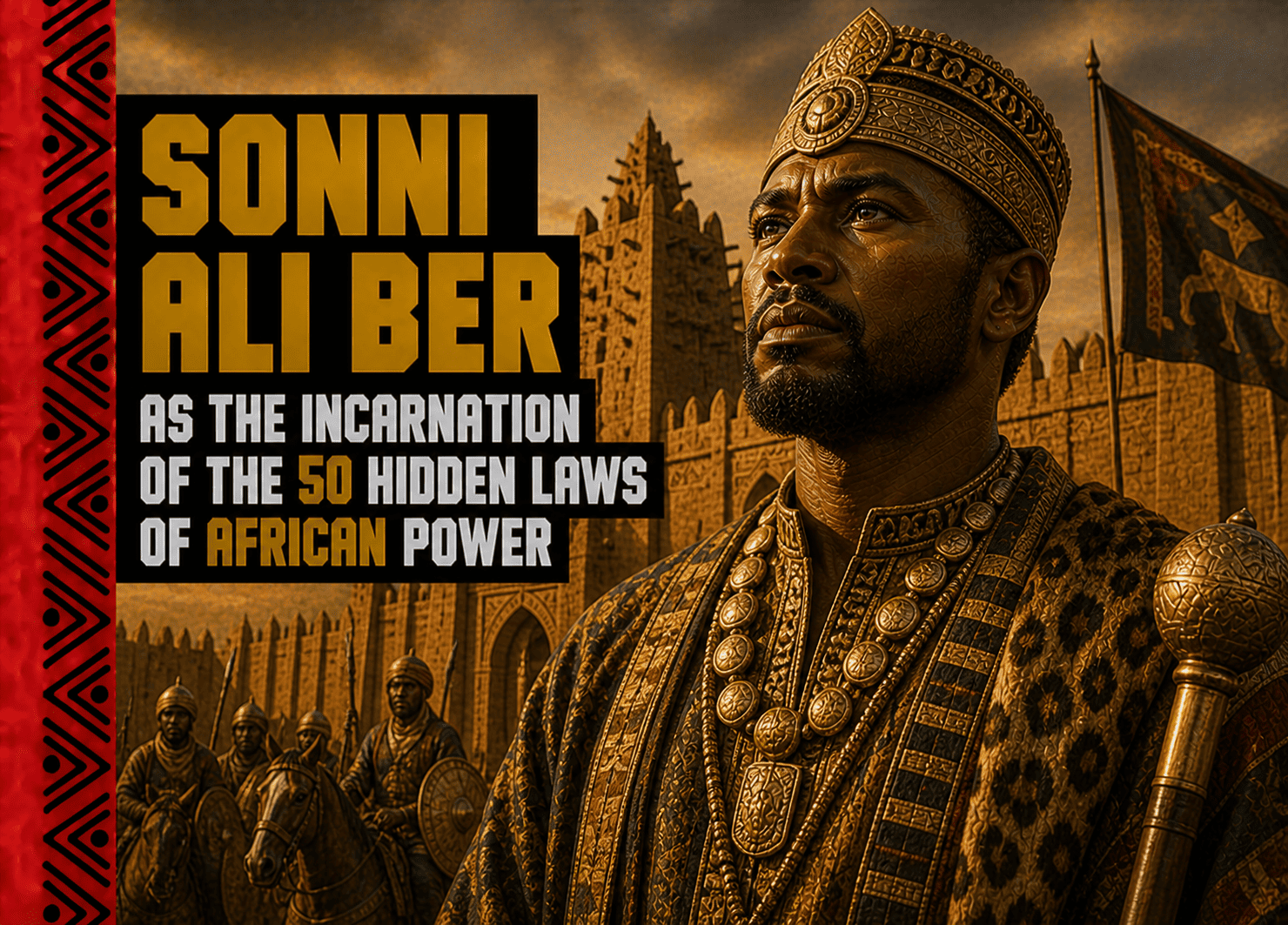
SONNI ALI BER — EMBODIMENT OF THE 50 HIDDEN LAWS OF AFRICAN POWER
Through conquest, cunning and force, the founder of the Songhai Empire unified the Sahel and made Timbuktu tremble.
I. HISTORICAL AND CIVILIZATIONAL CONTEXT
⭐ Who was Sonni Ali Ber? Sonni Ali Ber (aka Sonni Ali, died 1492) was the 15th ruler of the Sonni dynasty of the Songhai Empire and the true founder of its power. He reigned from 1464 to 1492. He conquered the key cities of Timbuktu (1468) and Djenné (1475), unified the Sahel regions, and laid the foundations of the empire that would peak under Askia Mohammed. He is often described as a ruthless ruler, a skilled strategist and a master of Niger River navigation.
West Africa in the 15th Century – The Decline of Mali and the Rise of Songhai
In the mid‑15th century, the Mali Empire was in decline. Peripheral provinces (Timbuktu, Gao, Djenné) became semi‑independent. The Songhai kingdom, centred on Gao, had been a vassal of Mali but gained autonomy. Sonni Ali Ber ascended the throne in 1464. He inherited a small territory and armies of cavalry and boatmen. In 28 years, he extended his authority over the Niger Bend, created a river fleet, and subdued the Tuareg, Fulani and Dogon. His reign marked the transition from the Songhai principality to a vast imperial empire.
❓ What does “Sonni Ali Ber” mean? “Sonni” is the dynastic title (equivalent to king), “Ali” his name, “Ber” means “the Great” in Songhai. Hence Sonni Ali the Great.
The Spiritual and Political Context
Sonni Ali Ber was Muslim, but his practice was criticised by the ulama of Timbuktu, who accused him of not respecting Sharia (he consulted animist diviners, showed cruelty). He pursued religious pragmatism: allied with marabouts against the Tuaregs, yet respected local cults. This earned him a bad reputation in Arabic chronicles, which describe him as a “tyrant”. His military and administrative genius remains undeniable.
🔗 CONNECTION TO THE 50 HIDDEN LAWS OF AFRICAN POWER
→ Law #1: Master Cosmic Balance (force and pragmatism)
Points of convergence:
• Sonni Ali balanced official Islam with local beliefs to unite his army – religious pragmatism.
• He combined military conquest with infrastructure building (fleet, fortifications) – destruction vs construction.
• Modern application: African leaders must sometimes choose effectiveness over orthodoxy – balance is a matter of survival.
• Strategic lesson: Enduring power comes from the ability to integrate diverse belief systems – Sonni Ali understood this.
II. ORIGINS AND SOCIAL ASCENSION
❓ How did Sonni Ali Ber become king of Songhai? He succeeded his father, Sonni Sulayman Daman, around 1464. The Songhai kingdom was then tributary to Mali. Ali began by subduing rebel tribes, then broke free from Malian tutelage and proclaimed independence.
Birth and Origins
Sonni Ali was born around 1430 in the Gao region (present‑day Mali). He belonged to the Sonni dynasty of Songhai origin. His father, Sonni Sulayman Daman, ruled before him. Sources on his childhood are scarce, but he was trained in warfare, navigation (the Niger River was crucial) and administration. He spoke Songhai, Arabic and possibly Fulani.
Military Training and Influences
Ali learned cavalry (imported horses) and river warfare. He observed conflicts between Tuaregs, Fulani and the remnants of the Mali Empire. He recruited mercenaries and surrounded himself with a loyal staff. His reputation for ruthlessness and cunning was forged in campaigns against Fulani tribes.
The Rise: Unification of Songhai (1464‑1475)
Becoming sovereign, he first had to quell internal revolts. He used a combination of force and diplomacy. He led an expedition against the kingdom of Mema and subdued it. Then he turned to Timbuktu, the wealthy trading city then held by the Tuaregs (with help from a Fulani chief). He took the city in 1468, massacred resisters, and settled in. Djenné, an island city, resisted longer; Ali besieged it from 1473 to 1475, using boats and engineers to build bridges. Djenné fell, opening up the interior. These victories earned him the title “Ber” (the Great).
🔗 CONNECTION TO THE LAWS OF AFRICAN POWER
→ Law #3: “Transform Knowledge into Power”
Points of convergence:
• Sonni Ali used his knowledge of the Niger (currents, seasons) to deploy a fleet and take Djenné – hydrological knowledge as a weapon.
• He mastered siege and dispersal tactics to defeat the Tuaregs – terrain adaptation.
• Modern application: African leaders must exploit natural resources (rivers, geography) as strategic advantages.
• Strategic lesson: Knowledge of the local environment is more valuable than imported weapons – Sonni Ali made it his asset.
III. TITLES AND FUNCTIONS
❓ What titles did Sonni Ali Ber hold? He was “Sonni” (king), “Ber” (the Great), “sovereign of Songhai”, “master of the Niger River”, “conqueror of Timbuktu and Djenné”. Arabic chroniclers called him “Ali the tyrant”.
- Sonni – hereditary dynastic title.
- Ber – epithet “the Great”.
- Commander‑in‑Chief of the armies – he personally led campaigns.
- Admiral of the Niger fleet – controlling war canoes.
- Unifier of Songhai, Fulani, Tuareg and Mandinka lands – forced federator.
🔗 CONNECTION TO THE LAWS OF AFRICAN POWER
→ Law #12: “Become Indispensable to Power”
Points of convergence:
• Sonni Ali was the only one able to maintain the fragile union of rival ethnic groups – without him, the empire would fracture.
• He held multiple roles: general, admiral, diplomat, judge – indispensable to governance.
• Modern application: African leaders must be versatile during nation‑building phases – indispensability is earned on the ground.
• Strategic lesson: After his son (Sonni Baru), the empire faltered – personal indispensability can be a risk for succession.
IV. THE TAKING OF TIMBUKTU – A BLOODY LEGACY
❓ How did Sonni Ali Ber conquer Timbuktu? In 1468, he marched on Timbuktu then held by the Tuaregs. After resistance, the city surrendered after a siege. According to chronicles, there was a massacre of notables, but archaeologists dispute the scale of destruction. The city was incorporated into the Songhai Empire, with a Songhai governor appointed.
Arabic sources (Tarikh al‑Fattash, Tarikh al‑Sudan) describe him as a “scourge” to Timbuktu’s scholars. Songhai oral tradition, however, portrays him as a liberator. He installed a garrison, confiscated wealth, and imposed tribute. Timbuktu remained a commercial centre but lost its political autonomy. Sonni Ali was not a scholar; he often despised the ulama, which earned him a bad reputation in later writings (under the more pious Askia Mohammed).
🔗 CONNECTION TO THE LAWS OF AFRICAN POWER
→ Law #15: “Build Monuments That Speak for You”
Points of convergence:
• Sonni Ali built no monuments, but his conquests themselves are monuments – every traveller, every caravan tells of his power.
• The capture of Timbuktu is an “intangible monument” – the legend of a merciless conqueror.
• Modern application: African leaders may leave warrior exploits as their legacy – reputation can be worth more than walls.
• Strategic lesson: A conquered city speaks louder than a thousand statues – Timbuktu is Sonni Ali’s trophy.
V. THE SIEGE OF DJENNÉ – RIVER GENIUS
The city of Djenné, located in the inner Niger Delta, was a prosperous trading city‑state. Sonni Ali besieged it for two years. He used his fleet of canoes to block supply routes, but the city held out. He ordered the construction of wooden bridges to facilitate access. Finally, the city fell during the rainy season (1475). According to legend, Ali crossed the waters on horseback, showing his determination. Djenné was annexed. Sonni Ali married a Fulani princess to seal the alliance with the Fulani.
🔗 CONNECTION TO THE LAWS OF AFRICAN POWER
→ Law #8: “Master Cycles – Time as a Weapon”
Points of convergence:
• Sonni Ali synchronised his attack with the Niger’s flood and recession cycles – the environment as ally.
• He patiently waited two years to take Djenné – perseverance pays.
• Modern application: African leaders must use natural cycles (seasons, floods) and economic cycles to strangle the enemy.
• Strategic lesson: Time favours those who control water and food – Sonni Ali proved it.
VI. ADMINISTRATION – AN EMPIRE OF COMMAND
Sonni Ali did not deeply reorganise the administration; he appointed governors (fari) in conquered provinces and stationed garrisons. He often left local chiefs in place if they paid tribute. He created a network of military posts along the Niger. His fleet numbered hundreds of armed canoes, commanded by admirals (hi koy). The army was a mix of light cavalry (Tuaregs, Fulani) and Songhai infantry. These structures would be perfected by Askia Mohammed.
🔗 CONNECTION TO THE LAWS OF AFRICAN POWER
→ Law #42: “Create a Legacy That Multiplies Your Power”
Points of convergence:
• The military structures set up by Sonni Ali allowed Askia Mohammed to expand the empire further – active legacy.
• The Niger fleet outlasted his reign – naval legacy.
• Modern application: African leaders must bequeath defensive and logistical institutions – they serve successors.
• Strategic lesson: A well‑organised army is the best monument – Sonni Ali built a war machine.
VII. DEATH AND SUCCESSION – THE FOUNDER’S DISAPPEARANCE
Sonni Ali Ber died on 6 November 1492, probably drowned during a crossing of the Niger or from illness. His son, Sonni Baru, succeeded him but was contested by strict Muslims (notably the Askia, General Mohammed Touré). Less than a year later, in 1493, Askia Mohammed overthrew Baru, founded the Askia dynasty, and rewrote history by demonising Sonni Ali. That is why Arabic chronicles describe him as a “pagan” and a “tyrant”. Songhai oral traditions venerate him.
🔗 CONNECTION TO THE LAWS OF AFRICAN POWER
→ Law #50: “Transcend Death – The Art of Immortality”
Points of convergence:
• His premature death did not prevent the Songhai Empire from surviving and prospering – his work lasted.
• The damnatio memoriae by Askia Mohammed tried to erase his image, but oral tradition preserved it.
• Modern application: African leaders may be distorted by successors, but popular memory resists.
• Strategic lesson: An empire‑builder does not need to be loved by scribes – rewritten history does not kill oral legend.
VIII. LEGACY – THE NAPOLEON OF THE SAHEL
Today, Sonni Ali is celebrated in Mali and Niger as a unifier. Streets and neighbourhoods bear his name (e.g., Sonni Ali in Niamey). The Niger fleet is symbolically associated with his naval genius. Modern historians rehabilitate him: he laid the territorial foundations of the Songhai Empire, created an effective army, and paved the way for Askia Mohammed’s great conquests. Statues of him are rare, but his legend is alive.
🔗 CONNECTION TO THE LAWS OF AFRICAN POWER
→ Law #45: “Become a Symbol – When Your Name Becomes a Movement”
Points of convergence:
• “Sonni Ali” evokes brute force, river unification, resistance to clerics – a popular symbol.
• Nigeriens and Malians see him as a warrior ancestor – his name unites.
• Modern application: African leaders can choose to be adored by the masses despite elite criticism – popularity is a form of power.
• Strategic lesson: A sovereign may lose the battle of chronicles but win the battle of songs – Sonni Ali lives in the griots.
IX. SOURCES AND TESTIMONIES
Written sources: Tarikh al‑Fattash (16th century), Tarikh al‑Sudan (17th century), writings of Al‑Sadi.
Oral sources: Songhai traditions, epic poems of griots.
Archaeology: Sites of Gao, Timbuktu, Djenné (fortification remains).
Secondary sources: Works by Jean Boulègue, Sékéné Mody Cissoko, Dierk Lange.
❓ Why did Arabic chroniclers hate Sonni Ali? Because he was not a strict Muslim. He consulted diviners, did not always respect Sharia, and did not protect Timbuktu’s ulama. Askia Mohammed, more pious, commissioned chronicles favourable to his own regime, demonising his predecessor.
🔗 CONNECTION TO THE LAWS OF AFRICAN POWER
→ Law #28: “Control Your Narrative – History Belongs to the One Who Writes It”
Points of convergence:
• Askia Mohammed had history written in his favour, discrediting Sonni Ali – the victor writes history.
• Despite this, Songhai oral tradition did not follow the Arabic version – a double narrative.
• Modern application: African leaders must keep allies in orality; griots are counter‑powers of memory.
• Strategic lesson: If you cannot control the chroniclers, make sure the people sing your praise – Sonni Ali lost the scribes but won the griots.
X. MYSTERIES AND UNSOLVED QUESTIONS
❓ What was Sonni Ali’s actual religion? Officially Muslim, but syncretic. He practised animist rites and consulted diviners. Arabic chroniclers accused him of mistreating pious Muslims.
❓ Where is his tomb? He is believed to have been buried near Gao, but the exact site has not been identified. Archaeological research is partial.
❓ Did Sonni Ali really destroy Timbuktu’s manuscripts? Chronicles claim so, but no manuscripts dating from before his conquest have been found in large numbers. He primarily eliminated notables, not systematically burned books.
🔗 CONNECTION TO THE LAWS OF AFRICAN POWER
→ Law #37: “Cultivate Mystery – What Is Hidden Fascinates”
Points of convergence:
• The shadow zones about his death (drowning? illness?) fuel legends.
• The vagueness about his religious beliefs allows both Muslims and animists to claim him.
• Modern application: Leaders may leave their private lives and beliefs ambiguous – interpretation varies and prolongs interest.
• Strategic lesson: A mysterious death turns a ruler into a romantic hero – Sonni Ali remains an enigma.
XI. FAQ – FREQUENTLY ASKED QUESTIONS ABOUT SONNI ALI BER
❓ Did Sonni Ali found the Askia dynasty? No, it was Askia Mohammed (Mohamed Touré) who founded the Askia dynasty after overthrowing Sonni Baru, Sonni Ali’s son. Sonni Ali was of the Sonni dynasty.
❓ How long did Sonni Ali reign? About 28 years (1464‑1492).
❓ What is the difference between Sonni Ali and Askia Mohammed? Sonni Ali conquered the empire; Askia Mohammed organised it (administration, taxation, official Islam). Askia Mohammed was more pious and gained the support of the ulama.
❓ Is there a film about Sonni Ali? No major film, but documentaries (BBC, “The Songhai Empire”) mention his role.
XII. LESSONS AND CONTEMPORARY RELEVANCE
💡 What can Africa learn from Sonni Ali Ber? Sonni Ali teaches that a tough, pragmatic, military leader can lay the foundations of an empire. He shows the importance of mastering one’s environment (the river) and using terror as a tool of consolidation. He reminds us that national unity sometimes requires force, and that founders are not always loved by scholars.
Mastery of territory and waterways: The Niger was his ally – African leaders must exploit their geography (rivers, lakes).
The importance of a fleet: A river navy can dominate the interior – invest in navigable waterways.
Being willing to be hated by elites if necessary: Sonni Ali ignored the ulama, but the masses followed him – popular support can outweigh clerical hostility.
Prepare the transition: He failed to ensure dynastic continuity – his son was overthrown within a year.
🔗 CONNECTION TO THE LAWS OF AFRICAN POWER
→ Law #5: “Master Multiple Domains – The Power of the Renaissance”
Points of convergence:
• Sonni Ali was simultaneously general, admiral, diplomat, administrator – a complete leader.
• He combined warfare, navigation, and tributary management – a cross‑functional vision.
• Modern application: African leaders must be versatile – the continent’s development requires multiple skills.
• Strategic lesson: An empire‑builder may not be a great theorist, but must excel in action – Sonni Ali proved it.
CONCLUSION: IMMORTALITY THROUGH CONQUEST AND THE RIVER
Sonni Ali Ber remains, more than five hundred years after his death, a fascinating and controversial figure of African history. His journey – Songhai prince turned empire founder, conqueror of Timbuktu and Djenné, master of the Niger – testifies to the power of force, cunning and determination. He left no lavish mosques, but a vast territory and a formidable army.
For contemporary Africa and its diaspora, Sonni Ali represents the conqueror who tamed a river, united diverse peoples, and laid the foundations of one of the Sahel’s greatest empires. He reminds us that unity is not decreed; it is won through arms and diplomacy. His name, Sonni Ali Ber, resonates today as a challenge: may every African nation produce builders who master their environment, federate communities, and leave an institutional legacy, even at the cost of displeasing historians.
🔗 SYNTHESIS: SONNI ALI BER AS THE EMBODIMENT OF THE HIDDEN LAWS OF AFRICAN POWER
📜 Summary of the laws embodied by Sonni Ali Ber: Balance (#1), Knowledge as Power (#3), Polymathy (#5), Control of Time (#8), Indispensability (#12), Monuments (#15), Healing through terror (#23), Narrative Control (#28), Mystery (#37), Multiplicative Legacy (#42), Symbol (#45), Immortality (#50).
- Law #1 (Balance) – Military force and religious pragmatism, conquest and tribute.
- Law #3 (Knowledge as Power) – Knowledge of the Niger, seasons, siege tactics.
- Law #5 (Polymathy) – War leader, admiral, administrator, negotiator – complete genius.
- Law #8 (Control of Time) – Two‑year siege of Djenné, using river cycles.
- Law #12 (Indispensability) – Only unifier of ethnic groups – focal point of the empire.
- Law #15 (Monuments) – Conquered cities (Timbuktu, Djenné) – urban monuments.
- Law #23 (Heal to Rule) – Terror as therapy against revolts – brutal but effective pacification.
- Law #28 (Control of Narrative) – Hostile Arabic chronicles but favourable oral tradition – double narrative.
- Law #37 (Mystery) – Uncertain death, unknown tomb, vague beliefs – fertile mysteries.
- Law #42 (Multiplicative Legacy) – His military structures served Askia Mohammed – active legacy.
- Law #45 (Symbol) – “Sonni Ali” = conquest, Niger River, brutal unification – living concept.
- Law #50 (Immortality) – Griots still sing of him, streets bear his name – persistent presence.
Practical Application for the Modern Leader:
✅ Master your geography – rivers, roads, seasons are weapons
✅ Use terror judiciously – fear can temporarily pacify
✅ Be versatile – a founder must know how to navigate, fight and negotiate
✅ Ensure your succession – Sonni Ali failed there
✅ Accept that written history will be partial – compensate with oral tradition and monuments
The Sonni Ali Ber Challenge for You:
“What river, road or natural resource will you master to extend your influence? How will you unite rival communities without losing your soul?”