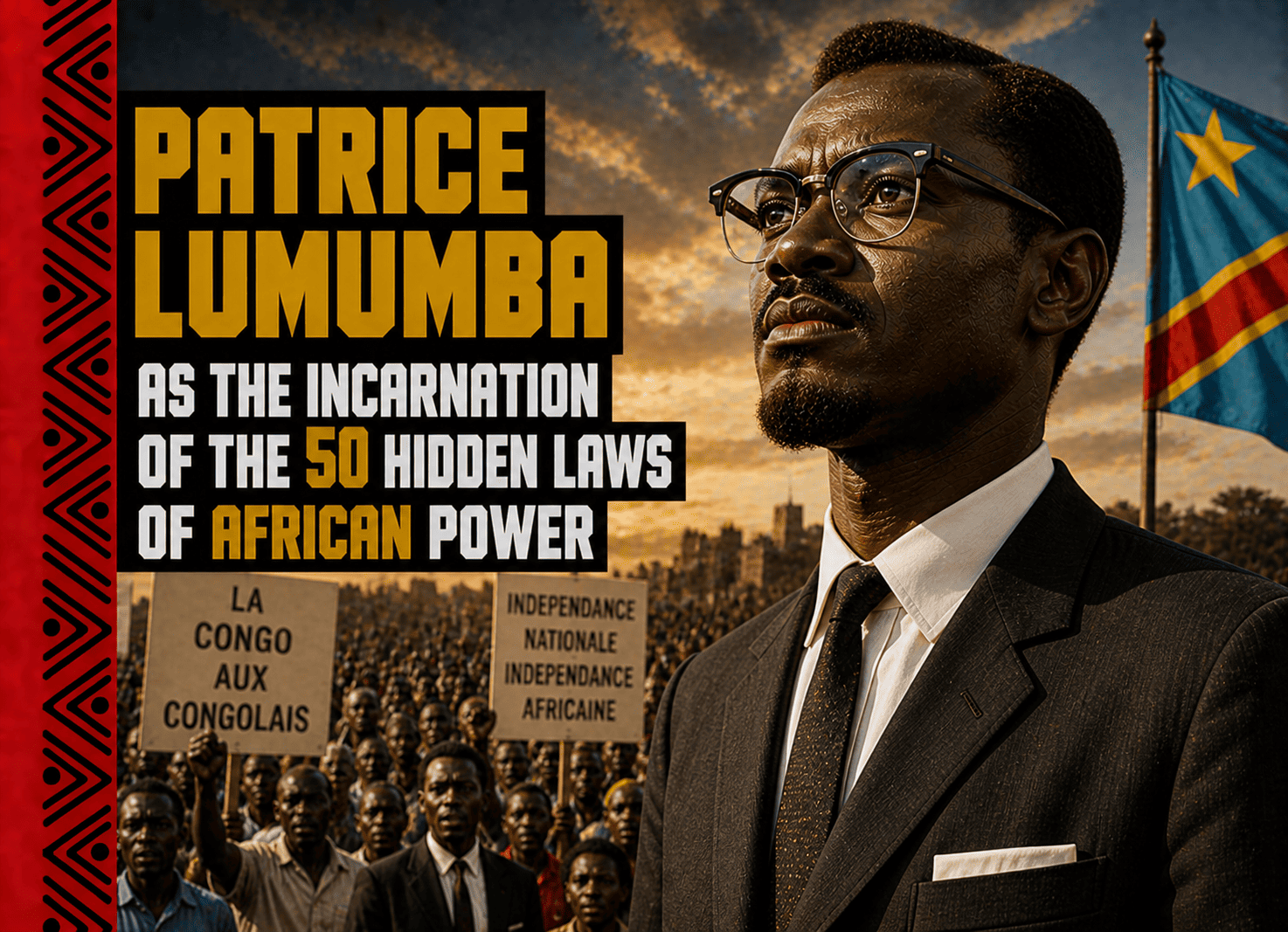
PATRICE LUMUMBA — EMBODIMENT OF THE 50 HIDDEN LAWS OF AFRICAN POWER
Through his words, courage and sacrifice, the first Prime Minister of the Congo embodied the dream of a free and united Africa.
I. HISTORICAL AND CIVILIZATIONAL CONTEXT
The Belgian Congo and the Wind of Independence (1950s‑1960)
Patrice Lumumba (1925‑1961) was the first Prime Minister of the Democratic Republic of Congo after independence on 30 June 1960. He was born in the Belgian Congo, a colony directly administered by the Belgian state (the personal property of King Leopold II until 1908). The colonial system was brutal: forced labour, segregation, an absence of trained elites (in 1960, only 16 Congolese university graduates). The wind of decolonisation, with the independence of Ghana (1957), Guinea (1958) and the Bandung Conference (1955), galvanised nationalist movements. Lumumba founded the National Congolese Movement (MNC) in 1958, demanding immediate and unitary independence. After the Brussels Round Table (1960), independence was set for 30 June 1960. Lumumba became Prime Minister (his coalition won the elections) while Joseph Kasa‑Vubu became President. But the country quickly plunged into crisis: army mutiny, Katanga secession (with Belgian support), UN intervention. Lumumba was overthrown in September 1960 and assassinated in January 1961.
The Spiritual and Ideological Context
Lumumba was a Pan‑Africanist nationalist, anti‑colonialist, but not a dogmatic Marxist. He claimed African socialism and continental unity. He admired Nkrumah, Sékou Touré and Nasser. He was also imbued with Christian values (Catholic education). His speeches were fiery; he embodied liberating speech. He opposed Belgium, the United States (which feared a communist tilt) and Western‑backed secessionists. His vision: a strong, united, sovereign Congo using its wealth (copper, cobalt, uranium) for the people’s benefit.
🔗 CONNECTION TO THE 50 HIDDEN LAWS OF AFRICAN POWER
→ Law #1: Master Cosmic Balance (national unity and Pan‑Africanism)
Points of convergence:
• Lumumba balanced Congo’s more than 200 ethnic groups by advocating a unitary state – balance through common citizenship.
• He wanted economic independence (balance against neocolonialism) and African unity.
• Modern application: African leaders must prioritise national unity beyond ethnic divisions – Lumumba sets an example.
• Strategic lesson: Enduring power comes from uniting diverse communities around a common project of sovereignty.
II. ORIGINS AND SOCIAL ASCENSION
Birth and Education
Patrice Lumumba was born on 2 July 1925 in Onalua, in the Kasai province (Belgian Congo). He belonged to the Batetela ethnic group. His father, François Tolenga, was a peasant. He attended a Catholic school, then a teacher‑training school. He worked as a clerk, a postman, then an accountant. He was self‑taught, reading widely (history, philosophy, politics). In 1955, he became a sales manager for a brewery, which allowed him to travel and meet intellectuals. He wrote poems and articles for the colonial press.
Political Engagement and Prison
In 1958, he founded the National Congolese Movement (MNC), a secular, unitary party. He was arrested in 1959 after riots in Stanleyville and sentenced to six months in prison. His popularity exploded. He took part in the Brussels Round Table (January‑February 1960), where he won rapid independence. He left prison and won the legislative elections (May 1960). He became Prime Minister on 30 June 1960.
The Independence Speech (30 June 1960) – A Thunderclap
In the presence of King Baudouin, Lumumba delivered a speech denouncing colonial humiliation, racism and violence. The king had previously praised Leopold II’s “civilising” work. Lumumba retorted:
“We have known the whip […] We have known sarcasm, insults, blows […] Our fate is now in our own hands.”
This speech sealed his fate: Belgium and Western powers saw him as ungrateful, but he became a myth for Congolese and Africans.
🔗 CONNECTION TO THE LAWS OF AFRICAN POWER
→ Law #3: “Transform Knowledge into Power”
Points of convergence:
• Lumumba used his pen and voice (he was a poet, journalist) to mobilise the masses – rhetorical knowledge as a weapon of liberation.
• He mastered the codes of diplomacy and political communication even in the face of colonial powers.
• Modern application: African leaders must master oratory and the media – well‑used words can topple empires.
• Strategic lesson: A speech can be more powerful than an army – Lumumba’s changed the course of history.
III. TITLES AND FUNCTIONS
Lumumba held political and symbolic titles:
- Prime Minister of the Republic of Congo (24 June 1960 – 14 September 1960).
- Minister of National Defence (from July 1960).
- President of the National Congolese Movement (MNC) – founder.
- National hero of independence – posthumous title.
- Symbol of the anti‑colonial struggle – Pan‑African icon.
🔗 CONNECTION TO THE LAWS OF AFRICAN POWER
→ Law #12: “Become Indispensable to Power”
Points of convergence:
• Lumumba was the only leader able to unite Congolese nationalist forces – without him, the coalition fell apart.
• He held multiple functions: head of government, defence minister, chief orator – indispensable to the independence process.
• Modern application: African leaders must be versatile in the early years of independence – but also know how to delegate.
• Strategic lesson: Indispensability can become a vulnerability – Lumumba’s assassination left the Congo without a pilot.
IV. THE CONGO CRISIS – INDEPENDENCE UNDER CONSTANT STRESS
Immediately after independence, the army (Force Publique) mutinied against Belgian officers. Belgium intervened militarily without the Congolese government’s authorisation and supported the secession of Katanga (rich in minerals) led by Moïse Tshombe. South Kasai also attempted secession. Lumumba called on the UN for help, but the Blue Helmets refused to intervene against the Katangan secession (under Western pressure). Lumumba then turned to the USSR, which sent planes and advisors. This alliance with the Soviets alarmed the United States, which feared a Cuba in Africa. The CIA organised (or supported) Lumumba’s fall. In September 1960, President Kasa‑Vubu dismissed him; Lumumba retaliated by dismissing the president. Colonel Mobutu (future Mobutu Sese Seko) seized power in a coup, placing Lumumba under house arrest.
🔗 CONNECTION TO THE LAWS OF AFRICAN POWER
→ Law #8: “Master Cycles – Time as a Weapon”
Points of convergence:
• Lumumba had no time to consolidate his power – the crisis broke out too early. He should have temporised.
• The manipulation of political cycles by external powers (Belgian intervention, CIA) proved fatal to him – time worked against him.
• Modern application: African leaders must accelerate cadre training and institution‑building before challenging foreign powers.
• Strategic lesson: Mastering time requires delaying external challenges until one is ready – Lumumba was caught in a pincer too soon.
V. THE ASSASSINATION – A CRIME AGAINST AFRICA
Lumumba escaped from house arrest, tried to join his supporters in Stanleyville. He was captured and transferred to Katanga on 17 January 1961. He was brutally tortured, then executed by a firing squad of Katangan soldiers (under Belgian supervision). His body was dissolved in acid (or burned) to prevent any burial. For decades, Belgium and the United States denied involvement; historical investigations (the Belgian Commission 2001‑2002) established the responsibility of the Belgian government and the CIA.
🔗 CONNECTION TO THE LAWS OF AFRICAN POWER
→ Law #50: “Transcend Death – The Art of Immortality”
Points of convergence:
• Lumumba’s body was erased, but his memory has become immense – the absence of a tomb amplifies the myth.
• Every year on 17 January, Africa commemorates his sacrifice – the martyr is more powerful than the living.
• Modern application: African leaders may be physically eliminated, but if their cause is just, they become immortal.
• Strategic lesson: Acid dissolution does not kill the idea – Lumumba is more alive than ever.
VI. LEGACY – THE MARTYR WHO HAUNTS BELGIUM
Lumumba became the symbol of the anti‑colonial struggle in Africa. Belgium recognised in 2002 its “moral responsibility” in his assassination. In 2020, his only relic (a tooth) was returned to his family. Streets, squares and monuments bear his name in Congo, Belgium, France, Senegal, etc. He inspires films (Lumumba by Raoul Peck), songs, novels. His statue stands in Kinshasa and Brussels. He is the father of the Congolese nation.
🔗 CONNECTION TO THE LAWS OF AFRICAN POWER
→ Law #45: “Become a Symbol – When Your Name Becomes a Movement”
Points of convergence:
• “Lumumba” is a first name given to thousands of Africans – his name has become an ideal of resistance.
• “Lumumbism” is a political current in the DRC and the diaspora – a school of thought.
• Modern application: African leaders must aim for their name to become a political programme.
• Strategic lesson: A martyr can be more influential than a president – death can found a legend.
VII. LUMUMBA AND THE PAN‑AFRICAN DREAM
Lumumba always advocated African unity. He supported liberation movements in other countries. He dreamed of a federation of the United States of Africa. His death galvanised anti‑colonial movements (Angola, Mozambique, Guinea‑Bissau). Nkrumah, Nasser and Ben Bella took him as a model. The African Union celebrates him as a hero.
🔗 CONNECTION TO THE LAWS OF AFRICAN POWER
→ Law #42: “Create a Legacy That Multiplies Your Power”
Points of convergence:
• Lumumba’s image has inspired future generations of African leaders – an active legacy.
• The returned tooth has become a symbolic object of reconciliation – the power of a relic.
• Modern application: African leaders must bequeath speeches, writings, images that cross decades.
• Strategic lesson: A well‑maintained legacy multiplies through films and books – Lumumba is in the history textbooks.
VIII. SOURCES AND TESTIMONIES
Writings and speeches: “Patrice Lumumba, l’homme et le mythe”, independence speech (30 June 1960), prison letters.
Testimonies: André L. (companion), Pauline Lumumba (wife), Belgian commission reports.
Archives: CIA, UN, Radio Congo, Belgian television.
Secondary sources: Biographies by Jean‑Claude Willame, Raoul Peck (films).
🔗 CONNECTION TO THE LAWS OF AFRICAN POWER
→ Law #28: “Control Your Narrative – History Belongs to the One Who Writes It”
Points of convergence:
• For decades, the Belgian and American version downplayed his role – Lumumba was demonised.
• African historians and filmmakers have restored the truth – the counter‑narrative has triumphed.
• Modern application: African leaders must fund historians, filmmakers, media to tell their story.
• Strategic lesson: The battle of memory can last decades – Lumumba won the posthumous war of narratives.
IX. LUMUMBA IN POPULAR CULTURE
Cinema: “The Death of Patrice Lumumba” (documentary), “Lumumba” by Raoul Peck (2000), “Forgotten Men”.
Music: Songs by Miriam Makeba, Tiken Jah Fakoly, Alpha Blondy, Fally Ipupa.
Literature: Novels, plays, comic books.
Art: Portraits, statues, graffiti worldwide.
🔗 CONNECTION TO THE LAWS OF AFRICAN POWER
→ Law #37: “Cultivate Mystery – What Is Hidden Fascinates”
Points of convergence:
• The absence of a body, the single tooth, the shadow zones about accomplices (CIA, Belgium) sustain the mystery.
• The independence speech was censored in Belgium but became mythical – secrecy amplifies legend.
• Modern application: Leaders may leave unsaid parts of their lives – posterity will conduct investigations.
• Strategic lesson: A historical mystery (who actually shot Lumumba?) drives research and memory.
X. MYSTERIES AND UNSOLVED QUESTIONS
The precise role of the United States: Did the CIA order or merely authorise the assassination? Archives are still partially classified.
Is the returned tooth authentic? Belgium says it recovered it, but doubts persist.
The UN’s stance: Why did Dag Hammarskjöld (Secretary‑General) not protect Lumumba? Accident or complicity?
His relationship with communists: Was he really a communist, or did he use Soviet aid solely out of pragmatism?
🔗 CONNECTION TO THE LAWS OF AFRICAN POWER
→ Law #37: “Cultivate Mystery – What Is Hidden Fascinates” (continued)
Points of convergence:
• Undeclassified archives (CIA, Belgian services) fuel conspiracy theories – doubt keeps interest alive.
• The controversy over his real ideology allows some to claim him as a nationalist, others as a Marxist – fruitful ambiguity.
• Modern application: Leaders may accept that their lives remain partly opaque – varied interpretation prolongs interest.
• Strategic lesson: A well‑sustained mystery (the real murder procedures) ensures that people will talk about you for centuries.
XI. LESSONS AND CONTEMPORARY RELEVANCE
The imperative of national unity: Congo suffered from ethnic fragmentation and secession – Lumumba was right, unity is strength.
Vigilance against neocolonialism: Foreign powers did not hesitate to destroy a legitimate leader to preserve their economic interests – Africans must control their resources.
The importance of integrity: Lumumba was never corrupt – he refused bribes – exemplarity pays in the long run.
Prepare for succession: He did not have time to train reliable cadres – his political legacy was hijacked by Mobutu.
🔗 CONNECTION TO THE LAWS OF AFRICAN POWER
→ Law #5: “Master Multiple Domains – The Power of the Renaissance”
Points of convergence:
• Lumumba was at once poet, journalist, political leader, improvised military strategist – forced polymathy.
• He could not excel in economics and diplomacy for lack of time – a lesson on the importance of prior training.
• Modern application: African leaders must prepare long before governing – versatility is acquired through experience.
• Strategic lesson: The African renaissance needs complete leaders, but also time – Lumumba ran out of time.
CONCLUSION: IMMORTALITY THROUGH SACRIFICE
Patrice Lumumba remains, more than sixty years after his death, one of the most iconic figures of the anti‑colonial struggle. His journey – employee turned Prime Minister, poet turned martyr – testifies to the power of ideas, liberating speech and personal sacrifice. He laid the foundations of Congolese independence, even though his assassination plunged the country into dictatorship and war.
For contemporary Africa and its diaspora, Lumumba represents political integrity, the refusal of corruption, and faith in a united and sovereign continent. He reminds us that formal independence is not enough – we must fight economic and military neocolonialism. His name, Patrice Lumumba, resonates today as a cry: may each generation produce its own Lumumba – those leaders who, through words, exemplarity and sacrifice, refuse to sell Africa and prefer death to betrayal.
🔗 SYNTHESIS: PATRICE LUMUMBA AS THE EMBODIMENT OF THE HIDDEN LAWS OF AFRICAN POWER
The 12 Major Laws Embodied by Lumumba:
- Law #1 (Balance) – National unity and Pan‑Africanism, socialism and non‑alignment.
- Law #3 (Knowledge as Power) – Mastery of speech, press, rhetoric – liberating words.
- Law #5 (Polymathy) – Poet, journalist, politician, strategist – but too short a time.
- Law #8 (Control of Time) – Lack of time to consolidate – lesson on urgency and patience.
- Law #12 (Indispensability) – Only national leader able to unify – too indispensable, without heir.
- Law #15 (Monuments) – Independence speech, statues, relic (tooth) – intangible and material monuments.
- Law #23 (Heal to Rule) – Wanted to “heal” Congo from colonisation – therapy through independence.
- Law #28 (Control of Narrative) – Demonised by the West, rehabilitated by African history.
- Law #37 (Mystery) – Dissolved body, uncertain tooth, secret archives – permanent mystery.
- Law #42 (Multiplicative Legacy) – Inspiring generations, films, songs – active legacy.
- Law #45 (Symbol) – “Lumumba” = African martyr, integrity, anti‑colonialism – living concept.
- Law #50 (Immortality) – Returned tooth, mythical speech, commemorations – persistent presence.
Practical Application for the Modern Leader:
✅ Master oratory – a speech can trigger independence
✅ Prepare your succession – do not leave chaos behind
✅ Beware of rushed alliances – both East and West seek domination
✅ Invest in cadres – training elites is a national priority
✅ Accept the risk of martyrdom – if your cause is just, it will outlive you
The Patrice Lumumba Challenge for You:
“What speech will you make to awaken consciences? What tooth (symbol) will you leave to history? Are you ready to die so that Africa may rise?”