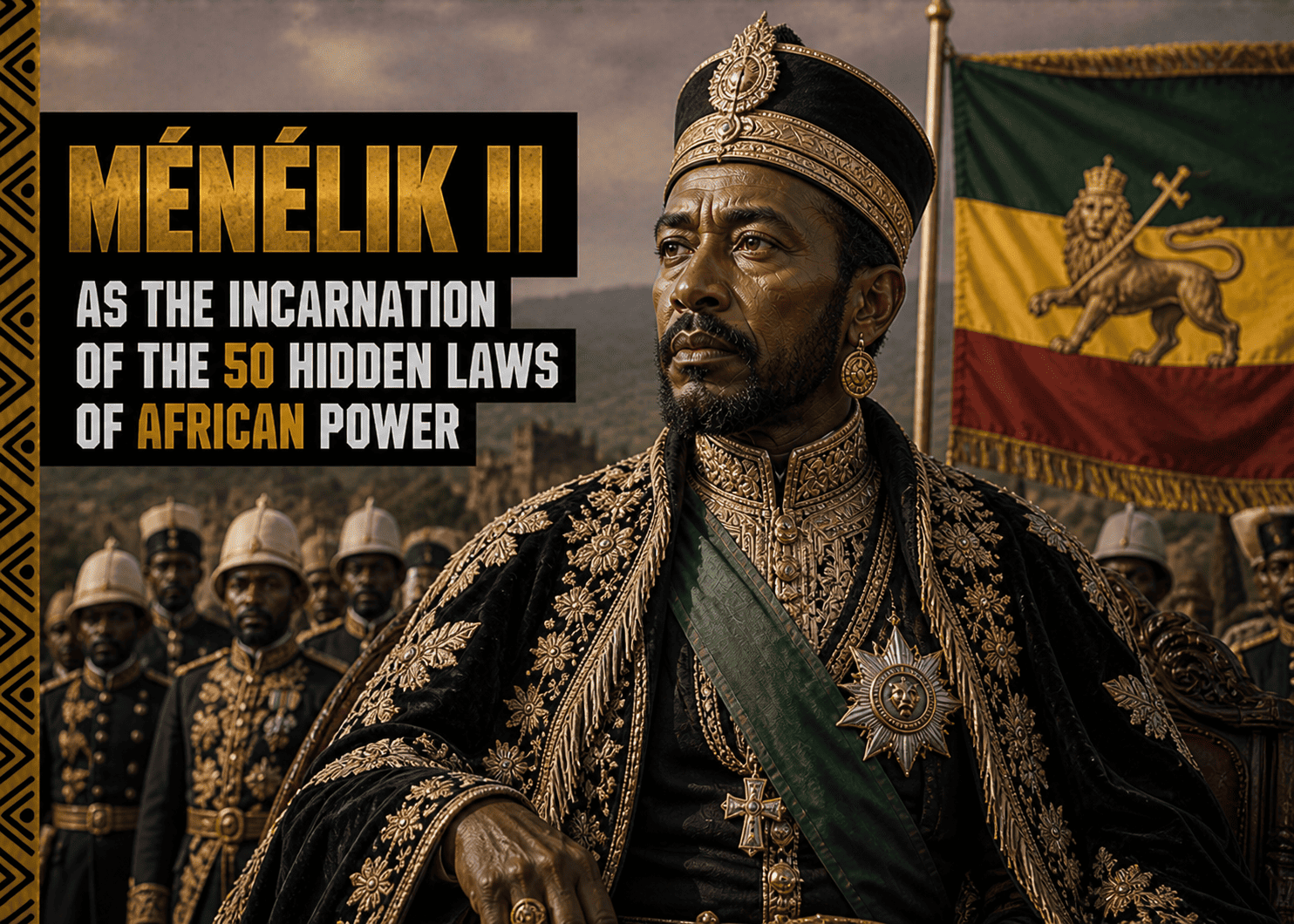
MENELIK II — EMBODIMENT OF THE 50 HIDDEN LAWS OF AFRICAN POWER
Through modernization, diplomacy, and the victory of Adwa, the Emperor of Ethiopia preserved his country’s independence and inspired all of Africa.
I. HISTORICAL AND CIVILIZATIONAL CONTEXT
Ethiopia and the Horn of Africa in the 19th Century – The Scramble for Africa
Menelik II (born Sahle Maryam, 1844‑1913) ruled Ethiopia from 1889 to 1913. He came to power at a time when Europe was embarking on the “Scramble for Africa” (Berlin Conference 1884‑1885). Ethiopia is one of only two African countries never to have been colonised (along with Liberia), and Menelik II managed to maintain its independence against Fascist Italy by winning the famous Battle of Adwa (1896).
The Ethiopian Empire, an ancient Orthodox Christian kingdom, was then fragmented into semi‑autonomous provinces (Tigray, Amhara, Shewa, etc.). Menelik, King of Shewa, would unify the country, expand its borders south and east, and launch a vast programme of modernisation (railway, telegraph, electricity, education, army). He founded the new capital, Addis Ababa (1886), and endowed it with modern institutions.
The Spiritual and Cultural Context
Ethiopia was a deeply religious society, where the Ethiopian Orthodox Tewahedo Church played a central role. Menelik II presented himself as the “Conquering Lion of the Tribe of Judah”, heir to the Solomonic dynasty (descended from Menelik I, son of Solomon and the Queen of Sheba). He used Orthodox Christianity to legitimise his power, while allying with Muslim leaders in conquered regions (Harar, Ogaden). This dual religious approach – Orthodox for the centre, tolerant on the periphery – allowed him to expand his empire without religious revolts.
🔗 CONNECTION TO THE 50 HIDDEN LAWS OF AFRICAN POWER
→ Law #1: Master Cosmic Balance (Orthodox Christianity and Interfaith Alliances)
Points of convergence:
• Menelik balanced Orthodox faith (national identity) with pragmatic policy toward Muslims – strategic tolerance.
• He united divided provinces through war, then diplomacy and administration – forced but lasting harmony.
• Modern application: African leaders must manage religious diversity to preserve national unity.
• Strategic lesson: Enduring power comes from the ability to unite communities of different faiths around a common project.
II. ORIGINS AND SOCIAL ASCENSION
Birth and Solomonic lineage
Menelik II was born on 17 August 1844 in Angolalla, in the province of Shewa. His father, Haile Melekot, was King of Shewa; his mother, Woizero Ejigayehu, was a commoner. He was thus of royal blood but illegitimate. Upon his father’s death (1855), Emperor Tewodros II invaded Shewa, captured the young Sahle Maryam and imprisoned him on the mountain of Magdala for several years. There he learned strategy and observed central power.
Education and Captivity
Released by Tewodros, he returned to Shewa and became king (negus) in 1865. He spent the following years consolidating his kingdom, modernising his army (importing modern weapons) and expanding his influence. In 1883 he married Taytu Betul, a formidable political woman who would become his advisor and de facto co‑ruler.
The Rise to the Imperial Throne (1889)
After the death of Emperor Yohannes IV (1889), Menelik proclaimed himself negus negast (king of kings) with the support of Shewa and the Church. He defeated rival claimants and became Emperor of Ethiopia under the name Menelik II. He then signed the Treaty of Wuchale with Italy (May 1889), which contained an ambiguous clause – Article 17 – which the Italians interpreted as a protectorate. Menelik denounced the treaty, leading to war.
🔗 CONNECTION TO THE LAWS OF AFRICAN POWER
→ Law #3: “Transform Knowledge into Power”
Points of convergence:
• Menelik used his knowledge of modern weapons (rifles, cannons) bought from Europeans to equip his army – he turned technical know‑how into military power.
• His understanding of European diplomacy (he corresponded with the great powers) allowed him to play colonial rivalries against each other.
• Modern application: African leaders must master the technologies and diplomatic codes of the powers to protect their sovereignty.
• Strategic lesson: Technical education and geopolitical intelligence are weapons of liberation – Menelik imported modern guns, not just missionaries.
III. TITLES AND FUNCTIONS
Menelik II held imperial and modern titles:
- Negus Negast (King of Kings, Emperor of Ethiopia).
- Conquering Lion of the Tribe of Judah – Solomonic dynastic title.
- King of Shewa (before 1889).
- Chief Moderniser – introduction of the railway (Djibouti‑Addis), telegraph, telephone, electricity, the first bank.
- Founder of Addis Ababa (permanent capital).
- Victor of Adwa (1896) – honorary title.
🔗 CONNECTION TO THE LAWS OF AFRICAN POWER
→ Law #12: “Become Indispensable to Power”
Points of convergence:
• Menelik was the only one able to federate Ethiopia’s provinces (Tigray, Amhara, Shewa, etc.) after decades of civil war – the nodal point of unity.
• He held the roles of military leader, lawgiver, builder and diplomat – irreplaceable.
• Modern application: African leaders must embody national unity while building strong institutions – indispensability is also a vulnerability.
• Strategic lesson: A leader can be indispensable, but must prepare his succession – Menelik ensured the transition to his daughter Zewditu, but power later shifted.
IV. THE BATTLE OF ADWA – THE ETHIOPIAN VICTORY
After the denunciation of the Treaty of Wuchale, Italy invaded Ethiopia. Menelik raised an army of 100,000 men (against 20,000 Italians) and faced General Baratieri’s troops on 1 March 1896 at Adwa. Using perfect knowledge of the terrain, better organisation and troop cohesion, Menelik crushed the Italian army. The Italians lost 6,000 men (many captured). The Treaty of Addis Ababa (October 1896) annulled the Treaty of Wuchale and recognised Ethiopia’s full independence. Italy had to pay reparations.
🔗 CONNECTION TO THE LAWS OF AFRICAN POWER
→ Law #8: “Master Cycles – Time as a Weapon”
Points of convergence:
• Menelik chose the opportune moment: the dry season to mobilise his troops, the Italians’ fatigue after long marches.
• He prepared his strategy based on intelligence (enemy position, topography) – knowledge of time and terrain is decisive.
• Modern application: African leaders must synchronise actions with natural, economic and political cycles – strike when the adversary is weak.
• Strategic lesson: The Battle of Adwa shows that preparation, intelligence and patience are worth more than technological superiority.
V. MODERNISATION – BRINGING ETHIOPIA INTO THE 20TH CENTURY
Menelik II encouraged the import of modern technologies. He signed an agreement with France for the construction of the Djibouti‑Addis Ababa railway (completed in 1917). He installed telegraph, telephone, electric lighting in his palace. He created the first modern school (Menelik II School), sent students to Europe, imported printing presses and issued the first national currency (birr). He reorganised the army with modern weapons (Gras rifles, cannons).
🔗 CONNECTION TO THE LAWS OF AFRICAN POWER
→ Law #15: “Build Monuments That Speak for You”
Points of convergence:
• The Djibouti‑Addis railway is a technical monument that still bears his name today – visible infrastructure.
• Menelik II School, the banks, printing presses – material institutions that immortalised his actions.
• Modern application: African leaders must invest in transport, energy and education infrastructure – these are the pyramids of the modern world.
• Strategic lesson: A railway speaks longer than a speech – travellers pronounce the emperor’s name on every kilometre.
VI. TERRITORIAL EXPANSION – THE MENELIK EMPIRE
Menelik expanded Ethiopia’s borders south, east and west: conquest of the Kingdom of Kaffa (1897), the Oromo, Sidama, Gurage regions, and the Ogaden. He signed treaties with colonial powers (France, Britain, Italy) to delimit Ethiopia’s present‑day borders. He created a provincial system with appointed governors (ras), centralised administration and imposed Amharic as the empire’s language.
🔗 CONNECTION TO THE LAWS OF AFRICAN POWER
→ Law #42: “Create a Legacy That Multiplies Your Power”
Points of convergence:
• The borders Menelik negotiated are still those of modern Ethiopia – an active geopolitical legacy.
• Centralised administration, Amharic language, the Orthodox Church as pillars shaped national identity – cultural legacy.
• Modern application: African leaders must leave a unified territory and institutions that unite – territorial integrity is a lasting heritage.
• Strategic lesson: An empire survives not only by arms, but by administration and assimilation – Menelik founded the modern Ethiopian state.
VII. DIPLOMACY OF BALANCE – BETWEEN FRANCE, BRITAIN AND ITALY
Menelik played imperial rivalries: he received weapons from France, Russia (which opened a hospital in Addis), and even from Italy after the defeat. He maintained cordial relations with Britain (Sudan border). He refused any protectorate and forced respect for his sovereignty. He sent diplomatic missions to Europe (ambassadors to France, Italy, Russia).
🔗 CONNECTION TO THE LAWS OF AFRICAN POWER
→ Law #28: “Control Your Narrative – History Belongs to the One Who Writes It”
Points of convergence:
• Menelik sent his own ambassadors to Europe, not just missionaries – he controlled his country’s narrative abroad.
• After Adwa, Ethiopia became a myth of African resistance – Menelik won the battle of consciences.
• Modern application: African leaders must have active diplomacy, embassies and international media – soft power is a continuation of war.
• Strategic lesson: Winning on the battlefield is not enough; you must win in chancelleries and newspapers – Menelik understood that.
VIII. FINAL YEARS – ILLNESS AND SUCCESSION
Menelik was struck by a debilitating illness (probably a stroke) from 1906 onward. He became increasingly infirm. His wife, Empress Taytu Betul, exercised unofficial regency, then a council of regents. Menelik died on 12 December 1913, leaving the throne to his daughter Zewditu (1916) after a brief chaotic transition (the reign of Lij Iyasu). His mausoleum is in the Ba’eta Le’ul Maryam church in Addis Ababa.
🔗 CONNECTION TO THE LAWS OF AFRICAN POWER
→ Law #50: “Transcend Death – The Art of Immortality”
Points of convergence:
• Menelik died infirm, but the Ethiopian state he built outlived him – his work was institutionalised.
• The Battle of Adwa is celebrated every year (1 March) – a commemoration that perpetuates his memory.
• Modern application: African leaders must ensure that institutions, national holidays and symbols perpetuate their action after death.
• Strategic lesson: Illness and final weakness do not erase greatness – immortality is won through victories, not health.
IX. LEGACY – THE FATHER OF MODERN ETHIOPIA
Menelik II is venerated as the founder of the modern Ethiopian state. His equestrian statue stands in Addis Ababa. He appears on banknotes (1 birr). Addis Ababa University bore his name (1990). His palace (the Menelik Palace) is still used. The victory of Adwa is a founding myth of Pan‑Africanism, cited by Marcus Garvey, Haile Selassie and anti‑colonialists. Menelik embodies the pride of an Africa that resists and modernises.
🔗 CONNECTION TO THE LAWS OF AFRICAN POWER
→ Law #45: “Become a Symbol – When Your Name Becomes a Movement”
Points of convergence:
• “Menelik” is a given name in Ethiopia – his name has become a symbol of national pride.
• The Adwa victory is taught in all African schools as an example of colonialism’s defeat – a Pan‑African legacy.
• Modern application: African leaders must aim for their name to become a reference of resistance and pride – that children bear it.
• Strategic lesson: A collective myth (Adwa) can outlive the hero – Menelik is immortal through the legend of the battle.
X. SOURCES AND TESTIMONIES
Ethiopian sources: Imperial chronicles, memoirs of his advisors, ministry archives.
Italian sources: Military reports, diplomatic correspondence, officers’ journals.
European sources: Travel accounts (Augustus B. Wylde, Jules Borelli), French and British ambassadors.
Modern archives: National Library of Ethiopia, Ministry of Foreign Affairs archives in Addis Ababa.
🔗 CONNECTION TO THE LAWS OF AFRICAN POWER
→ Law #37: “Cultivate Mystery – What Is Hidden Fascinates”
Points of convergence:
• The shadow zones about his illness, the real role of Taytu Betul, the details of the Wuchale treaty negotiations – all unanswered questions that fuel research.
• The mystery of his succession (Lij Iyasu, Zewditu) makes history even more complex – ambiguity prolongs interest.
• Modern application: African leaders may leave certain decisions unexplained – posterity will interpret them.
• Strategic lesson: A measure of mystery around the end of a reign gives depth to the character – we don’t know everything, so we talk about him.
XI. MENELIK II IN CONTEMPORARY CONSCIOUSNESS
Ethiopian national hero: His mausoleum is a pilgrimage site, his portrait adorns public buildings and banknotes.
Pan‑African icon: Adwa is celebrated by the African Union; Menelik is often cited in speeches on anti‑colonial resistance.
Popular culture: Ethiopian films, novels, patriotic songs.
Historical debate: Some critics accuse him of using famine as a weapon of war during his conquests (brutal methods), but defenders recall the context of the era.
🔗 CONNECTION TO THE LAWS OF AFRICAN POWER
→ Law #37: “Cultivate Mystery – What Is Hidden Fascinates” (continued)
Points of convergence:
• The controversies over his conquest methods make his character more nuanced, hence more human – the imperfect hero is more accessible.
• Questions about his authoritarianism or his dependence on Empress Taytu fuel debate.
• Modern application: Leaders should not seek perfection – flaws make the legend credible.
• Strategic lesson: An overly smooth icon is forgotten; a complex figure is discussed indefinitely.
XII. LESSONS AND CONTEMPORARY RELEVANCE
Modernise without submitting: Menelik imported European technologies without accepting a protectorate – African leaders can draw inspiration from this model of selective appropriation.
National unity as strength: The Adwa victory came from the unity of Ethiopia’s provinces – disunity is the weakness of nations.
Diplomacy is a continuation of war: Menelik knew how to negotiate, cheat, play powers off against each other – political realism over idealism.
Prepare your succession: His institutional legacy survived, but his personal succession was chaotic – plan a clear transition system.
🔗 CONNECTION TO THE LAWS OF AFRICAN POWER
→ Law #5: “Master Multiple Domains – The Power of the Renaissance”
Points of convergence:
• Menelik was simultaneously war chief, diplomat, administrator, builder, moderniser – an imperial polymath.
• He excelled in technology (arms import, railway), religion (balance), foreign policy – cross‑functional vision.
• Modern application: African leaders today must combine economic, diplomatic, military and educational skills – leadership is multidisciplinary.
• Strategic lesson: The African renaissance requires leaders capable of embracing everything – Menelik is an example.
CONCLUSION: IMMORTALITY THROUGH THE VICTORY OF ADWA
Menelik II remains, more than a century after his death, one of the founding fathers of modern Africa. His journey – Tewodros’s prisoner turned emperor, builder of a unified state and victor over a colonial power – testifies to the power of strategic vision, controlled modernisation and armed resistance. He proved that an African country, well armed, well organised and united, could defeat a European army.
For contemporary Africa and its diaspora, Menelik II represents the sovereign who said “no” to colonialism, opened his country to technology without selling his soul, and bequeathed a viable state. He reminds us that independence is not a gift but a permanent conquest. His name, Menelik, resonates today as a challenge: may every African nation produce its own Menelik – those leaders who, through intelligence, modernisation and unity, preserve their sovereignty and inspire the world.
🔗 SYNTHESIS: MENELIK II AS THE EMBODIMENT OF THE HIDDEN LAWS OF AFRICAN POWER
The 12 Major Laws Embodied by Menelik II:
- Law #1 (Balance) – Orthodoxy and Muslim alliances, Solomonic tradition and modernity.
- Law #3 (Knowledge as Power) – Import of modern weapons, mastery of diplomatic codes – technical and political knowledge.
- Law #5 (Polymathy) – General, diplomat, administrator, builder, lawgiver – complete state genius.
- Law #8 (Control of Time) – Choosing the moment at Adwa, synchronising reforms – strategic patience.
- Law #12 (Indispensability) – Only unifier of Ethiopia’s provinces – focal point.
- Law #15 (Monuments) – Railway, Addis Ababa, Menelik School – material and living monuments.
- Law #23 (Heal to Rule) – Healing internal divisions through conquest and administration.
- Law #28 (Control of Narrative) – Ambassadors abroad, Adwa victory publicised – narrative control.
- Law #37 (Mystery) – Illness, Taytu’s role, treaty details – fertile mysteries.
- Law #42 (Multiplicative Legacy) – Current borders, national holiday (Adwa) – still‑active legacy.
- Law #45 (Symbol) – “Menelik” = African resistance, Ethiopian pride – living concept.
- Law #50 (Immortality) – Statue, mausoleum, memory of Adwa – perpetual presence.
Practical Application for the Modern Leader:
✅ Modernise without accepting foreign tutelage – technological borrowing is not submission
✅ Unite your country – disunity is the mother of colonisation
✅ Use diplomacy to play rival powers – multipolarity is an asset
✅ Prepare your succession – let the state survive the individual
✅ Build visible infrastructure – a railway speaks for you
The Menelik Challenge for You:
“What strategic technology will you master to protect your nation? How will you unite the living forces of your country against an external threat? By which emblematic battle will you mark history?”