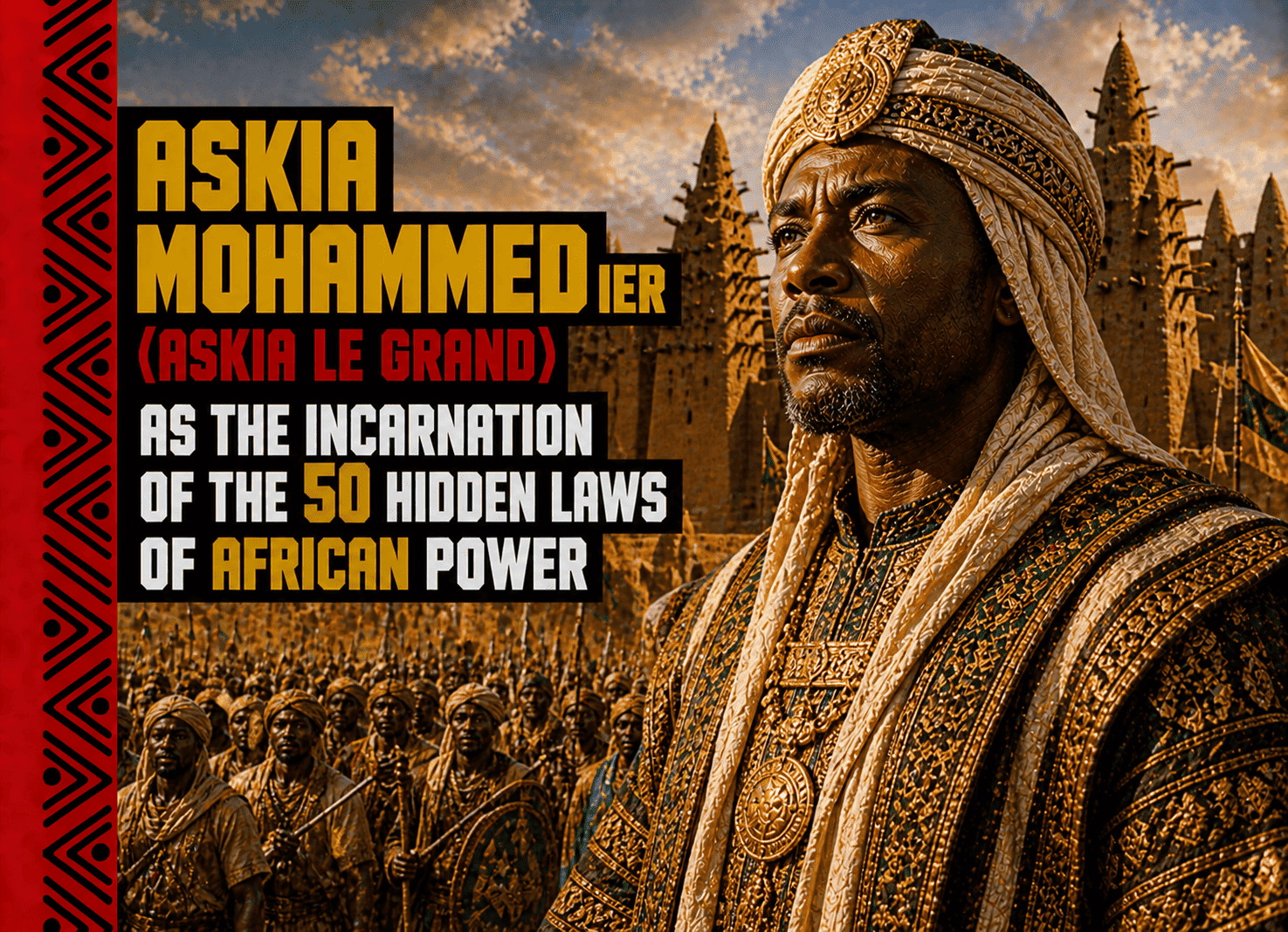
ASKIA MOHAMMED I (ASKIA THE GREAT) — EMBODIMENT OF THE 50 HIDDEN LAWS OF AFRICAN POWER
Through administrative reform, centralization, and the pilgrimage to Mecca, the Songhai emperor elevated his empire to the rank of the Sahel’s greatest powers.
I. HISTORICAL AND CIVILIZATIONAL CONTEXT
The Songhai Empire in the 15th‑16th Century (West Africa)
Askia Mohammed I (Mohamed Touré, also called Askia the Great) ruled the Songhai Empire from 1493 to 1528. The Songhai Empire, centred on the Niger Bend (present‑day Mali, Niger, Burkina, Nigeria, etc.), succeeded the Mali Empire after its decline. At its peak under Askia Mohammed, it controlled the cities of Gao (capital), Timbuktu, Djenné, and stretched from the Niger River to the Sahara’s edge. It was one of the greatest African empires before colonisation.
Emperor Sonni Ali Ber (1464‑1492) had already conquered Mali and expanded the territory; but it was General Touré, who took the title Askia (commander‑in‑chief) after a coup against Sonni Ali’s successors, who organised the empire, endowed it with an efficient administration, a professional army and a prosperous economic system. Askia Mohammed undertook his famous pilgrimage to Mecca between 1496 and 1498, recognized by the caliph as “Caliph of Sudan”, which reinforced his religious legitimacy.
The Spiritual and Cultural Context
Askia Mohammed was a devout Muslim, belonging to a Sufi brotherhood. He made Islam the state religion and imposed Sharia in the cities, while partially tolerating traditional beliefs in the countryside. He attracted Arab and Andalusian scholars to Timbuktu, developed the Sankoré University, and completed Timbuktu’s rise as a leading intellectual centre (500,000 manuscripts). He consulted ulama before major decisions. His governance mixed personal piety, centralised bureaucracy and military power.
🔗 CONNECTION TO THE 50 HIDDEN LAWS OF AFRICAN POWER
→ Law #1: Master Cosmic Balance (Islam and Administration)
Points of convergence:
• Askia Mohammed balanced Islamic faith with temporal power – he legitimised his reign through pilgrimage and Sharia.
• He tolerated local cults in the bush while Islamising the cities – spiritual pragmatism.
• Modern application: African leaders must know how to combine majority religious convictions with belief diversity.
• Strategic lesson: Enduring power comes from balancing spiritual rigour (for the elite) with tolerance (for the masses).
II. ORIGINS AND SOCIAL ASCENSION
Birth and Soninké origins
Mohamed Touré was born around 1442 in the Gao region (present‑day Mali), into a Soninké family (a trading, Islamised people). His father, a merchant, died young; he was raised by his mother, who sent him to study the Qur’an and religious sciences. He entered the Songhai army under Sonni Ali Ber. His bravery and strategic intelligence earned him promotion.
Military and administrative training
Askia Mohammed learned the art of war: cavalry organisation, expedition logistics, fortifications. He also studied Islamic law (fiqh) and administration (land redistribution, tax management). He spoke Songhai, Arabic and Fulani. He became the “Askia” (commander) of the armies.
The Coup and Rise to the Throne (1493)
Upon Sonni Ali Ber’s death, his son Sonni Baru, less competent, ascended the throne. Mohamed Touré, with the support of ulama, merchants and part of the army, carried out a coup against Baru (1493). He won a decisive battle (Anfao) and proclaimed himself Askia Mohammed I. He adopted Islamic titles and legitimised his usurpation through piety.
🔗 CONNECTION TO THE LAWS OF AFRICAN POWER
→ Law #3: “Transform Knowledge into Power”
Points of convergence:
• Askia Mohammed used his knowledge of the Qur’an and Islamic law to gain the support of religious leaders, essential for his seizure of power.
• His mastery of fiscal and commercial mechanisms allowed him to finance conquests and administration.
• Modern application: African leaders must master religious, economic and military codes – legitimacy is built on multiple pillars.
• Strategic lesson: A successful coup is not merely a military act – it is an operation of ideological legitimation.
III. TITLES AND FUNCTIONS
Askia Mohammed held religious, political and military titles:
- Askia (“commander‑in‑chief” in Songhai, modified into an imperial title).
- Caliph of Sudan (title conferred by the Abbasid caliph in Cairo).
- Amir al‑mu’minin (“Commander of the Believers”).
- Reformer of the empire – division into provinces, appointment of governors (fari and mondioro).
- Creator of a professional army – heavy cavalry, infantry, river flotilla.
- Driver of intellectual renaissance – founder of schools and patron of Timbuktu’s library.
🔗 CONNECTION TO THE LAWS OF AFRICAN POWER
→ Law #12: “Become Indispensable to Power”
Points of convergence:
• Askia Mohammed centralised all levers: administration, finance, army, religion – without him, the empire teetered.
• He made himself indispensable by creating a state civil service (wazir, provincial chiefs) loyal to him.
• Modern application: African leaders must build institutions (administrations, armies) that are beholden to them – indispensability becomes bureaucratic.
• Strategic lesson: Personal power must transform into institutional power to survive the leader – Askia Mohammed built the Songhai state.
IV. THE PILGRIMAGE TO MECCA – INTERNATIONAL RECOGNITION
In 1496, Askia Mohammed undertook a lavish pilgrimage with a retinue of 1,000 foot soldiers, 500 horsemen and 300,000 gold pieces. He crossed the Sahara, arrived in Cairo, met the Abbasid caliph Al‑Mutawakkil III, who named him “Caliph of Sudan” (representative of Islamic authority in West Africa). He continued to Arabia, distributed alms, consulted the ulama of Mecca on governance. This pilgrimage established his international legitimacy, attracted scholars and diplomats, and strengthened trans‑Saharan trade.
🔗 CONNECTION TO THE LAWS OF AFRICAN POWER
→ Law #15: “Build Monuments That Speak for You” (pilgrimage as monument)
Points of convergence:
• The pilgrimage is a “living monument” – the story of his generosity and piety travels through centuries.
• The title of caliph earned him lasting diplomatic recognition – the Songhai Empire became an actor in the Muslim world.
• Modern application: African leaders should seek international recognition (UN, AU, prizes) to strengthen local legitimacy.
• Strategic lesson: A well‑orchestrated religious and diplomatic act can yield more than conquests – Askia Mohammed gained prestige through faith.
V. ADMINISTRATIVE REFORMS – THE MODERN SONGHAI STATE
Askia Mohammed divided the empire into provinces (14 in number), each headed by a governor (fari or mondioro) appointed by the emperor. He created a council of ministers (wazir), a public treasury (beit al‑mal), an Islamic court of justice, and a state postal service (barid). He standardised weights and measures and developed land registry. These reforms enabled efficient taxation, rapid army levies and judicial administration.
🔗 CONNECTION TO THE LAWS OF AFRICAN POWER
→ Law #8: “Master Cycles – Time as a Weapon”
Points of convergence:
• Askia Mohammed timed tax collections to seasonal cycles, aligned judges’ tours with the dry season.
• The state postal service accelerated information time – central power controlled space and time.
• Modern application: African leaders must modernise administration and communication – speed of decision is a weapon.
• Strategic lesson: Whoever controls the flow of information (roads, post, messengers) dominates their territory.
VI. THE PROFESSIONAL ARMY – WAR AND CONSOLIDATION
Askia Mohammed transformed the imperial army: organisation of heavy cavalry (horses imported from the Maghreb), a war flotilla on the Niger (armed canoes), infantry equipped with swords and spears. He conquered the Air province (Tuareg country), subdued the Mossi kingdom of Yatenga, extended his authority to Lake Chad and pushed back the Fulani. He did not conquer vast new territories but consolidated and pacified frontiers, ensuring caravan security.
🔗 CONNECTION TO THE LAWS OF AFRICAN POWER
→ Law #23: “Heal to Rule” (pacify and secure)
Points of convergence:
• Askia Mohammed used the army not only to conquer but to “heal” trade routes of bandits – security as economic therapy.
• He integrated local elites of conquered provinces into the administration – healing through inclusion.
• Modern application: African leaders must prioritise security of commercial and logistics networks – stability attracts investment.
• Strategic lesson: War is not an end in itself; it must serve commercial peace – Askia Mohammed understood this.
VII. TIMBUKTU’S GOLDEN AGE – THE SANKORÉ UNIVERSITY
Under Askia Mohammed, Timbuktu became a leading intellectual centre, with over 25,000 students and 400,000 manuscripts (medicine, mathematics, astronomy, Islamic law). He brought scholars from Granada (Andalusia) and Egypt, paid their salaries, built libraries and mosques (extension of Sankoré). He said: “The ink of the scholar is more sacred than the blood of the martyr.”
🔗 CONNECTION TO THE LAWS OF AFRICAN POWER
→ Law #42: “Create a Legacy That Multiplies Your Power”
Points of convergence:
• The Sankoré University is Askia Mohammed’s intangible monument – it trained elites who spread his prestige.
• The Timbuktu manuscripts, preserved to this day, still speak of his reign – textual legacy.
• Modern application: African leaders must invest in higher education, libraries and archives – knowledge is a form of posthumous power.
• Strategic lesson: A king who funds a university is more immortal than a king who funds an army – books outlast centuries.
VIII. TRADE AND PROSPERITY – GOLD AND SALT
Askia Mohammed secured and developed trans‑Saharan routes (Timbuktu‑Ghadames, Gao‑Tafilalt). The empire controlled the salt mines of Taghaza and Taoudenni, the gold deposits of Bambouk, and cotton‑producing regions. He instituted a system of customs and standardised weighing. Timbuktu and Gao became commercial hubs where Arab, Berber, Italian Jewish and Songhai merchants converged. The prosperous economy financed all imperial projects.
🔗 CONNECTION TO THE LAWS OF AFRICAN POWER
→ Law #8: “Master Cycles – Time as a Weapon” (economic continuation)
Points of convergence:
• Mastery of caravan cycles (winter to cross the Sahara) and gold harvests enabled precise fiscal planning.
• Standardisation of weights and measures (gold dirhams) facilitated long‑distance exchange.
• Modern application: African leaders must invest in regional economic integration and standardisation (free trade area).
• Strategic lesson: Controlling resources (gold, salt) and routes means controlling prosperity – Askia Mohammed built economic power.
IX. THE FALL AND BLINDING – THE TRAGEDY OF THE GREAT KING
In 1528, the elderly and weakened Askia Mohammed was deposed by his eldest son, Askia Musa, and locked in a hut where he was blinded. Legend says his son acted because the old emperor had fathered a son he favoured. Askia Mohammed languished in captivity until his death in 1538, blind and almost forgotten. His son, Askia Ishaq I, tried to rule, but the empire began to decline. Posterity has nevertheless remembered mainly his reforms and pilgrimage, not his tragic end.
🔗 CONNECTION TO THE LAWS OF AFRICAN POWER
→ Law #50: “Transcend Death – The Art of Immortality”
Points of convergence:
• Askia Mohammed died deposed and blinded, but his work outlived him: the empire remained powerful for another half‑century.
• The tragic finale adds a human dimension to the legend – the hero who lost everything.
• Modern application: African leaders must prepare their succession to avoid filial coups – power transition is the ultimate test.
• Strategic lesson: Immortality does not depend on a happy ending, but on the solidity of the institutions left behind – the Songhai empire survived its founder.
X. LEGACY – THE GREAT REFORMER OF MUSLIM AFRICA
Askia Mohammed is celebrated as one of the greatest administrators in African history. His model of centralised state (provinces, civil servants, taxation) inspired later kingdoms (Fulani, Bambara). He made Islam a factor of unification rather than division. He left an imprint in the collective memory of Mali, Niger, Burkina and Nigeria. In 2009, the Askia Institute in Timbuktu was named after him.
🔗 CONNECTION TO THE LAWS OF AFRICAN POWER
→ Law #45: “Become a Symbol – When Your Name Becomes a Movement”
Points of convergence:
• The title “Askia” became a dynastic name – his descendants ruled until the end of the 16th century.
• Askia Mohammed is often cited by modern African reformers as a precursor of the rule of law and territorial administration.
• Modern application: African leaders must leave an institutional legacy (constitution, administrative divisions) that bears their mark.
• Strategic lesson: A name associated with a lasting governance system is more powerful than a statue.
XI. MYSTERIES AND UNSOLVED QUESTIONS
Exact location of his tomb: Believed to be in Gao, on Kanaga island (Tombs of the Askia), but access is restricted.
Exact number of children and succession: Chronicles differ on the number of his sons and the legitimacy of the blinding.
Authenticity of the caliph title: Some historians doubt that the Abbasid caliph actually invested Askia Mohammed – imperial propaganda may have amplified.
His attitude toward non‑Muslims: Was he as tolerant as legend suggests? Sources are unclear.
🔗 CONNECTION TO THE LAWS OF AFRICAN POWER
→ Law #37: “Cultivate Mystery – What Is Hidden Fascinates”
Points of convergence:
• The barely accessible tomb, doubts about the blinding narrative, uncertainty about the caliphal recognition – all these vaguenesses sustain mystery.
• The debate over his real religious tolerance allows historians to project their interpretations.
• Modern application: African leaders may leave certain episodes of their lives ambiguous – history loves to fill gaps.
• Strategic lesson: A well‑maintained myth (the lavish pilgrimage) can survive factual criticism – legend often prevails.
XII. LESSONS AND CONTEMPORARY RELEVANCE
Centralisation and effective administration: The Songhai Empire prospered through its bureaucracy – African leaders must invest in strong civil institutions.
Trade as a lever of power: Askia Mohammed understood that wealth comes from controlling exchange, not only conquest.
Education as a strategic investment: Timbuktu was a knowledge hub – academic excellence is a source of influence.
Prepare succession to avoid coups: Askia Mohammed’s blinding by his son reminds us of the importance of clear succession rules.
🔗 CONNECTION TO THE LAWS OF AFRICAN POWER
→ Law #5: “Master Multiple Domains – The Power of the Renaissance”
Points of convergence:
• Askia Mohammed was simultaneously administrator, general, religious reformer, patron, diplomat – a state polymath.
• He understood that modern power (for his time) rests on economy, religion, war and education – a holistic vision.
• Modern application: African leaders must develop cross‑functional skills – one‑dimensional leadership no longer suffices.
• Strategic lesson: The African renaissance requires leaders capable of thinking about the state in all its dimensions – Askia Mohammed offers an example.
CONCLUSION: IMMORTALITY THROUGH INSTITUTION AND KNOWLEDGE
Askia Mohammed I remains, more than five centuries after his reign, one of the greatest state‑builders of pre‑colonial Africa. His journey – general turned usurper, pilgrim turned caliph, reformer blinded by his son – testifies to the power of administrative vision, faith and diplomacy. Even deposed, his work outlived him: the Songhai Empire was one of the most prosperous of its time, and Timbuktu a world intellectual reference.
For contemporary Africa and its diaspora, Askia Mohammed represents the leader who modernised his kingdom without denying his roots, who made Islam a vector of unity, and who understood that power is built as much by books as by arms. His administrative reforms, economic management and intellectual patronage remind us that African excellence is not a recent phenomenon, but a centuries‑old tradition to be reactivated.
His name, Askia (“general”) turned imperial title, resonates today as a challenge: may each generation produce its own Askia – those leaders who, through organisation, trade, faith and education, elevate their people and enter them into history.
🔗 SYNTHESIS: ASKIA MOHAMMED I AS THE EMBODIMENT OF THE HIDDEN LAWS OF AFRICAN POWER
The 12 Major Laws Embodied by Askia Mohammed:
- Law #1 (Balance) – Islam and tolerance, centralisation and provincial autonomy, war and trade.
- Law #3 (Knowledge as Power) – Mastery of Islamic law, taxation and administration – knowledge that legitimises.
- Law #5 (Polymathy) – Administrator, general, theologian, diplomat, patron – complete genius.
- Law #8 (Control of Time) – Fiscal synchronisation, state postal service, caravan cycles – temporal mastery.
- Law #12 (Indispensability) – Centralisation of powers, loyal bureaucracy – nodal point.
- Law #15 (Monuments) – Tomb of the Askia, Sankoré University, manuscripts – material and intangible monuments.
- Law #23 (Heal to Rule) – Securing roads, inclusion of local elites – effective pacification.
- Law #28 (Control of Narrative) – Pilgrimage story, obtaining the caliph title – control of religious and diplomatic narrative.
- Law #37 (Mystery) – Hidden tomb, doubt about the caliphate, unclear succession – persistent mystery.
- Law #42 (Multiplicative Legacy) – Influence on Fulani, Bambara kingdoms, history textbooks – active legacy.
- Law #45 (Symbol) – “Askia” = title of empire‑builder, African reformer – living concept.
- Law #50 (Immortality) – Living university, preserved tomb, honoured name – persistent presence.
Practical Application for the Modern Leader:
✅ Build an efficient administration – the state is a machine, not a personal ambition
✅ Invest in education – Timbuktu University outlived the empire
✅ Secure trade routes – prosperous peace attracts partners
✅ Prepare your succession – Askia Mohammed’s blinding is a warning
✅ Seek international recognition (prizes, titles, travels) – external prestige reinforces internal power
The Askia Mohammed Challenge for You:
“What administration will you reform? What university will you found? What diplomatic pilgrimage will you undertake to establish your legitimacy?”