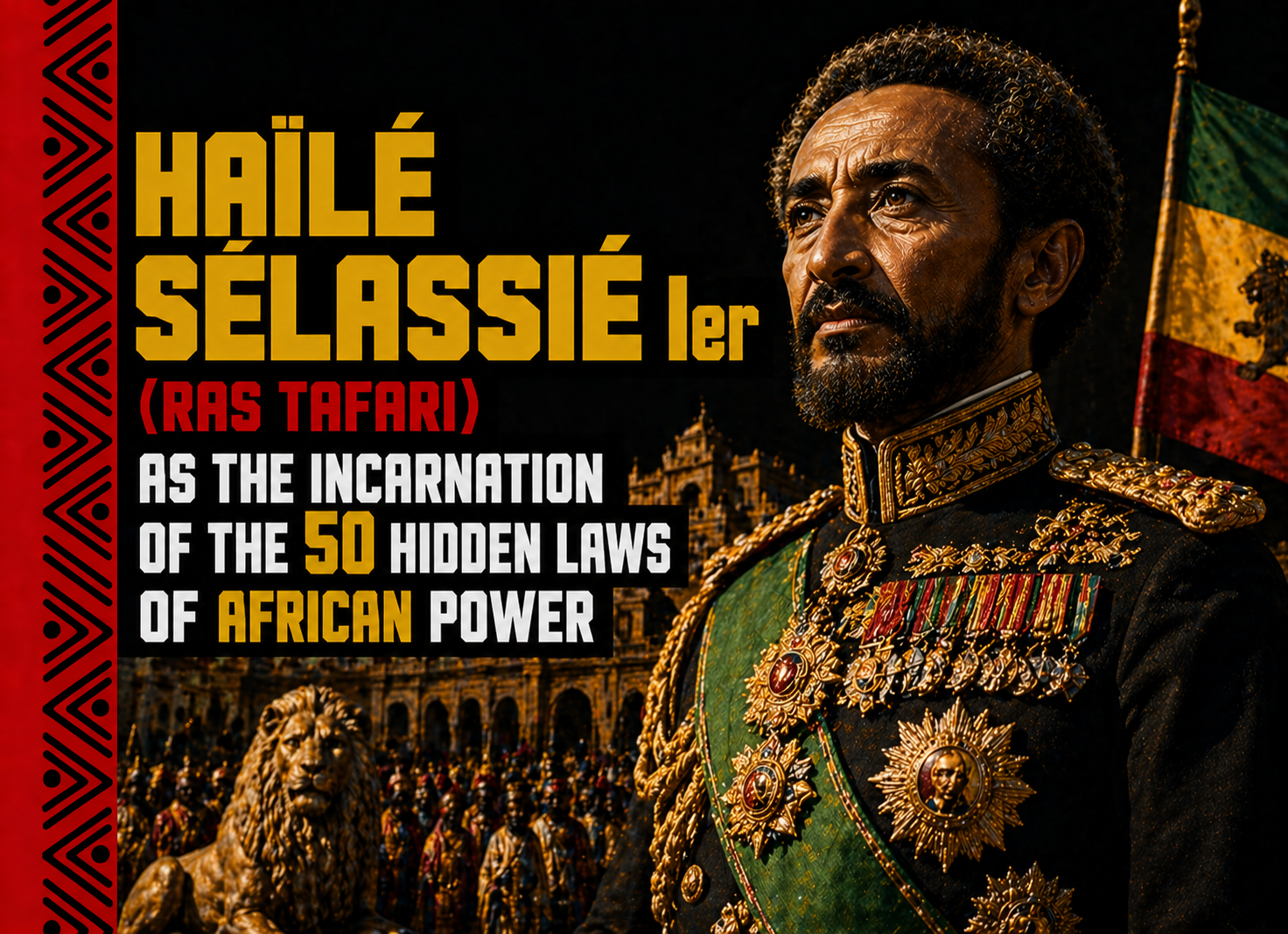
HAILE SELASSIE I (RAS TAFARI) — EMBODIMENT OF THE 50 HIDDEN LAWS OF AFRICAN POWER
Through modernization, resistance, and pan‑African vision, the “Lion of Judah” became a living symbol of African sovereignty and a messianic icon.
I. HISTORICAL AND CIVILIZATIONAL CONTEXT
Ethiopia and the Horn of Africa in the 20th Century (1892‑1975)
Haile Selassie I (born Tafari Makonnen, 1892‑1975) ruled Ethiopia during one of the most transformative and challenging periods in modern African history: the struggle against European colonialism, the Italo‑Ethiopian War, the rise of pan‑Africanism, and the reshaping of post‑World War II Africa. As the last emperor of the Solomonic dynasty (which claimed descent from King Solomon and the Queen of Sheba), he embodied both ancient tradition and modernist ambition.
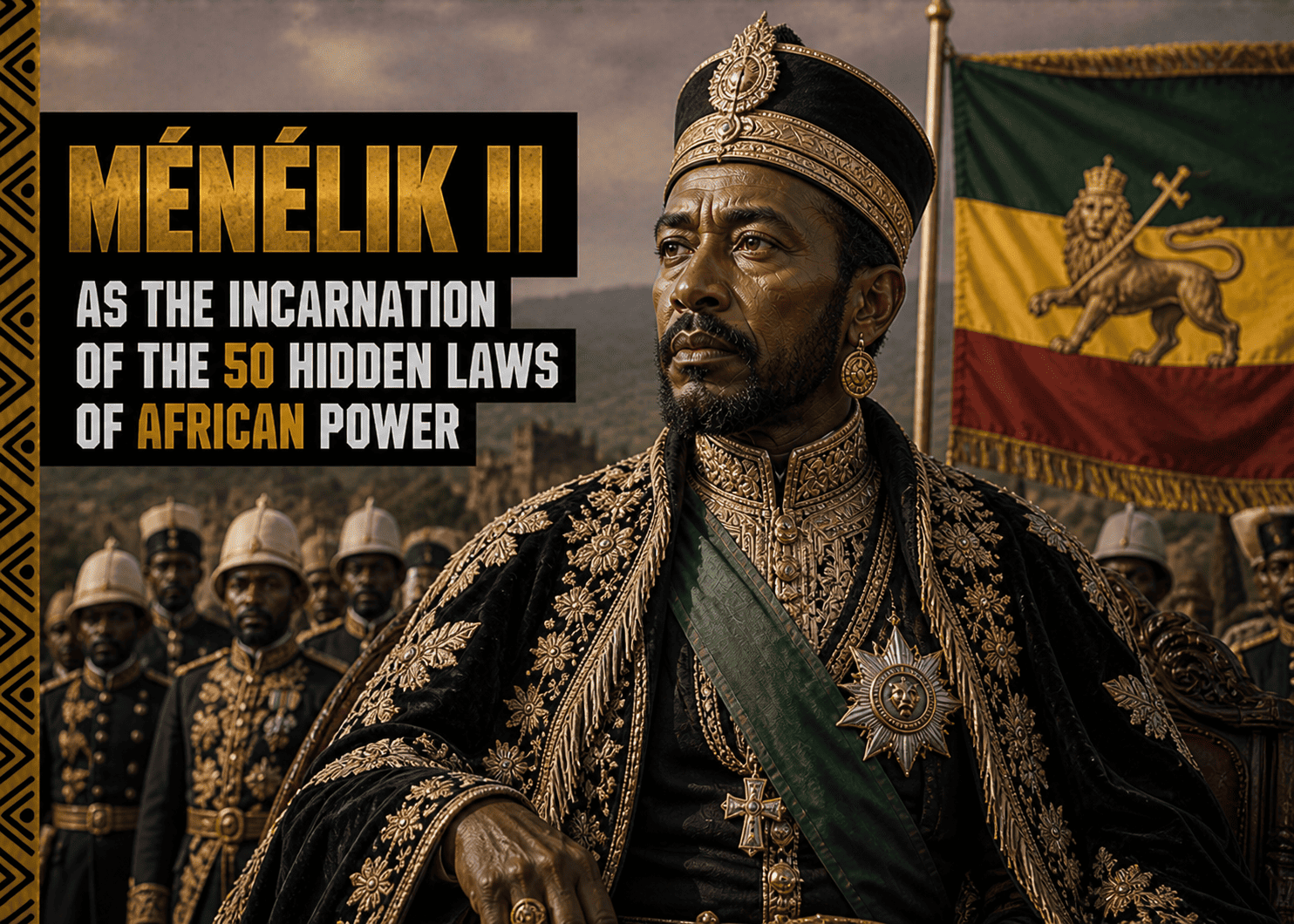
Ethiopia was unique in Africa: it was one of only two nations never formally colonized, having defeated Italy at the Battle of Adwa (1896) under Emperor Menelik II. However, fascist Italy under Mussolini invaded again in 1935, forcing Haile Selassie into exile and occupying the country until 1941. His return from exile and his role in the founding of the United Nations and the Organization of African Unity (OAU) made him a global symbol of African self‑determination.
The Spiritual and Cosmological Context
Haile Selassie was deeply rooted in the Ethiopian Orthodox Tewahedo Church, one of the oldest Christian traditions in the world. He was viewed by his subjects as the “Conquering Lion of the Tribe of Judah, Elect of God, King of Kings” – titles linking him directly to biblical kingship. Beyond traditional Christianity, his coronation in 1930 using the title “King of Kings” (Negusa Nagast) and the prophecy of Marcus Garvey (“Look to Africa, for a black king shall be crowned”) gave rise to the Rastafari movement in Jamaica. Followers of Rastafari revere Haile Selassie as the returned Messiah (Jah) and a living symbol of black redemption.
Balancing his personal humility (he was a devout Christian) with the heavy weight of messianic expectations placed upon him by millions (especially in the Caribbean diaspora) became a unique spiritual challenge – one he never fully embraced but never entirely renounced.
🔗 CONNECTION TO THE 50 HIDDEN LAWS OF AFRICAN POWER
→ Law #1: Master Cosmic Balance (Solomonic Kingship and Modernity)
Points of convergence:
• Haile Selassie balanced ancient lineage (Solomon, Sheba) with modern state‑building (constitution, education, diplomacy).
• He embodied both Christian emperor and secular modernizer – a rare fusion.
• Modern application: African leaders must navigate between tradition and modernization without discarding either – legitimacy often rests on ancestral roots.
• Strategic lesson: The most durable power is that which roots itself in history while reaching for the future – the Lion of Judah knew this.
II. ORIGINS AND SOCIAL ASCENSION
Birth and Family
Haile Selassie was born Tafari Makonnen on July 23, 1892, in the village of Ejersa Goro, in the Harar region of Ethiopia. His father, Ras Makonnen Wolde Mikael, was a powerful governor and a cousin of Emperor Menelik II; his mother, Yeshimebet Ali, was of noble lineage. The family belonged to the Shoan branch of the Solomonic dynasty, which traced its descent from Menelik I, son of King Solomon and the Queen of Sheba.
Tafari was raised in the Orthodox Christian faith and educated by French Catholic missionaries, which gave him fluency in French (the language of diplomacy at the time) and exposure to modern ideas. His father died when Tafari was only 14, leaving him under the guardianship of Emperor Menelik II.
Education and Early Career
Tafari received a traditional Ethiopian education (theology, literature, history) alongside instruction in modern governance and languages. He mastered Amharic, French, and later English. He served as governor of a minor province at the age of 19, then became Governor of Harar in 1910. He was known for his administrative efficiency, his interest in modern technology (telephones, printing presses), and his cautious approach to Western influence – neither opening the floodgates nor closing the doors entirely.
The Rise to Power: From Regent to Emperor
After Emperor Menelik II’s death (1913), the throne passed to Lij Iyasu, a Muslim‑leaning, unpredictable ruler. In 1916, a coup d’état backed by aristocrats and the church deposed Iyasu. Menelik’s daughter, Zewditu, was crowned Empress, and Tafari was made Regent (with the title Ras) and heir to the throne. As Regent, he traveled abroad (Europe, 1924) and modernized Ethiopia’s administration, banking, postal service, and armed forces.
Upon Empress Zewditu’s death in 1930, Tafari was crowned Emperor as Haile Selassie I (“Power of the Trinity”). His coronation was a lavish affair attended by foreign dignitaries, showcasing Ethiopia’s sovereignty and ambition.
🔗 CONNECTION TO THE LAWS OF AFRICAN POWER
→ Law #3: “Transform Knowledge into Power”
Points of convergence:
• Ras Tafari’s mastery of French and English, and his study of European constitutions, allowed him to negotiate with colonial powers on equal footing and to attract foreign investment.
• His knowledge of modern administration (postal, banking, military) transformed Ethiopia from a feudal state into a pseudo‑modern nation.
• Modern application: African leaders must acquire the technical and linguistic tools of the global powers to protect their sovereignty.
• Strategic lesson: Knowledge of the other’s language and systems is not submission – it is the first step toward independence.
III. TITLES AND FUNCTIONS
Haile Selassie accumulated titles that fused biblical, imperial and modern roles:
- King of Kings, Lord of Lords, Conquering Lion of the Tribe of Judah – traditional Solomonic titles.
- Elect of God – religious legitimacy within Ethiopian Orthodoxy.
- Emperor of Ethiopia (Negusa Nagast) – supreme political authority.
- Chairman of the Organization of African Unity (OAU) – helped found and lead the pan‑African body in 1963.
- Modernizer‑in‑Chief – introduced Ethiopia’s first written constitution (1931), banned slavery, and built schools and hospitals.
- Diplomatic Pillar – one of the few African leaders to address the League of Nations (1936) and later a founding father of the United Nations.
- Rastafari Messiah (post‑coronation) – though he never claimed divinity, millions of Rastafarians revere him as Jah, the returned Christ.
🔗 CONNECTION TO THE LAWS OF AFRICAN POWER
→ Law #12: “Become Indispensable to Power”
Points of convergence:
• Haile Selassie was the only Ethiopian leader who could converse directly with European powers, navigate both conservative church leaders and modern reformers, and embody the nation’s ancient prestige.
• He diversified his legitimacy: Solomonic bloodline, Orthodox piety, parliamentary constitution, pan‑African leadership.
• Modern application: African leaders must build legitimacy on multiple pillars – tradition, religion, law, and international recognition.
• Strategic lesson: Irreplaceability comes from being the only one who speaks to all constituencies – the emperor alone was the keystone.
IV. THE ITALIAN INVASION AND EXILE – RESISTANCE AND J’ACCUSE
The invasion and the emperor’s leadership in war
In October 1935, fascist Italy under Benito Mussolini invaded Ethiopia. Despite resistance, the poorly equipped Ethiopian army faced modern tanks, aircraft and chemical weapons (mustard gas). Haile Selassie led troops personally at the Battle of Maychew and appealed to the League of Nations for help. When Geneva failed to act, he went into exile in Bath, England in May 1936.
The League of Nations speech (June 1936) – a historic indictment
On June 30, 1936, Haile Selassie addressed the League of Nations in Geneva. His speech, in Amharic (translated into French and English), delivered a powerful moral indictment: “It is us today. It will be you tomorrow.” He warned that the League’s failure to condemn aggression would lead to world war. The speech was ignored at the time but became a landmark in international law and collective security.
Return from exile (1941)
During World War II, British forces helped liberate Ethiopia. Haile Selassie returned triumphantly on May 5, 1941, famously stating: “Today is the day on which we will begin to take our place among the civilized nations of the world.” He immediately set about rebuilding his war‑torn country.
🔗 CONNECTION TO THE LAWS OF AFRICAN POWER
→ Law #23: “Heal to Rule – The Power of the Healer”
Points of convergence:
• Haile Selassie used the trauma of invasion and exile to build a narrative of national healing and rebirth – he returned as a “physician” for Ethiopia’s wounded soul.
• His speech at the League of Nations was an act of moral healing for colonized peoples worldwide – he gave voice to African grievance.
• Modern application: African leaders must turn national wounds into unifying stories – suffering can be a source of moral authority.
• Strategic lesson: The leader who speaks truth to power on behalf of the oppressed gains a debt of gratitude that lasts generations.
V. MODERNIZATION OF ETHIOPIA – A RAPID HALF‑CENTURY
Constitutional and administrative reforms
Haile Selassie introduced a revised constitution in 1955 that established a bicameral parliament (though the emperor retained final authority). He modernized the judiciary, created the first national bank, and expanded the civil service. He abolished slavery (legally, though effectively ended earlier) and land tenure reform was attempted.
Education, health, and infrastructure
He founded the University College of Addis Ababa (later Haile Selassie I University), built schools, hospitals and roads. He invited Ethiopian Orthodox missions abroad and opened the country to Western education while preserving Ethiopian identity.
Foreign policy and pan‑Africanism
Haile Selassie was a key figure in decolonization. He hosted the first Conference of Independent African States in 1963, which led to the creation of the Organization of African Unity (OAU), headquartered in Addis Ababa. He served as its first chairman. He famously stated: “African unity is a necessity, not a luxury.”
🔗 CONNECTION TO THE LAWS OF AFRICAN POWER
→ Law #42: “Create a Legacy That Multiplies Your Power”
Points of convergence:
• The OAU (now African Union) is Haile Selassie’s greatest institutional legacy – a living monument that multiplies his influence across the continent.
• His universities and hospitals educated generations of African leaders who would later admire or criticize him – the debt remains.
• Modern application: African leaders must build institutions (AU, universities, hospitals) that outlive them and serve as a permanent power base.
• Strategic lesson: One man’s vision, institutionalized, becomes a force that centuries may not erase.
VI. THE RASTAFARI MOVEMENT – AN UNWANTED MESSIAH
Even before his coronation in 1930, Marcus Garvey’s prophecy (“Look to Africa, for a black king shall be crowned”) spread among black Jamaicans. When Tafari Makonnen became Haile Selassie I, they saw the coronation as fulfillment. From the 1930s onward, Rastafarians revere him as Jah (God incarnate), the returned Jesus Christ. They practice Ital food, wear dreadlocks (inspired by biblical Nazarites), and see Ethiopia as Zion.
Haile Selassie himself was always cautious: he never claimed divinity, remained a faithful Orthodox Christian, and famously told Rastafarian leaders in 1966 (during his visit to Jamaica): “I am not a god. I am just a man. But I do represent a cause.” Nevertheless, he allowed Rastafarians to visit Ethiopia and gave them land. The movement grew globally, making his name a household word in reggae music (Bob Marley, “Iron Lion Zion”).
🔗 CONNECTION TO THE LAWS OF AFRICAN POWER
→ Law #45: “Become a Symbol – When Your Name Becomes a Movement”
Points of convergence:
• Haile Selassie is the rare leader whose name became a religion – Rastafari. Even without his personal claim, the myth multiplied his power post‑death.
• His image (the Lion of Judah) and his titles are chanted by millions who never saw him – ultimate symbolic transcendence.
• Modern application: African leaders may not seek divinity, but the stories people build around them can far exceed their mortal deeds.
• Strategic lesson: You cannot control how others worship your memory – but you can decide whether to reject or accept the burden of symbol.
VII. THE LATER YEARS AND THE FALL – THE LION OLD AND TRAPPED
By the 1960s, despite modernization, Ethiopia faced famines (the 1973 Wollo famine), economic stagnation, student unrest, and a restive military. The Derg, a Marxist‑Leninist military committee, seized power on September 12, 1974, while Haile Selassie was sick. He was detained in his palace and died on August 27, 1975, officially from “respiratory failure” – though many believe he was murdered by strangulation or poison. His body was buried under a toilet in the palace, only unearthed and given a proper burial in 2000.
🔗 CONNECTION TO THE LAWS OF AFRICAN POWER
→ Law #50: “Transcend Death – The Art of Immortality”
Points of convergence:
• Even hidden, even desecrated, his grave could not erase the legend – his memory survived the Derg’s attempt to destroy it.
• The Rastafari movement, the OAU, and the Ethiopian Orthodox Church kept his flame alive – institutions outlive individuals.
• Modern application: African leaders may die in disgrace or in secret, but if they built movements, they cannot be fully erased.
• Strategic lesson: Defeat in life may become victory in memory – the Lion of Judah still roars in reggae and in pan‑African halls.
VIII. PAN‑AFRICAN LEGACY AND GLOBAL INFLUENCE
Haile Selassie’s greatest political legacy is the Organization of African Unity (now African Union), headquartered in Addis Ababa. He also inspired figures like Kwame Nkrumah, Julius Nyerere, and Nelson Mandela. His 1963 speech to the OAU remains a classic: “Our liberty is meaningless unless we come together in the pursuit of a common destiny.”
For the African diaspora, especially through Rastafari, he is a spiritual father. Bob Marley’s songs (“So Much Things to Say,” “Iron Lion Zion,” “Exodus”) spread his name worldwide. Even today, his birthday (July 23) is celebrated by Rastafarians as a holy day.
🔗 CONNECTION TO THE LAWS OF AFRICAN POWER
→ Law #28: “Control Your Narrative – History Belongs to the One Who Writes It”
Points of convergence:
• Haile Selassie wrote his own autobiography (“My Life and Ethiopia’s Progress”) and controlled state media – he carefully curated his image.
• Yet, the Rastafarian narrative (divine emperor) outpaced his official one – he could not control the Caribbean reinterpretation.
• Modern application: African leaders must understand that once you become a symbol, others will write your story – you may guide it but never fully control it.
• Strategic lesson: Leave enough ambiguity and power for people to project their hopes onto you – that is the secret of immortal symbols.
IX. SOURCES AND TESTIMONIES
Ethiopian sources: Official chronicles, Haile Selassie’s own autobiography, government archives.
Western sources: Reports by diplomatic envoys, journalists (Evelyn Waugh’s “Scoop” satire, Ryszard Kapuściński’s “The Emperor”).
Rastafarian sources: Oral traditions, reggae lyrics, theological works (e.g., “The Holy Piby”).
Archives: League of Nations records, UN documents, OAU protocols.
🔗 CONNECTION TO THE LAWS OF AFRICAN POWER
→ Law #37: “Cultivate Mystery – What Is Hidden Fascinates”
Points of convergence:
• The mystery of his death (murdered or natural?) and the hidden burial for 25 years made his story more powerful – the injustice fuels the legend.
• His ambiguous stance on Rastafari divinity (“I am a man, but I represent a cause”) leaves room for endless interpretation – mystery as strategy.
• Modern application: African leaders should not clarify every ambiguity – the unsolved question keeps the story alive.
• Strategic lesson: A death half‑hidden is a death half‑remembered – and half‑remembered is forever.
X. HAILE SELASSIE IN CONTEMPORARY CONSCIOUSNESS
Pan‑African icon: Statues of him stand at the African Union headquarters and in many African capitals. His face appears on Ethiopian banknotes and in Rastafarian iconography.
Popular culture: Bob Marley’s music, movies (“The Lion of Judah” documentaries), and countless reggae songs keep his name alive.
Controversy: Critics point to famine, human rights abuses under his later rule, and concentration of wealth. Defenders argue he was a product of his time and a giant of decolonization.
Rastafari today: Millions of Rastafarians worldwide still regard him as the living God, and pilgrimages to Ethiopia (“Zion”) are sacred.
🔗 CONNECTION TO THE LAWS OF AFRICAN POWER
→ Law #15: “Build Monuments That Speak for You”
Points of convergence:
• The African Union headquarters is a living monument to Haile Selassie – every meeting there speaks his name.
• The Bob Marley songs and Rastafarian rituals are intangible monuments that broadcast his legacy daily.
• Modern application: African leaders must create both physical (headquarters, universities) and cultural (music, art, rituals) monuments – both are necessary.
• Strategic lesson: A statue can be torn down, but a reggae song travels across oceans – invest in cultural legacy.
XI. MYSTERIES AND UNSOLVED QUESTIONS
His death: Did the Derg murder the 83‑year‑old emperor? Autopsy reports conflict. The hidden grave suggests a cover‑up.
His true religious belief: Did he privately believe in his own divinity? Or was he simply a pragmatic Orthodox Christian? Rastafarians insist the divine is true; historians see a man caught in a myth.
The archives of the League of Nations speech: Some scholars debate whether his famous 1936 address was ghost‑written – but the moral power remains undisputed.
🔗 CONNECTION TO THE LAWS OF AFRICAN POWER
→ Law #37: “Cultivate Mystery – What Is Hidden Fascinates” (continued)
Points of convergence:
• The unanswered questions about his last days and his faith allow Rastafarians, historians, and political activists to project their own narratives – the ambiguity is productive.
• His ghost‑written speech does not diminish its historical impact – often, the messenger matters more than the scribe.
• Modern application: Leaders should not worry about every detail being “authentic” – the power of the message can transcend its origin.
• Strategic lesson: A good mystery keeps people talking for generations – Haile Selassie mastered the art of the unsaid.
XII. LESSONS AND CONTEMPORARY RELEVANCE
The power of pan‑African unity
Haile Selassie showed that a single African nation could lead the continent toward decolonization. The African Union is his enduring legacy – Africa’s voice in global affairs.
Modernization without Westernization
He adopted Western technology and institutions but preserved Ethiopian identity (language, religion, calendar). African leaders can learn to select what serves them and reject what does not.
The burden of symbol
He became a messianic figure against his will – proof that leaders cannot always control the meanings people assign to them. The wise leader learns to manage the symbol, not fight it.
🔗 LIEN AVEC LES LOIS DU POUVOIR AFRICAIN
→ Law #8 : « Maîtriser les cycles – Le temps comme arme » (version anglaise conservée thématiquement)
Points de convergence :
• Haile Selassie understood the cycles of international diplomacy: he waited 25 years for the world to listen to his League of Nations prophecy – patience paid off.
• He also missed the internal cycles of social change in the 1970s – student and military revolts caught him off guard.
• Modern application: African leaders must read both international and domestic cycles – external patience and internal vigilance.
• Strategic lesson: Time is a weapon, but it cuts both ways – the emperor who mastered world opinion failed to master his own army.
CONCLUSION: IMMORTALITY THROUGH PROPHECY AND RESISTANCE
Haile Selassie I remains, decades after his death, one of the most complex and influential figures in modern African history. His journey – from governor of Harar to emperor in exile to icon of pan‑Africanism and Rastafari – testifies to the power of resilience, diplomatic genius, and the ability to embody hope for millions.
For Africa and its diaspora, he represents both the pride of an uncolonized nation and the tragedy of a ruler outstripped by events. He gave Africa a voice at the League of Nations, founded the OAU, and modernized Ethiopia. Yet he was swept away by famine and revolution, his body hidden ignominiously.
His name, Haile Selassie (“Power of the Trinity”), resonates today as a dual legacy: build institutions that outlive you, but also listen to the people’s suffering before it is too late. May each generation produce its own Ras Tafari – a leader who dares to speak truth to empires, who unites the continent, and who, whether mortal or myth, lifts the souls of Africans everywhere.
🔗 SYNTHESIS: HAILE SELASSIE I AS THE EMBODIMENT OF THE HIDDEN LAWS OF AFRICAN POWER
The 12 Major Laws Embodied by Haile Selassie:
- Law #1 (Balance) – Ancient Solomonic kingship and modern constitutionalism; Orthodox piety and pan‑African secular leadership.
- Law #3 (Knowledge as Power) – Mastery of French, English, and European diplomacy to defend Ethiopia’s sovereignty.
- Law #5 (Polymathy) – Military commander, diplomat, administrator, constitutional monarch, pan‑African visionary – but with blind spots.
- Law #8 (Control of Time) – Waited decades for international justice; yet failed to foresee the 1974 revolution – timing both mastered and missed.
- Law #12 (Indispensability) – The only Ethiopian leader recognized by the West, the church, and the diaspora – truly irreplaceable.
- Law #15 (Monuments) – African Union headquarters, Addis Ababa University, and Bob Marley’s songs – tangible and intangible monuments.
- Law #23 (Heal to Rule) – Healed Ethiopia after Italian occupation; tried to heal Africa through the OAU; could not heal internal rifts.
- Law #28 (Control of Narrative) – Wrote his own autobiography, but the Rastafarian myth outgrew it – narrative escaped his control.
- Law #37 (Mystery) – Disputed death, hidden grave, ambiguous divinity – mystery fuels the Rastafari faith.
- Law #42 (Multiplicative Legacy) – The African Union, Rastafari communities, reggae music – his influence multiplies without him.
- Law #45 (Symbol) – “Haile Selassie” is a concept: African sovereignty, black redemption, divine kingship – a universal symbol.
- Law #50 (Immortality) – Lives on in every Rastafarian prayer, every AU summit, every Bob Marley song – not mere memory, but active presence.
Practical Application for the Modern Leader:
✅ Build regional institutions (like the AU) – they are stronger than any individual
✅ Learn the languages and systems of your rivals – knowledge is the first line of defense
✅ Accept that you may become a symbol you did not choose – manage it wisely
✅ Listen for social cycles – even the Lion of Judah missed the rumblings of the young
✅ Leave behind both stone monuments (universities, headquarters) and songs – one may fall, the other flies
The Haile Selassie Challenge for You:
“What institutional legacy will you leave for Africa? How will you speak truth to the powerful even when they ignore you? If the world calls you a god, how will you remain human?”