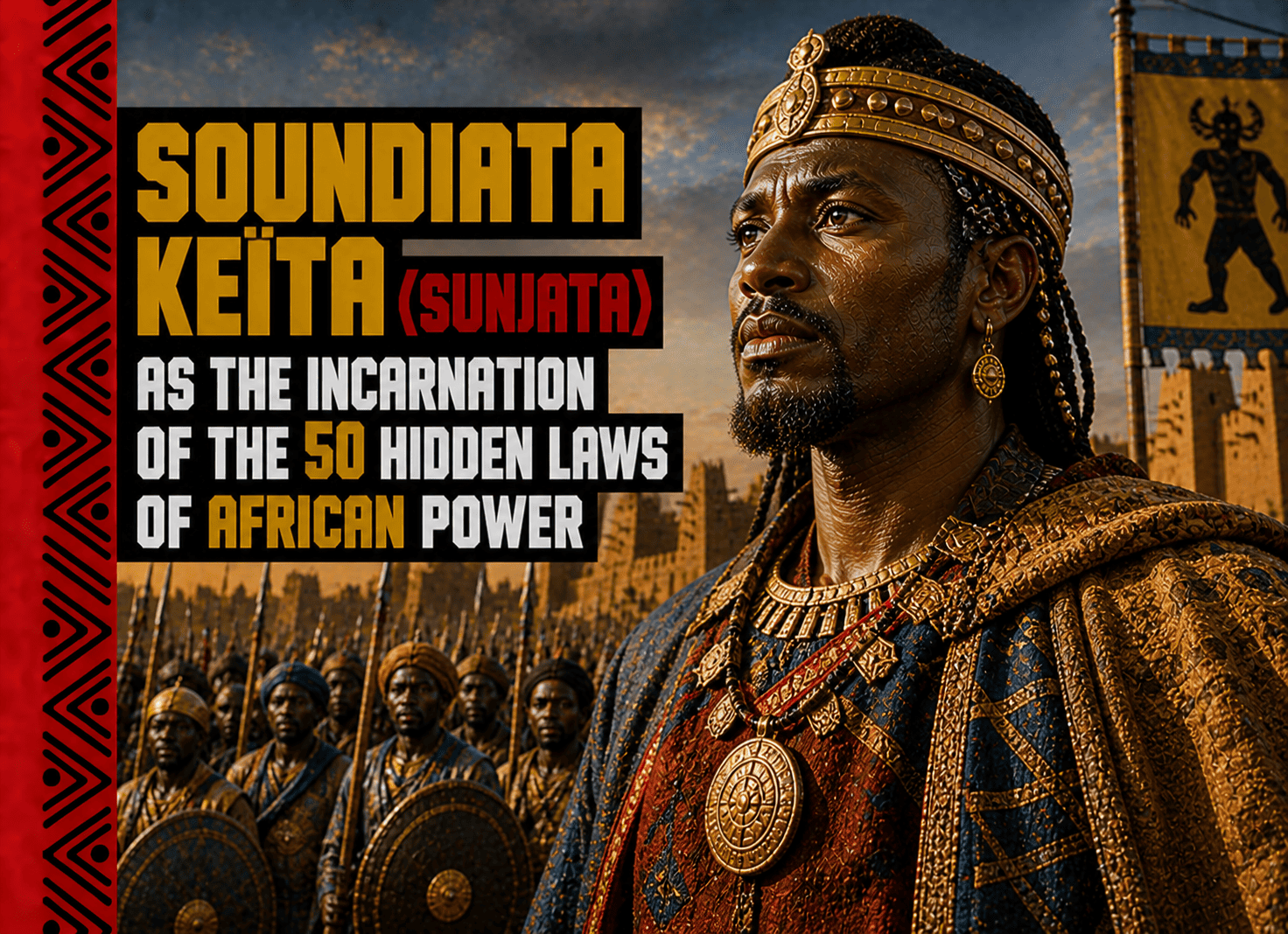
SOUNDIATA KEITA (SUNJATA) — EMBODIMENT OF THE 50 HIDDEN LAWS OF AFRICAN POWER
Through strength, cunning, and unity, the “Lion of Mali” founded one of Africa’s greatest empires.
I. HISTORICAL AND CIVILIZATIONAL CONTEXT
West Africa in the 13th Century
Soundiata Keita (c. 1217‑1255) is the founder of the Mali Empire, one of the greatest powers in African history. At its peak, the empire would stretch from the Atlantic Ocean to the Niger River, controlling the valuable gold mines and trans‑Saharan trade routes. Soundiata was born during a period of turmoil: the once‑powerful Ghana Empire had collapsed, leaving behind rival kingdoms, notably the Sosso kingdom of Soumaoro Kanté, a ruler renowned for his cruelty and magical powers.
Soundiata was the heir to the small kingdom of Niani (in present‑day Guinea). Exiled from childhood because of his fragile health and court intrigues, he would return to unite the Mandinka clans, defeat Soumaoro at the Battle of Kirina (c. 1235), and lay the foundations of a lasting empire, structured by the famous Manden Charter (considered one of the earliest declarations of human rights).
The Spiritual and Cosmological Context
Mandinka culture rests on a balance between the visible and invisible worlds: ancestors, bush spirits, forces of nature. Soundiata is portrayed as a “man‑of‑destiny” (gifted by God/spirits), capable of supernatural feats. He is assisted by griots (notably Balla Fasséké), the keepers of speech and history, who become his advisors and spokespersons.
His victory over Soumaoro, a master of magic, is told as a struggle between the power of Mandinka unity (embodied by Soundiata) and solitary tyranny (embodied by Soumaoro). This epic and spiritual dimension makes Soundiata a civilizing hero, unifier of the clans and restorer of violated order.
🔗 CONNECTION TO THE 50 HIDDEN LAWS OF AFRICAN POWER
→ Law #1: Master Cosmic Balance (Manden Kurufa)
Points of convergence:
• Soundiata balances Soumaoro’s magical forces through alliance of clans and moral values – faith in the common ancestor.
• He unifies peoples of diverse traditions (Mandinka, Soninké, Fulani, etc.) under a single federation.
• Modern application: African leaders must harmonize diverse ethnicities and beliefs to build durable nations.
• Strategic lesson: Sacred unity and a federation of individual wills create a power that magic alone cannot overcome.
II. ORIGINS AND SOCIAL ASCENSION
Birth and Family
Soundiata was born around 1217 in Niani, into the royal Keita family. His father, Naré Maghann Konaté, king of Manden, received a visit from a hunter‑diviner who predicted that an exceptional child born to an ugly but remarkable woman would make the kingdom great. He then married Sogolon Kondé, a hunchbacked, unattractive woman endowed with mystical powers. Soundiata was the son of this union.
He had several siblings, including Dankaran Touman (the elder half‑brother who usurped the throne). His mother, Sogolon, was a protective and determined figure who raised him despite his disability (he did not walk for years). Soundiata was also close to the griot Balla Fasséké, his childhood friend and future advisor.
Childhood and Disability: Building Resilience
Soundiata did not walk until the age of seven, which made him despised by his half‑brothers. But on the diviner’s advice, he eventually rose, bent an iron rod, and performed his first warrior dance – the famous “lion dance.” This physical rebirth symbolized his inner strength and ability to overcome obstacles. He learned hunting, strategy and command, while listening to griots’ epics.
Exile and the War against Soumaoro
After his father’s death, his half‑brother Dankaran Touman took the throne but fled before the invasion of the Sosso king Soumaoro Kanté. Soundiata, his mother and his siblings went into exile in neighboring kingdoms (Mema, Wagadou). He trained alongside local princes, won allies and gathered an army. He returned to Manden, united the rebel clans and confronted Soumaoro at the Battle of Kirina (c. 1235). According to the epic, Soundiata, advised by the positive magic of the griots, managed to neutralize Soumaoro’s spells and defeat him. He became “Mansa” (king of kings) and founded the Mali Empire.
🔗 CONNECTION TO THE LAWS OF AFRICAN POWER
→ Law #3: “Transform Knowledge into Power”
Points of convergence:
• Soundiata uses the griots’ knowledge (clan histories, legends, tactics) to persuade chiefs to rally.
• His knowledge of routes and water sources during exile allows him to survive and organize the reconquest.
• Modern application: African leaders must draw on local knowledge (history, orality, traditions) to unite and resist.
• Strategic lesson: Knowledge is not only bookish – collective memory and griots are weapons of mobilization.
III. TITLES AND FUNCTIONS
Soundiata held titles that reflected his political, military and spiritual authority:
- Mansa (“king of kings”, emperor of Mali – he was the first to bear this title).
- Sunjata (variant of “Soundiata”, sometimes “Sogolon Djata” – son of Sogolon).
- Lion of Mali (his clan, the lion, symbol of royal strength).
- Founder of the Mandinka Confederation (Manden Kurufa).
- Promulgator of the Manden Charter (oral constitution, basis of the empire).
- Grand Master of Hunters – sacred function linked to nature.
These titles make him the archetype of the African hero‑founder, at once war chief, lawgiver and mythical figure.
🔗 CONNECTION TO THE LAWS OF AFRICAN POWER
→ Law #12: “Become Indispensable to Power”
Points of convergence:
• Soundiata is the only one who can unite the Mandinka clans after Soumaoro’s tyranny – without him, the empire does not exist.
• He accumulates roles: strategist, diplomat (alliances with exile kingdoms), lawgiver and guarantor of traditions.
• Modern application: African leaders must be federators, capable of bringing divergent interests together around a common project.
• Strategic lesson: Indispensability arises from the ability to embody the solution to a deep crisis – Soundiata is the remedy to Soumaoro’s tyranny.
IV. THE BATTLE OF KIRINA – THE FOUNDATION OF THE EMPIRE
The Coalition against Soumaoro Kanté
Soumaoro, king of Sosso, had invaded Manden, burned Niani and executed Soundiata’s relatives. Soundiata, returning from exile, formed a coalition with the kingdoms of Mema, Wagadou, the Manden hunters and Fulani clans. He used the power of persuasion of the griots (especially Balla Fasséké) to convince the reluctant.
The Magical Combat and Outcome
The epic tells that Soumaoro possessed magical powers: he could transform into animals, cast spells. Soundiata, for his part, possessed a talisman given by the diviner (lion’s claws) and was advised by the griots. He used an arrow tipped with a white cock’s spur to neutralize the enemy’s magic. At Kirina, the two armies clashed. Soundiata won the victory; Soumaoro disappeared into the Koulikoro mountains. Soundiata was crowned Mansa.
🔗 CONNECTION TO THE LAWS OF AFRICAN POWER
→ Law #23: “The Power of the Healer – Heal to Rule”
Points of convergence:
• Soundiata “heals” Manden from Soumaoro’s oppression, restoring order and justice.
• He uses positive magic and clan alliances as instruments of national reconciliation.
• Modern application: African leaders must be social therapists, able to heal the wounds of conflicts.
• Strategic lesson: Military victory is not enough – one must restore the people’s soul; Soundiata promulgates the Manden Charter to institutionalize peace.
V. THE MANDEN CHARTER – AN EARLY AFRICAN CONSTITUTION
After Kirina, Soundiata gathered the Mandinka chiefs at Kurukan Fuga (on the Sankarani River). There he proclaimed the Manden Charter, divided into several precepts:
- Prohibition of slavery from within (captives of war should not be reduced to slavery).
- Division of labor (clans of blacksmiths, hunters, griots, etc.) with mutual respect.
- Freedom of speech and the duty of counsel.
- Protection of the weak, women and children.
- Organization of the empire into provinces with a central court.
The Charter is recognized by UNESCO as one of the oldest declarations of human rights (inscribed as a masterpiece of the oral and intangible heritage of humanity).
🔗 CONNECTION TO THE LAWS OF AFRICAN POWER
→ Law #15: “Build Monuments That Speak for You”
Points of convergence:
• The Manden Charter is an “intangible monument” – an oral constitution that structured the empire and influenced future generations.
• Soundiata builds not only cities but enduring political institutions.
• Modern application: African leaders must bequeath constitutions, charters, founding principles, not only buildings.
• Strategic lesson: The spoken word, laws written (orally) and justice are mightier pillars than walls.
VI. EMPIRE ORGANIZATION – AN AFRICAN FEDERAL MODEL
Soundiata divided the empire into provinces (tiédi) governed by loyal chiefs. He established an assembly of clans (Gbara) to advise him. He assigned hereditary but revocable functions. He created a professional army based on cavalry and infantry. He organized the protection of trade routes and managed the gold mines (Bambouk, Bure).
He died accidentally around 1255 (drowned in the Sankarani according to tradition), leaving a solid empire to his descendants, including Mansa Ouali, Mansa Musa and others.
🔗 CONNECTION TO THE LAWS OF AFRICAN POWER
→ Law #8: “Master Cycles – Time as a Weapon”
Points of convergence:
• Soundiata understood the cycles of gold (seasonal extraction) and trans‑Saharan trade to build a prosperous economy.
• He organized the empire to last beyond him – dynastic transmission, institutions.
• Modern application: African leaders must think about succession and institutional durability.
• Strategic lesson: An empire that does not survive its founder is a failure – Soundiata prepared his political legacy.
VII. THE GREAT CLANS AND THE ROLE OF GRIOTS – COLLECTIVE GOVERNANCE
Soundiata assigned specific roles to clans:
- The Keïta – ruling dynasty.
- The Konaté – warriors.
- The Kouyaté – griots and advisors (descendants of Balla Fasséké).
- The Kamara – blacksmiths and artisans.
- The Traoré – hunters and protectors.
The griots became the “memory of the empire,” singing epics, advising kings, orchestrating ceremonies. This system of oral counter‑power prevented absolute concentration of power.
🔗 CONNECTION TO THE LAWS OF AFRICAN POWER
→ Law #5: “Master Multiple Domains – The Power of the Renaissance”
Points of convergence:
• Soundiata delegated skills to specialized clans, creating a talent ecosystem.
• He did not rule alone – he relied on griots, chiefs, blacksmiths, etc.
• Modern application: African leaders must surround themselves with competent, diverse advisors, not centralize everything.
• Strategic lesson: Power shared in networks is more durable than solitary power – Soundiata invented participatory governance.
VIII. LEGACY – THE EPIC OF SOUNDIATA, A FOUNDATIONAL WORK
The Epic of Soundiata, transmitted orally by the griots of Mande for eight centuries, is one of the greatest works of African literature. It blends history, myth, morality and genealogy. It serves as an identity cement for the Mandingo peoples (Mali, Guinea, Senegal, Gambia, Burkina, Ivory Coast).
Soundiata has become the archetypal hero of West Africa; his name is given to schools, squares, institutions. His charter inspired modern democratic movements.
🔗 CONNECTION TO THE LAWS OF AFRICAN POWER
→ Law #42: “Create a Legacy That Multiplies Your Power”
Points of convergence:
• The Epic of Soundiata grows with each generation – recited, sung, reinterpreted – his moral authority increases.
• The Manden Charter has been recognized by UNESCO, extending its influence beyond Africa.
• Modern application: African leaders must invest in oral and written transmission of their reforms – popular memory is a powerful vector.
• Strategic lesson: Leave a story that griots (media) will tell – if it is beautiful, it will outlive you.
IX. SOURCES AND TESTIMONIES
Oral sources: The Epic of Soundiata collected by D.T. Niane (“Soundjata ou l’Épopée mandingue”, 1960), as well as versions by griots (Kouyaté, Camara, Diabaté).
Medieval Arabic sources: Ibn Khaldun mentions the kings of Mali and the Battle of Kirina.
Archaeological sources: Excavations at Niani, Kirina; studies of Mandingo fortresses.
European sources: 15th‑century Portuguese accounts of Mali.
🔗 CONNECTION TO THE LAWS OF AFRICAN POWER
→ Law #28: “Control Your Narrative – History Belongs to the One Who Writes It”
Points of convergence:
• The griots are “living archives” – Soundiata ensures his story is sung by a dedicated caste.
• Mandingo oral tradition resisted colonialism and external writing – it preserved the hero’s dignity.
• Modern application: African leaders must fund historical research, encourage storytellers, create digital archives.
• Strategic lesson: If you don’t control your legend, others will – Soundiata secured loyal griots.
X. SOUNDIATA IN CONTEMPORARY CONSCIOUSNESS
National hero: In Mali, Guinea, Senegal, Soundiata is an official figure. His portrait appears in textbooks and on old banknotes.
Literature and arts: Many theatrical adaptations, novels (including D.T. Niane’s), documentary films, comic books.
Symbol of African unity: For the African Union and Pan‑African movements, Soundiata embodies Africans’ capacity to build powerful states before colonization.
Reference for governance models: The Manden Charter is studied in African universities as an example of pre‑colonial participatory democracy.
🔗 CONNECTION TO THE LAWS OF AFRICAN POWER
→ Law #45: “Become a Symbol – When Your Name Becomes a Movement”
Points of convergence:
• “Soundiata” evokes bravery, unity, resistance to oppression – his name is a political program.
• West African politicians invoke him to legitimize regional union.
• Modern application: African leaders should aim to embody universal values (unity, justice, courage) so that their name transcends them.
• Strategic lesson: Ultimate power is to become a first name given to children – Soundiata is still alive.
XI. MYSTERIES AND UNSOLVED QUESTIONS
The lost tomb: Soundiata’s remains have never been formally identified. A stele at Dakoumana (Mali) is sometimes attributed, but excavations are inconclusive.
The share of myth in history: The magical episodes (Soundiata paralyzed as a child, Soumaoro’s metamorphoses) blur actual history. Historians distinguish the epic hero from the historical figure.
The exact accuracy of the Manden Charter: Transmitted orally, it has undergone variations. Its exact dating (1236) is debated.
🔗 CONNECTION TO THE LAWS OF AFRICAN POWER
→ Law #37: “Cultivate Mystery – What Is Hidden Fascinates”
Points of convergence:
• The missing tomb and historical fuzziness turn Soundiata into a myth rather than a man – mystery amplifies his greatness.
• The magical episodes (the magic duel) make the story unforgettable – legend sometimes matters more than factual truth.
• Modern application: Leaders may leave certain aspects of their lives ambiguous – interpretation will continue to fuel debate.
• Strategic lesson: A hero too well documented becomes fragile; a measure of obscurity makes him eternal.
XII. LESSONS AND CONTEMPORARY RELEVANCE
The power of federation: Soundiata does not conquer the region alone; he federates clans around a project (charter, power‑sharing).
The importance of institutions over the person: The Manden Charter structures the empire; Soundiata dies, the empire lasts.
Oral transmission as a political force: The griots prevent forgetting – today, African leaders must use media, schools and festivals to tell their achievements.
Disability is not a stop sign: Soundiata does not walk as a child, yet becomes the greatest king – adversity can be a driving force.
🔗 CONNECTION TO THE LAWS OF AFRICAN POWER
→ Law #50: “Transcend Death – The Art of Immortality”
Points of convergence:
• Soundiata achieves immortality not through monuments, but through a sung epic, a respected charter, a federation of clans.
• He drowned, yet his political legacy survives: the Mali Empire lasts three centuries.
• Modern application: African leaders must create institutions, narratives, rituals that act after them.
• Strategic lesson: Immortality lies in collective memory – make sure you are told about at evening gatherings.
CONCLUSION: IMMORTALITY THROUGH UNITY
Soundiata Keita remains, more than seven centuries after his death, one of the most revered figures in West Africa. His journey – a paralyzed child in exile, becoming the “Lion” who founded a vast empire – testifies to the power of resilience, unity and justice.
For contemporary Africa and its diaspora, Soundiata represents the founding ancestor, the civilizing hero, the lawgiving king. He reminds us that African political excellence does not date from the colonial era but has deep roots in federative traditions, human rights charters and sophisticated institutions. His epic invites us to overcome our divisions and build united, prosperous nations.
His name, Sunjata (the lion), resonates today as a challenge: may each generation produce its own Soundiata – those leaders who, through the power of speech, the federation of clans and the quest for justice, elevate their people and restore Africa’s dignity.
🔗 SYNTHESIS: SOUNDIATA KEITA AS THE EMBODIMENT OF THE HIDDEN LAWS OF AFRICAN POWER
The 12 Major Laws Embodied by Soundiata:
- Law #1 (Balance) – Harmony between clans, between magic and politics, between tradition and institutional innovation.
- Law #3 (Knowledge as Power) – Knowledge of genealogies, alliances and griots – social and epic knowledge.
- Law #5 (Polymathy) – War chief, lawgiver, diplomat, empire builder, spiritual figure.
- Law #8 (Control of Time) – Planning the reconquest, exile as training, institutional legacy.
- Law #12 (Indispensability) – Only one who could defeat Soumaoro and unite Manden – unique pole.
- Law #15 (Monuments) – The Manden Charter, Kurukan Fuga – intangible monument.
- Law #23 (Heal to Rule) – Restoration of justice after tyranny; reconciliation of clans.
- Law #28 (Control of Narrative) – Griots as living archives; mastery of oral transmission.
- Law #37 (Mystery) – Lost tomb, miraculous childhood, magical combat – myth enlarged.
- Law #42 (Multiplicative Legacy) – The Mali Empire, its successors (Mansa Musa) – productive heritage.
- Law #45 (Symbol) – “Soundiata” = unity, resistance, African renaissance – living concept.
- Law #50 (Immortality) – Epic sung for 800 years, charter recognized by UNESCO – dead, but eternally alive.
Practical Application for the Modern Leader:
✅ Federate rather than conquer – alliance is more durable than submission
✅ Legislate for the future – a charter or constitution is your true palace
✅ Surround yourself with modern “griots” (advisors, media, historians) to engrave your actions
✅ Never underestimate the power of narratives – an epic is worth an army
✅ Turn your failures and handicaps into stories of resilience – Soundiata could not walk
The Soundiata Challenge for You:
“What is your ‘Battle of Kirina’? How will you bring the national clans together around a federating charter? What epic will you leave for the griots of tomorrow?”