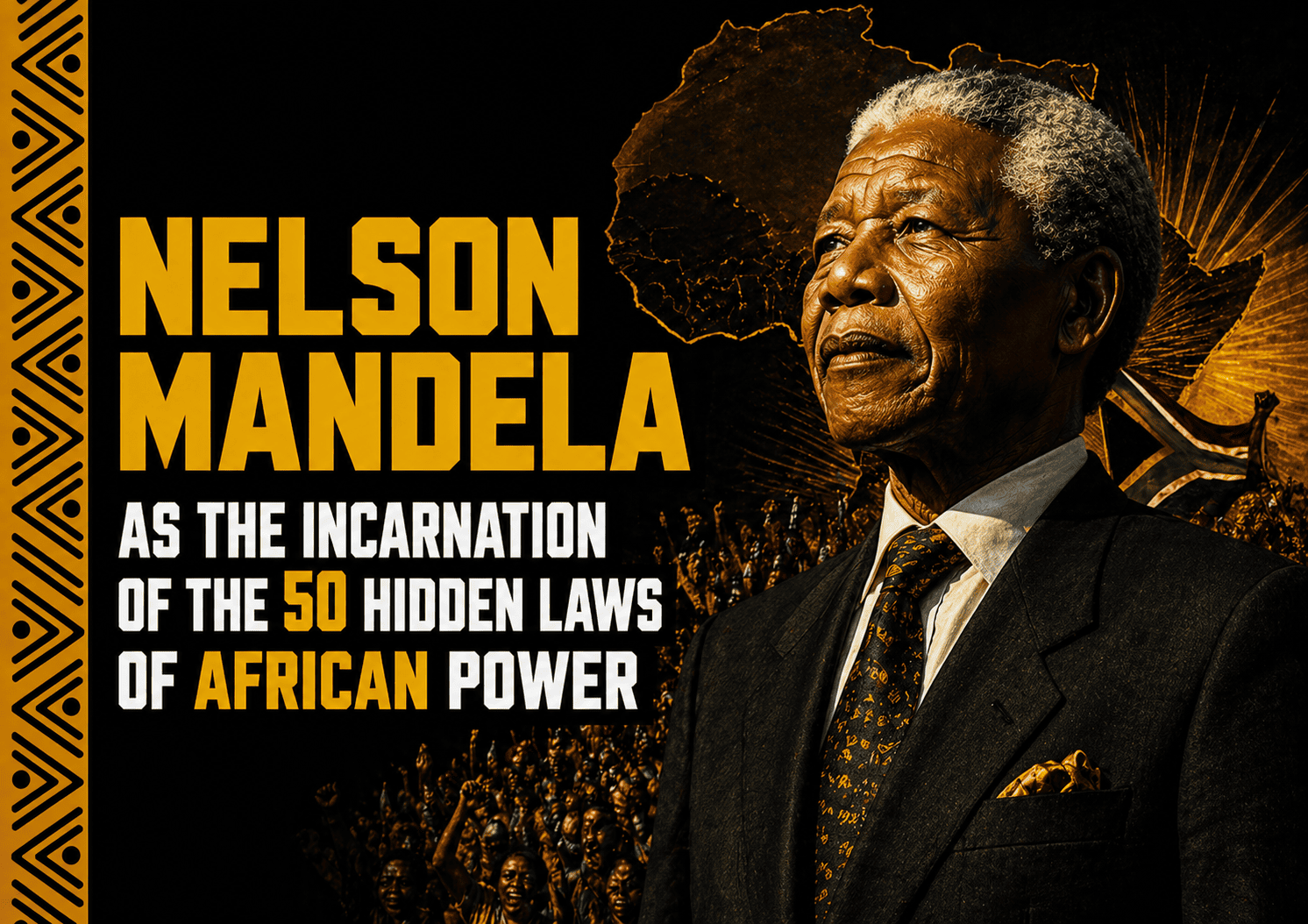
NELSON MANDELA — EMBODIMENT OF THE 50 HIDDEN LAWS OF AFRICAN POWER
Through reconciliation, resilience, and vision, "Madiba" transformed a nation and inspired the world.
I. HISTORICAL AND CIVILIZATIONAL CONTEXT
20th‑Century South Africa: Apartheid and the Liberation Struggle
Nelson Mandela (1918‑2013) lived during one of the darkest and most decisive periods in African history: the rise and fall of the apartheid regime in South Africa. Instituted by the Afrikaner National Party from 1948 onward, apartheid was a system of institutionalized racial segregation that oppressed the Black majority and other non‑white populations.
In response to this injustice, the African National Congress (ANC) and other resistance movements waged a multifaceted struggle: non‑violent protests, civil disobedience, strikes, and, after the Sharpeville massacre (1960), armed resistance through the creation of Umkhonto we Sizwe (“Spear of the Nation”). Mandela, a trained lawyer, quickly became one of the most iconic figures of this resistance.
The Spiritual and Philosophical Context
The traditional African philosophy of ubuntu (“humanity toward others”) permeated Mandela’s vision. Ubuntu holds that a person is fully human only through their relationship with the community: “I am because we are.” This holistic view of social ties inspired the strategy of national reconciliation that Mandela implemented after his release.
Mandela also combined diverse influences: African nationalism, Marxism (in his youth), Western democratic principles, and a personal spirituality forged during his 27 years of imprisonment. This original synthesis enabled him to speak to all South Africans, regardless of their background.
🔗 CONNECTION TO THE 50 HIDDEN LAWS OF AFRICAN POWER
→ Law #1: Master Cosmic Balance (Ubuntu)
Points of convergence:
• Mandela balanced radical opposition to oppression with reconciliation with the oppressors – a harmony between justice and forgiveness.
• His vision integrated African traditions with political modernity, spirituality with pragmatism.
• Modern application: Successful contemporary leaders know how to combine firmness and compassion, rupture and continuity.
• Strategic lesson: Enduring power comes from the ability to maintain equilibrium between seemingly contradictory forces – revenge and forgiveness, struggle and dialogue.
II. ORIGINS AND SOCIAL ASCENSION
Birth and Family
Nelson Rolihlahla Mandela was born on July 18, 1918, in Mvezo, in the Transkei region (present‑day Eastern Cape, South Africa). His first name Rolihlahla means “pulling a branch from a tree” or, colloquially, “troublemaker” – a prophecy of his destiny.
He was the son of Gadla Henry Mphakanyiswa, a counselor to the Thembu king, and Nosekeni Fanny. Descended from the Thembu royal family (the Madiba clan), Mandela grew up in an environment where customary authority and resistance to colonial domination were values passed down through generations. When his father died, nine‑year‑old Mandela was placed under the guardianship of Regent Jongintaba Dalindyebo, who oversaw his education.
Education and Early Experiences
Mandela attended missionary schools and earned his diploma at Clarkebury College. He then enrolled at the University of Fort Hare, the first university open to Black South Africans, where he befriended Oliver Tambo. Expelled for participating in a student strike, he escaped to Johannesburg, where he completed his degree by correspondence and began studying law.
In Johannesburg, he witnessed the harshness of racial inequality and joined the ANC in 1944. With Tambo and Walter Sisulu, he founded the ANC Youth League, advocating a more militant, mass‑based approach against the white regime. His legal training enabled him to defend the oppressed and understand the inner workings of the system he was fighting.
The Rise to Leadership
Mandela quickly rose through the ranks of the ANC. In 1952, he organized the Defiance Campaign against unjust laws. In 1955, he participated in the adoption of the Freedom Charter, which set out the principles of a democratic, non‑racial South Africa. Arrested several times, he became a target of the authorities. After the Sharpeville massacre (1960) and the banning of the ANC, Mandela went underground and co‑founded Umkhonto we Sizwe, the armed wing. In 1962 he was arrested, and in 1964 he was sentenced to life imprisonment at the Rivonia Trial.
🔗 CONNECTION TO THE LAWS OF AFRICAN POWER
→ Law #3: “Transform Knowledge into Power”
Points of convergence:
• Mandela used his legal training to denounce apartheid, defend his comrades, and understand the system he wanted to dismantle – knowledge as a weapon.
• His ability to learn Afrikaans in prison and study the texts of white leaders allowed him to negotiate as an equal with his jailers turned partners.
• Modern application: African leaders must master the codes and knowledge of established powers to turn them into tools of liberation.
• Strategic lesson: Education serves not only individual advancement – it is the key to dismantling systems of oppression.
III. TITLES AND FUNCTIONS
Mandela’s life was marked by titles and roles that reflect the breadth of his influence:
- President of the ANC (1991‑1997) – After his release, he modernized and led the historic party.
- President of the Republic of South Africa (1994‑1999) – The country’s first Black president, elected in the first multiracial elections.
- Co‑founder and commander of Umkhonto we Sizwe (1961) – Responsible for the armed struggle against apartheid.
- Lawyer and human rights defender – With Oliver Tambo, he opened the first Black law firm in South Africa.
- Nobel Peace Prize laureate (1993) – With F. W. de Klerk, for peacefully negotiating the end of apartheid.
- International mediator – After his presidency, he mediated conflicts in Burundi, the DRC, and the Comoros.
- Madiba – His Thembu clan name, which became a universal honorary title.
This diversity of functions – revolutionary, prisoner, negotiator, president, elder – makes Mandela an indispensable figure, irreducible to a single aspect.
🔗 CONNECTION TO THE LAWS OF AFRICAN POWER
→ Law #12: “Become Indispensable to Power”
Points of convergence:
• Mandela was the only leader who could speak to radical militants, the white community, foreign powers, and moderates – his replacement was unthinkable.
• He accumulated roles: resistance hero, iconic prisoner, credible negotiator, unifying president.
• Modern application: Successful contemporary African leaders cultivate versatility that makes them irreplaceable during delicate transitions.
• Strategic lesson: Indispensability is built through the ability to occupy multiple registers – firmness and flexibility, radicalism and moderation.
IV. THE FIGHT AGAINST APARTHEID
From Non‑violence to Armed Struggle
Mandela went through all phases of resistance:
1. The Non‑violent Period (1948‑1960)
Inspired by Gandhi, Mandela organized civil disobedience campaigns, strikes, and boycotts. The Defiance Campaign (1952) gathered thousands of volunteers who deliberately broke segregation laws. The Congress of the People (1955) adopted the Freedom Charter, which called for a democratic society.
2. The Armed Turning Point (1961‑1964)
After the Sharpeville massacre of 69 Black protesters and the banning of the ANC, Mandela concluded that peaceful resistance alone would not break apartheid. He co‑founded Umkhonto we Sizwe (“Spear of the Nation”) and planned sabotage actions targeting symbolic infrastructure (avoiding human casualties). He was arrested in 1962 and sentenced to life imprisonment in 1964.
3. The Struggle from Prison (1964‑1990)
For 27 years, Mandela became the global symbol of oppression and resistance. From his cell on Robben Island, he continued to lead the ANC clandestinely, dictated memoirs, studied, and trained his comrades. International pressure (sanctions, “Free Mandela” campaigns) helped isolate the regime.
4. Negotiation and Transition (1990‑1994)
Released on February 11, 1990, Mandela engaged in complex negotiations with President Frederik de Klerk. Despite persistent violence (clashes between the ANC, Inkatha, and state elements), he kept the course toward democratic elections. In 1994, the first multiracial elections brought the ANC to power and Mandela to the presidency.
🔗 CONNECTION TO THE LAWS OF AFRICAN POWER
→ Law #23: “Pacify to Reign – The Power of the Healer”
Points of convergence:
• Mandela turned his enemies into partners: he negotiated with those who had imprisoned him and maintained apartheid.
• He used his own suffering (27 years in prison) as moral capital to demand a just peace, not revenge.
• Modern application: African mediators in civil conflicts (Burundi, CAR, Sudan) draw on the Mandela model: talk to everyone, exclude no one.
• Strategic lesson: The deepest power belongs to the one who heals the wounds of history – he controls the gratitude of an entire people.
V. THE PRESIDENCY AND THE WORK OF RECONCILIATION
President Mandela (1994‑1999)
His term was marked by major innovations that transformed South Africa:
- The Truth and Reconciliation Commission (TRC) – Chaired by Desmond Tutu, it allowed victims to testify and perpetrators to receive amnesty in exchange for full disclosure – a legal and moral innovation that prevented a bloodbath.
- The 1996 Constitution – One of the most progressive in the world, guaranteeing fundamental rights, equality, and dignity for all, regardless of race, gender, or sexual orientation.
- The Reconstruction and Development Programme (RDP) – Aimed at reducing apartheid‑era inequalities, including housing construction and access to water and electricity.
- Rugby as a vehicle for reconciliation – Mandela wore the Springboks jersey (the white national team) during the 1995 Rugby World Cup victory – a powerful symbolic gesture that reconciled part of the white population.
After the Presidency: The Nation’s Elder
Mandela did not seek re‑election in 1999. He then devoted himself to humanitarian causes (HIV/AIDS fight, education, international mediation). His foundation, the Mandela Rhodes Foundation, and the Nelson Mandela Children’s Fund continue his work.
🔗 CONNECTION TO THE LAWS OF AFRICAN POWER
→ Law #5: “Master Multiple Domains – The Power of the Renaissance”
Points of convergence:
• Mandela was not a one‑dimensional leader: he was simultaneously revolutionary, strategist, negotiator, president, philanthropist.
• He mastered symbolic art (the rugby jersey, the raised fist) as well as law (the constitution) and politics.
• Modern application: The most influential African leaders today combine politics, media, diplomacy, and philanthropy.
• Strategic lesson: In a complex world, superiority comes from digesting multiple disciplines – the T‑shaped leader.
VI. CONTRIBUTIONS TO WORLD PEACE AND DIPLOMACY
The Nobel Peace Prize and Beyond
In 1993, Mandela received the Nobel Peace Prize jointly with F. W. de Klerk for “their work for the peaceful termination of the apartheid regime, and for laying the foundations for a new democratic South Africa.” But his influence extends far beyond that award:
- Mediator in Burundi – In 1999, he was appointed facilitator of the peace process, contributing to the Arusha Accords (2000).
- Intervention in the DRC and Comoros – He used his moral authority to calm civil conflicts.
- Criticism of Western powers – Uncompromising, he denounced the U.S. invasion of Iraq (2003) and the lack of support for Africa.
- Global human rights icon – His birthday (July 18) was declared “Mandela Day” by the UN.
🔗 CONNECTION TO THE LAWS OF AFRICAN POWER
→ Law #28: “Control Your Narrative – History Belongs to the One Who Writes It”
Points of convergence:
• Mandela used Western media, but also African songs and symbols, to forge a universal narrative – he never let himself be trapped in a single image.
• He imposed his own version of South African history: reconciliation, not revenge; truth, not oblivion.
• Modern application: African leaders must control their own narrative on both international and local stages.
• Strategic lesson: Whoever defines the terms of the debate wins before any weapons are fired – Mandela won the battle of consciences long before political liberation.
VII. UBUNTU: THE PHILOSOPHY OF SHARED POWER
“I Am Because We Are”
Mandela popularized the African philosophy of ubuntu as a guide to governance. Ubuntu holds that an individual’s humanity is inextricably linked to that of others. In political terms, this meant:
- Reconciliation rather than revenge.
- Consensus‑seeking rather than brutal majority imposition.
- Forgiveness as strength, not weakness.
Mandela applied ubuntu when creating the Truth and Reconciliation Commission, which spared South Africa a civil war. He also advocated a foreign policy based on mutual respect and cooperation.
🔗 CONNECTION TO THE LAWS OF AFRICAN POWER
→ Law #50: “Transcend Death – The Art of Immortality”
Points of convergence:
• Mandela did not seek fleeting glory but deep transformation – his name became synonymous with forgiveness and resilience.
• His philosophy (ubuntu) lives on beyond him, taught in schools, quoted by leaders worldwide.
• Modern application: African leaders must bequeath not only institutions but also values, ideas that survive.
• Strategic lesson: Immortality is not bought by biological longevity but by creating a school of thought – Mandela became an adjective (“Mandelaesque”).
VIII. LEGACY AND GLOBAL INFLUENCE
An Icon Beyond Borders
Mandela’s legacy is multifaceted:
- Domestic politics – Democratic South Africa, despite persistent challenges (corruption, inequality), remains stable thanks to the institutions and reconciliatory spirit he established.
- Transitional justice thought – His model has been emulated in Rwanda, Colombia, Northern Ireland.
- Women’s leadership – Though sometimes criticized for being slow on women’s rights, he appointed women to key positions (Frene Ginwala as Speaker of Parliament).
- Global philanthropy – The Mandela Foundations fight poverty, AIDS, and promote education.
🔗 CONNECTION TO THE LAWS OF AFRICAN POWER
→ Law #42: “Create a Legacy That Multiplies Your Power”
Points of convergence:
• Each generation that rediscovers Mandela amplifies his message – his reputation grows after his death.
• The institutions he founded (TRC, Constitution, Mandela Foundation) perpetuate his influence long beyond his term.
• Modern application: African leaders must think in decades, not terms – build durable structures.
• Strategic lesson: True posthumous power is that which continues to act without you – bequeath ideas and institutions, not just memories.
IX. SOURCES AND TESTIMONIES
Autobiography and Writings
- Long Walk to Freedom (1994) – Autobiographical account of his life, from childhood to presidency.
- Conversations with Myself (2010) – Personal notebooks, letters, and prison notes.
Biographies and Academic Studies
- Anthony Sampson, Mandela: The Authorized Biography (1999).
- Tom Lodge, Mandela: A Critical Life (2006).
- Nelson Mandela Foundation – digital archives and research.
Archives and Museums
- Apartheid Museum (Johannesburg).
- Robben Island Memorial Centre.
- South African National Archives.
🔗 CONNECTION TO THE LAWS OF AFRICAN POWER
→ Law #28: “Control Your Narrative – History Belongs to the One Who Writes It” (continued)
Points of convergence:
• Mandela wrote his autobiography in prison, preparing the story he wanted to leave.
• He controlled access to his legend: he chose his authorized biographers and preserved his archives.
• Modern application: Leaders must invest in their own documentation – memoirs, interviews, foundations – to avoid being left to hostile interpretations.
• Strategic lesson: Power is measured not only by deeds but by how they are told to future generations.
X. NELSON MANDELA IN CONTEMPORARY CONSCIOUSNESS
A Planetary Icon
Mandela is one of the most celebrated historical figures of the 21st century:
- Mandela Day (July 18) – Declared by the UN, it encourages 67 minutes of community service (one minute for each year of public engagement).
- Artistic representations – Films (Invictus, Mandela: Long Walk to Freedom), songs (The Specials, “Free Nelson Mandela”), statues (in Johannesburg, London, Washington).
- Namesake schools – Thousands of institutions bear his name in Africa and worldwide.
- Symbol of the fight against injustice – He is cited by Black Lives Matter, political prisoners, and human rights defenders.
🔗 CONNECTION TO THE LAWS OF AFRICAN POWER
→ Law #45: “Become a Symbol – When Your Name Becomes a Movement”
Points of convergence:
• Mandela is no longer an individual but a category: “a Mandela” designates an upright, reconciling leader.
• He is invoked in very different, sometimes contradictory contexts – a sign that his name has surpassed his person.
• Modern application: African leaders must aim to become an adjective, a concept – “pull a Mandela.”
• Strategic lesson: Ultimate power is achieved when your name immediately evokes a universal value (freedom, forgiveness, courage).
XI. MYSTERIES AND UNSOLVED QUESTIONS
The “Real” Mandela vs. the Myth
Historians continue to debate: Was Mandela really the secular saint he is often portrayed as? He had blind spots: his belated insistence on women’s rights, his pragmatism sometimes criticized by the radical left, his silence on certain ANC abuses in exile. These questions fuel research.
Secret Negotiations with the Regime
As early as the 1980s, secret contacts occurred between Mandela in prison and the government. The full details of those exchanges, and what Mandela may have conceded, are not entirely known.
The Controversial Economic Legacy
Despite political progress, post‑Mandela South Africa remains one of the most unequal societies in the world. Some argue Mandela did not sufficiently challenge the economic structure inherited from apartheid; others respond that he had to work within immense constraints.
🔗 CONNECTION TO THE LAWS OF AFRICAN POWER
→ Law #37: “Cultivate Mystery – What Is Hidden Fascinates”
Points of convergence:
• The ambiguity of certain aspects of Mandela’s life (his compromises, his silences) allows every side to claim him – the right praises his moderation, the left his resistance.
• The lack of complete details about his secret negotiations fuels debate and scholarly interest.
• Modern application: Leaders should not seek total transparency – a degree of mystery makes the legend larger.
• Strategic lesson: A life without shadows is a life without depth – history loves complex figures, not perfect saints.
XII. LESSONS AND CONTEMPORARY RELEVANCE
The Model of the Reconciling Leader
In a world marked by civil wars, populisms, and identity hatreds, Mandela offers a model: firmness on principles (nothing justifies oppression) and flexibility on means (knowing how to negotiate with one’s enemies).
Moral Innovation as a Political Lever
The Truth and Reconciliation Commission may be the greatest political innovation of the late 20th century – it showed that justice can take non‑punitive, restorative forms.
The Power of Personal Exemplarity
Mandela understood that the leader must embody what they preach: by publicly forgiving his jailers, by refusing revenge, he disarmed white fear and neutralized extremists.
🔗 CONNECTION TO THE LAWS OF AFRICAN POWER
→ Law #8: “Master Cycles – Time as a Weapon”
Points of convergence:
• Mandela spent 27 years in prison without ever giving in – he turned the length of his sentence into moral capital.
• He knew how to wait for the right moment to negotiate, when the balance of power had shifted (end of the Cold War, international pressure).
• Modern application: African leaders must think in decades, not electoral terms – strategic patience is a virtue.
• Strategic lesson: Whoever controls time – who knows when to strike and when to hold back – controls the future.
CONCLUSION: IMMORTALITY THROUGH FORGIVENESS
Nelson Mandela remains, more than a decade after his death (December 5, 2013), one of the most universal names in African and world history. His exceptional journey – lawyer turned revolutionary, prisoner turned negotiator, president turned elder of humanity – testifies to the transformative power of conviction, resilience, and love of freedom.
Architect of South African reconciliation, pioneer of transitional justice, icon of human rights, Mandela embodies the ideal of the leader who serves not himself but his people. For contemporary Africa and its diaspora, he is the father of the rainbow nation, whose legacy reminds us that the most enduring power is that which rests on forgiveness and shared dignity.
His name, Rolihlahla (“troublemaker”), resonates today as an invitation: may each generation produce its own Mandela – those leaders who, through integrity, vision, and humility, elevate humanity.
🔗 SYNTHESIS: NELSON MANDELA AS THE EMBODIMENT OF THE HIDDEN LAWS OF AFRICAN POWER
The 12 Major Laws Embodied by Mandela:
- Law #1 (Ubuntu/Balance) – Harmony between resistance and reconciliation, firmness and forgiveness.
- Law #3 (Knowledge as Power) – Using his legal training and mastery of Afrikaans to negotiate.
- Law #5 (Polymathy) – Revolutionary leader, negotiator, president, international mediator, philanthropist.
- Law #8 (Control of Time) – 27 years of strategic patience, striking at the opportune moment.
- Law #12 (Indispensability) – The only one able to speak to all sides, impossible to bypass.
- Law #15 (Monumental Works) – The South African Constitution and the TRC as living monuments.
- Law #23 (Heal to Rule) – National reconciliation as medicine against civil war.
- Law #28 (Control the Narrative) – His autobiography, speeches, and foundations perpetuating his vision.
- Law #37 (Mystery) – Cultivated ambiguities (secret negotiations, compromises) that fuel the myth.
- Law #42 (Multiplicative Legacy) – His ideas and institutions (Mandela Foundation) still act today.
- Law #45 (Universal Symbol) – “Mandela” has become a global concept of reconciliation.
- Law #50 (Immortality) – Transcends death through ubuntu, Mandela Day, and perpetual inspiration.
Practical Application for the Modern Leader:
✅ Turn adversity (prison, exile, persecution) into moral capital
✅ Negotiate with your enemies without ever betraying your core principles
✅ Establish institutions that will survive your term
✅ Cultivate strategic patience – some struggles take a lifetime
✅ Turn your life into a symbol – become an adjective
The Mandela Challenge for You:
“What cause are you willing to invest 27 years in? How will you turn your adversaries into partners? By what symbolic gesture will you mark history?”