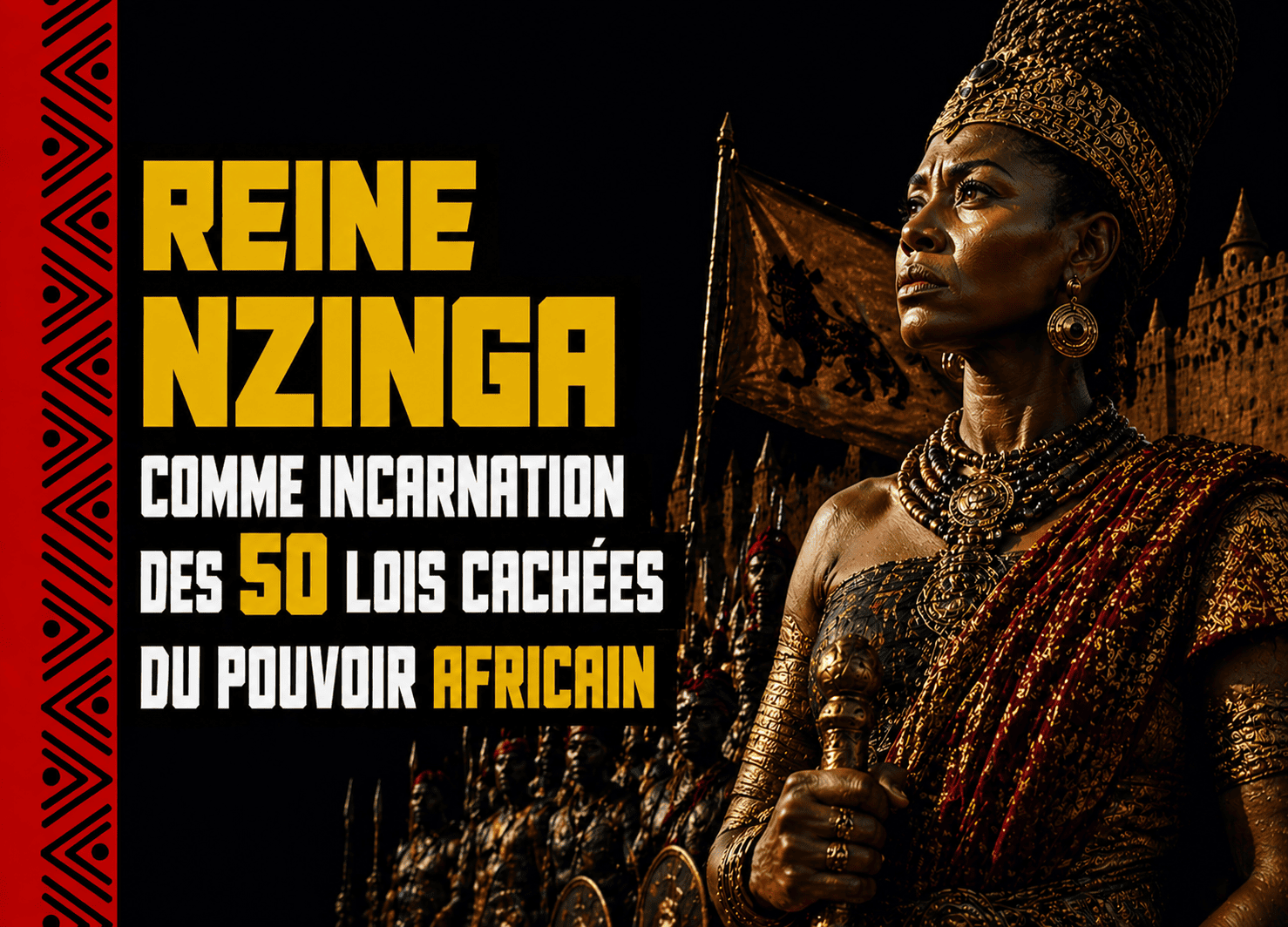
QUEEN NZINGA MBANDE — EMBODIMENT OF THE 50 HIDDEN LAWS OF AFRICAN POWER
Through diplomacy, guerrilla warfare, and indomitable will, the "Queen of Ndongo and Matamba" defied empires and forged a legacy of resistance.
I. HISTORICAL AND CIVILIZATIONAL CONTEXT
West‑Central Africa in the 17th Century (1583–1663 CE)
Queen Nzinga (Nzinga Mbande, also known as Ana de Sousa) ruled during one of the most turbulent and transformative periods in African history: the expansion of the Atlantic slave trade, the Portuguese colonial penetration into the interior of West‑Central Africa, and the fierce resistance of African kingdoms to preserve their sovereignty. She emerged as the sovereign of the Ndongo and later Matamba kingdoms (in present‑day Angola).
Born around 1583 into the royal family of Ndongo, Nzinga witnessed the Portuguese establishing a bridgehead at Luanda and exploiting internal rivalries to extend their influence. Her reign (1624–1663) spanned nearly four decades of military, diplomatic, and spiritual struggle against European colonialism and the slave trade.
The Spiritual and Cosmological Context
The kingdoms of Ndongo and Matamba were rooted in Bantu spiritual traditions that emphasized the sacred role of the ngola (king or queen) as an intermediary between the ancestors, the living, and the natural forces. Power was not merely political but also ritual: the queen ensured the fertility of the land, the prosperity of the people, and the balance between the living and the dead.
Nzinga skillfully integrated traditional religious authority with pragmatic statecraft. She wielded both the spiritual symbols of the throne (the royal drums, the sacred fire) and the instruments of modern diplomacy (alliances, treaties, conversion to Christianity when strategically useful). Her holistic vision of power combined ancestral legitimacy, military leadership, and diplomatic innovation.
🔗 CONNECTION TO THE 50 HIDDEN LAWS OF AFRICAN POWER
→ Law #1: Master Cosmic Balance (Maât / Kintuadi)
Points of convergence:
• Nzinga balanced traditional spiritual authority with pragmatic adaptation (e.g., accepting baptism to gain diplomatic advantage while preserving ancestral rites).
• Her rule harmonized warfare and negotiation, resistance and alliance – a dynamic equilibrium between confrontation and coexistence.
• Modern application: Leaders who navigate between preserving cultural identity and engaging with global systems maintain long‑term power.
• Strategic lesson: Enduring leadership requires balancing opposing forces – tradition and innovation, resistance and diplomacy.
II. ORIGINS AND SOCIAL ASCENSION
Birth and Family
Nzinga Mbande was born around 1583 in the kingdom of Ndongo (present‑day Angola), daughter of King (Ngola) Kiluanje kia Samba and his second wife, Guenguela Cakombe. The name “Nzinga” derives from the Kimbundu word kujinga (to twist or turn), alluding to her umbilical cord being wrapped around her neck – a sign of destiny and exceptional character.
Her father was a powerful ruler who resisted Portuguese encroachment. Her brother, Mbandi, would succeed him but proved a weak leader, unable to stop the Portuguese advance. Nzinga grew up learning the arts of war, diplomacy, and statecraft at her father’s court, witnessing the complexities of negotiating with the Portuguese while trying to preserve Ndongo’s independence.
Education and Training
Unlike most women of her time, Nzinga received a comprehensive education in military strategy, court politics, trade, and traditional rituals. She was also instructed in Portuguese language and Christian theology – a rare asset that later enabled her to negotiate directly with colonial officials. Her intelligence, eloquence, and strategic mind became legendary.
The Rise to Power
After her brother Mbandi’s indecisive reign, he called upon Nzinga to negotiate a peace treaty with the Portuguese governor in Luanda (1622). During the famous encounter, the Portuguese seated her on a mat on the floor, refusing her a chair. She ordered one of her servants to kneel on all fours and sat on his back – thus never lowering herself and asserting her royal dignity. Impressed, the governor signed a treaty that restored some territories to Ndongo.
Upon her brother’s death (likely poisoned), Nzinga ascended the throne in 1624. However, the Portuguese refused to recognize a female ruler and supported rival claimants. Forced to flee, she conquered the neighboring kingdom of Matamba (c. 1631) and made it her military base. From there, she waged a relentless war against the Portuguese and their allies for the next three decades.
🔗 CONNECTION TO THE LAWS OF AFRICAN POWER
→ Law #3: "Transform Knowledge into Power"
Points of convergence:
• Nzinga’s multilingualism and knowledge of Portuguese culture gave her a decisive advantage in diplomacy – she could play on the colonizers’ own terms.
• Her military expertise, acquired through observation and practice, allowed her to lead troops personally and organize effective guerrilla warfare.
• Modern application: African leaders who acquire skills from rival powers (technology, finance, language) can turn those tools against domination.
• Strategic lesson: The most transformative power comes from mastering the enemy’s weapons – cultural, intellectual, and diplomatic – while remaining rooted in one’s own strength.
III. TITLES AND FUNCTIONS
Queen Nzinga held multiple titles, reflecting her political, military, and spiritual authority:
- Ngola (King/Queen) of Ndongo – Sovereign ruler of the Ndongo people.
- Queen of Matamba – After conquering Matamba, she made it her capital.
- Military Commander‑in‑Chief – Personally led armies and guerrilla raids.
- Head of the Imbangala (mercenary) forces – Integrated the fierce Imbangala warriors into her army.
- Chief Diplomat – Negotiated treaties with Portugal, the Dutch, and the Catholic Church.
- Spiritual Guardian of Ancestral Traditions – Preserved Bantu rituals even after formal conversion to Christianity.
- Ana de Sousa (baptismal name) – Used her Christian identity as a diplomatic tool when advantageous.
This accumulation of roles – queen, warrior, diplomat, spiritual leader – made Nzinga an indispensable figure, impossible to replace or ignore. She embodied power in its multiple forms.
🔗 CONNECTION TO THE LAWS OF AFRICAN POWER
→ Law #12: "Become Indispensable to Power"
Points of convergence:
• Monopoly of critical skills: Nzinga was the only leader who could negotiate with the Portuguese, lead the army, and maintain the loyalty of diverse factions.
• Diversification of legitimacy sources: she drew authority from royal lineage, military victories, spiritual rituals, and even Christian baptism (as needed).
• Modern application: Contemporary leaders who succeed are those who cannot be replaced because they control multiple levers – political, economic, cultural.
• Strategic lesson: Being indispensable is the ultimate job security – cultivate versatility and strategic ambiguity.
IV. MILITARY AND STRATEGIC ACHIEVEMENTS
The Art of Guerrilla Warfare and Alliance‑Building
Nzinga transformed Matamba into a fortress state. Her military innovations included:
1. Fighting in the Mangroves and Forests
Instead of confronting the Portuguese in open field battles (where they had firepower advantage), she used the dense forests and swamps of Matamba for ambushes. Her warriors, mostly women and Imbangala, were masters of hit‑and‑run tactics.
2. The Dutch Alliance (1641‑1648)
When the Dutch captured Luanda in 1641, Nzinga immediately sent envoys. She signed a military and commercial alliance with the Dutch West India Company, receiving weapons, troops, and recognition. Together they besieged Portuguese positions, temporarily reversing colonial gains.
3. Reclaiming the Ndongo Homeland
From 1644 to 1648, Nzinga’s forces fought several major battles, including the Battle of Masangano. Although the Dutch were eventually expelled, Nzinga recovered large parts of Ndongo and forced the Portuguese to negotiate a peace treaty (1656) that recognized her sovereignty over Matamba and parts of Ndongo.
4. Female Warrior Corps
Nzinga created an elite unit of female warriors who served as her personal guard and shock troops – a radical departure from traditional gender roles, demonstrating that power could be wielded by women as effectively as men.
🔗 CONNECTION TO THE LAWS OF AFRICAN POWER
→ Law #23: "The Power of Strategic Alliances – Heal and Rule"
Points of convergence:
• Nzinga turned enemies into allies (e.g., the Dutch, runaway slaves, rival Imbangala) – she mastered the art of healing divisions to create a united front.
• She used diplomacy to buy time, regroup, and strike when the enemy was weak – patience as a weapon.
• Modern application: Successful African leaders build coalitions across ethnic, political, and even ideological lines to challenge dominant powers.
• Strategic lesson: The ability to form alliances that multiply your strength is more valuable than any single victory.
V. DIPLOMATIC AND INTELLECTUAL CONTRIBUTIONS
The Diplomatic Genius of Nzinga
Nzinga’s diplomatic maneuvers remain a model of negotiation under pressure. Her signature achievements:
- The 1622 Peace Treaty with Portugal: Secured the return of captured Ndongo territories and the release of prisoners – a rare African victory at the negotiating table.
- Embassy to the Dutch (1641): Sent a delegation that resulted in a formal military alliance, creating a two‑front war for the Portuguese.
- Post‑Peace Consolidation (1656 onwards): After the Dutch withdrawal, she negotiated a separate peace that guaranteed Matamba’s independence, demilitarized borders, and restored trade relations.
- Religious Diplomacy: She accepted Catholic baptism in 1622 (taking the name Ana de Sousa) to gain European trust, but never abandoned her traditional spiritual practices. Later, she hosted Capuchin missionaries to keep communication channels open while resisting colonial control.
Governance and State‑Building
Nzinga reformed Matamba’s administration, creating a centralized state capable of resisting colonial encroachment. She established a permanent army, organized tax collection, and encouraged the integration of runaway slaves (quilombolas) as loyal subjects and soldiers. Her court was a multicultural hub of refugees, merchants, and diplomats.
🔗 CONNECTION TO THE LAWS OF AFRICAN POWER
→ Law #28: "Control Your Narrative – History Belongs to the One Who Writes It"
Points of convergence:
• Nzinga deliberately cultivated multiple versions of her story: to the Portuguese, she was a Christian queen; to her people, an ancestral heroine; to the Dutch, a reliable ally.
• She controlled how she was portrayed in European diplomatic correspondence and missionary accounts, leveraging their own records to shape her legacy.
• Modern application: African leaders must tell their own stories in international media, academic circles, and digital platforms – or others will tell them.
• Strategic lesson: Your reputation is a battlefield – invest in shaping the narrative in every language and sphere where it matters.
VI. SOCIAL AND HUMANITARIAN LEGACY
Protector of the Oppressed
Nzinga’s Matamba became a sanctuary for those fleeing the Portuguese slave trade. She welcomed runaway slaves (many of whom became elite soldiers) and absorbed displaced peoples from neighboring kingdoms. Her policies demonstrated that power could be wielded not just for conquest but also for protection and inclusion.
Empowerment of Women
As a female ruler in a patriarchal world (both African and European), Nzinga broke gender barriers. She appointed women as generals, councilors, and bodyguards. Her success inspired later female leaders in Angola, including the legendary “Ngola” tradition.
🔗 CONNECTION TO THE LAWS OF AFRICAN POWER
→ Law #42: "Create a Legacy That Multiplies Your Power"
Points of convergence:
• By sheltering thousands of refugees, Nzinga gained a loyal population that fought for her – humanitarian protection as a strategic asset.
• Her example empowered future generations: she became a symbol of resistance and gender equality, used by 20th‑century Angolan nationalists.
• Modern application: Philanthropy, education, and social protection can be forms of long‑term power – they create moral authority and enduring loyalty.
• Strategic lesson: The most durable power is rooted in service to the vulnerable – it generates a debt that transcends generations.
VII. DIVINIZATION AND POST‑MORTEM LEGACY
From Queen to Ancestral Heroine
Although Nzinga was not formally deified in a polytheistic sense, she became a legendary ancestor in the oral traditions of Angola and the Congo region. Her name is invoked as a protective spirit, a symbol of unyielding resistance, and a model of strategic intelligence.
Memory in Oral Tradition
Kimbundu and Kikongo oral epics celebrate Nzinga as a warrior‑queen who never surrendered, who tricked the Portuguese, and whose cleverness ensured the survival of her people. Many praise songs and proverbs reference her exploits.
National and Pan‑African Symbol
In the 20th century, Nzinga was adopted as a national heroine by Angola (including the socialist MPLA government) and later by pan‑African feminists. She appears on banknotes, statues, school curricula, and street names across Angola. Her image was used during the anti‑colonial war (1961‑1975) to mobilize resistance.
🔗 CONNECTION TO THE LAWS OF AFRICAN POWER
→ Law #45: "Become a Symbol – When Your Name Becomes a Movement"
Points of convergence:
• Nzinga’s name transcended her historical person to become a rallying cry for Angolan independence and women’s empowerment.
• She is one of the few African women from the pre‑colonial era whose story is known globally – a testament to the power of symbolic immorality.
• Modern application: Leaders who align themselves with timeless values (freedom, justice, dignity) see their influence grow long after their death.
• Strategic lesson: To become immortal, attach your name to a universal principle – resistance, justice, or liberation.
VIII. INFLUENCE ON AFRICAN AND GLOBAL LEADERSHIP
Impact on Anti‑Colonial Thought
Nzinga’s strategies – combining guerrilla warfare, diplomatic flexibility, and religious pragmatism – later inspired African nationalists like Agostinho Neto (first president of Angola) and even thinkers of the Black Panther Party. Her alliance with the Dutch foreshadowed later “enemy of my enemy” coalitions.
Feminist Icon
Nzinga is celebrated globally as a symbol of African female leadership. Scholars of African women’s history rank her alongside queens like Amina of Zazzau and Makeda of Sheba. Her life disproves colonial stereotypes of passive African women.
Diplomatic Role Model
Her ability to negotiate from a position of weakness while never appearing weak is studied in diplomatic history. She understood that treaties are tools – to be broken, renegotiated, or used for delay – not sacred obligations.
🔗 CONNECTION TO THE LAWS OF AFRICAN POWER
→ Law #5: "Master Multiple Domains – The Power of the Renaissance"
Points of convergence:
• Nzinga was simultaneously a warrior, diplomat, spy‑master, spiritual leader, and administrator – a renaissance woman of the 17th century.
• She integrated European and African knowledge systems, using each when it served her goals.
• Modern application: The most influential African leaders today combine politics, business, media, and cultural influence – they are not one‑dimensional.
• Strategic lesson: Depth in one domain plus breadth in several others creates a synergy that single‑focused competitors cannot match.
IX. SOURCES AND TESTIMONIES
European Primary Sources
- Portuguese colonial archives – Letters, reports, and treaty records from Luanda.
- Dutch West India Company records – Detailed accounts of the alliance with Nzinga.
- Capuchin missionary reports – Writings by Giovanni Antonio Cavazzi da Montecuccolo (17th century) describing Nzinga’s court and personality (though often biased).
African Oral Traditions
- Kimbundu praise poems (mbré) – Celebrating Nzinga’s exploits.
- Angolan folk tales – Many feature “Queen Nzinga” as a trickster figure.
Modern Historiography
- Linda Heywood, Njinga of Angola: Africa’s Warrior Queen (Harvard, 2017) – a definitive biography.
- John K. Thornton, Africa and Africans in the Making of the Atlantic World.
- Joseph C. Miller, Way of Death: Merchant Capitalism and the Angolan Slave Trade.
🔗 CONNECTION TO THE LAWS OF AFRICAN POWER
→ Law #28: "Control Your Narrative – History Belongs to the One Who Writes It"
Points of convergence (continued):
• Despite biased European sources, Nzinga managed to leave an imprint that even hostile chroniclers could not erase – she forced them to acknowledge her cunning and power.
• Modern scholars have recovered and re‑interpreted her story, proving that African agency can be rediscovered despite colonial archives.
• Strategic lesson: Even when the powerful write history, the truth can be reclaimed by later generations who know where to look.
X. QUEEN NZINGA IN CONTEMPORARY CONSCIOUSNESS
Academic Renaissance
Over the past 30 years, Nzinga has become a subject of serious academic study in African history, gender studies, and diplomatic history. Conferences, books, and documentaries have reintroduced her to global audiences.
Popular Culture
- Literature: Novels like Nzingha: Warrior Queen of Matamba (The Royal Diaries series).
- Film & TV: Documentaries on African empires; an upcoming feature film announced by historical producers.
- Video games: Appearances in Civlization VI and Age of Empires III as a playable leader.
- Education: Included in African and world history textbooks, especially units on resistance to colonialism.
Pan‑African and Feminist Symbol
Nzinga is often quoted in speeches about African resilience and women’s leadership. Her statue stands in Luanda, and her face appears on Angolan currency (20 kwanza banknote). She is a source of pride for the Angolan diaspora globally.
🔗 CONNECTION TO THE LAWS OF AFRICAN POWER
→ Law #37: "Cultivate Mystery – What Is Hidden Fascinates"
Points of convergence:
• The gaps in the historical record (e.g., exact details of her later years, her secret negotiations) allow each generation to imagine and reinterpret Nzinga – mystery amplifies her legend.
• Her deliberate ambiguity in religious matters (Christianity vs. traditional beliefs) makes her a complex, fascinating figure, not a flat stereotype.
• Modern application: Leaders who are completely predictable become boring – maintaining some strategic opacity keeps people engaged.
XI. MYSTERIES AND UNANSWERED QUESTIONS
The Exact Circumstances of Nzinga’s Death (1663)
Some sources say she died peacefully after receiving last rites from a Capuchin priest; oral traditions suggest she retreated into the forest to die as a traditional queen. Her burial site has never been definitively located.
The Full Extent of Her Alliance with the Dutch
How deeply did she coordinate military campaigns? Did she ever consider converting to Calvinism to secure a lasting alliance? The archives remain incomplete.
Her Personal Beliefs
Was she a sincere Christian or a pragmatic diplomat? The evidence is contradictory, deliberately so – Nzinga may have wanted to keep the question open.
🔗 CONNECTION TO THE LAWS OF AFRICAN POWER
→ Law #37: "Cultivate Mystery – The Power of the Unknown"
Points of convergence:
• The uncertainty about Nzinga’s final years and her religious sincerity keeps historians and artists debating – she remains a living topic, not a closed book.
• Her legend grows because we cannot definitively pin her down – she escapes full categorization.
• Strategic lesson: Leave some questions unanswered about your life and actions – that way, you never stop being discussed.
XII. LESSONS AND CONTEMPORARY RELEVANCE
The Model of Strategic Resilience
Nzinga’s 40‑year struggle against colonial powers, slave traders, and internal rivals shows that strategic patience, tactical flexibility, and moral authority can overcome overwhelming force.
Innovation under Pressure
She invented new forms of warfare (guerrilla in swamps, female military corps), new diplomatic models (asymmetric alliances with European powers), and new state structures (refugee‑centered governance).
The Power of Identity Fluidity
Nzinga moved between African and European identities (Nzinga vs. Ana de Sousa) as a tool, never losing her core objective: sovereignty. This teaches contemporary leaders to use all available tools without being co‑opted.
🔗 CONNECTION TO THE LAWS OF AFRICAN POWER
→ Law #50: "Transcend Death – The Art of Immortality"
Points of convergence:
• Nzinga achieved immortality not through monuments but through stories, symbols, and the living memory of a people.
• Her example inspired the liberation of Angola centuries later – her power was transmitted across generations.
• Modern application: Your greatest legacy may not be a building but a movement, a spirit, a way of resisting.
• Strategic lesson: Immortality lies in becoming an idea that cannot be killed – a name that means “resistance” forever.
CONCLUSION: IMMORTALITY THROUGH RESISTANCE
Queen Nzinga remains, nearly 400 years after her death, one of the most powerful symbols of African resistance to colonialism and a model of strategic leadership. Her journey – from princess to refugee to queen – demonstrates that force of will, intellectual mastery, and diplomatic cunning can turn the tide of history.
For contemporary Africa and its diaspora, Nzinga represents the warrior queen who refused to bow, who negotiated from a servant’s back, who fought in swamps with female warriors, and who died undefeated. Her legacy challenges us: never accept oppression, always keep learning, and use every tool – tradition, modernity, diplomacy, war – in the service of liberation.
Her name, Nzinga (“the twisting one”), reminds us that power is not straight lines but curves, twists, and adaptations. May each generation produce its own Nzinga – leaders who, through courage and intelligence, set their people free.
🔗 SYNTHESIS: QUEEN NZINGA AS THE EMBODIMENT OF THE HIDDEN LAWS OF AFRICAN POWER
The 12 Major Laws Embodied by Nzinga:
- Law #1 (Maât/Balance) – Harmonized tradition and innovation, Christianity and ancestral rites, war and diplomacy.
- Law #3 (Knowledge as Power) – Used Portuguese language and Christian theology as diplomatic weapons.
- Law #5 (Polymathy) – Excelled as warrior, diplomat, strategist, spiritual leader, and administrator.
- Law #8 (Control of Time) – Fought a 40‑year guerrilla war with strategic patience; outlasted several Portuguese governors.
- Law #12 (Indispensability) – No one else could unite Ndongo, Matamba, Imbangala, and runaway slaves – she was the essential problem‑solver.
- Law #15 (Monumental Works) – Her “monument” was not stone but a liberated state and a people’s loyalty.
- Law #23 (Heal to Rule) – She healed ethnic and social rifts, creating a unified front against colonialism.
- Law #28 (Control the Narrative) – Crafted a public image for Europeans while remaining authentically African to her people.
- Law #37 (Cultivate Mystery) – Kept her true beliefs ambiguous, fueling discussion and legend for centuries.
- Law #42 (Multiplicative Legacy) – Inspired Angolan independence and global feminism – her influence grows with time.
- Law #45 (Become a Symbol) – Her name stands for resistance, female leadership, and anti‑colonial struggle worldwide.
- Law #50 (Immortality) – Lives on in oral tradition, banknotes, statues, and the hearts of freedom fighters.
Practical Application for the Modern Leader:
✅ Transform every disadvantage (gender, exile, lack of firepower) into a strategic asset
✅ Use allies strategically – never become dependent on any single partner
✅ Build a sanctuary of loyalty by protecting the vulnerable
✅ Master the art of ambiguous identity – be all things to all people while staying true to your core mission
✅ Ensure that your name becomes a verb or a symbol – “Nzinga” means “to resist with intelligence”
The Nzinga Challenge for You:
"In the face of overwhelming obstacles, what will be your strategy for turning weakness into strength? How will you make yourself indispensable and your legacy immortal?"